Categories
Data Driven Compliance

Data Driven Compliance – Understanding the ECCTA and Its Impact with Jonathan Armstrong

Welcome to Season 2 of the award-winning Data Driven Compliance. In this new season, we will look at the new Failure to Prevent Fraud offense. Join host Tom Fox as we explore this new law and how to comply with it through the lens of data-driven compliance. This podcast is sponsored by konaAI. In this episode of Season 2, Tom Fox is joined by Jonathan Armstrong.

Tom and Jonathan explore the historical context of fraud laws in the UK, the specifics and implications of the new legislation, the role of the Serious Fraud Office under the new rules, and its impact on corporations, especially those with international operations. Jonathan also outlines necessary steps corporations need to take to comply with the Act and prevent fraud within their organizations, including the importance of thorough risk assessments, top-level commitment, and effective communication and training programs.

Key highlights:

  • Key Legal Points of the New Law
  • Jurisdiction and Global Impact
  • Fraud Risk Assessment and Prevention
  • Technological and ESG Fraud

Resources:

Jonathan Armstrong on LinkedIn

konaAI, a Covasant company

Click here for konaAI White Paper Rethinking Compliance: Practical Steps for Adapting to the UK’s New Fraud Legislation

Connect with Tom Fox on LinkedIn

Categories
Compliance Tip of the Day

Compliance Tip of the Day – Final Thoughts on Pre-Acquisition Due Diligence in M&A

Welcome to “Compliance Tip of the Day,” the podcast where we bring you daily insights and practical advice on navigating the ever-evolving landscape of compliance and regulatory requirements. Whether you’re a seasoned compliance professional or just starting your journey, we aim to provide you with bite-sized, actionable tips to help you stay on top of your compliance game. Join us as we explore the latest industry trends, share best practices, and demystify complex compliance issues to keep your organization on the right side of the law. Tune in daily for your dose of compliance wisdom, and let’s make compliance a little less daunting, one tip at a time.

Today, we conclude our week-long series on pre-acquisition due diligence in M&A from the anti-bribery/anti-corruption perspective.

For more on this topic, check out The Compliance Handbook, a Guide to Operationalizing Your Compliance Program, 6th edition, which LexisNexis recently released. It is available here.

Categories
Compliance and AI

Compliance and AI – Cybersecurity Insights with Robert Meyers – Privacy, Data, and AI Challenges

What is the role of Artificial Intelligence in compliance? What about Machine Learning? Are you using ChatGPT? These questions are just three of the many we will explore in this cutting-edge podcast series, Compliance and AI, hosted by Tom Fox, the award-winning Voice of Compliance. In this episode, Tom Fox interviews Robert Meyers, a cybersecurity and privacy expert with over 30 years of experience.

Meyers shares his professional journey, emphasizing the evolution of IT and cybersecurity practices. He discusses significant privacy challenges, including data breaches and the philosophical divide between US and European privacy laws. The conversation also covers the integration of privacy principles and cybersecurity tools, the importance of cross-functional collaboration, and the role of agentic AI in reshaping security models. Additionally, Meyers highlights his ongoing work, including his book ‘Privacy Snippets for the Cybersecurity Professional,’ and his dedication to volunteer work at San Diego Comic-Con.

Key highlights:

  • Robert Meyers’ Professional Background
  • Early Cybersecurity Challenges
  • Evolution of Privacy and Security
  • Privacy Perspectives: US vs Europe
  • Role of Executives in Cybersecurity
  • Cross-Functional Collaboration
  • Innovative Cybersecurity Tools
  • Agentic AI and Privacy
  • Comic-Con and Professional Insights
  • Career Advice for Aspiring Professionals

Resources:

Privacy Snippets for the Cybersecurity Professional on Amazon

Robert Meyers’ Profile on Amazon

Robert Meyers’ on LinkedIn

Tom Fox

Instagram

Facebook

YouTube

Twitter

LinkedIn

Categories
Regulatory Ramblings

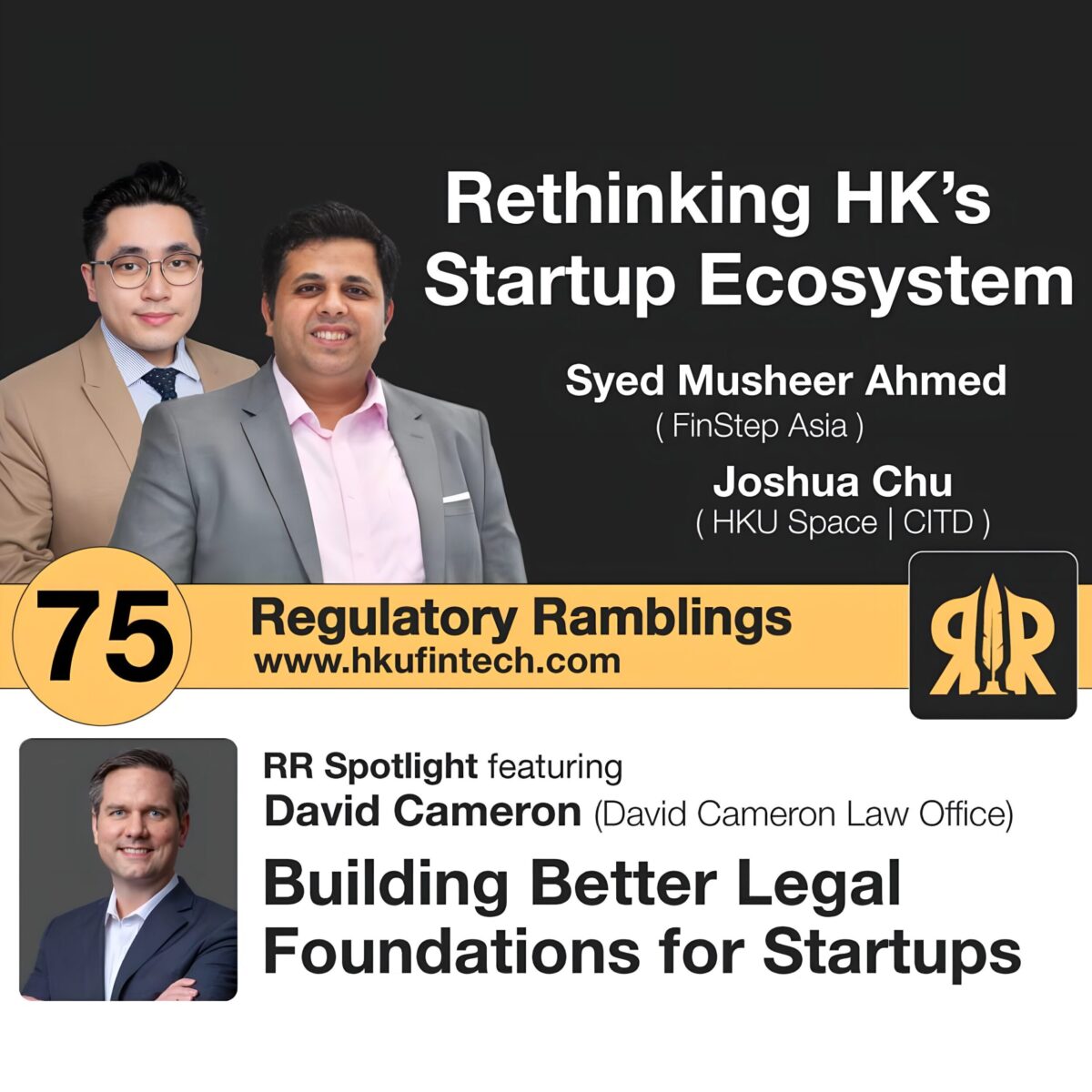
Regulatory Ramblings: Episode 75 – Rethinking Hong Kong’s Startup Ecosystem and Its Legal Foundations with Syed Musheer Ahmed, Joshua Chu, and David Cameron

In this episode, we feature two conversations exploring different frontiers of finance and technology.

This episode focuses on Hong Kong’s startup company environment. Specifically, how conducive is the city’s ecosystem for their inception, growth, and scaling up—legally, commercially, and policy-wise?

In the initial spotlight segment, we speak with David Cameron, a veteran American lawyer based in the territory who advises startups on the challenges and pitfalls startups face in their earlier stages. Obtaining affordable and sound legal advice is a key part of their quandary.

Following that, we discuss how to establish a body that provides genuine support and mentoring to emerging HK businesses, featuring Syed Musheer Ahmed, managing director of FinStep Asia and a former regulator with the Virtual Asset Regulatory Authority in Dubai, alongside local lawyer Joshua Chu. Simply put, it’s going to revolve around a public-private partnership.

David Cameron is managing partner and founder of the David Cameron Law Office, or DCLO—an independent, HK-based law firm offering international legal services. Founded in 2021, the firm is qualified to act on matters of Hong Kong and New York law. He has 16 years of experience in the Hong Kong market—including time spent at some of the largest law firms in the world, such as Linklaters and Allen & Overy.

DCLO is a corporate law firm, offering advice and solutions on general corporate matters, capital raising, M&A, fund formation, and contract law. DCLO also has specialized areas in family law, employment law, immigration, and litigation. In addition, DCLO has the unique offering of acting as external general counsel for growing companies that do not yet have their own in-house legal counsel.

DCLO is also deeply involved in Hong Kong initiatives, such as family offices, Hong Kong limited partnership funds (LPFs), Hong Kong open-ended fund companies (OFCs), and the Hong Kong Capital Investment Entrant Scheme.

Joshua Chu is a prominent Hong Kong lawyer in all matters fintech and crypto, and a prolific writer. His opinion and insights are much sought after by the local press and correspondents of major foreign news organizations operating in the city. You can often hear him at his most candid on the radio at RTHK. He is also co-chair of the Hong Kong Web 3 Association and legal advisor to the Hong Kong Blockchain Association.

Syed Musheer Ahmed is the managing director of FinStep Asia—a firm he founded six years ago. With over 18 years of extensive experience as an ecosystem builder in the realms of capital markets, fintech, and virtual assets, including a decade as a global markets trader, before coming to Hong Kong to attain his MBA from the University of Hong Kong and London Business School’s joint program.

A self-described “fintech ballerina,” since 2016, Musheer has contributed extensively to building the region’s fintech and virtual assets ecosystem, particularly as the co-founder and as a concurrent board member and the inaugural general manager of the Fintech Association of Hong Kong (FTAHK).

He has also done a stint as a regulator. Beyond his many contributions to the territory’s fintech regulatory policy during his tenure with the FTAHK, from October 2022 to January 2024, he served as a financial markets risk assurance lead with the Virtual Assets Regulatory Authority in Dubai.

Discussion:

The conversation begins with a recent article published in the South China Morning Post, written by Petty Sito and Julie Zhang, which discusses how InvestHK, a quasi-governmental body, is now supporting local companies in expanding their overseas operations, a shift from its previous focus on attracting investment to the city over the past 25 years.

The article mentions that the Evident Group, operator of a digital investment platform for alternative assets and licensed by the Securities and Futures Commission, formed a partnership with Zand Bank, the UAE’s first fully licensed digital bank. The collaboration will provide the Dubai-based bank’s clients with investment opportunities through Evident’s tokenization technology and infrastructure.

Yet, is that enough when places like Singapore, Taiwan, and Israel long ago seemed to have learned how to nurture and scale up startups to go global? Our guests today believe that an empowered, well-resourced startup-centric body would be a good idea, and it will require a public-private partnership to make it happen.

The crux of the discussion is what can be done to improve Hong Kong’s startup ecosystem? More pointedly, what can be done to help up-and-coming companies reach their potential and become the juggernauts of tomorrow? Indications are that it will require a separate entity offering genuine startup support, something beyond InvestHK, Cyberport, Science Park, or the Hong Kong Trade Development Council.

David kicks things off, sharing his thoughts on the legal and compliance challenges that startups face in the Special Administrative Region with Regulatory Ramblings host Ajay Shamdasani. They discuss how to effectively serve as a lawyer for a startup when they don’t have much of a legal budget. In such instances, fractional or part-time in-house counsel might be more suited to a firm’s means and needs.

Yet, beyond legal considerations, other mistakes do startups make, such as running out of money too soon, seem like a cliché at this point. David shares his perspective on what can be done to improve the city’s ecosystem for startups and stresses that legal expenses should be seen as an investment in a firm’s future rather than costly, burdensome drudgery.

The discussion then shifts to Musheer and Joshua in the second segment. They stress that looking objectively at the SAR’s existing structure of InvestHK, Cyberport, and Science Park, and without being overly critical of what has come before, though past government actions – mistakes have been made and, hopefully, lessons have been learned. Even still, they ask, what would need to be done to create a proper startup support entity?

As Musheer notes, something distinct from either Cyberport or HKSTP is needed: “more of an internal InvestHK with a main [key performance indicator] of building and sustaining [a] local ecosystem.”

They both emphasize that the hallmark of a strong startup ecosystem is the strength of its community. “They need bank account access, government subsidies, and both local and international business ties,” Musheer said.

In a similar vein, Joshua added: “Is the community open to it [startups]? Hong Kong can be very myopic, with everyone doing their own thing. Early-stage funding in here is weak. How do we fix that?”

Both men cited examples from around the world that have been successful, including private-public partnerships, incubators like Hong Kong’s WHub, and university grants for startups – all of which Hong Kong has.

“The pain points in Hong Kong are that it is rich in tech and ideas, but you need many people for startups to thrive; a critical mass of consumers. They need a pool of consumers ready to be excited about product launches. Then look at how incubators can pitch to select committees,” Joshua said.

Both experts conclude that the city needs not only investors, but also mentors and a nurturing, open-minded community with support systems. That includes non-financial operational support for local startups in Hong Kong, with adequate communication and partnerships, and angel investors who can help with coordinating matters.

Culture and mindset are a key part of the equation. The local startup scene needs local angel advisers because, as Joshua observes, “the Hong Kong business environment is too Asian, too formulaic and math-based. We need some element of [creative] strategy.”
Infrastructure issues are also a concern. For example, the city’s Cyberport and Science Park could use better transportation, they say, because both locations are far away from the core business districts of Central, Admiralty, and Wanchai. Beyond that, both say the city has great facilities that can help bring innovative companies together.
“What’s needed is more facilitation of commercialization,” Musheer said.

The ultimate question is whether private enterprises can collaborate with the government to develop more effective business strategies.

Regulatory Ramblings podcasts is brought to you by The University of Hong Kong – Reg/Tech Lab, HKU-SCF Fintech Academy, Asia Global Institute, and HKU-edX Professional Certificate in Fintech, with support from the HKU Faculty of Law.

Useful links in this episode:

You might also be interested in:

Connect with RR Podcast at:

LinkedIn: https://hk.linkedin.com/company/hkufintech 
Facebook: https://www.facebook.com/hkufintech.fb/
Instagram: https://www.instagram.com/hkufintech/ 
Twitter: https://twitter.com/HKUFinTech 
Threads: https://www.threads.net/@hkufintech
Website: https://www.hkufintech.com/regulatoryramblings 

Connect with the Compliance Podcast Network at:

LinkedIn: https://www.linkedin.com/company/compliance-podcast-network/
Facebook: https://www.facebook.com/compliancepodcastnetwork/
YouTube: https://www.youtube.com/@CompliancePodcastNetwork
Twitter: https://twitter.com/tfoxlaw
Instagram: https://www.instagram.com/voiceofcompliance/
Website: https://compliancepodcastnetwork.net


Categories
TechLaw10

TechLaw10: AI: US AI Action Plan vs EU AI Act

In this film, Punter Southall Law’s Jonathan Armstrong discusses different approaches to AI legislation with Eric Sinrod, California professor and attorney at Duane Morris LLP. This is episode 294 in the popular TechLaw10 series. You can listen to earlier podcasts here.

Jonathan & Eric start by talking about America’s AI Action Plan and the hands-off approach to AI regulation promoted by the Trump administration. Jonathan contrasts that approach with the approach in the EU under the EU AI Act. Jonathan talks about the elements of the EU AI Act that are already in force:

1. bans on prohibited AI

2. mandatory AI literacy programs

3. provisions relating to GPAI. There are FAQs on the EU AI Act here.

There is also a glossary of AI terms here.

Jonathan also talks about the GPAI Code, which is discussed here.

Eric & Jonathan also talk about:

  • The UK’s approach to AI regulation
  • The effect of AI regulation on the economy
  • The differences between Federal and State law in the US
  • The FTC’s role in policing AI & whether that will change
  • AI-related dawn raids
  • AI-related GDPR fines
  • suspensions of AI apps in Europe
  • The European AI Office

Our previous podcast on AI literacy is here    • TechLaw10: AI Literacy – What is it & How …  .

The AI Action Plan, which Eric discusses, is here.

Jonathan talks briefly about his work on the NYSBA AI Task Force. There are details of that here.

You can learn more about Eric at Duane Morris LLP, and Jonathan here at Punter Southall Law

This podcast was recorded on 5 August 2025

Connect with the Compliance Podcast Network at:

LinkedIn

Facebook

YouTube

X (formerly Twitter)

Instagram

Website

Categories
Blog

Sherlock Holmes and Compliance: Investigative Insights from “The Valley of Fear”

Here’s a detailed, insightful article in the style of Tom Fox for a corporate compliance audience, highlighting investigative lessons from the Sherlock Holmes novel, “The Valley of Fear.”

For compliance professionals, investigations are the bedrock of effective compliance programs. Whether it’s tracking down evidence of bribery, uncovering fraud schemes, or rooting out systemic misconduct, the investigative methods you deploy can significantly impact your organization’s integrity, reputation, and bottom line.

“The Valley of Fear” offers a wealth of investigative wisdom. Its narrative of deception, undercover operations, secret societies, and surprising plot twists provides vivid lessons highly relevant to today’s corporate compliance landscape. Let’s unpack five key investigative lessons, each illustrated with memorable scenes from this timeless detective classic.

Lesson 1: Do Not Take Facts at Face Value

Illustrated By: Detailed Analysis of the Crime Scene. Upon arrival at Birlstone Manor, Holmes carefully examines the room where Douglas’s body was discovered, noting inconsistencies like the placement of furniture, window access, and unusual blood patterns.

The central narrative of “The Valley of Fear” revolves around the apparent murder of John Douglas at his Manor House in Birlstone. Initially, the crime scene appears straightforward: Douglas has seemingly been shot at close range, and the crime scene implicates an intruder. Yet Holmes immediately suspects deeper layers beneath the obvious evidence. His meticulous examination of the scene, blood patterns, room layout, and oddities like misplaced items reveals inconsistencies that others missed.

For compliance professionals, the lesson is clear: avoid jumping to conclusions based solely on initial evidence. It is tempting and human to embrace straightforward narratives quickly. But like Holmes, investigators must resist that impulse, digging deeper, questioning assumptions, and rigorously testing evidence for hidden contradictions or overlooked facts. By refusing to accept surface-level interpretations, compliance teams protect organizations from premature and potentially misguided conclusions.

Compliance Takeaway: Always scrutinize initial evidence meticulously and objectively. Never accept evidence without question or assume that initial appearances represent complete facts.

Lesson 2: Investigative Cooperation is Essential

Illustrated By: Collaboration between Holmes and MacDonald. Holmes and Inspector MacDonald openly discuss theories, evidence, and ideas, working cooperatively rather than competitively. Holmes shares insights freely, establishing mutual trust and respect that propel the investigation forward. 

Throughout the novel, Holmes collaborates closely with Scotland Yard’s Inspector MacDonald, who initially struggles to make sense of the complex scenario. Rather than competing, Holmes works cooperatively with MacDonald, openly sharing insights, theories, and information. Their mutual respect, dialogue, and professional cooperation ultimately contribute to solving the intricate puzzle.

Corporate compliance investigations similarly require effective internal and external cooperation. Compliance departments must partner seamlessly with Legal, HR, Audit, and IT functions, as well as outside counsel or forensic experts when necessary. Effective cooperation and collaboration across departments ensure thoroughness and objectivity, minimize blind spots, and enhance investigative outcomes. Holmes demonstrates that strong investigative results rely on teamwork rather than isolation or internal competition.

Compliance Takeaway: Foster collaborative relationships across organizational functions, aligning investigative efforts with Legal, HR, IT, and other stakeholders to produce effective outcomes.

Lesson 3: Patience and Persistence Yield Results

Illustrated By: Patient Uncovering of Douglas’s Background. Holmes painstakingly reconstructs Douglas’s past life in America, gradually identifying him as a Pinkerton detective who infiltrated the Scowrers. This meticulous work takes time, patience, and sustained investigative discipline.

Holmes painstakingly pieces together the clues surrounding John Douglas, ultimately revealing Douglas’s true identity as Birdy Edwards, a former Pinkerton detective who infiltrated a dangerous criminal organization, the Scowrers, in the United States. This revelation is not instantaneous; Holmes’ success comes from persistence, incremental discovery, and careful analysis of evidence collected over time.

In corporate compliance investigations, patience and persistence are equally critical. Compliance officers must frequently manage complex, multi-faceted investigations spanning weeks, months, or even years. Instant resolutions are rare; critical information often emerges slowly and incrementally. Holmes’s deliberate and patient approach to unraveling Douglas’s identity highlights the importance of tenacity, emphasizing that thoroughness and sustained attention invariably produce the clearest investigative outcomes.

Compliance Takeaway: Recognize and embrace that thorough investigative efforts are often incremental, requiring sustained attention and patience to understand complex compliance issues fully.

Lesson 4: Maintain a Big-Picture Perspective

Illustrated By: Contextual Awareness of Moriarty’s Influence. Holmes keeps Moriarty’s potential involvement clearly in mind throughout, maintaining awareness that individual incidents might connect to larger criminal patterns.

In the novel, Holmes repeatedly emphasizes that the apparent Birlstone murder is merely one small part of a larger, sinister picture orchestrated by the infamous Professor Moriarty. Though Moriarty never physically appears, his influence permeates the narrative, connecting seemingly unrelated events and adding deeper context to the investigation. Holmes maintains a sharp awareness of this broader context throughout, ensuring he does not lose sight of underlying motivations and interconnected plots.

This lesson resonates powerfully for compliance professionals. Frequently, investigations initially perceived as isolated incidents reveal systemic compliance or ethical weaknesses within an organization. Investigators must always remain cognizant of the broader organizational, cultural, or regulatory contexts influencing misconduct. By keeping this “big picture” perspective, compliance teams ensure investigations are holistic, not narrowly focused, enabling effective systemic remediation rather than piecemeal solutions.

Compliance Takeaway: Maintain holistic awareness in compliance investigations, ensuring isolated incidents are analyzed within broader organizational, regulatory, or ethical contexts to uncover deeper systemic issues.

Lesson 5: Effective Communication is Crucial 

Illustrated By: Contextual Awareness of Moriarty’s Influence. Holmes keeps Moriarty’s potential involvement clearly in mind throughout, maintaining awareness that individual incidents might connect to larger criminal patterns.

At key points throughout the novel, Holmes carefully explains his deductions, processes, and conclusions to Inspector MacDonald, Dr. Watson, and other key players. His ability to clearly articulate reasoning and insights, especially when conclusions appear counterintuitive or complex, is essential to maintaining credibility, building consensus, and driving effective outcomes.

Corporate compliance investigators must also master clear, effective communication. It’s insufficient merely to uncover misconduct; the true skill lies in effectively communicating findings to stakeholders, management, regulators, and even potentially implicated employees. Holmes shows us that investigative brilliance must be matched by communicative clarity. In corporate settings, investigative reports must clearly explain methodology, facts, assumptions, and conclusions, ensuring decisions based on investigations are informed, justified, and actionable.

Compliance Takeaway: Maintain holistic awareness in compliance investigations, ensuring isolated incidents are analyzed within broader organizational, regulatory, or ethical contexts to uncover deeper systemic issues.

Sherlock Holmes as Compliance Inspiration

Sherlock Holmes remains an enduring inspiration to corporate compliance professionals precisely because effective investigations are foundational to compliance success. Holmes’s methods, including detailed scrutiny of evidence, a collaborative approach, patient and persistent inquiry, a holistic perspective, and clear communication, are not merely fictional flourishes; they represent essential best practices.

“The Valley of Fear” offers compliance officers vivid, relatable insights, underscoring that successful investigations require disciplined methodology, sustained inquiry, careful analysis, cross-functional cooperation, and effective stakeholder communication. As Sherlock Holmes memorably states, “It is, of course, a trifle, but there is nothing so important as trifles.” For compliance professionals today, Holmes’s wisdom is more relevant than ever, reminding us that attention to detail, disciplined process, and communicative clarity are never trivial.

By embracing Holmes’s investigative rigor and lessons from this classic novel, compliance professionals equip themselves and their organizations to meet today’s complex challenges effectively. After all, just like Holmes himself, the compliance investigator’s role is fundamentally about uncovering truth; patiently, methodically, and tirelessly ensuring organizational integrity and ethical clarity amidst a complex corporate landscape.


Categories
Innovation in Compliance

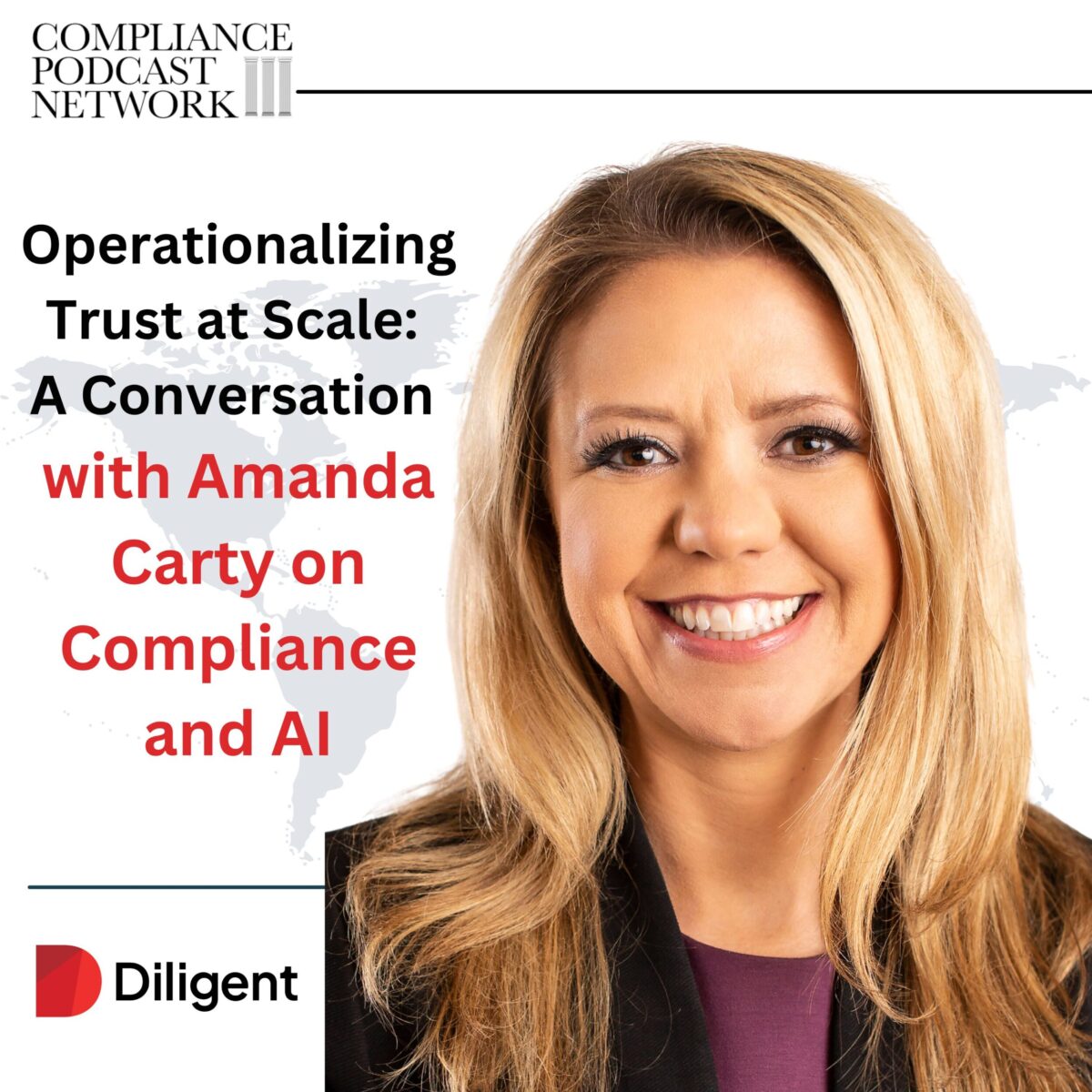
Operationalizing Trust at Scale: A Conversation with Amanda Carty on Compliance and AI

Innovation comes in many areas, and compliance professionals must be ready for and embrace it. Join Tom Fox, the Voice of Compliance, as he visits with top innovative minds, thinkers, and creators in the award-winning Innovation in Compliance podcast. Today, we begin a 3-part podcast series sponsored by Diligent with Jessica Czeczuga, Amanda Carty, and Neta Meidav. In Part 2, Tom is joined by Amanda Carty, GM Compliance Solutions at Diligent.

Carty shares insights from her decade-long experience in the GRC field and offers detailed perspectives on how leaders can model ethical behavior within their organizations. The conversation dives into how Diligent helps companies assess and document leadership effectiveness and the role of AI in enhancing compliance initiatives. Carty emphasizes the necessity of leaders acting as ambassadors of culture and the impact of measurable outcomes in compliance programs. The episode also explores the integration of AI and chatbots to provide real-time compliance support to employees, ensuring efficiency and ease of access to crucial information.

Key highlights:

  • Importance of Tone at the Top
  • Leadership and Ethical Culture
  • AI in Compliance
  • Employee Engagement and Technology
  • Actionable Takeaways for Compliance Professionals 

Resources:

Amanda Carty on LinkedIn

⁠Diligent⁠

Tom Fox

⁠Instagram⁠

⁠Facebook⁠

⁠YouTube⁠

⁠Twitter⁠

⁠LinkedIn

Categories
Trekking Through Compliance

Trekking Through Compliance: Episode 67 – The Dangers of Assumption: How Star Trek’s “Elaan of Troyius” Proves Due Diligence Is Essential

Today, let’s set our phasers to “analyze” and travel back to one of Star Trek: The Original Series’ most underrated diplomatic dramas: “Elaan of Troyius.” This episode is not just a space opera of culture clashes, hidden agendas, and diplomatic peril; it is a near-perfect parable for compliance professionals wrestling with the eternal question: Why is due diligence mandatory when considering a new business partner?

Let’s get into the heart of the episode and draw out five compliance lessons that every organization should heed before it signs that next contract.

1. First Impressions Are Deceptive: Always Probe Deeper

Illustrated By: Elaan’s arrival is marked by dramatic displays of power, arrogance, and cultural superiority.

Compliance Lesson. How many times have we seen organizations swept off their feet by a potential partner’s surface credentials, market reputation, or charismatic leadership? Due diligence is your organization’s safeguard against falling for the “Elaan effect”: the temptation to trust a partner’s public image without digging into their true character, operational practices, or hidden risks.

2. Cultural Blind Spots: Understand the Landscape Before You Leap

Illustrated By: Misunderstandings abound, from differing customs around authority and gender to fundamental misalignments in values.

Compliance Lesson. Entering into any partnership without understanding your partner’s culture, whether corporate, regional, or national, is asking for trouble.

3. Hidden Agendas and Sabotage: Trust, But Verify

Illustrated By: The mission is sabotaged by Elaan’s retinue, her bodyguard conspires with the Klingons, hiding a device that compromises the Enterprise’s defenses.

Compliance Lesson. When evaluating new partners, you must assume that unseen risks may be lurking just below the surface.

4. Emotional Reactions Cloud Judgment: Stay Objective

Illustrated By: Kirk finds himself emotionally entangled with Elaan after being exposed to her tears, which act as a potent love potion.

Compliance Lesson. In real-world business, emotional bias can cause teams to overlook red flags, downplay risks, or shortcut due diligence.

5. The Price of Ignorance: Remediation Is Harder Than Prevention

Illustrated By: Only after chaos erupts do Kirk and the crew scramble to uncover the source of their problems, a hidden device sabotaging the Enterprise’s engines.

Compliance Lesson. If you do not invest in rigorous due diligence up front, you will inevitably spend much more time, money, and resources cleaning up the mess after something goes wrong.

Final ComplianceLog Reflections

Elaan of Troyius” is a warning to any organization tempted to “wing it” when evaluating a new business partner. Diplomacy, optimism, and trust are essential, but they are not substitutes for due diligence. Hidden risks, cultural misunderstandings, and emotional biases can turn opportunity into disaster in a heartbeat. Kirk and the crew of the Enterprise ultimately succeed not because of luck, but because they confront hard truths, adapt, and persevere. In the world of corporate compliance, the same rules apply.

Resources:

⁠⁠Excruciatingly Detailed Plot Summary by Eric W. Weisstein⁠⁠

⁠⁠MissionLogPodcast.com⁠⁠

⁠⁠Memory Alpha

Categories
Daily Compliance News

Daily Compliance News: August 7, 2025, The SEC Can Gag Edition

Welcome to the Daily Compliance News. Each day, Tom Fox, the Voice of Compliance, brings you compliance-related stories to start your day. Sit back, enjoy a cup of morning coffee, and listen in to the Daily Compliance News. All, from the Compliance Podcast Network. Each day, we consider four stories from the business world, compliance, ethics, risk management, leadership, or general interest for the compliance professional.

Top stories include:

  • Trump is making corruption more dangerous. (Foreign Affairs)
  • Uber picked business over customer safety. (NYT)
  • The 9th Circuit upholds the SEC gag rule. (Reuters)
  • To Regulate or Not to Regulate. (Bloomberg)

You can donate to flood relief for victims of the Kerr County flooding by going to the Hill Country Flood Relief here.

Categories
Hill Country Authors

Hill Country Authors – Exploring the Challenges of a Green Transition with Tom Ortiz

Welcome to a new season of the award-winning Hill Country Authors Podcast, sponsored by Stoney Creek Publishing. In this podcast, Hill Country resident Tom Fox visits with authors who live in and write in and about the Texas Hill Country. In this episode, Tom visits with Tom Ortiz, who discusses his diverse professional background, ranging from thermodynamic experiments to oil and gas industry work, and his critical views on the green energy transition.

Ortiz elaborates on his new book, ‘Why We Struggle to Go Green,’ aiming to bridge the gap between casual readers and academic audiences with accessible yet detailed insights into energy systems like hydrogen and carbon capture. He addresses the harsh realities of shifting to renewable sources, emphasizing the need for reduced energy consumption and greater resilience to climate change. Ortiz also reflects on the evolving role of academia and its challenges in fostering unbiased technological advancement. The discussion concludes with Ortiz’s future aspirations and a brief about his collaboration with Stony Creek Publishing.

Key highlights:

  • The Genesis of the Book
  • Harsh Realities of the Green Transition
  • Managing the Costs of Clean Energy
  • The Role of Academia
  • Sustainable Solutions for Population Growth

Resources:

Tom Ortiz on LinkedIn

Tom Ortiz Substack

Tom Ortiz on Stoney Creek Publishing

Why We Struggle to Go Green on Texas A&M University Press

Stoney Creek Publishing Website

Podcast Cover Art

Nancy Huffman Fine Art

Tom Fox

Instagram

Facebook

YouTube

Twitter

LinkedIn