


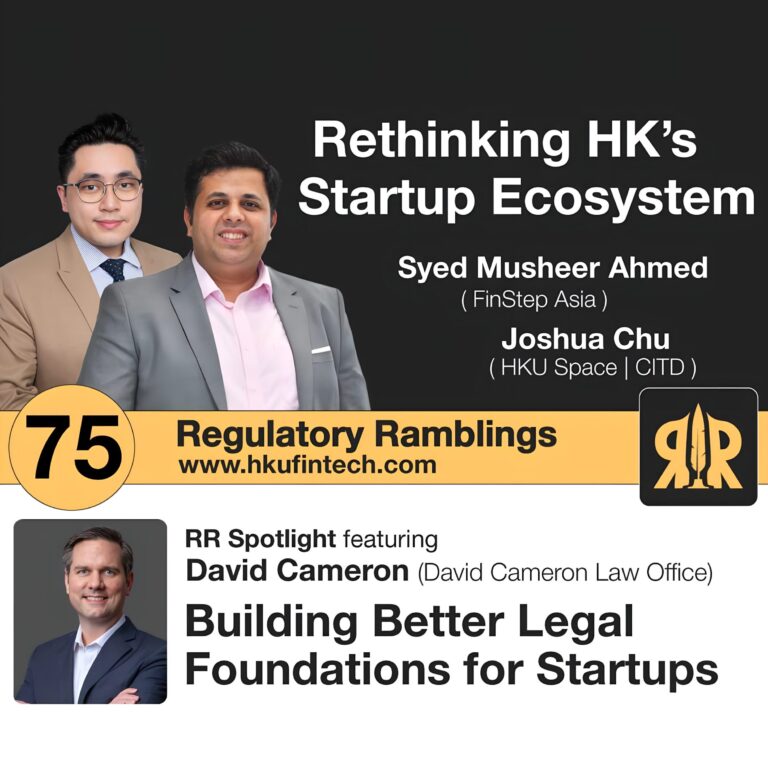
In this episode, we feature two conversations exploring different frontiers of finance and technology.
This episode focuses on Hong Kong’s startup company environment. Specifically, how conducive is the city’s ecosystem for their inception, growth, and scaling up—legally, commercially, and policy-wise?
In the initial spotlight segment, we speak with David Cameron, a veteran American lawyer based in the territory who advises startups on the challenges and pitfalls startups face in their earlier stages. Obtaining affordable and sound legal advice is a key part of their quandary.
Following that, we discuss how to establish a body that provides genuine support and mentoring to emerging HK businesses, featuring Syed Musheer Ahmed, managing director of FinStep Asia and a former regulator with the Virtual Asset Regulatory Authority in Dubai, alongside local lawyer Joshua Chu. Simply put, it’s going to revolve around a public-private partnership.
 David Cameron is managing partner and founder of the David Cameron Law Office, or DCLO—an independent, HK-based law firm offering international legal services. Founded in 2021, the firm is qualified to act on matters of Hong Kong and New York law. He has 16 years of experience in the Hong Kong market—including time spent at some of the largest law firms in the world, such as Linklaters and Allen & Overy.
DCLO is a corporate law firm, offering advice and solutions on general corporate matters, capital raising, M&A, fund formation, and contract law. DCLO also has specialized areas in family law, employment law, immigration, and litigation. In addition, DCLO has the unique offering of acting as external general counsel for growing companies that do not yet have their own in-house legal counsel.
DCLO is also deeply involved in Hong Kong initiatives, such as family offices, Hong Kong limited partnership funds (LPFs), Hong Kong open-ended fund companies (OFCs), and the Hong Kong Capital Investment Entrant Scheme.
 Joshua Chu is a prominent Hong Kong lawyer in all matters fintech and crypto, and a prolific writer. His opinion and insights are much sought after by the local press and correspondents of major foreign news organizations operating in the city. You can often hear him at his most candid on the radio at RTHK. He is also co-chair of the Hong Kong Web 3 Association and legal advisor to the Hong Kong Blockchain Association.
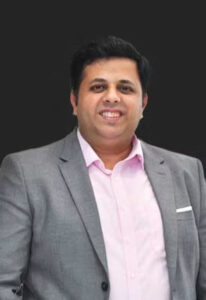 Syed Musheer Ahmed is the managing director of FinStep Asia—a firm he founded six years ago. With over 18 years of extensive experience as an ecosystem builder in the realms of capital markets, fintech, and virtual assets, including a decade as a global markets trader, before coming to Hong Kong to attain his MBA from the University of Hong Kong and London Business School’s joint program.
A self-described “fintech ballerina,” since 2016, Musheer has contributed extensively to building the region’s fintech and virtual assets ecosystem, particularly as the co-founder and as a concurrent board member and the inaugural general manager of the Fintech Association of Hong Kong (FTAHK).
He has also done a stint as a regulator. Beyond his many contributions to the territory’s fintech regulatory policy during his tenure with the FTAHK, from October 2022 to January 2024, he served as a financial markets risk assurance lead with the Virtual Assets Regulatory Authority in Dubai.
Discussion:
The conversation begins with a recent article published in the South China Morning Post, written by Petty Sito and Julie Zhang, which discusses how InvestHK, a quasi-governmental body, is now supporting local companies in expanding their overseas operations, a shift from its previous focus on attracting investment to the city over the past 25 years.
The article mentions that the Evident Group, operator of a digital investment platform for alternative assets and licensed by the Securities and Futures Commission, formed a partnership with Zand Bank, the UAE’s first fully licensed digital bank. The collaboration will provide the Dubai-based bank’s clients with investment opportunities through Evident’s tokenization technology and infrastructure.
Yet, is that enough when places like Singapore, Taiwan, and Israel long ago seemed to have learned how to nurture and scale up startups to go global? Our guests today believe that an empowered, well-resourced startup-centric body would be a good idea, and it will require a public-private partnership to make it happen.
The crux of the discussion is what can be done to improve Hong Kong’s startup ecosystem? More pointedly, what can be done to help up-and-coming companies reach their potential and become the juggernauts of tomorrow? Indications are that it will require a separate entity offering genuine startup support, something beyond InvestHK, Cyberport, Science Park, or the Hong Kong Trade Development Council.
David kicks things off, sharing his thoughts on the legal and compliance challenges that startups face in the Special Administrative Region with Regulatory Ramblings host Ajay Shamdasani. They discuss how to effectively serve as a lawyer for a startup when they don’t have much of a legal budget. In such instances, fractional or part-time in-house counsel might be more suited to a firm’s means and needs.
Yet, beyond legal considerations, other mistakes do startups make, such as running out of money too soon, seem like a cliché at this point. David shares his perspective on what can be done to improve the city’s ecosystem for startups and stresses that legal expenses should be seen as an investment in a firm’s future rather than costly, burdensome drudgery.
The discussion then shifts to Musheer and Joshua in the second segment. They stress that looking objectively at the SAR’s existing structure of InvestHK, Cyberport, and Science Park, and without being overly critical of what has come before, though past government actions – mistakes have been made and, hopefully, lessons have been learned. Even still, they ask, what would need to be done to create a proper startup support entity?
As Musheer notes, something distinct from either Cyberport or HKSTP is needed: “more of an internal InvestHK with a main [key performance indicator] of building and sustaining [a] local ecosystem.”
They both emphasize that the hallmark of a strong startup ecosystem is the strength of its community. “They need bank account access, government subsidies, and both local and international business ties,” Musheer said.
In a similar vein, Joshua added: “Is the community open to it [startups]? Hong Kong can be very myopic, with everyone doing their own thing. Early-stage funding in here is weak. How do we fix that?”
Both men cited examples from around the world that have been successful, including private-public partnerships, incubators like Hong Kong’s WHub, and university grants for startups – all of which Hong Kong has.
“The pain points in Hong Kong are that it is rich in tech and ideas, but you need many people for startups to thrive; a critical mass of consumers. They need a pool of consumers ready to be excited about product launches. Then look at how incubators can pitch to select committees,” Joshua said.
Both experts conclude that the city needs not only investors, but also mentors and a nurturing, open-minded community with support systems. That includes non-financial operational support for local startups in Hong Kong, with adequate communication and partnerships, and angel investors who can help with coordinating matters.
Culture and mindset are a key part of the equation. The local startup scene needs local angel advisers because, as Joshua observes, “the Hong Kong business environment is too Asian, too formulaic and math-based. We need some element of [creative] strategy.”
Infrastructure issues are also a concern. For example, the city’s Cyberport and Science Park could use better transportation, they say, because both locations are far away from the core business districts of Central, Admiralty, and Wanchai. Beyond that, both say the city has great facilities that can help bring innovative companies together.
“What’s needed is more facilitation of commercialization,” Musheer said.
The ultimate question is whether private enterprises can collaborate with the government to develop more effective business strategies.
Regulatory Ramblings podcasts is brought to you by The University of Hong Kong – Reg/Tech Lab, HKU-SCF Fintech Academy, Asia Global Institute, and HKU-edX Professional Certificate in Fintech, with support from the HKU Faculty of Law.
Useful links in this episode:
-
Follow David Cameron on LinkedIn
-
Visit David Cameron Law Office website
-
Follow Joshua Chu on LinkedIn
-
Visit HKU Space website
-
Follow Syed Musheer Ahmed on LinkedIn
-
Visit FinStep Asia website
You might also be interested in:
-
Must have book by Ross Buckley, Douglas Arner & Dirk Zetzsche – FinTech: Finance, Technology & Regulation
-
Building Better Financial Systems: FinTech Sustainability – Research
-
HKU-SCF Fintech Academy – website
-
Asia Global Institute – website
-
Most sought after Fintech course on edX – Introduction to Fintech
Connect with RR Podcast at:
LinkedIn: https://hk.linkedin.com/company/hkufintech
Facebook: https://www.facebook.com/hkufintech.fb/
Instagram: https://www.instagram.com/hkufintech/
Twitter: https://twitter.com/HKUFinTech
Threads: https://www.threads.net/@hkufintech
Website: https://www.hkufintech.com/regulatoryramblings
Connect with the Compliance Podcast Network at:
LinkedIn: https://www.linkedin.com/company/compliance-podcast-network/
Facebook: https://www.facebook.com/compliancepodcastnetwork/
YouTube: https://www.youtube.com/@CompliancePodcastNetwork
Twitter: https://twitter.com/tfoxlaw
Instagram: https://www.instagram.com/voiceofcompliance/
Website: https://compliancepodcastnetwork.net