


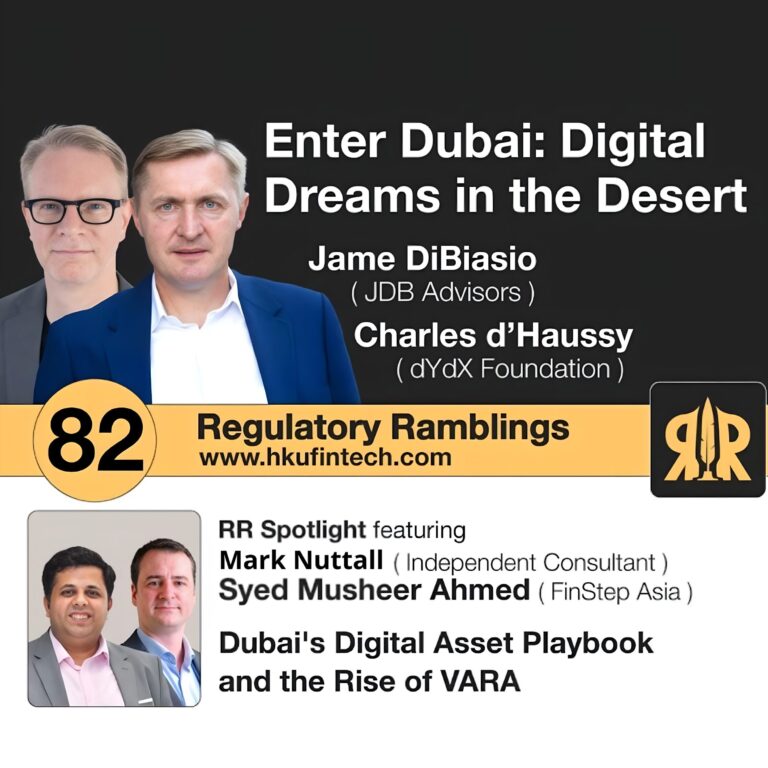
Today’s podcast is Mideast-centric, specifically focusing on the United Arab Emirates—and in particular, its most renowned emirate, Dubai. In our spotlight section, we will be joined by two returning guests—Syed Musheer Ahmed of FinStep Asia and Mark Nuttall, founder of the Dubai-based Faustus Consultancy—to discuss the proposition: what has made Dubai a success in the virtual assets space compared to other jurisdictions? Since the start of the decade, the emirate has established a reputation in the cryptocurrency arena.
After that, we speak with authors Jame DiBiasio and Charles d’Haussy about their new book, Arabian Crypto, about digital-asset pioneers in the UAE.
Biography:
Syed Musheer Ahmed has over 18 years of extensive experience as an ecosystem builder in the realms of capital markets, fintech, and virtual assets, which includes a decade as a global markets trader before relocating to Hong Kong to pursue his MBA from the University of Hong Kong and the London Business School’s joint program.
Since 2016, Musheer has contributed extensively to building the region’s fintech and virtual asset ecosystem, particularly as co-founder and concurrent board member, as well as the inaugural general manager of the Fintech Association of Hong Kong.
Based in Hong Kong, he has been the managing director of FinStep Asia for almost five years, a position he has held since founding the firm. In the interim, he served as a financial regulator from October 2022 to January 2024, when he was the Financial Markets Risk Assurance Lead with VARA in Dubai.
Mark Nuttall is a Dubai-based executive, geopolitical advisor, and strategic deal facilitator. With over 25 years of experience in strategic leadership, risk management, and business development, he has held roles at the Metropolitan Police Service (in London), Thomson Reuters, INTERPOL, and Hill and Associates. He founded the Faustus Consultancy and The Iron Club.
Mark offers his executive advisory services across the Asia Pacific, MENA, and Europe, driving growth, optimizing operations, facilitating deals, and enhancing governance. Particularly in risk management and governance, he has extensive experience in implementing plans focused on risk mitigation and resilience, as well as enhancing governance standards. He has also managed complex investigations and multi-agency operations.
In terms of subject matter expertise, Mark has delivered advisory services about compliance, risk reduction, finance, leadership, governance, geopolitics, AML, resilience, security, and ESG. He has also provided keynote speeches and mentorship to C-suite and geopolitical audiences.
Jame DiBiasio has had a remarkable journey, transitioning from a seasoned reporter to writer, editor, author, and content creator (particularly in the realm of fintech), ultimately leading to becoming a media entrepreneur, board director, and podcaster. He still regards himself as all of the above—as he puts it, “leveraging experiences to provide bespoke story-based projects and to advise companies.”
Based in Hong Kong, he is currently the founder and managing partner of JDB Advisors, providing companies in fintech, financial services, wealth management, and digital assets with insight, advice, and services to support their growth and narrative. The firm’s edge lies in its ability to leverage media expertise, encompassing co-authorship, podcasting, writing, research, and recruitment.
Ultimately, he helps fintech and finance businesses with media, narrative, content, and governance. His firm, JDBA, also publishes its own in-house media, The JDB Report, which covers technology and finance.
Jame’s passion, however, is writing. He is the author of a dozen books, five of which are nonfiction. In addition to Arabian Crypto, his other titles include Planet VC, which tells the story of venture capital beyond Silicon Valley; Block Kong, in which he profiles blockchain leaders and entrepreneurs shaping Hong Kong’s virtual asset ecosystem; and Cowries to Crypto—a history of money.
His non-business history books are “The Story of Angkor” and “Who Killed the King of Bagan?”, each covering one of Southeast Asia’s great temple civilizations. Jame also writes fiction under a pen name, which he encourages us to figure out.
Charles d’Haussy is based in Dubai and serves as the CEO of the dYdX Foundation, a community centered on decentralized derivatives trading, with a core focus on a decentralized finance (DeFi) protocol for perpetual futures.
Before joining dYdX, Charles served as the global head of business development at ConsenSys. His diverse career includes entrepreneurial ventures, executive roles in fintech startups, and a stint as the head of fintech at InvestHK, a quasi-governmental body.
In 2018, Charles was recognized as one of the Top 50 FinTech influencers in Asia. His expertise in fintech and blockchain earned him widespread acclaim. In 2021, he co-authored the book Block Kong with Jame.
Discussion:
This episode’s spotlight segment begins with a reference to a recent LinkedIn post by Anton Golub, the Chief Business Officer of the Freedx crypto exchange in Dubai. It helps put things in perspective regarding the emirate’s success in the virtual asset space.
As he put it, Dubai became the world’s largest regulated crypto market. Not New York. Not London. Not Hong Kong. Not Singapore.
Not bad for a place that, well into the early 1990s, only had one major Western-style shopping mall to speak of—the famed Al Ghurair Centre.
According to Golub’s figures, for the year-to-date (YTD) 2025, Dubai logged over AED 2.5 trillion (approximately USD 680.64 billion) in regulated virtual-asset transactions. He adds that Dubai also boasts over 40 licensed entities under the oversight of its Virtual Asset Regulatory Authority (VARA), the world’s first such regulator, which was launched in 2022.
To its credit, Dubai has also fined 19 firms under clear enforcement measures, and more broadly, its neighboring emirate Abu Dhabi—the UAE’s capital—has made a US$2 billion institutional investment into Binance.
All of this has happened in just three short years. What did Dubai understand that other places did not? While planning matters, execution is key. While different jurisdictions debated definitions, the UAE established its fintech infrastructure to support the growth and development yet to come.
To quote Golub’s LinkedIn post: “While Europe buried itself in MiCA [Markets in Crypto-Assets Regulation], Dubai executed. While the US chased headlines, VARA licensed markets.”
Of VARA’s creation, he said it was “built like sovereign infrastructure. Every major exchange—Binance, OKX, Bybit—moved fast to comply. This wasn’t about ‘crypto-friendly. This was crypto-integrated.”
Musheer and Mark reiterate many of the above sentiments while chatting with Regulatory Ramblings host Ajay Shamdasani, all while sharing their own thoughts on why Dubai has become a successful digital asset hub based on their time on the ground there.
As Golub noted, Dubai’s strength was that it had a vision before regulation: the UAE as a nation understands that “digital assets are not about price—they’re about power.” Additionally, they valued “infrastructure before hype” with “tiered licenses,” “real enforcement,” and “credible frameworks.” Lastly, the emirate recognized that integration must precede scale, as “digital assets were woven into AI, banking, [the] cloud, and sovereign funds.”
The net result, according to Golub, is that “Dubai now governs trust infrastructure for a multi-trillion-dollar global asset class. The UAE is not waiting for the future. It’s building it.”
Giving a preview of things to come in the UAE, he points to:
– The tokenization of real-world assets
– Central Bank Digital Currency (CBDC)-backed stablecoin flows (“Digital Dirham”)
– AI-native finance via MGX, G42, Presight
– On-chain financial infrastructure as national policy
The emphasis on execution and Dubai’s “can-do attitude” is also something that both Musheer and Mark stress in an age when so-called crypto hubs like Singapore issue licenses sluggishly, placing a great many firms on provisional status. Those that get to market first will benefit by virtue of being early movers.
Indeed, legal debates about whether stablecoins are currency or securities seem quaint at this point.
The conversation continues with Jame and Charles. The premise of their book, Arabian Crypto, is that the UAE has exploded onto the crypto scene. Every major player, from exchanges to DeFi founders and traditional finance bankers, is establishing a presence in either Dubai or Abu Dhabi.
But why the UAE? How did this nation of 10 million become the leading global hub for crypto? Is it too late for those who want to participate in the UAE’s growth story to join the party?
Arabian Crypto showcases the perspectives of regulators, founders, and executives across the spectrum of digital assets to understand what drives the UAE’s success, how to conduct business in the country, and how to navigate its regulatory landscape. Multiple exciting projects are being built there, and it begs the question: What will it mean for the UAE’s role in the global blockchain-enabled commerce industry?
The book is a valuable primer into the cutting edge of East-meets-West innovation and the future of money.
The authors discuss their views on VARA’s effectiveness as a regulator with Ajay, explaining what prompted them to write the book and what they believe it contributes to the ever-growing body of work on crypto and fintech writ large.
They acknowledge that their target audience is those from the world of tradfi, while also noting that there are lessons for established APAC financial hubs, such as Hong Kong and Singapore, to learn from the UAE as well.
Regulatory Ramblings podcasts is brought to you by The University of Hong Kong – Reg/Tech Lab, HKU-SCF Fintech Academy, Asia Global Institute, and HKU-edX Professional Certificate in Fintech, with support from the HKU Faculty of Law.
Useful links in this episode:
-
Follow Syed Musheer Ahmed on LinkedIn
-
Follow Mark Nuttall on LinkedIn
-
Follow Jame DiBiasio on LinkedIn
-
Follow Charles d’Haussy on LinkedIn
-
Buy the book Arabian Crypto: UAE Edition at amazon
You might also be interested in:
-
Must have book by Ross Buckley, Douglas Arner & Dirk Zetzsche – FinTech: Finance, Technology & Regulation
-
Building Better Financial Systems: FinTech Sustainability – Research
-
HKU-SCF Fintech Academy – website
-
Asia Global Institute – website
-
Most sought-after Fintech course on edX – Introduction to Fintech
Connect with RR Podcast at:
LinkedIn: https://hk.linkedin.com/company/hkufintech
Facebook: https://www.facebook.com/hkufintech.fb/
Instagram: https://www.instagram.com/hkufintech/
Twitter: https://twitter.com/HKUFinTech
Threads: https://www.threads.net/@hkufintech
Website: https://www.hkufintech.com/regulatoryramblings
Connect with the Compliance Podcast Network at:
LinkedIn: https://www.linkedin.com/company/compliance-podcast-network/
Facebook: https://www.facebook.com/compliancepodcastnetwork/
YouTube: https://www.youtube.com/@CompliancePodcastNetwork
Twitter: https://twitter.com/tfoxlaw
Instagram: https://www.instagram.com/voiceofcompliance/
Website: https://compliancepodcastnetwork.net