


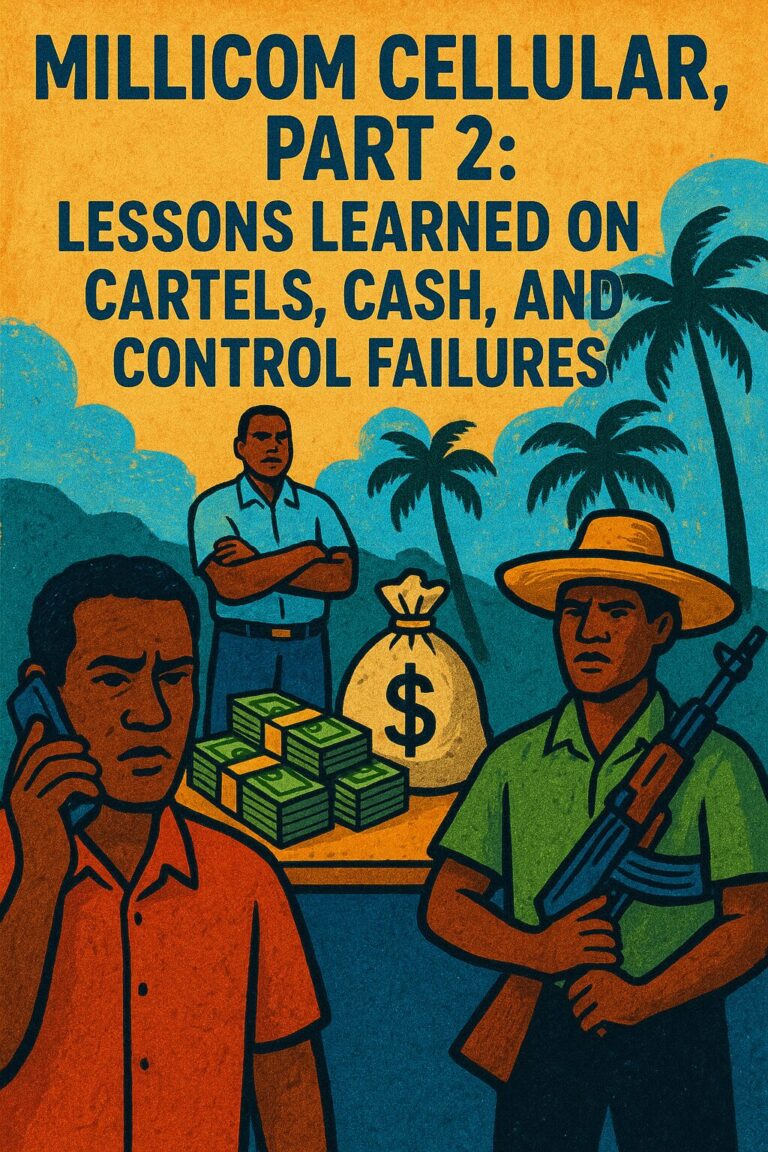
The Millicom Cellular FCPA enforcement action is not just another FCPA case. It is a case that signals a new frontier for compliance risk. It blends classic corrupt-payment schemes with organized crime, narcotrafficking proceeds, obstructed governance, and aggressive legislative capture. It is a wake-up call for compliance officers that the threat landscape is expanding in ways that require deeper operational controls, broader due diligence frameworks, and more sophisticated cross-functional collaboration.
In Part 1, we considered the underlying facts and FCPA violations of this matter. In Part 2, we examine what compliance professionals must take away from the case.
Lesson 1: Joint-Venture Governance Failures Are Not a Defense
Millicom Cellular held a 55 percent ownership stake in TIGO Guatemala, but the local partner exercised operational control and blocked Millicom Cellular from information and cooperation. The DOJ notes that Millicom Cellular voluntarily disclosed early concerns in 2015 but was unable to compel cooperation from local executives or obtain complete data. The result is a clear message:
Ownership without operational control equals enormous FCPA exposure.
Compliance professionals must:
- Implement JV governance protocols that require access rights, audit rights, and cooperation language in shareholder agreements. Try to place your company’s representative as the CFO of the joint venture.
- Establish escalation pathways if a partner obstructs investigations.
- Treat “majority ownership without control” as a high-risk structure in compliance risk assessments.
Yet notwithstanding the foregoing, DOJ has made clear it will not accept a lack of control as an excuse for failing to detect corruption, especially when red flags are visible.
Lesson 2: Cash-Based Bribery Ecosystems Require a Different Kind of Monitoring
The bribery scheme ran almost entirely on cash: cash in duffel bags delivered by helicopter, cash laundered through drug traffickers, cash moved through shell companies, and cash withdrawn from banks in plastic bags. Traditional financial controls are almost useless in the face of an off-books cash economy. Compliance must be enhanced:
- Controls around cash withdrawals
- Monitoring of cash-intensive vendors
- Patterns of invoicing irregularities
- Real-time analytics on deviations in expense and procurement behavior
This is not a theoretical exercise. It is an operational reality for companies in high-risk jurisdictions.
Lesson 3: Cartel Exposure Is Emerging as a Corporate Compliance Obligation
This case represents one of the most explicit linkages between FCPA violations and narco-trafficking cash flows. The scheme not only involved bribes; it also involved bribes financed by organized crime. Compliance officers must now assume that criminal networks may view legitimate multinationals as conduits for illicit financial flows. This demands:
- Enhanced beneficial-ownership checks
- Screening for cartel-linked financial intermediaries
- Deeper diligence on bankers, lawyers, and consultants
- Country-level threat mapping that includes cartel and organized crime indicators
The DOJ has increasingly emphasized convergence risk between corruption, money laundering, and organized crime. The Millicom Cellular enforcement action is a prime example.
Lesson 4: “Influencing Legislation” Is a Red Flag, Not a Business Strategy
TIGO Guatemala sought legislative outcomes that would alter the national telecom law. That in itself is not illegal. What is unlawful is tying legislative outcomes to cash bribes, helicopter deliveries, and cartel-funded transactions. Compliance teams must scrutinize:
- Payments to lobbyists, political consultants, and intermediaries
- Relationships with legislators and political parties
- Sponsorships, charitable donations, and community programs with political beneficiaries
Any effort to “shape legislation” must come with strict controls.
Lesson 5: Data Gaps Are Compliance Gaps
Millicom’s inability to obtain information access within its own joint venture delayed detection and undermined the credibility of its initial self-disclosure. Compliance professionals must demand:
- Rights to data
- Rights to conduct investigations
- Rights to interview employees
- The right to require cooperation from partners
A partner who denies access creates liability.
Lesson 6: Remediation Must Be Conducted Like a Corporate Transformation
Millicom’s remediation was extensive. It included:
- Replacing senior personnel
- Centralizing compliance oversight
- Enhancing third-party onboarding and continuous monitoring
- Adding data analytics
- Conducting control testing across more than 250 transactions
- Creating an ephemeral-messaging retention policy
- Increasing compliance headcount by 800 percent (pages 5–6)
The DOJ’s description reads less like remediation and more like organizational reinvention. That is the expectation now. Compliance must treat remediation as a fully integrated operational overhaul.
Lesson 7: The DOJ Will Reopen Cases When New Evidence Emerges
The DOJ initially closed the investigation in 2018. It reopened the case in 2020 after uncovering new evidence from outside sources, including cartel-linked transactions. The message is clear:
- Self-disclosure is not a shield when the company lacks visibility into misconduct.
- Failure to detect ongoing wrongdoing can undermine trust and credit for cooperation.
- Compliance must ensure continuous monitoring even after perceived risk has been reduced.
Conclusion: The New Compliance Mandate
The Millicom Cellular enforcement action demonstrates that compliance risk is no longer confined to corrupt payments. It now involves organized crime, cash-based bribery systems, cross-border laundering, political capture, and governance obstructions. Compliance professionals must operate with a broader risk lens, encompassing cartel risk, cash-economy vulnerabilities, high-risk political interactions, and joint-venture control structures. This is a key enforcement effort of the Trump Administration.
The future of compliance is not about preventing bribery alone. It is about defending the corporation from becoming an unwitting partner in a criminal enterprise.