


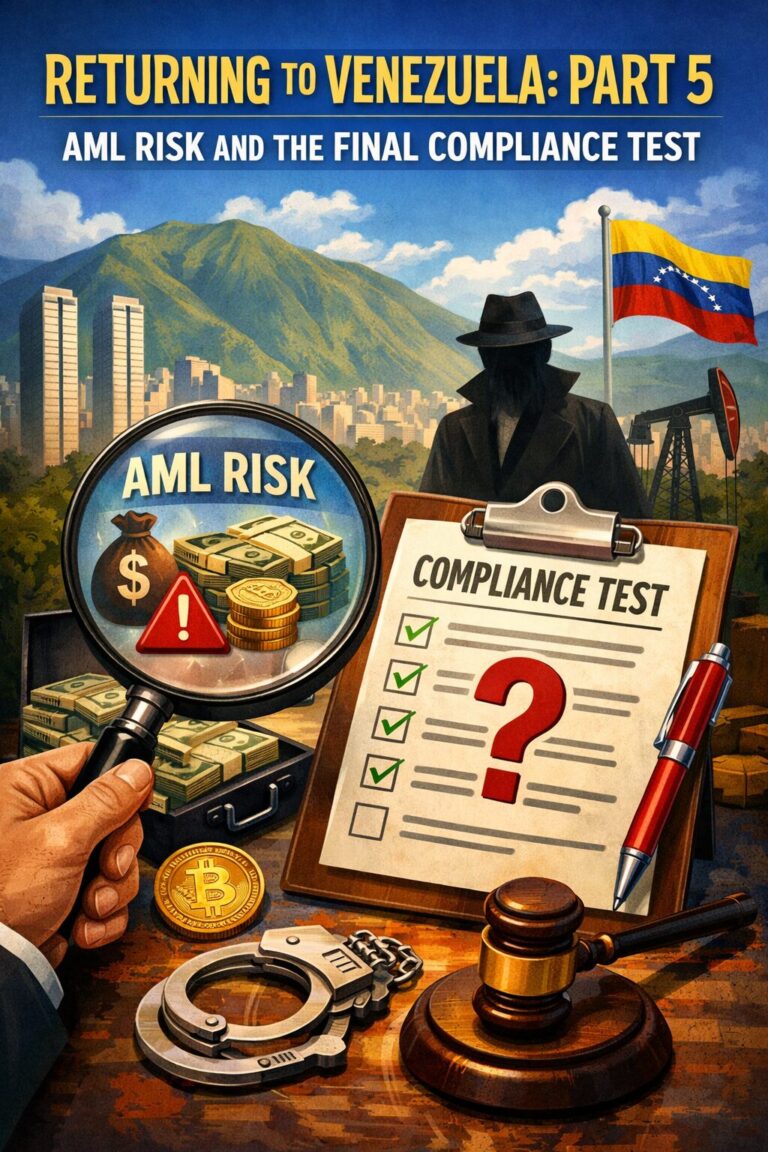
In this five-part series, I have walked through the core compliance risks US energy companies will face as they consider a return to Venezuela. We began with bribery and corruption and the long shadow of PdVSA (Parts 1 & 2). We moved through export controls (Part 3), security risks (Part 4), and the broader operational and strategic challenges of working in one of the most complex risk environments in the world. But this final post is different. Money laundering risk is not simply another risk category. It is the connective tissue that binds all the others together.
If bribery is how improper value enters the system, money laundering is how it is disguised, moved, and legitimized. If export control violations create pressure to reroute goods or payments, money laundering techniques make that rerouting possible. If security risks require local intermediaries, cash payments, or opaque vendors, those same decisions create AML exposure. For the compliance professional, money laundering risk in Venezuela is the capstone test of whether the program actually works.
The Regulatory Frame: FinCEN, ECCP, and Correspondent Banking Reality
Any AML discussion must start with expectations. US regulators have been explicit. The AML program pillars articulated by the Financial Crimes Enforcement Network (FinCEN) are not optional abstractions. They are operational requirements: risk-based controls, internal policies, independent testing, training, and designated responsibility.
Overlay that with the Department of Justice Evaluation of Corporate Compliance Programs (ECCP), which asks whether controls are designed, implemented, tested, and actually effective. Then add the reality of correspondent banking risk. Even if a US energy company does not directly move funds through US banks, its banking partners will apply US standards. Banks do not absorb Venezuela’s risk on behalf of their customers. They de-risk. Compliance failures upstream become frozen accounts downstream. This is why AML must be treated as an enterprise risk, not a compliance side project.
Operating Under Licenses Does Not Reduce AML Risk
This blog assumes that operations occur under general licenses, specific licenses, or wind-down authorizations issued by the Office of Foreign Assets Control. That matters for sanctions analysis, but it does not reduce AML exposure. Licenses permit activity. They do not cleanse counterparties, validate payment flows, or excuse weak controls. In fact, licensed activity often attracts heightened scrutiny because regulators know companies will push forward aggressively once permission is granted.
In Venezuela, licensed operations still involve high-risk state actors, politically exposed persons, weak financial institutions, and a long history of financial opacity. From an AML perspective, licenses are a starting gun, not a shield.
PdVSA as a Multi-Vector AML Risk
As we have previously noted, PdVSA must be treated not as a single counterparty risk but as multiple overlapping AML risk vectors. First, there is trade-based money laundering. Oil shipments are uniquely vulnerable to pricing manipulation, volume misstatements, phantom cargoes, and circular trading. In Venezuela, these risks are amplified by distressed infrastructure, a history of sanctions, and reliance on intermediaries.
Second, there is an intermediary risk. Shipping companies, charterers, port agents, and customs facilitators often operate through layered ownership structures. The farther one moves from the wellhead, the less transparency exists. Third, there is a risk to the payment structure. Delayed payments, in-kind arrangements, and third-country settlement accounts create fertile ground for laundering illicit proceeds. When oil becomes currency, AML controls must follow the barrel, not the invoice.
Venezuelan, Crypto, and Third-Country Banking Risk
Venezuelan banks operate under severe constraints. Many lack robust AML systems, and even well-intentioned institutions face talent shortages and technology gaps. As a result, payments often move through third-country banks. These arrangements create several red flags: unusual routing, non-USD transactions, inconsistent settlement timelines, and opaque beneficiary information. Each red flag increases the likelihood of SAR filings and banking friction. Compliance professionals must understand that correspondent banks apply their own risk lens. If they are uncomfortable, they will exit. That operational disruption becomes a compliance failure.
Crypto and alternative payment mechanisms are not edge cases in Venezuela. They are practical responses to currency instability, banking limitations, and sanctions pressure. From an AML standpoint, crypto introduces wallet anonymity, cross-border velocity, and limited recourse once funds move. Any use of crypto, whether by the company or its third parties, must be explicitly prohibited or tightly controlled. Silence is not neutrality. Silence is exposure.
Third Parties: Where AML, Bribery, and Security Collide
Local agents, logistics providers, customs brokers, and security vendors represent the highest combined risk in Venezuela. These third parties often operate in cash-intensive environments, maintain close ties to government actors, and perform functions critical to business continuity. Family-owned and politically connected vendors demand enhanced due diligence. That means beneficial ownership verification, source-of-funds analysis, ongoing monitoring, and contractual audit rights. Initial diligence alone is insufficient. Relationships evolve, and risk escalates quickly.
This is where the bribery blog, the security blog, and this AML blog converge. The same third party that creates bribery risk also creates money laundering risk. Controls must be integrated, not siloed.
The Operational Reality: This Is Manageable If You Manage It
Despite these risks, this is not a counsel of despair. US companies have operated in high-risk jurisdictions before. The key is realism. AML programs in Venezuela cannot rely on annual certifications, static risk assessments, or generic policies. They require transaction-level visibility, real-time escalation, and empowered compliance personnel. Friction with the business is inevitable and necessary.
Venezuela-Specific AML Operational Checklist
Below is a practical, compliance-focused checklist for operating in Venezuela:
Risk Assessment
- Conduct a Venezuela-specific AML risk assessment tied to operations, not geography alone
- Map payment flows end-to-end, including third-country routing
- Identify trade-based money laundering scenarios tied to oil shipments
Policies and Controls
- Prohibit unauthorized crypto usage explicitly
- Require documented economic justification for all intermediaries
- Establish clear escalation thresholds for delayed or rerouted payments
Third-Party Due Diligence
- Perform enhanced due diligence on all local agents, logistics providers, customs brokers, and security vendors
- Verify beneficial ownership and political exposure
- Assess the source of funds and expected transaction behavior
Transaction Monitoring
- Monitor oil pricing, volumes, and delivery discrepancies
- Flag unusual settlement patterns or changes in banking instructions
- Integrate AML alerts with sanctions and export control monitoring
Training and Culture
- Provide targeted AML training for operations, finance, and procurement teams
- Reinforce speak-up mechanisms tied to payment and logistics concerns
Testing and Auditing
- Conduct targeted audits focused on high-risk transactions
- Test controls against realistic laundering typologies
- Document remediation and program enhancements
AML as the Series Capstone
This series has shown that returning to Venezuela is not a single compliance decision. It is a systems test. Money laundering risk sits at the center of that test because it exposes weaknesses everywhere else. If your AML program can function effectively in Venezuela, it can function anywhere. If it cannot, no license, policy, or assurance letter will save it. This is doable. But only if compliance is brought in early, appropriately resourced, and empowered to say yes, if.