


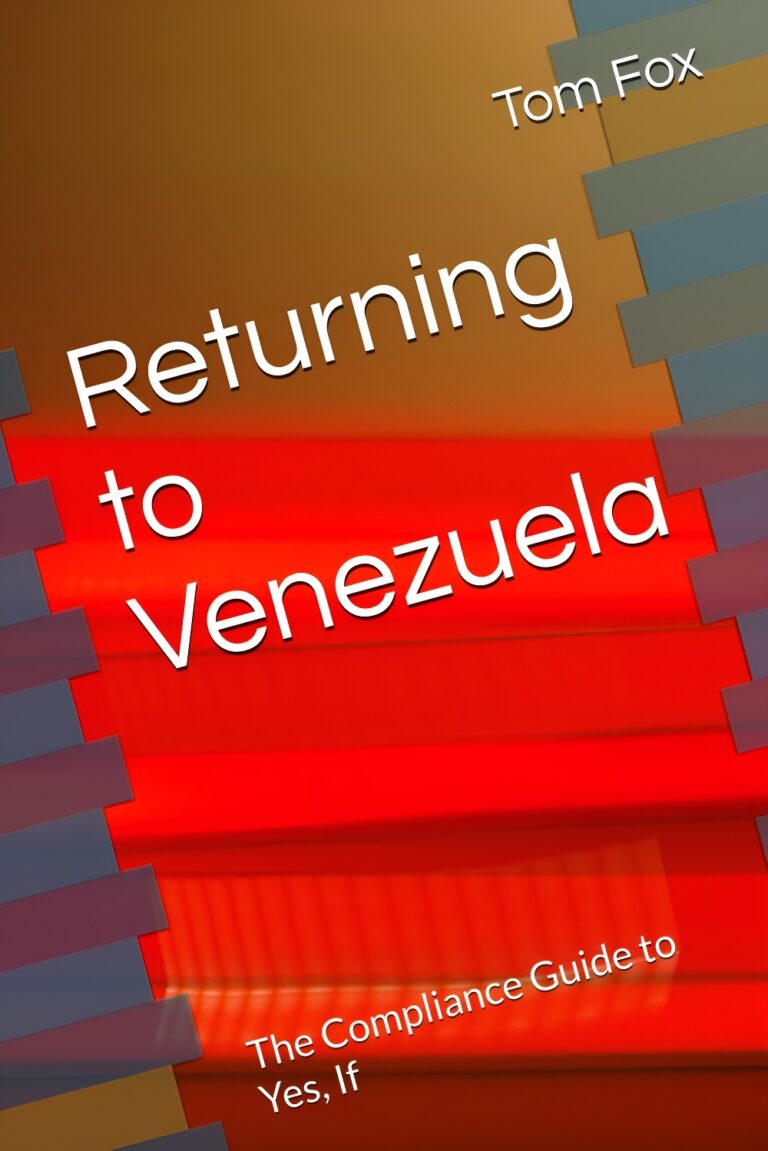
Most of you readers know that sometimes when I get going on a project, it (the project, not me) just keeps on growing. What started as a podcast with Matt Ellis on the risks of going back into Venezuela expanded out into a series of podcasts on the FCPA Compliance Report and with Mike DeBernardis on All Things Investigations. The podcasts led to a five-part blog post series on the same topic in the FCPA Compliance and Ethics Blog. I then needed to expand the blogs into a book and provide forms, checklists, frameworks, and deployment packs for compliance professionals to help them think through the issues presented in Venezuela and in other similarly high-risk jurisdictions.
All of that has led to the only book on how to return to Venezuela, Returning to Venezuela: The Compliance Guide to Yes, If (Title inspired by Mike DeBernardis). It is available in both print and eBook versions on Amazon.com.
When companies talk about returning to Venezuela, the conversation almost always begins with opportunity. Oil reserves. Market access. First-mover advantage. What the book Returning to Venezuela does is effectively reset that conversation where it belongs for compliance professionals: with reality. It is a disciplined, compliance-first analysis of what it actually means to operate in one of the world’s highest-risk jurisdictions.
The core message is uncompromising but straightforward: Venezuela is not a place for optimism, informal controls, or siloed compliance. It is a stress test. If your compliance program can function there, it can function anywhere. If it cannot, no license, policy, or assurance letter will save you. The book is not a warning label about Venezuela. It is a working manual for how a compliance function should assess risk, design controls, and govern decision-making before commercial momentum takes over.
Step One: Reframing the Risk Assessment
The first way a compliance professional should use Returning to Venezuela is to recalibrate how risk assessments are performed. Traditional country risk assessments often ask abstract questions: corruption perception scores, sanctions status, and enforcement history. Those inputs are necessary, but insufficient. Returning to Venezuela pushes compliance professionals to replace abstract scoring with operational mapping.
Instead of asking whether Venezuela is high risk, the framework asks:
- Where will government discretion arise?
- Where can delay be monetized?
- Where does the business depend on intermediaries?
- Where does value move, pause, or change form?
This is a critical shift. Risk is no longer treated as a country attribute. It becomes a process attribute. Compliance professionals can use Returning to Venezuela’s structure to redesign their risk assessment around real business steps: procurement, logistics, payment, security, licensing, and dispute resolution.
Step Two: Identifying Pressure Points Before They Become Incidents
Returning to Venezuela is especially useful in helping compliance professionals identify pressure points, not just risk categories. Pressure points are moments where the business is most likely to face demands for improper value, shortcuts, or exceptions. Procurement is one. Customs clearance is another. Security access, utilities, labor approvals, and payment routing are others.
Using Returning to Venezuela, compliance professionals can document:
- Where pressure is expected;
- Who owns the decision at that point?
- What escalation looks like; and
- When refusal or exit becomes mandatory.
This transforms compliance from a reactive role into a proactive role in designing decision architecture.
Step Three: Using the Checklists as Control Gates, Not Paper Artifacts
A common compliance failure is treating red flags as documentation exercises rather than control mechanisms. One of the strengths of Returning to Venezuela is that its red flags are designed as gates, not records. Each checklist answers a single question: Is this activity governable under our current assumptions?
Compliance professionals can deploy these checklists at defined moments:
- Market entry discussions
- Vendor and JV selection
- Transaction structuring
- Payment and banking design
- Security and logistics planning
If a red flag cannot be cleared, the activity cannot proceed. That discipline is what makes the framework defensible. It also protects compliance officers personally, because decisions are anchored in documented governance rather than informal judgment.
Step Four: Integrating Risk Domains Instead of Managing Them in Silos
Another way compliance professionals should use Returning to Venezuela is as a blueprint for breaking down internal silos. The book makes clear that in Venezuela, corruption, export controls, AML, sanctions, security, and extortion are not separate risks. They are interconnected expressions of the same operating pressure. Treating them separately guarantees blind spots.
Practically, this means compliance can use the book to justify:
- Integrated risk reviews instead of sequential sign-offs;
- Shared escalation forums across functions;
- Unified monitoring rather than separate dashboards; and
- Common exit triggers across risk domains.
This is particularly important for AML. Returning to Venezuela positions money laundering risk not as a standalone compliance obligation, but as the capstone test of whether the entire framework works.
Step Five: Structuring Board Oversight Around Decisions, Not Updates
Too often, boards receive high-level compliance updates that provide comfort but not clarity. Returning to Venezuela gives compliance professionals a way to reframe board oversight around decisions, not reports. Using the board materials and decision templates, compliance can:
- Force explicit risk acceptance;
- Document assumptions that underpin approvals;
- Secure delegated authority to pause or exit operations; and
- Establish clear revisit and escalation triggers.
This protects both the organization and the compliance function. When conditions change, the discussion is no longer “Why did this happen? ” but “Which assumption failed, and what decision does that trigger? ” That is governance functioning as intended.
Step Six: Building a Repeatable Risk Management Framework
The final and most important way to use Returning to Venezuela is as a template, not a one-off Venezuela playbook. While the facts are Venezuela-specific, the framework is portable. Compliance professionals can lift this framework and apply it to:
- Other high-risk markets;
- Post-merger integration;
- Sanctions-heavy environments; and
- Complex third-party ecosystems.
The Appendices: The Operational Backbone of Returning to Venezuela: Yes, If
One of the defining features of Returning to Venezuela: The Compliance Guide to Yes, If is that it does not stop at analysis. The appendices convert risk identification into governance, decision-making, and operational control. They are not academic supplements. They are the machinery that makes a “yes, if” decision possible in practice.
Taken together, the appendices form an integrated compliance control stack designed for one purpose: to govern decision-making in an environment where corruption, coercion, sanctions, AML exposure, and weak rule of law are not edge cases but daily conditions.
Appendix A: One-Page Operational Checklists
Appendix A contains a series of one-page checklists, each focused on a distinct but interconnected risk domain. These are not policy summaries. They are operational gating tools meant to be used before decisions are made, not after problems occur.
Appendix B: The CCO Deployment Pack
Appendix B is written from the perspective of the Chief Compliance Officer and is explicitly operational. It is designed to be deployed internally to executive leadership, business sponsors, and control functions.
Appendix C: Board of Directors Materials
Appendix C is aimed squarely at directors and audit or compliance committees. Its function is not to educate boards on Venezuela generally but to structure how boards make, record, and revisit risk acceptance decisions.
Appendix D: Decision-Making Frameworks
Appendix D pulls together the logic underlying the entire book. It provides decision-making frameworks that force organizations to confront uncomfortable realities before committing resources.
How the Appendices Work Together
Individually, each appendix addresses a specific audience or function. Collectively, they form an integrated control system that aligns:
- Operational decision-making.
- Compliance authority.
- Board oversight.
- Exit discipline.
The appendices are designed to prevent the most common failure pattern in high-risk jurisdictions: waiting until conditions deteriorate before asking hard questions. By then, leverage is gone.
Final Thought
The most important contribution of Returning to Venezuela is that it does not accurately describe risk. It shows compliance professionals how to operate in the real world without surrendering control.
Used correctly, the book becomes a working tool:
- To assess risk honestly;
- To design controls that hold under pressure;
- To align management and the board, and finally
- To decide when “yes” becomes “no.”
For compliance professionals, that is not just risk management. It is about meeting the business in an operational setting with a risk management strategy for literally the highest risk on earth.
You can purchase Returning to Venezuela: The Compliance Guide to Yes, if on Amazon.com.