


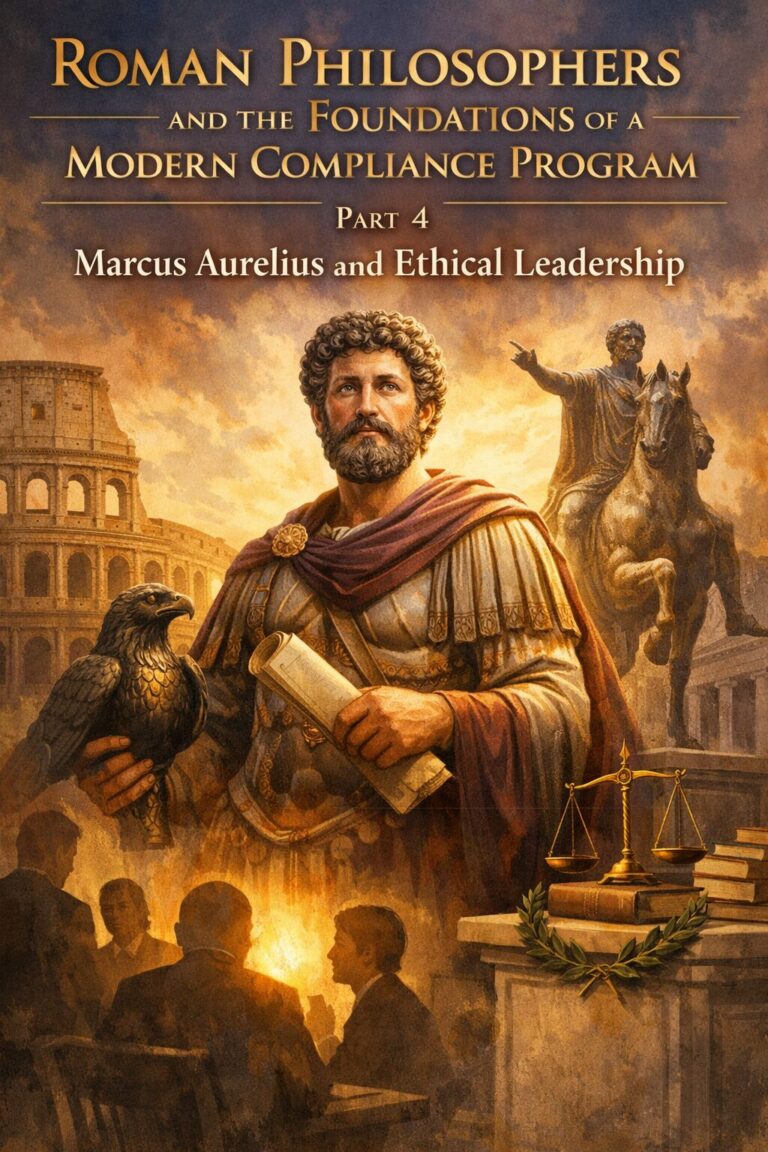
I recently wrote a series on the direct link between ancient Greek Philosophers and modern corporate compliance programs and compliance professionals. It was so much fun and so well-received that I decided to follow up with a similar series on notable Roman Philosophers. This week, we will continue our exploration of the philosophical underpinnings of modern corporate compliance programs and compliance professionals by looking at five philosophers from Rome, both from the BCE and AD eras.
We have considered Cicero and the duties, law, and moral limits of business; Seneca on power, pressure, and ethical decision-making under stress; and Varro on corporate governance. Today, we consider Marcus Aurelius and ethical leadership and tone at the top. Tomorrow, we will conclude with Lucretius to explore rationality, fear, and risk perception. Today, we continue with Marcus Aurelius, Ethical Leadership, and Culture as a Compliance Control
I. Marcus Aurelius in Context: Power with Restraint
Imagine you are the single most powerful person on earth. Are you going to be an unrepentant narcissist in the manner of Donald Trump, who believes he should govern on his own twisted morality based simply on ‘gut instinct’? Or are you going to take a different approach, set out your reasoned approach to governing in a book, and then govern with the moral authority of thousands of years of philosophy?
Marcus Aurelius is often remembered as the philosopher-king, but that description understates the difficulty of his position. He ruled the Roman Empire during a period of war, plague, economic strain, and political instability. Unlike many philosophers, Marcus Aurelius did not write for an audience. His Meditations were private reflections, written to discipline his own thinking while exercising absolute power.
This matters for compliance professionals. Marcus Aurelius did not theorize about ethical leadership from a distance. He lived inside it. He understood that power magnifies temptation, insulates leaders from feedback, and creates opportunities for self-deception. His philosophy is therefore preoccupied with restraint, humility, consistency, and responsibility.
Marcus repeatedly reminded himself that leadership is not a privilege but a burden. Authority did not entitle him to indulgence; it imposed higher expectations. He believed that leaders set moral boundaries through conduct long before they issue instructions. In modern terms, Marcus Aurelius understood that culture flows downward from leadership behavior rather than upward from policy documents.
II. The Compliance Problem Marcus Aurelius Illuminates: Culture Eats Controls
One of the central lessons of modern compliance enforcement is that formal controls cannot compensate for poor culture. Organizations with detailed policies and sophisticated monitoring still fail when leadership behavior signals that results matter more than integrity. The DOJ Evaluation of Corporate Compliance Programs (ECCP) explicitly asks whether senior leaders demonstrate commitment to compliance through actions, not words. Regulators assess whether ethical behavior is encouraged, whether misconduct is addressed consistently, and whether leaders tolerate or reward problematic conduct.
Marcus Aurelius would recognize this dynamic immediately. He believed that people learn how to behave by observing those in power. When leaders act inconsistently with stated values, cynicism follows. When leaders rationalize misconduct, that rationalization spreads. Compliance programs often falter when leadership treats ethics as a communication exercise rather than a lived expectation. Codes of conduct and training sessions cannot overcome the daily signals sent by executive decisions, incentive structures, and responses to failure.
Marcus teaches that culture is not accidental. It is created continuously by leadership choices, especially under pressure.
III. Modern Corporate Application: Marcus Aurelius, DOJ Expectations, and Leadership Accountability
Applying Marcus Aurelius to modern compliance reveals several concrete expectations that closely align with DOJ guidance.
First, leadership behavior must be consistent. Marcus believed hypocrisy was corrosive to authority. The DOJ similarly evaluates whether leaders follow the same rules they impose on others. Exceptions for senior executives undermine program credibility and weaken deterrence.
Second, leadership must respond to misconduct with moral clarity. Marcus wrote that anger and denial cloud judgment. In compliance terms, this means addressing issues promptly, transparently, and proportionately. Delayed or defensive responses signal tolerance, even when discipline eventually occurs.
Third, middle management matters. Marcus understood that culture is transmitted through layers of authority. DOJ guidance emphasizes the role of middle managers as culture carriers. Compliance programs should equip managers with the tools and incentives to reinforce ethical behavior, not merely deliver targets.
Fourth, incentives must reflect values. Marcus warned against leaders who chase reputation or reward at the expense of principle. Modern compliance programs must ensure compensation structures do not reward outcomes achieved through questionable means. The DOJ has repeatedly cited incentive misalignment as a root cause of misconduct.
Finally, leadership must create psychological safety. Marcus believed leaders should listen more than they speak. In compliance terms, this translates into openness to bad news, encouragement of dissent, and protection for those who raise concerns. A culture that punishes truth-telling cannot sustain compliance.
IV. Key Takeaways for Compliance Professionals
1. The Blueprint. Compliance professionals should view Marcus Aurelius and his writings as the blueprint for culture-based compliance. You can draw a direct line from the Meditations to both your compliance program and the leadership skills a CCO needs. Compliance should evaluate leadership behavior as a primary control, not a soft factor. This means not only reviewing employees who are promoted to management, but also a deep dive into their backgrounds. Also, thorough due diligence for any senior management hires from outside your organization.
2. Higher Standards. Compliance should hold senior leaders to higher standards of consistency and accountability.
3. Institutional Justice. Compliance should focus on how leaders respond to misconduct, not just how they prevent it. This is the CCO’s charge, and it must include an institutional fairness component in your compliance program.
- Compliance should ensure incentives reinforce ethical behavior at every level. The DOJ has consistently discussed the role of incentives in any compliance program, as far back as the 1st edition of the FCPA Guidance in 2012.
- Compliance should treat culture as an operational risk area subject to oversight and testing. Culture should be assessed, monitored, and improved. Simply because it is seen as a ‘soft’ part of an organization does not mean it should be treated differently.
4. Walk the Walk. Finally, Marcus Aurelius reminds us that ethical leadership is not performative. It is visible, daily, and decisive. In organizations, culture follows leadership long before it follows policy.
V. Conclusion
Marcus Aurelius brings the compliance lifecycle to its cultural apex. He shows that leadership behavior is not merely influential but determinative, shaping whether ethical expectations are taken seriously or quietly dismissed. Yet even the strongest ethical culture is not self-sustaining. Leaders are human, memory fades, and good intentions erode without reinforcement. This is where culture must be supported by systems that observe, test, and correct.
Marcus Aurelius teaches us how leaders should behave; Lucretius challenges us to examine how organizations think. If Marcus focuses on moral example, Lucretius turns our attention to rational observation, warning against fear, superstition, and self-deception. The transition from Marcus Aurelius to Lucretius mirrors the shift from cultural leadership to continuous improvement, from ethical intent to empirical verification. In compliance terms, it is the move from assuming the program works to proving that it does, using data, monitoring, and clear-eyed analysis rather than hope or habit.
Join us tomorrow for our concluding article on Lucretius and Rationality in Monitoring and Continuous Improvement. We will consider where culture gives way to systems, data, and the discipline of seeing risk clearly rather than through fear or superstition.