


I have explored the work of ancient Greek and Roman philosophers to understand the underpinnings of the modern corporate compliance program. This week, I want to move to Enlightenment Thinkers. Our category is broader than that of philosophers, as many of these men excelled in numerous fields, including science, mathematics, calculus, and medicine. However, each contributed a key component that relates directly to our modern compliance regimes.
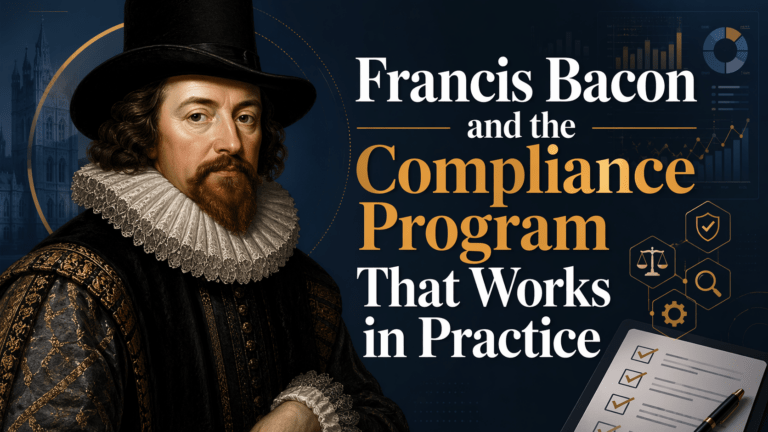
The five we will explore are Francis Bacon, René Descartes, John Locke, Thomas Hobbes, and Issac Newton. Today, we begin with Francis Bacon and the design of a compliance program that works not simply in theory but in practice.
There is a reason Francis Bacon is the right place to begin a series on what Enlightenment thinkers can teach us about modern corporate compliance. Bacon did not simply advance a philosophical idea. He changed the way serious people were supposed to think. He pushed inquiry away from inherited assumptions and abstract theorizing and toward observation, testing, evidence, and disciplined learning from experience. In many ways, that is the same journey corporate compliance has had to take.
For too long, compliance programs were judged by what they had on paper. Did the company have a code of conduct? Did it conduct annual training? Did it maintain a hotline? Did it have policies and procedures? Those questions still matter, of course, but they are no longer enough. The Department of Justice has made that point repeatedly through its Evaluation of Corporate Compliance Programs. The DOJ does not simply ask whether a company has a program. It asks whether the program is well designed, whether it is being applied earnestly and in good faith, and whether it works in practice. That final phrase could have been written by Bacon himself.
Why Bacon Matters to Compliance
Francis Bacon is most closely associated with empiricism, the idea that knowledge should be grounded in observation and experience rather than assumption or pure deduction. He believed that if you want to understand the world, you do not begin with what you hope is true. You begin with facts. You gather information. You test propositions. You challenge your own biases. Then you refine your conclusions based on the evidence. That mindset is at the heart of every effective compliance program.
A Chief Compliance Officer cannot assume that a policy is effective because it was well-drafted. A board cannot assume that a training program changes behavior because employees clicked through an online module. A legal department cannot assume that third-party due diligence is functioning because questionnaires are being completed. In each case, the real question is Baconian: what evidence do you have that the control is working as intended?
This is where philosophy becomes practice. Bacon gives compliance professionals a method. He reminds us that the difference between performative compliance and effective compliance is proof.
The DOJ Standard Is a Baconian Standard
The modern DOJ approach is deeply consistent with Bacon’s philosophy. The ECCP has moved the compliance conversation away from formalism and toward effectiveness. Prosecutors are instructed to consider whether a company has access to relevant data, whether it uses that data to monitor performance, whether it investigates red flags, whether it adapts the program based on lessons learned, and whether it performs root-cause analysis after misconduct occurs. That is not a paper exercise. That is evidence-based governance.
The DOJ is effectively saying that compliance must be a living system of observation, testing, response, and continuous improvement. In Bacon’s world, knowledge advances by disciplined interaction with reality. In the DOJ’s world, compliance credibility advances the same way. A company earns trust not because it announces a program, but because it can demonstrate through data, testing, and response that the program actually functions.
From Risk Assessment to Real Measurement
A Bacon-inspired compliance program begins with risk assessment, but it does not end there. Too many organizations treat the risk assessment as an annual exercise that produces a polished heat map and then disappears into a slide deck. Bacon would reject that approach. A risk assessment should be a working hypothesis about where misconduct and control failure are most likely to occur. That hypothesis must then be tested through monitoring, internal reporting, auditing, and data review.
Consider a company that identifies third-party risk as a top concern. A paper-based approach might stop with enhanced due diligence procedures and contract clauses. A Baconian approach goes further. It asks whether third parties are actually being onboarded according to policy, whether approvals are properly documented, whether high-risk distributors are subject to enhanced monitoring, whether payments match contractual terms, whether red flags are closed or merely noted, and whether the company can identify trends across geographies, business units, or product lines. That is where compliance becomes operational.
Monitoring Is How a Program Proves Itself
One of the clearest lessons Bacon offers is that observation must be ongoing. In compliance terms, that means monitoring is not an optional add-on. It is how the program proves itself. COSO has long emphasized monitoring as a core element of an effective internal control framework. The same logic applies to compliance more broadly. Monitoring tells a company whether its controls are operating consistently, whether local business practices are drifting from policy expectations, and whether emerging risks are being detected early enough to matter.
Hotline data is a good example. Many organizations report the number of calls received, but that is only the beginning. A Baconian compliance officer looks beneath the surface. Are certain allegations rising in a specific region? Are retaliation claims increasing after a business reorganization? Are reports being substantiated at a lower rate because employees do not understand what should be reported? Are investigation closure times lengthening in a way that undermines confidence in the process? Those are not just operational questions. There are questions about whether the compliance system is learning.
Root Cause Analysis Is Bacon in Action
If there is one area where Bacon’s influence should be explicit, it is root cause analysis. When misconduct happens, the least useful response is to identify the wrongdoer, discipline the individual, and move on. That may satisfy a desire for closure, but it does not satisfy the demands of an effective compliance program.
Bacon would ask a different set of questions. What conditions allowed this to happen? What signals were missed? Were incentives misaligned? Was a manager pressuring a sales team in ways that made policy noncompliance more likely? Did the control exist on paper but fail in operation? Was a prior warning sign identified but not escalated?
Those questions matter because substantive compliance violations are never random. It is often the product of pressure, weak controls, poor communication, bad assumptions, or failures to learn from earlier warning signs. Root cause analysis is the process by which a company examines the conditions that led to a failure and turns that failure into institutional knowledge.
Culture Needs Evidence Too
Compliance professionals often speak about culture, and they should. But here, too, Bacon has a warning for us. Culture cannot be measured only by slogans or tone-at-the-top statements. A company that wants to claim a strong ethical culture should be able to point to supporting evidence.
Do employees raise concerns without fear of retaliation? Are managers evaluated in part on ethical leadership? Do exit interviews reveal pressure points that formal reporting channels miss? Are discipline outcomes consistent across levels of seniority? Does the organization respond to bad news constructively or defensively? These are empirical questions. They require information, not aspiration.
This is where compliance, internal audit, legal, and HR can work together in a mature governance model. Surveys, hotline trends, investigation data, audit findings, and employee feedback all become part of the evidence base. Culture, in this framework, is not soft. It is observable. It can be tested, assessed, and strengthened.
The Compliance Officer as Institutional Scientist
Perhaps Bacon’s greatest gift to the compliance profession is this: he offers a model for what the compliance officer should be. Not merely a policy custodian. Not merely a trainer. Not merely an investigator. The modern compliance leader is, in part, an institutional scientist.
That phrase may sound grand, but it captures something important. The CCO studies how the organization really works. Which incentives shape conduct? Which controls hold under pressure? Where are the blind spots? What do the data show? What must change? In that sense, the compliance function is not external to the business. It is one of the primary ways the business learns about itself.
That is why evidence matters so much. It is the basis for credibility with the board, with regulators, and with employees. It is how a program shows that it is more than a collection of good intentions. Francis Bacon would have understood that immediately.
Five Lessons Learned for the Modern Compliance Professional
First, a compliance program must be judged by evidence, not by appearance. Policies and training matter, but proof of effectiveness matters more.
Second, risk assessments should be treated as working hypotheses that must be tested through monitoring, auditing, and ongoing review.
Third, data is central to the credibility of compliance. Hotline trends, investigation outcomes, audit findings, and control testing demonstrate that a company’s program works in practice.
Fourth, root cause analysis is essential. Misconduct should trigger institutional learning, not merely individual discipline.
Fifth, culture itself must be supported by evidence. Speak-up, non-retaliation, consistency in discipline, and employee trust are all observable markers of program health.
Coming Next: René Descartes and the Discipline of Internal Investigation
If Francis Bacon teaches us how to gather evidence, René Descartes teaches us what to do with it. In Part 2, I will examine how Descartes’ method of disciplined doubt provides a blueprint for internal investigations, allegation triage, and rigorous compliance inquiry. In a world of management narratives, incomplete facts, and pressure to reach quick conclusions, Descartes reminds us that the compliance professional’s first duty is not comfort. It is clear thinking.