


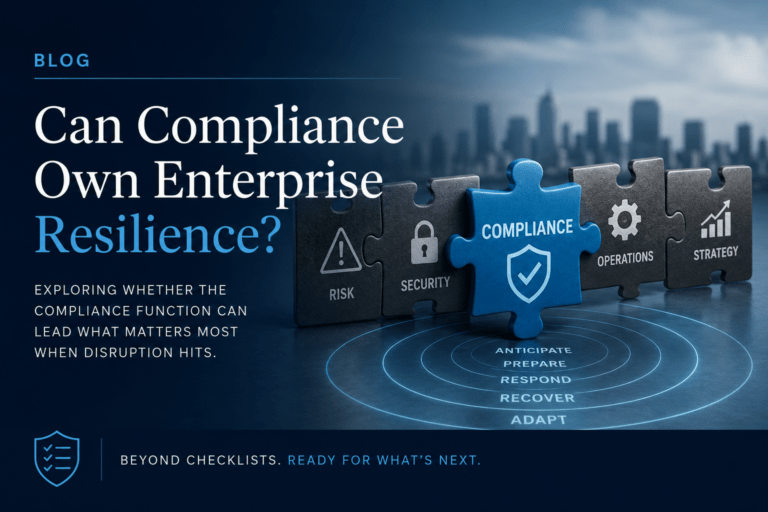
It has been some time since I checked in with the Harvard Business Review for some blog posts. To remedy this deficiency, I will write this week’s blog posts based on recent HBR articles that caught my interest. Today, we begin with The Case for Hiring a Chief Resilience Officer, which argues that there is a major governance gap inside most organizations. It is that no single executive is accountable for coordinating enterprise-wide resilience and recovery when failures cascade across functions. The article looks at a chief resilience officer (CResO) role which would be responsible for aligning continuity planning, recovery objectives, crisis response, and organizational learning across an enterprise.
The authors begin by noting that the July 2024 CrowdStrike outage will be remembered as more than a technology failure. It was a governance lesson. A routine software update caused cascading operational disruption across airlines, hospitals, logistics systems, and other critical services. The technical root cause mattered, but it was not the only lesson. The larger issue was how quickly a single failure could ripple across functions, third parties, customer obligations, regulatory expectations, and business operations. The article articulated this as the case for a CResO, because many organizations have no single executive accountable for coordinating enterprise-wide resilience and recovery when disruption crosses organizational boundaries.
For the corporate compliance function, that argument should sound familiar. Compliance professionals have spent years explaining that risk does not respect departmental boundaries. Bribery risk can arise from sales incentives, third-party relationships, financial controls, gifts and hospitality, and management pressure. Data risk can sit in technology, privacy, procurement, HR, and customer operations. AI risk can sit in product development, vendor management, legal, cybersecurity, records retention, and board oversight.
Operational resilience is the same kind of problem. It is not only an IT issue. It is not only a business continuity issue. It is not only a risk management issue. It is a governance issue, a controls issue, a documentation issue, a third-party issue, and a board oversight issue. That makes it a compliance issue as well.
The Compliance Significance of Resilience
The central insight behind the CResO role is that most organizations already have pieces of resilience, but they do not always have resilience governance. Risk teams assess exposure. Cybersecurity teams protect systems. Operations teams manage delivery. Business continuity teams write plans and run exercises. Procurement manages vendors. Legal evaluates obligations. Communications handles stakeholders. Compliance monitors controls, policies, reporting, and escalation. Each function may be doing its job. The problem appears when no one owns the integrated answer.
That is why operational resilience has become a regulatory and governance priority. The Basel Committee defines operational resilience as the ability to deliver critical operations through disruption and emphasizes governance, mapping interdependencies, third-party dependency management, business continuity testing, and incident management. The FCA in the UK similarly focuses on important business services, impact tolerances, mapping, testing, vulnerability remediation, lessons learned, and communications planning. In the EU, the Digital Operational Resilience Act (DORA) has elevated digital operational resilience, technology and information third-party risk, incident reporting, and resilience testing into a formal financial sector regulatory framework.
For compliance professionals, the message is clear. Resilience is moving from planning to evidence. Regulators, boards, and senior management will increasingly ask not simply whether the company had a plan, but whether the company knew its critical services, mapped its dependencies, tested severe but plausible scenarios, documented vulnerabilities, assigned accountability, and remediated weaknesses.
That is familiar territory for compliance. The DOJ Evaluation of Corporate Compliance Programs (ECCP) asks whether a compliance program is well designed, adequately resourced and empowered, and works in practice. It also asks whether improvements to compliance and internal controls have been tested to show they would prevent or detect similar misconduct in the future. Those questions are not limited to bribery, fraud, or sanctions. They reflect a broader governance discipline: design, authority, resources, testing, remediation, and proof.
Can Compliance Absorb the CResO Role?
The answer is yes, but only under the right conditions. A compliance function can absorb the resilience governance role if it has the mandate, authority, resources, data access, and board visibility to do the job. It cannot absorb the role if the organization merely adds resilience to the CCO’s already crowded list of responsibilities without giving compliance the ability to coordinate across technology, operations, procurement, cybersecurity, finance, legal, human resources, communications, and business leadership. This distinction matters.
Compliance can own the governance framework for resilience. It can help define standards, require documentation, monitor remediation, test controls, escalate gaps, and report to the board. It can ensure that resilience obligations are embedded into policies, third-party oversight, incident response, investigations, root cause analysis, training, and internal controls.
Compliance should not become the operator of every resilience process. The first line must still own business services. Technology must still own systems. Cybersecurity must still own cyber defense. Procurement must still own vendor contracting and supplier performance. Operations must still own delivery. Legal must still advise on obligations. Communications must still manage stakeholder messaging. The CCO can serve as the enterprise resilience governance leader, but not as a substitute for operational ownership. That is the practical dividing line.
When Compliance Is the Right Home
Compliance is a strong candidate to absorb the CResO function when resilience is framed as an enterprise governance and controls discipline. This is especially true in organizations where the compliance function already has mature capabilities in risk assessment, policy governance, third-party risk management, investigations, remediation tracking, board reporting, training, monitoring, and documentation. In that model, compliance can bring several advantages.
First, compliance understands cross-functional risk. A well-designed compliance program already reaches into the business, finance, procurement, HR, legal, internal audit, IT, and senior leadership. That horizontal view is essential for resilience.
Second, compliance understands evidence. Resilience cannot be built on verbal assurance. It requires inventories, dependency maps, testing records, incident reports, remediation plans, escalation logs, board materials, and lessons learned. Compliance professionals know how to create a record that demonstrates program effectiveness.
Third, compliance understands accountability. A resilience program without accountable owners will become a collection of meetings. Compliance can help define who owns each critical service, each dependency, each recovery objective, and who must act when testing identifies a vulnerability.
Fourth, compliance understands third-party risk. Many resilience failures begin outside the company’s walls. A critical software provider, cloud provider, logistics partner, manufacturer, payroll vendor, or data processor can disrupt the company’s ability to deliver. Compliance can help connect due diligence, contracting, ongoing monitoring, audit rights, incident notification, and exit planning into a resilience framework.
Finally, compliance understands board reporting. Resilience is a board-level issue because disruption can affect customers, investors, regulators, employees, and the company’s license to operate. The FCA has emphasized that boards need enough information to understand the firm’s resilience approach, who is responsible for it, and the organization’s ability to recover important business services within impact tolerances. Those are governance questions. Compliance is built to translate them into a management system.
When Compliance Should Not Absorb the Role
Compliance should not assume the CResO role if the function lacks operational authority, technical depth, crisis-management access, or senior-level support. A CCO who is asked to “own resilience” without the resources to do so has not been empowered. That CCO has been handed accountability without control. There are several warning signs.
If compliance does not have direct access to the CEO, executive committee, and board, it cannot coordinate enterprise resilience. If compliance cannot require action from technology, operations, procurement, and business units, it cannot close resilience gaps. If compliance lacks data on critical services, vendor concentration, system dependencies, recovery times, incident history, and testing results, it cannot evaluate resilience in practice. If compliance is already under-resourced, resilience will become another paper responsibility.
That would be a mistake. The worst outcome would be to move resilience into compliance as a label while leaving the real decision-making elsewhere. That creates the appearance of governance without its substance.
A Better Model: Compliance as Resilience Governor
For many companies, the right answer is not a binary choice between a standalone CResO and a compliance-owned resilience function. The better model may be compliance as a resilience governor. Under this approach, the company appoints a senior resilience owner, either as a CResO (chief risk and resilience officer) or as a named executive with enterprise authority. Compliance then provides the governance architecture: standards, controls, testing expectations, third-party requirements, escalation procedures, documentation rules, remediation tracking, and board reporting.
This model preserves first-line ownership while giving the organization a consistent second-line framework. It also allows compliance to ask the questions that matter:
Who owns each critical business service? What are the maximum tolerable disruptions? What systems, people, facilities, data, and third parties support each service? What severe but plausible scenarios have been tested? What vulnerabilities were identified? Who owns remediation? What evidence shows that remediation worked? What has been reported to the board?
These are not theoretical questions. They are the difference between a plan and a program.
Five Lessons for Compliance Professionals
- Resilience is now a compliance program issue. It involves governance, controls, accountability, documentation, testing, remediation, and board oversight.
- Compliance can absorb the resilience governance role, but not the operational role. The CCO can govern the framework. The business must still own delivery.
- Authority matters. A compliance-led resilience function must have CEO support, board visibility, cross-functional access, and the ability to require remediation.
- Evidence is essential. Dependency maps, scenario tests, incident reports, remediation records, and board materials are what turn resilience from aspiration into proof.
- The board should focus on accountability before structure. Whether the company appoints a CResO, places resilience under risk, or builds a compliance-led governance model, the core question remains the same: who owns the enterprise response when disruption crosses every boundary?
The practical compliance lesson is straightforward. Resilience cannot remain a collection of disconnected plans. It must become an operating discipline. For some companies, that discipline will require a dedicated Chief Resilience Officer. For others, a mature, properly empowered compliance function can assume the governance role. But no company should leave resilience to assumption, informal coordination, or after-the-fact improvisation.
In today’s risk environment, the ability to recover is not only an operational strength. It is evidence of effective governance.