


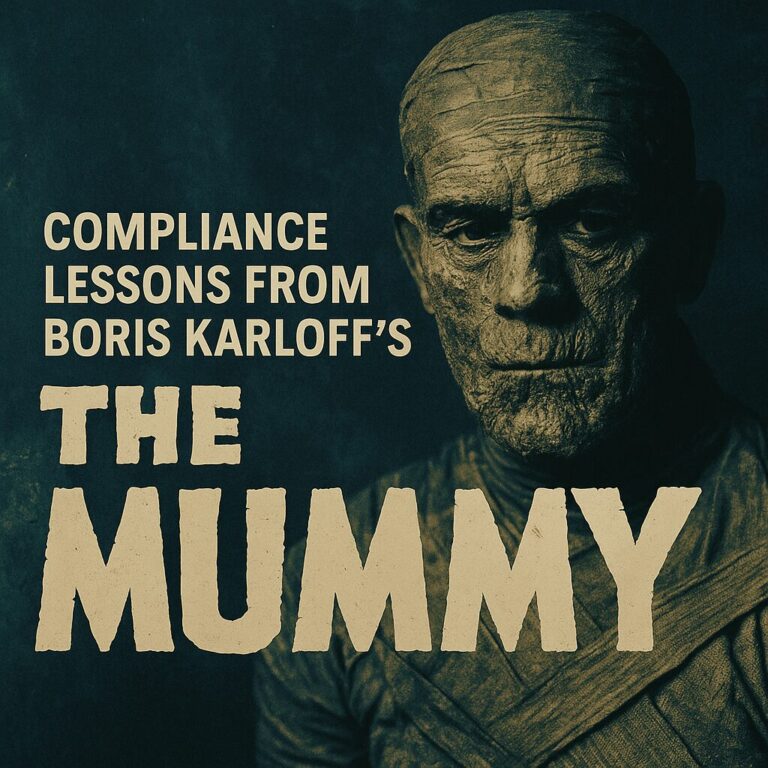
As many of my readers know, I am a huge fan of the Classic Universal Picture Movie Monsters, focusing on the period from 1931 to the mid-1950s. In October, I traditionally use our Halloween-ending month to look at the Classic Universal Movie Monsters, as well as others, such as Hammer Studio movies, Val Lewton productions, and Vincent Price movies. This year, I wanted to go back to basics by looking at the Classic Universal Movie Monsters: Dracula (1931), Frankenstein (1931), The Invisible Man (1933), The Mummy (1936), and The Wolf Man (1940).
Over the next five weeks, I will look at each of these movies through the lens of compliance and mine them for compliance lessons. Today, I continue with the Classic Universal Movie Monster Boris Karloff’s version of The Mummy. If you want to take a deeper dive into this movie in the podcast format, check out the special series on the FCPA Compliance Report, hosted by my friends Fiona and Timothy. These podcasts will post contemporaneously with the blog post each Friday during October.
When Boris Karloff first appeared swathed in ancient wrappings as The Mummy in 1932, audiences were transfixed. The story of Imhotep, an ancient Egyptian priest condemned for forbidden acts and resurrected thousands of years later, was both eerie and tragic. Unlike Frankenstein’s Monster or Dracula, Karloff’s Imhotep was not simply a beast or predator. He was a figure burdened by history, secrecy, and the consequences of defying rules.
For corporate compliance professionals, The Mummy is not just a gothic horror tale; rather, it is a parable about hidden risks, the danger of ignoring history, and the importance of clear rules and controls. Karloff’s Mummy reminds us that the past is never truly buried; if ignored, it will resurface to haunt organizations.
We continue our look at Classic Universal Monsters by exploring five compliance lessons from the Karloff version of The Mummy.
Ignoring History Leads to Repeated Mistakes
The British archaeologists who uncover Imhotep’s tomb are warned not to disturb it. Hieroglyphs clearly state the dangers. Yet curiosity and a touch of hubris push them to ignore the warnings. The result? They unleash a centuries-old curse. This resonates strongly with compliance. Organizations that fail to study their own past missteps or the lessons learned from industry scandals are doomed to repeat them. How many times have we seen bribery scandals unfold in sectors where other companies had already been punished? How often do firms enter high-risk markets without learning from past enforcement actions?
Compliance takeaway: Compliance programs must institutionalize lessons learned. Post-mortems, root cause analyses, and case study training ensure that past failures are not forgotten. History is a teacher; ignoring it is an invitation for disaster.
Secrets Fester in the Dark
Imhotep survives for thousands of years because he is hidden, entombed, forgotten, and buried under the sands of secrecy. When he reemerges, he operates in shadows, manipulating others with half-truths and disguises. His power thrives because no one knows his true identity until it is too late. This is a powerful metaphor for compliance risks. Misconduct, whether corruption, fraud, or abuse, thrives in secrecy. When information is concealed, when transparency is absent, risks multiply. By the time issues surface, the damage is often catastrophic.
Compliance takeaway: Transparency is the enemy of misconduct. Compliance officers must insist on disclosure, whether through clear financial reporting, transparent third-party relationships, or open communication channels. Darkness enables misconduct; transparency shines light on hidden risks.
Culture Outlasts Controls
What is striking about The Mummy is that even after 3,700 years, Imhotep’s devotion to his forbidden love, Ankh-es-en-amon, drives his every action. The cultural imprint of his choices outlives laws, punishments, and time itself.
The same is true in corporate life: culture outlasts controls. Policies and procedures may be updated, training refreshed, and leadership reshuffled, but if a culture of secrecy, corruption, or retaliation exists, it will endure unless deliberately changed. Regulators such as the DOJ have repeatedly emphasized that culture, not paper programs, determines compliance success.
Compliance takeaway: Compliance professionals must focus on shaping culture. This requires tone from the top, modeling from the middle, and reinforcement at every level. Controls matter, but without cultural alignment, they are as fragile as papyrus.
Obsession with the Past Can Blind Us to the Present
Imhotep is consumed by his obsession with reviving his ancient love. He manipulates the modern world only to resurrect the past. This obsession blinds him to present realities and ultimately leads to his downfall. Organizations can fall into the same trap. Compliance programs that focus solely on past risks, outdated procedures, legacy markets, and historical problems without quickly adapting to new realities become obsolete. Think of the rapid rise of ESG compliance, AI governance, and supply chain transparency. Companies stuck in “last decade’s risks” are unable to address emerging threats.
Compliance takeaway: Compliance must balance history with forward-looking risk assessments. Yes, learn from the past, but don’t become captive to it. The 2024 Update to the Evaluation of Corporate Compliance Programs (2024 ECCP) stresses the need to assess new business models and emerging risks. Compliance must look ahead as much as it looks back.
Lack of Boundaries Leads to Unintended Consequences
The archaeologists who awaken Imhotep fail because they have no boundaries; they open what should remain closed, touch what should remain untouched, and ignore the warnings etched on the tomb. Their lack of restraint unleashes destruction. This is a classic compliance lesson: boundaries exist for a reason. In business, these boundaries are policies, internal controls, approval processes, and ethical standards. When ignored—even unintentionally—they create exposure. The global enforcement landscape is littered with companies that ignored boundaries in pursuit of profit.
Compliance takeaway: Reinforce boundaries. Build controls that prevent risky actions, monitor for boundary-crossing behavior, and emphasize in training why rules exist. Boundaries are not bureaucratic obstacles; they are protective structures that prevent organizations from unleashing their own “mummies.”
Conclusion: The Mummy as a Compliance Case Study
Karloff’s The Mummy endures because it is more than a horror story; rather, it is a meditation on history, secrecy, obsession, and consequence. For compliance professionals, it is also a parable about governance.
For compliance officers, the film offers a powerful reminder: the past is never truly buried. Misconduct, once unleashed, is hard to contain. Our role is to study history, insist on transparency, shape culture, anticipate new risks, and enforce boundaries.
Like Imhotep, compliance failures rarely emerge overnight. They are buried, hidden, and ignored until they rise again with destructive force. The Karloff Mummy teaches us that vigilance, transparency, and cultural strength are the only safeguards against being haunted by the past.
Join us next Friday, October 31, as we conclude our special series by looking at The Invisible Man.
