


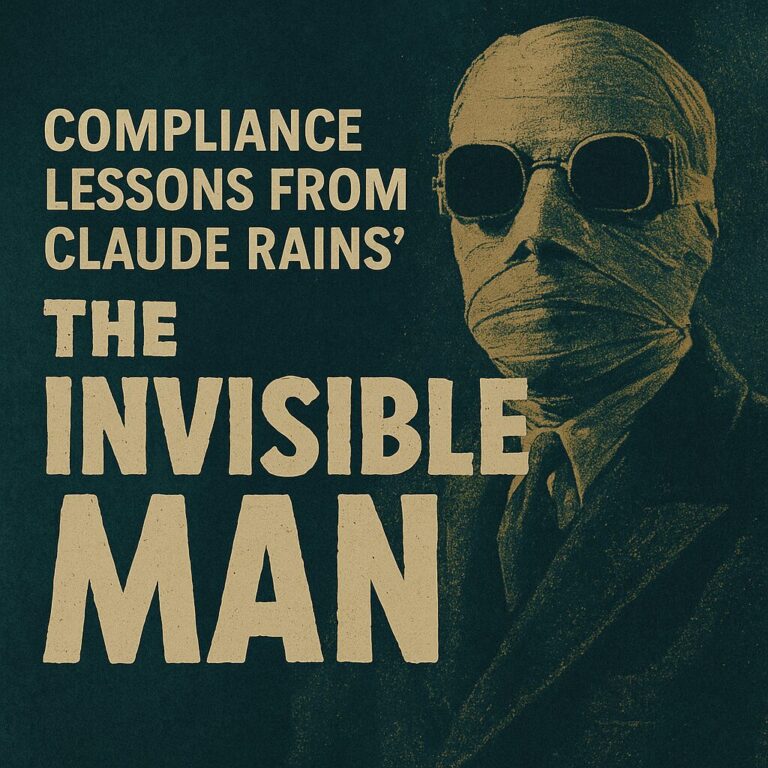
Ed. Note: We conclude our five-part blog post series on compliance lessons from Classic Universal Movie Monsters this week by examining one of the lesser-known movies and monsters: The Invisible Man. Accompanying this blog post series are Fiona and Timothy, who review the movie and share their thoughts on the compliance lessons from this classic, starring Claud Rains. They appear on a special series on the Popcorn and Compliance, part of the Compliance Podcast Network.
When Claude Rains debuted in James Whale’s 1933 film The Invisible Man, audiences were introduced to one of Universal Pictures’ most chilling and thought-provoking monsters. Unlike Frankenstein’s creature or the Wolf Man, Rains’s Jack Griffin is not a tragic victim of fate. He is a brilliant scientist who, after discovering a formula for invisibility, loses all sense of restraint and morality. His newfound freedom from accountability drives him to madness, violence, and destruction.
For compliance professionals, The Invisible Man is a powerful allegory about transparency, accountability, and the risks of unchecked power. Rains’s chilling laugh and the image of clothing moving without a body remind us that when actions go unseen, misconduct is most likely to flourish. The compliance program’s task is to make the invisible visible.
We conclude our special Classic Universal Monster series for October 2025 by examining five key lessons in compliance from the Claude Rains film, The Invisible Man.
1. Lack of Transparency Breeds Misconduct
Griffin’s transformation into the Invisible Man immediately removes the ordinary constraints of social behavior. Knowing that others cannot see him, he becomes bolder, more reckless, and ultimately violent. His invisibility grants him a sense of impunity.
This is the same danger corporations face when operations, transactions, or third parties operate without transparency. Hidden bank accounts, shell companies, off-the-books payments. These are the “invisible” spaces where bribery, fraud, and misconduct thrive. Regulators, such as the DOJ and SEC, consistently emphasize transparency as a cornerstone of compliance, as opacity often enables wrongdoing.
Compliance takeaway: Compliance officers must eliminate blind spots. Use data analytics to detect unusual transactions, require third-party disclosures, and insist on clear documentation. Invisibility may be thrilling in fiction, but in business, it is a direct path to misconduct.
2. Power Without Accountability Is a Recipe for Abuse
Griffin revels in his power. “An invisible man can rule the world! No one will see him come, no one will see him go,” he boasts. But stripped of accountability, his brilliance is corrupted. What begins as a scientific achievement devolves into tyranny.
Organizations face the same risk when individuals wield unchecked power. A star salesperson who brings in revenue but defies compliance controls, a regional manager who operates “off the radar,” or a senior executive whose behavior goes unquestioned, these are real-world Invisible Men. Without oversight, they can manipulate systems, pressure subordinates, and expose the company to massive legal and reputational harm.
Compliance takeaway: Build accountability into every level of the organization. No one should be exempt from oversight, not even high performers or senior leaders. Clear escalation pathways, independent reporting to the board, and consistent enforcement of rules ensure that power remains accountable.
3. Culture Determines Whether Controls Work
What makes Griffin’s story chilling is not only his invisibility, but how others respond to it. At first, they are horrified. However, some characters quickly fall into denial, hoping the threat will subside. Others are fascinated, drawn in by his apparent power. Ultimately, fear dominates; no one wants to confront him directly.
This dynamic mirrors corporate culture. Even the best-designed controls fail if the culture tolerates misconduct, ignores warning signs, or allows fear to silence employees. Culture determines whether employees speak up or stay silent, whether compliance officers are respected or marginalized, and whether ethical boundaries are enforced or ignored.
Compliance takeaway: Compliance officers must relentlessly shape and measure culture. Culture surveys, hotline analytics, and focus groups are as important as transaction monitoring. If employees are too afraid to confront misconduct—or too fascinated by results to ask questions—compliance controls will never succeed.
4. Risk Becomes Exponential When Innovation Outpaces Ethics
The core of The Invisible Man is a cautionary tale about the dangers of innovation. Griffin’s formula is groundbreaking, but it was developed without consideration of ethics, risk assessment, or oversight. His scientific achievement outpaces his moral responsibility, leading to catastrophe.
This is the same challenge corporations face today with artificial intelligence, biotechnology, and other emerging technologies. Innovation is valuable, but when ethics and compliance lag, risks multiply. Regulators are increasingly focused on whether companies consider the ethical implications, not just the technical achievements.
Compliance takeaway: Compliance must be embedded in innovation. New products, markets, or technologies should undergo compliance risk assessments, just as they undergo financial or safety reviews. Ethics cannot be an afterthought; it must guide innovation from the start.
5. Crisis Preparedness Is Non-Negotiable
The climax of the film shows villagers and authorities in chaos. They have no plan for dealing with an invisible adversary. Panic ensues. Griffin wreaks havoc until circumstances, not preparation, bring him down.
For organizations, this is a vivid illustration of why crisis preparedness matters. Whether it is a corruption investigation, a cyberattack, or an ESG controversy, chaos reigns if companies are unprepared. By the time regulators or the media arrive, it is often too late to design an effective crisis response.
Compliance takeaway: Compliance programs must include crisis management planning. This means having clear incident response procedures, conducting tabletop exercises, and ensuring cross-functional coordination. Preparedness is the difference between chaos and resilience.
Conclusion: Making the Invisible Visible
Claude Rains’s Invisible Man endures because it speaks to something primal, the fear of what cannot be seen. For compliance professionals, it resonates because much of our work involves uncovering the unseen: hidden risks, opaque transactions, and cultural undercurrents.
The Invisible Man reminds us that risk is most dangerous when it is hidden, when accountability is absent, and when systems fail to shine light into the shadows. The task of compliance is to make the invisible visible, to detect what others cannot see, to enforce accountability, and to ensure that innovation and power operate within ethical boundaries.
The Invisible Man, as portrayed by Claude Rains, is not just a horror story; rather, it is a commentary on the nature of compliance. For organizations, the real monster is not invisibility itself, but the complacency that allows invisible risks to thrive unchecked. Our job is to ensure that nothing in our organizations operates unseen.
