


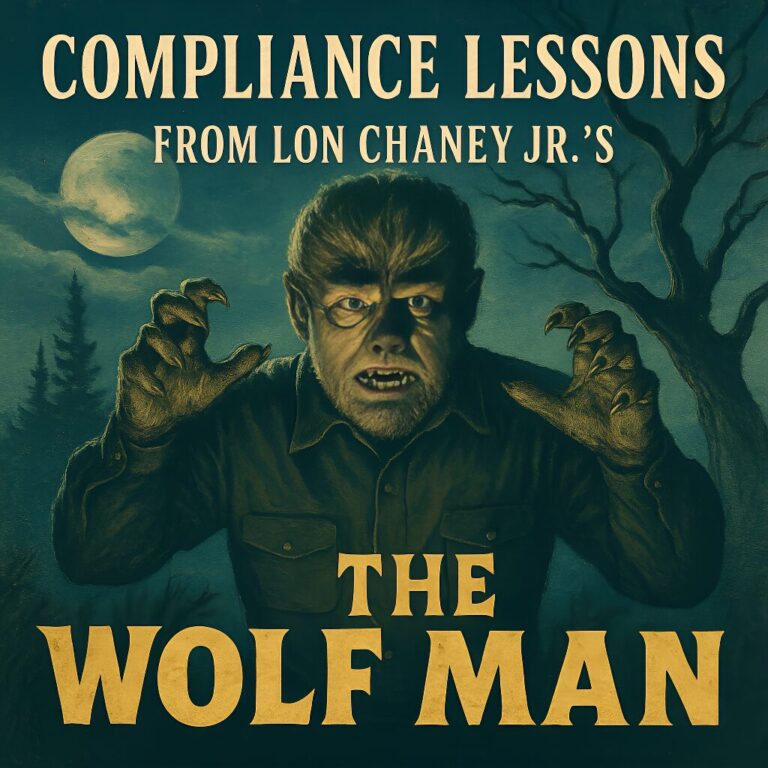
As many of my readers know, I am a huge fan of the Classic Universal Picture Movie Monsters, focusing on the period from 1931 to the mid-1950s. In October, I traditionally use our Halloween-ending month to explore the Classic Universal Movie Monsters, along with other films from the Hammer Studio, those produced by Val Lewton, and those starring Vincent Price. This year, I wanted to go back to basics by looking at the Classic Universal Movie Monsters, starting with Dracula and Frankenstein in 1931, followed by The Invisible Man in 1933, The Mummy in 1936, and ending with The Wolf Man in 1940.
Over the five Fridays in October, I will examine each of these movies through the lens of compliance and extract compliance lessons from each one. Today, I continue with perhaps the most psychologically complicated of the top 5: the Classic Universal Movie Monster Lon Chaney Jr.’s version of The Wolf Man. If you want to take a deeper dive into this movie in the podcast format, check out the special series on Popcorn and Compliance, hosted by my friends Fiona and Timothy. These podcasts will be posted alongside the blog post each Friday during October.
When Lon Chaney Jr. first appeared on screen as Larry Talbot in The Wolf Man (1941), audiences were introduced to one of the most enduring monsters in cinema. Unlike Frankenstein’s creation or Lugosi’s Dracula, Chaney’s Wolf Man was not entirely “other.” He was human, a son returning home, trying to reconnect with family, and falling victim to forces beyond his control. His torment was that he transformed into a monster against his will, unable to control the destruction he unleashed.
For compliance professionals, The Wolf Man offers some striking lessons. Chaney’s performance shows how good people can end up in bad situations, how organizations ignore warning signs at their peril, and how systems must be designed not only to catch intentional wrongdoing but also to address risks that emerge when ordinary individuals are put under pressure.
We continue our exploration of Classic Universal Monster Movies by considering five compliance lessons from Lon Chaney Jr.’s The Wolf Man.
1. Ordinary People Can Become Compliance Risks
Larry Talbot begins as an essentially decent man. He returns to his family estate, reconciles with his father, and awkwardly woos the local shopkeeper’s daughter. There is nothing inherently villainous about him. But after being bitten, he becomes something he cannot control. By moonlight, he turns into the Wolf Man and wreaks havoc. This duality mirrors what compliance professionals often see. Not every compliance violation comes from a “bad actor.” Sometimes it comes from ordinary employees under extraordinary circumstances: pressure, opportunity, or rationalization (the famous “fraud triangle”). Even good employees can become risks if they are put in the wrong situation without proper safeguards.
Compliance takeaway: Programs must be designed to account for human weakness. Training should emphasize not only rules but also ethical decision-making. Monitoring should not assume intent but look for patterns of behavior that may indicate an employee is slipping into risk. Like Larry Talbot, sometimes risk comes from within.
2. Warnings Ignored Become Disasters Realized
Throughout the film, there are clear warnings. Locals whisper about werewolves. An old Romani woman (played by great character actor Maria Ouspenskaya) gives a direct warning: “Even a man who is pure in heart and says his prayers by night, may become a wolf when the wolfsbane blooms and the autumn moon is bright.” But these warnings are dismissed as folklore, superstition, or exaggeration.
This is a common compliance failure: ignoring red flags. Whether it is a whistleblower report, suspicious payments, or unusual accounting entries, companies often rationalize risks away until they become unavoidable crises. Regulators such as the DOJ have repeatedly emphasized that ignoring warning signs is tantamount to negligence.
Compliance takeaway: Listen to the warnings. Investigate whistleblower reports promptly, document your findings, and act on them. A culture that treats red flags as noise will end up in crisis. As in The Wolf Man, the warnings were there. The failure was in dismissing them.
3. The Curse of Silence and Stigma
One of the most tragic elements of The Wolf Man is Larry Talbot’s isolation. He tries to tell others about what is happening to him, but he is met with disbelief, ridicule, or silence. The stigma of his transformation keeps him from getting the help he needs.
This resonates powerfully with the experience of corporate whistleblowers. Too often, employees who raise concerns are ignored, marginalized, or retaliated against. The result is silence, and silence allows misconduct to thrive. In its 2024 Evaluation of Corporate Compliance Programs (2024 ECCP), the DOJ emphasized the need to encourage reporting, keep whistleblowers informed, and protect them from retaliation.
Compliance takeaway: Break the curse of silence. Companies must foster cultures where employees feel safe raising concerns. Reporting channels must be confidential, retaliation must be prohibited, and whistleblowers should be treated as allies, not threats. Without breaking the stigma, organizations risk letting problems grow in the shadows.
4. Risk Is Cyclical and Predictable
Larry Talbot’s transformations follow a cycle; the full moon triggers his change into the Wolf Man. The risk is not random; it is predictable. Once you understand the pattern, you can anticipate the danger. This is precisely how compliance professionals must view risk. Corruption, fraud, and misconduct often follow cycles such as end-of-quarter pressure, market entry into high-risk jurisdictions, merger and acquisition activity, or supply chain disruptions. These moments are “full moons” in corporate life, where risks spike and vulnerabilities appear.
Compliance takeaway: Compliance must not only react but anticipate. Use data analytics and risk assessments to map the cycles of risk within your organization. Build monitoring around predictable pressure points. Just as villagers could expect when the Wolf Man would appear, compliance officers must anticipate when and where misconduct risks are most likely to emerge.
5. Tragedy Comes from Lack of Intervention
The story of The Wolf Man is, at its heart, a tragedy. Larry Talbot’s father refuses to believe him. Authorities dismiss his pleas. Friends ignore his warnings. No one intervenes until it is too late. By the end, Larry is destroyed, both man and monster, undone by neglect. The same pattern appears in many corporate scandals. Think of Wells Fargo’s sales practices scandal, Volkswagen’s emissions testing fraud, or recent FCPA enforcement actions. In nearly every case, someone knew. Red flags were visible. But intervention never came, whether out of fear, complacency, or willful blindness.
Compliance takeaway: Timely intervention is the difference between a near miss and a full-blown scandal. Compliance officers must have authority, resources, and independence to intervene early. Boards and executives must empower compliance not only to identify risk but also to act upon it. Without intervention, tragedy is inevitable.
Conclusion: The Wolf Man as a Compliance Parable
What makes Lon Chaney Jr.’s The Wolf Man so enduring is his humanity. He is not a monster by choice, but by circumstance. He represents the vulnerability of all people—how, under the wrong pressures, even the best of us can cross into dangerous territory. For compliance professionals, the lesson is not to hunt down “bad apples” alone, but to design systems that recognize, support, and mitigate human weakness before it becomes destructive.
As compliance officers, our role is to act before the full moon rises. We must listen to warnings, protect whistleblowers, anticipate risk cycles, and intervene decisively. Lon Chaney Jr.’s The Wolf Man is more than a gothic tragedy; rather, it is a case study in compliance failure.
The DOJ and SEC may not speak in the language of werewolves and curses, but their message is the same: prevent risk before it transforms into something uncontrollable. Because once the transformation occurs, once the Wolf Man is loose, no compliance officer can undo the damage already done.
Join us next Friday as we consider The Mummy.
