


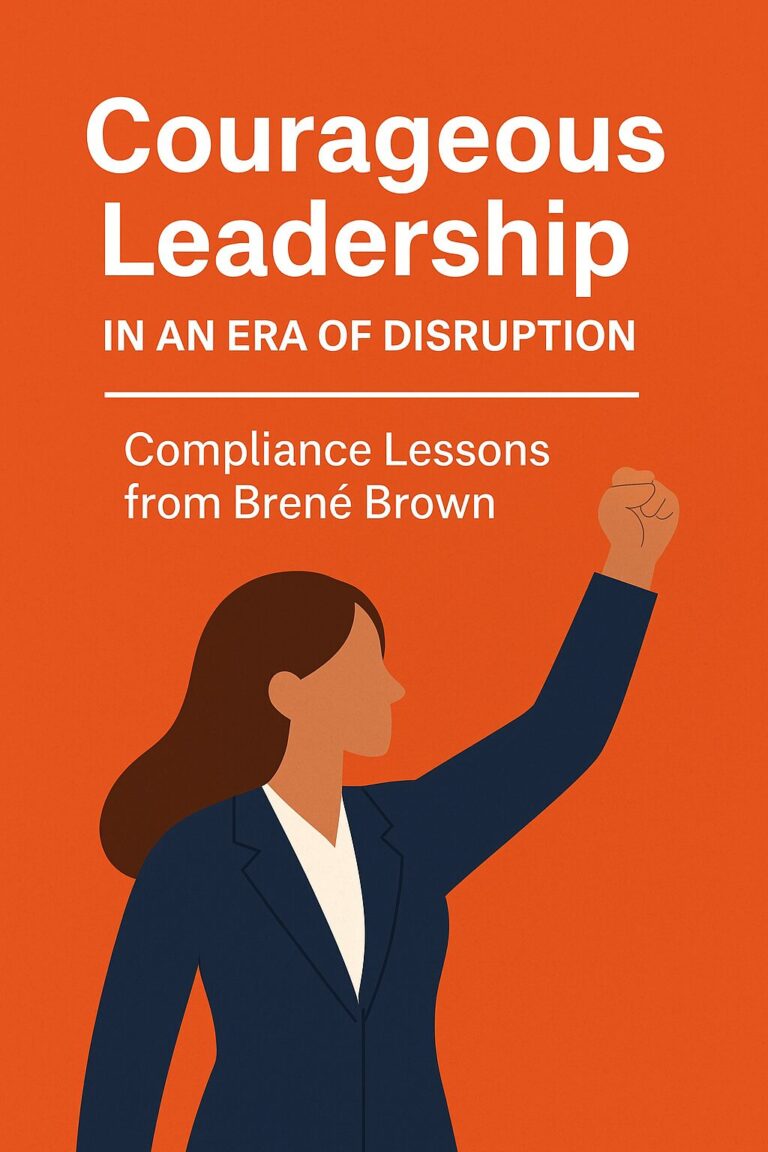
The New York Times (NYT) recently published an interview with Brené Brown, best known for her TEDx Talk on “The Power of Vulnerability.” Her TEDx Talk focused on individuals. Brown is now using those concepts as a basis for work in the corporate world. Many of the concepts she discussed in this interview directly apply to a Chief Compliance Officer (CCO) and corporate compliance function. In this article, I will summarize the key themes of Brown’s discussion and draw out five critical lessons for compliance professionals navigating today’s turbulent environment.
The world of corporate compliance does not exist in a vacuum. Every day, compliance professionals work within organizations facing extraordinary pressures: disruptive technologies, geopolitical instability, shifting marketplaces, and evolving workforce expectations. Against this backdrop, Brené Brown, renowned researcher on shame, vulnerability, and courage, has turned her attention to leadership in corporate, nonprofit, and even military contexts. Her latest reflections provide timely insights not just for executives, but for compliance professionals tasked with guiding organizations through uncertainty.
Brown’s message is clear: in moments of disruption, the quality of leadership matters more than ever. She challenges us to think about courage, vulnerability, and clarity not as “soft skills,” but as the very foundation of sustainable organizational performance. For the compliance professional, her work resonates deeply. After all, compliance is fundamentally about behavior, how people act under pressure, how they respond to risk, and how organizations foster cultures of accountability and trust.
The Pace of Change and the Trap of Fear
Brown describes today’s business climate as a “supercycle” of unprecedented change. Artificial intelligence, geopolitical instability, and economic volatility create a sense of scarcity, a nagging feeling that organizations lack sufficient time, resources, or talent to keep up. For compliance leaders, this context should feel familiar. When regulations shift overnight or enforcement priorities change, fear and reactive decision-making often follow.
Brown cautions against “action over impact,” where leaders rush to act without pausing to assess whether their actions are aligned with strategy. For compliance, this is the difference between a carefully calibrated monitoring program and a scattershot set of controls that look good on paper but fail in practice. Strategic urgency, not blind urgency, must guide the compliance function.
Courage, Accountability, and Human Leadership
At the heart of Brown’s research is the idea that courage, not technical expertise alone, is the limiting factor in organizational performance. Across industries, she found leaders struggling to have hard conversations, to hold others accountable, and to resist blame and shame.
For compliance, this insight hits home. We have all seen organizations where misconduct festers because leaders fear confrontation, or where accountability is deflected onto “bad apples” instead of being addressed systemically. Brown reminds us that courage means leaning into discomfort, whether that’s delivering difficult feedback, shutting down toxic behavior, or confronting senior leaders when ethical lines are at risk of being crossed.
Communication as a Compliance Tool
Brown describes good communication as rooted in clarity, discipline, and accountability. It requires vulnerability, honesty, and a willingness to tolerate discomfort. In her words, “A brave life is basically 15 hard conversations a day.” Compliance professionals should take note. Too often, compliance messages are dulled by legal jargon or buried in training modules that merely check the box without creating a genuine understanding. Effective compliance communication is not about volume, but clarity — stating expectations plainly, reinforcing them consistently, and holding both leaders and employees accountable when those expectations are not met.
When compliance officers avoid difficult conversations, whether with business leaders, employees, or regulators, they fail in their role as stewards of integrity.
Generational Shifts and the “Why” Question
Another theme Brown highlights is the growing demand from younger generations to understand the “why” behind organizational decisions. Gen Z, in particular, tends to resist following orders blindly. They ask questions, challenge assumptions, and expect transparency.
For compliance, this is an opportunity, not a threat. When employees ask “why,” they create space for dialogue about risk, ethics, and accountability. If handled well, these conversations can strengthen the compliance culture. If dismissed or ignored, however, they can morph into conflict and disengagement. Compliance professionals must equip themselves and their organizations with the skills to turn task conflict into innovation, rather than emotional conflict that fractures teams.
The Decline of Fear-Based Leadership
Brown pushes back against the notion that fear-driven leadership, exemplified by mass layoffs or authoritarian management, produces sustainable performance. Fear may yield quick results, but its shelf life is short. To maintain fear as a motivator, leaders must repeatedly demonstrate cruelty, which corrodes trust and drives talent away.
Compliance programs grounded in fear face the same limitation. Employees may comply out of fear of punishment in the short term, but over time, they disengage, seek ways to evade controls, or leave the organization entirely. Sustainable compliance requires trust, fairness, and accountability, not periodic shows of cruelty.
Five Key Takeaways for the Compliance Professional
1. Strategic Urgency Over Panic
In times of disruption, resist “chicken with your head cut off” urgency. Compliance programs must prioritize thoughtful, strategic action over quick fixes that create the illusion of progress without real impact.
2. Courage as the Compliance Differentiator
Having hard conversations, holding people accountable, and confronting uncomfortable truths are the core of both leadership and compliance. Technical expertise matters, but courage drives results.
3. Communication Builds Trust
Effective compliance communication requires clarity, discipline, and accountability. Don’t hide behind jargon or check-the-box training. Say what needs to be said, even when it’s uncomfortable.
4. Harness the Power of ‘Why’
Younger employees demand transparency and reasoning. Use this as a lever to build stronger compliance cultures. Equip leaders to turn questions into opportunities for education, engagement, and innovation.
5. Reject Fear-Based Models
Fear is a short-term motivator with long-term costs. Compliance programs grounded in trust, fairness, and respect will outperform those that rely on punishment and intimidation.
Compliance Lessons in Courage
Brené Brown’s reflections on leadership are not abstract musings. They speak directly to the challenges compliance professionals face in guiding organizations through uncertainty, disruption, and cultural change. At its core, compliance is about shaping behavior and building cultures of integrity. That work requires courage, clarity, and compassion, which are precisely the traits Brown identifies as the hallmarks of effective leadership.
As we look ahead to the next wave of regulatory change, technological disruption, and workforce transformation, compliance officers must resist the temptation to react out of fear. Instead, we must embrace courageous leadership that aligns action with impact, values clarity over noise, and treats people with humanity even in moments of adversity.
Brown’s work reminds us that compliance is not just about preventing wrongdoing; it is also about promoting ethical behavior. It is about cultivating courage and clarity in organizations so that, when disruption hits, leaders and employees alike know how to “settle the ball,” take a breath, and make the right play.
