


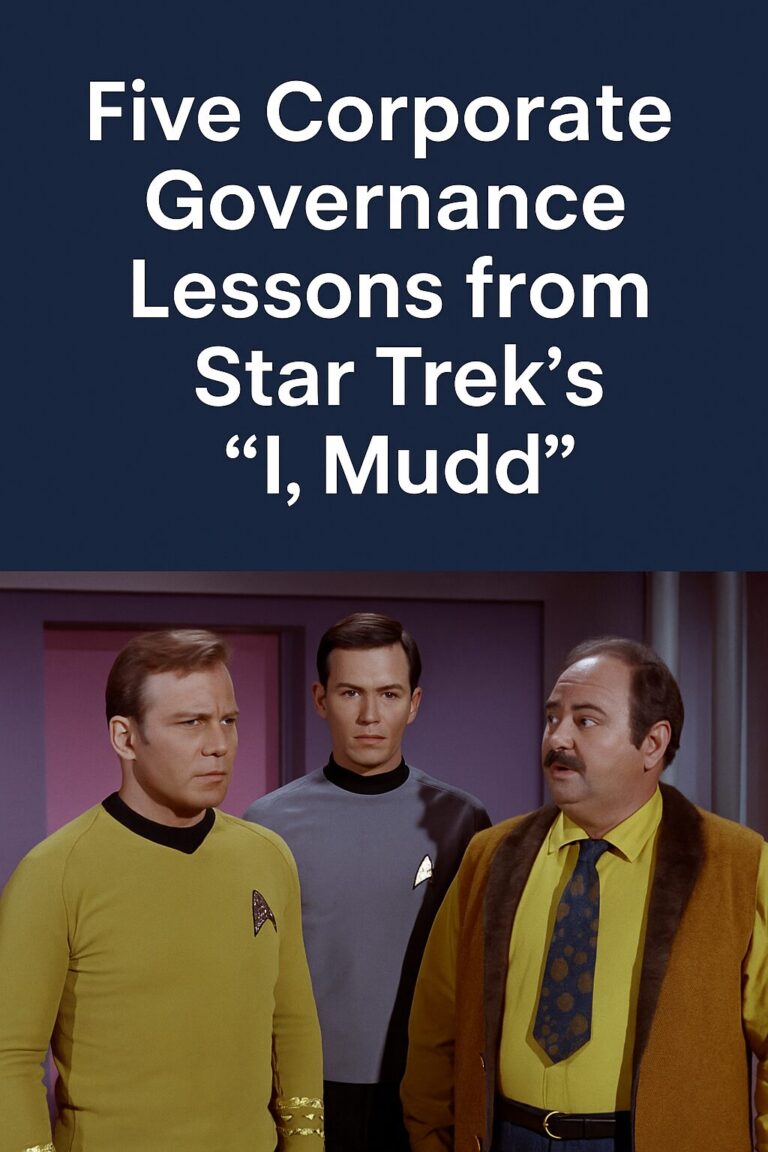
Who could have imagined that “I, Mudd,” a quirky, comedic episode from Star Trek: The Original Series, would offer valuable lessons in corporate governance? Yet, here we are, boldly going where no compliance blogger has gone before, using the misadventures of Captain Kirk and the enigmatic Harry Mudd to distill governance wisdom for modern compliance practitioners.
In this episode, “I, Mudd,” the Enterprise crew encounters Harry Mudd once more, stranded on a planet ruled by androids who are both obsessed with order and baffled by human irrationality. Mudd attempts to exploit the androids’ logic for his gain but soon finds himself captive to their strict interpretation of governance, leading Kirk and crew to intervene with creative tactics. Beneath the humor and hijinks lie critical corporate governance principles highly relevant to today’s compliance professionals. Let’s dive deeper.
Lesson 1: Transparency is Essential in Leadership
Illustrated By: Discovery of Harry Mudd’s True Motives and History with the Androids.
Early in the episode, Kirk and the Enterprise crew uncover that Harry Mudd has deceived both them and the androids, presenting himself falsely to hide his questionable motives. His lack of transparency ultimately erodes trust, causing tension, conflict, and misunderstandings.
In corporate governance, transparency is equally crucial. Leaders who operate without openness risk organizational distrust, inefficiency, and dysfunction. Transparent leadership is foundational in governance—it supports robust stakeholder trust, improves organizational effectiveness, and mitigates potential scandals or compliance failures.
As compliance professionals, our role includes advocating for transparent communication channels, clear decision-making processes, and openly accessible policies and procedures. Creating a corporate culture of transparency ensures that the organization remains credible and effective in meeting both regulatory requirements and stakeholder expectations.
Lesson 2: Balance Between Structure and Flexibility
Illustrated By: The Androids’ Rigid Governance Framework. The androids in “I, Mudd” operate within an inflexible, logic-driven governance structure, incapable of handling unpredictable or irrational behavior. Their strict adherence to rules, without flexibility or situational judgment, ultimately leads to their downfall, as Kirk creatively exploits their rigidity.
This episode perfectly illustrates the need for governance structures to maintain balance. Excessively rigid controls can stifle innovation, responsiveness, and organizational resilience. Conversely, too much flexibility can lead to inconsistent decision-making and compliance vulnerabilities. Compliance professionals must strive to find the optimal balance, developing corporate governance frameworks that are robust enough to ensure compliance while also being adaptable enough to meet the shifting regulatory and business environments. A well-balanced governance approach allows organizations to respond effectively to unforeseen challenges while maintaining critical controls.
Lesson 3: Importance of Ethical Leadership and Integrity
Illustrated By: Harry Mudd’s Attempts to Manipulate Android Governance. Harry Mudd’s self-serving manipulations and attempts to exploit governance structures for personal gain represent a classic example of unethical leadership. His disregard for ethical integrity generates instability and places everyone, including himself, at risk.
This scenario resonates deeply within corporate governance. Integrity and ethical behavior must underpin all governance activities. Leaders who prioritize short-term gains over ethical conduct inevitably compromise their organization’s long-term health and credibility.
Compliance professionals play a vital role in deeply embedding ethics into an organization’s culture and governance processes. Encouraging ethical leadership, providing comprehensive ethics training, and embedding ethical considerations into all governance decisions fortifies the organization’s resilience against corruption, scandals, and regulatory scrutiny.
Lesson 4: Critical Thinking and Challenging Assumptions
Illustrated By: Kirk and Crew’s Strategy to Confuse the Androids with Illogical Behavior. Perhaps the most memorable and amusing scene in “I, Mudd” occurs when Kirk and his crew use creative, illogical behaviors to disrupt the androids’ strictly logical governance system. This tactic underscores the importance of critical thinking and challenging assumptions inherent in established governance practices.
Governance Lesson. In a corporate context, governance systems sometimes become complacent, relying heavily on assumptions about internal controls, the effectiveness of risk management, and ethical conduct. Compliance leaders must encourage ongoing critical thinking, regularly challenging these assumptions to uncover vulnerabilities and weaknesses.
Regular audits, testing governance procedures through scenario planning and tabletop exercises, and encouraging critical questioning by employees help ensure governance systems remain robust, flexible, and prepared to manage emerging threats. This proactive approach safeguards organizations from complacency-induced governance failures.
Lesson 5: The Value of Diversity and Human Insight in Governance
Illustrated By: The Androids’ Failure to Comprehend Human Nuance and Individuality. In “I, Mudd,” the androids’ governance system fails primarily because they cannot appreciate human diversity, emotional intelligence, and individuality. Their failure underscores the importance of these factors in effective governance.
Governance Lesson. Corporate governance similarly benefits from diverse perspectives, experiences, and insights. Organizations overly dependent on homogeneous leadership perspectives or mechanical decision-making processes become vulnerable to blind spots, groupthink, and systemic errors.
Compliance officers must advocate vigorously for diversity across governance committees, senior management teams, and boards. Diverse perspectives, combining analytical rigor and human insight, allow governance processes to anticipate better, understand, and manage risks, regulatory requirements, and ethical considerations. Encouraging and valuing diverse voices and fostering inclusion greatly enhances organizational decision-making and governance efficacy.
Final ComplianceLog Reflections
Who could have predicted that governance wisdom would emanate so vividly from the colorful escapades aboard the Enterprise with Harry Mudd and the androids? Yet, as compliance evangelists, we learn that corporate governance principles, such as transparency, ethical leadership, balanced structures, critical thinking, and diversity, are truly timeless.
By integrating these lessons into governance practices, compliance professionals can cultivate organizations that are capable of navigating complexities, mitigating risks, and ensuring adherence to ethical and regulatory standards. As Captain Kirk and his intrepid crew demonstrate, effective governance requires clarity, adaptability, ethical strength, critical thinking, and diverse insights—qualities indispensable for addressing today’s corporate governance challenges.
Resources:
