


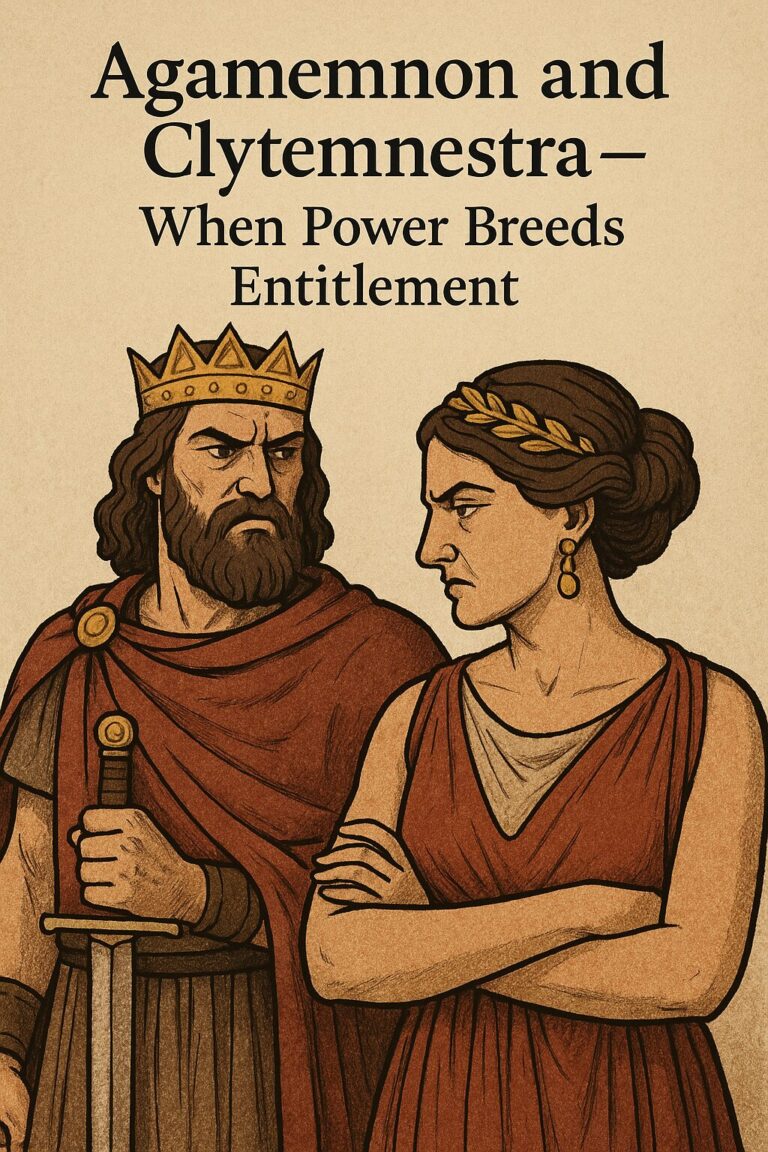
We continue our look at lessons from the House of Atreus for the 21st-century compliance profession, focusing on key stories and mining them for compliance lessons. In today’s Part 4, we take up the Agamemnon Problem: a leader so focused on results, so convinced of their indispensability, that ethics become negotiable. It is the mindset that says, “We’ll fix the compliance later—after we win.”
In Greek tragedy, that rationalization cost Agamemnon his life. In corporate life, it costs organizations their culture, credibility, and sometimes their license to operate. The story of Agamemnon and Clytemnestra is not only one of betrayal and revenge, it is a powerful parable about what happens when leaders mistake power for permission and performance for purpose.
The King’s Fatal Trade-Off
As the legend goes, Agamemnon, king of Mycenae and commander of the Greek forces at Troy, faced a crisis before the war even began. The goddess Artemis, angered by his arrogance, becalmed the winds and trapped his fleet in port. The only way to appease her, a seer declared, was to sacrifice his daughter, Iphigenia.
Agamemnon’s dilemma was stark: abandon his military ambitions or sacrifice his own child. He chose the latter. The winds rose, the ships sailed, and the war began. Years later, when Agamemnon returned triumphant, his wife Clytemnestra murdered him in his bath as revenge for their daughter’s death. This was not just a family tragedy; it was a leadership failure of the highest order. Agamemnon traded ethics for expedience, and the cost was everything he loved.
The Corporate Iphigenia
Every organization has its Iphigenia(s); the values, people, or principles that get sacrificed for “strategic goals.” It may be:
- Cutting compliance budgets to hit quarterly numbers.
- Overriding safety protocols to meet production quotas.
- Ignoring harassment complaints to keep a star performer happy.
Like Agamemnon, leaders rationalize these sacrifices as necessary or temporary. But every compromise chips away at the moral capital that sustains the enterprise. Once the organization learns that “winning” matters more than doing right, the line between ambition and arrogance disappears.
The Entitlement of Success
When Agamemnon returned from Troy, he arrived not as a humbled survivor but as an entitled conqueror. He paraded Cassandra, a captive prophetess, before his wife and walked proudly across a purple carpet, a gesture the Greeks saw as blasphemous arrogance. It’s the same pattern we see in modern compliance disasters: success breeding entitlement. Executives who deliver profits begin to believe they’ve earned the right to bend the rules. Performance metrics replace principles as the measure of worth.
Consider a few familiar examples:
- The Wells Fargo sales scandal: Pressure to perform led employees to create millions of fake accounts. It also involved senior management lying to its own Board of Directors.
- Volkswagen’s emissions fraud: Engineers rationalized deception as necessary to stay competitive. But this rationalization went all the way to the CEO.
- Boeing’s safety crisis: Leadership prioritized schedules and cost over engineering integrity. Then they blamed the airline’s pilots for operational failures.
In each case, strong organizations were undone not by ignorance of ethics but by entitlement —the belief that achievement excused misconduct.
The Compliance Cost of Entitlement
Entitlement corrodes three pillars of compliance: accountability, transparency, and humility.
1. Accountability: When leaders feel untouchable, rules become optional. Internal controls are ignored, and ethical review is seen as bureaucracy rather than protection.
2. Transparency: Entitled leaders hoard information and discourage challenge. “Bad news doesn’t travel up” becomes the cultural norm.
3. Humility: Ethical reflection gives way to moral blindness. If success is proof of righteousness, who needs oversight?
Agamemnon’s decision to sacrifice Iphigenia was not just moral cowardice; it was a governance failure. He believed his power justified his actions, and no one around him could say otherwise. That is precisely how modern compliance collapses begin.
Clytemnestra: The Whistleblower Turned Avenger
Clytemnestra’s revenge may seem extreme, but, symbolically, she represents the voice of accountability that has been ignored for too long. She warned, questioned, and grieved, yet was silenced by hierarchy and hubris. When the system denied her justice, she took justice into her own hands.
Modern organizations often create their own Clytemnestras when they suppress legitimate dissent. Whistleblowers who feel unheard can become external leakers, litigants, or catalysts for regulatory scrutiny. Every retaliation case begins as an unheeded complaint. The DOJ’s 2024 ECCP emphasizes this point. Organizations must protect, inform, and empower those who speak up. When internal channels fail, external consequences follow, just as Clytemnestra’s knife followed Agamemnon’s silence.
Ethical Decision-Making Under Pressure
Agamemnon’s fateful choice came under immense pressure, a condition every executive recognizes. But pressure is where compliance either proves its worth or disappears. Strong organizations prepare for ethical stress tests long before a crisis strikes. They establish frameworks that turn moral instinct into a structured process:
1. Define Core Non-Negotiables – The “values that will not be sacrificed.” If integrity, safety, or human dignity are ever negotiable, they soon become expendable.
2. Create Decision Pathways – Require escalation when choices have ethical or reputational risk. Ethical red flags should automatically trigger review, not after-action regret.
3. Model Accountability at the Top – Leaders must demonstrate that difficult ethical decisions are shared, not borne alone. Agamemnon acted in isolation; modern governance demands collaboration.
The Tyranny of Performance Metrics
Much of Agamemnon’s arrogance stemmed from performance obsession, the need to deliver victory at any cost. That same tyranny drives unethical behavior in today’s boardrooms. Metrics matter, but when they become idols, they demand sacrifices. Compliance programs should therefore measure how results are achieved, not just whether they are achieved.
The 2024 Evaluation of Corporate Compliance Programs (ECCP) specifically instructs prosecutors to ask whether companies’ incentives reward ethical behavior. A compliant organization aligns compensation with conduct; an entitled one rewards outcomes regardless of means. A key question for leaders: Would I still consider this a “win” if it were public tomorrow?
From Power to Stewardship
The entitlement cure is stewardship, the recognition that power is not owned, but entrusted. Great leaders see themselves as guardians of values, not exploiters of privilege. This mindset shift transforms compliance from constraint to compass:
- Stewards ask how their choices affect stakeholders beyond themselves.
- Stewards invite transparency because they understand accountability strengthens credibility.
- Stewards use compliance as a mirror, not a muzzle.
Agamemnon ruled as an owner; a steward would have ruled as a custodian. The difference is the difference between arrogance and integrity.
The Compliance Evangelist’s Reflection: The Scarlet Carpet of Arrogance
When Agamemnon strode across that purple carpet, he symbolically walked across the values he was sworn to protect. Every leader who dismisses compliance as “red tape” does the same. Each step says, “The rules are for others.” But history and enforcement teach a consistent lesson: when leaders trample ethics, the organization soon trips over the fabric they have soiled. Clytemnestra’s dagger was not random vengeance; it was the return of consequence. In today’s language, it was enforcement action, indeed a reckoning deferred until accountability could no longer be ignored.
Breaking the Cycle: From Arrogance to Accountability
The tragedy of Agamemnon and Clytemnestra is that both were right and both were wrong. He betrayed his values for ambition; she destroyed justice in the name of vengeance. Their story ends in blood because neither trusted process, transparency, or accountability. Modern organizations don’t have to share that fate. Compliance offers a third path: structured accountability through systems, not swords. It ensures that no one, no matter how powerful, stands above the moral order that sustains the enterprise.
When companies embrace that mindset, they turn tragedy into transformation. They move from the purple carpet of arrogance to the solid ground of integrity. Because, as every compliance professional knows, the true test of leadership is not what you achieve when you are powerful, it is what you refuse to sacrifice to stay that way.
I hope you will join us for our concluding Part 5 — Orestes and Electra: Breaking the Cycle Through Accountability. This is my favorite story from the House of Atreus. With this myth, we will see how justice, rule of law, and redemption finally end the curse of the House of Atreus and what that means for the modern compliance function striving to build ethical resilience and renewal.
