


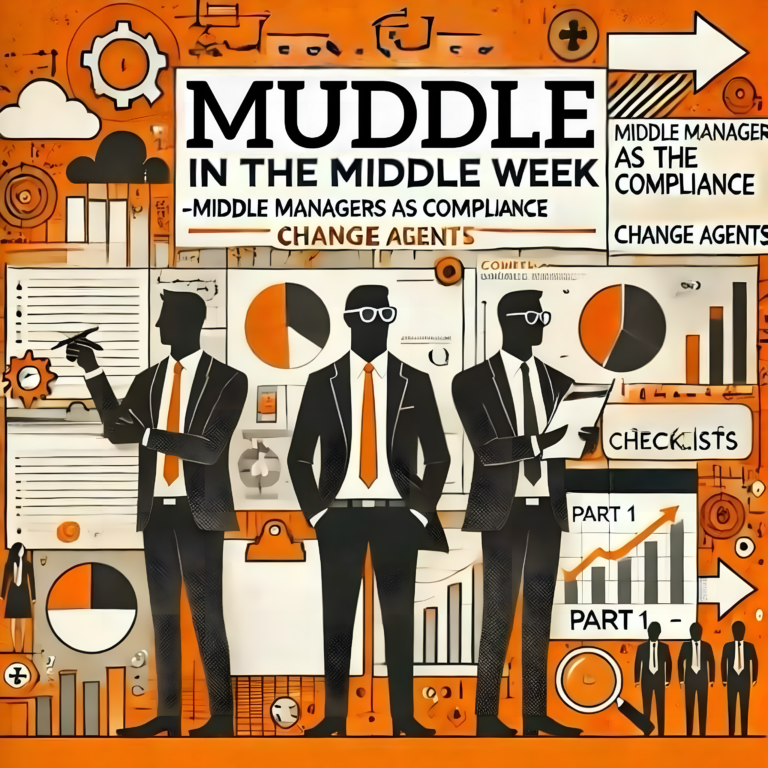
Is there confusion within your company, especially regarding compliance issues and your SpeakUp/ListenUp culture? As a compliance professional, what tools can you bring to your organization’s middle managers? This week, I will explore several aspects of middle managers and middle management, all from the compliance perspective.
A recent article in the Harvard Business Review entitled What’s the Future of Middle Management? by authors Gretchen Gavett and Vasundhara Sawhney got me thinking about those questions and several more regarding middle managers. The authors considered the role of middle management going forward, particularly with the rise of AI and a trend toward flatter organizations. One set of experts they spoke with was Raffaella Sadun, the Charles Edward Wilson Professor of Business Administration at HBS, and Jorge Tamayo, an assistant professor at the Harvard Business School. Their current research examines the pivotal role of middle managers in driving performance disparities within firms. I have taken their article and adapted it for a corporate compliance perspective.
There is a recurring narrative that middle managers are on the brink of obsolescence, destined to disappear into corporate history, replaced by sleek algorithms and streamlined organizational charts. Gartner forecasts that by 2026, AI will flatten organizational structures, eliminating over half of current middle management positions. Korn Ferry intensifies the discussion by highlighting a notable decrease in manager-level roles. Yet, intriguingly, middle managers still represent a significant and even growing proportion of the workforce, now 13% of the U.S. labor force, up from 9.2% four decades ago.
This juxtaposition begs important questions for corporate compliance professionals: Is there a fundamental misunderstanding of the role of middle managers? What lessons can compliance teams draw from evolving middle management trends, particularly regarding regulatory adherence, ethical culture, and organizational agility? I have distilled five crucial lessons for compliance professionals about the pivotal role middle managers can and should play as agents of compliance change.
Lesson 1: Recognize Middle Managers as Compliance Catalysts
Compliance, at its core, involves more than adhering to regulations; it’s about fostering an ethical, responsive, and adaptive organizational culture. Middle managers, positioned between senior leadership and frontline staff, uniquely enable this cultural alignment. They possess direct access to nuanced frontline insights about emerging compliance risks, ethical dilemmas, and policy adherence trends.
As highlighted in recent research, middle managers serve as essential links, providing feedback loops that alert senior leadership to compliance risks early enough to address them proactively. Acknowledging and enhancing this catalytic role of middle managers can significantly strengthen your compliance infrastructure.
Lesson 2: Empower Managers to Drive Ethical Behavior Through Mentorship
In times of rapid technological and regulatory shifts, employees require more than compliance training; they need ongoing mentorship and coaching. Middle managers are ideally situated to fulfill this role. They do not merely translate senior management’s strategic visions; they actively coach employees on ethical decision-making, guide them through regulatory changes, and reinforce organizational values daily.
The article emphasizes middle managers’ critical function in guiding employees through transitions, notably those driven by technological change. This skill is invaluable for compliance professionals; managers who mentor and encourage ethical behavior significantly decrease the likelihood of non-compliance and misconduct incidents.
Lesson 3: Reallocate Administrative Tasks Through Strategic Automation
A significant hurdle identified in the analysis is the misallocation of managerial duties, with middle managers often burdened by routine administrative functions better suited to automation. From a compliance perspective, this inefficient allocation hinders their ability to engage deeply in strategic risk management and ethical coaching.
Compliance professionals should advocate and support the integration of automated tools to handle administrative compliance tasks. Such an approach would free managers to tackle more complex issues, such as facilitating compliance training, monitoring risk culture, and promoting ethical decision-making practices across their teams.
Lesson 4: Provide Comprehensive Skills Training Tailored to Compliance Goals
It is not enough to reassign tasks; middle managers require substantial upskilling in both soft and technical skills to function effectively as compliance change agents. The article emphasizes a gap in consistent, high-quality training, especially concerning the essential soft skills needed for mentoring and coaching. Moreover, with AI increasingly managing lower-order tasks, middle managers must enhance their analytical and strategic capabilities to complement technology.
For compliance teams, this translates into designing and advocating training programs explicitly aimed at enhancing managerial competencies in ethics, risk assessment, regulatory interpretation, and communication—the critical pillars of effective compliance programs.
Lesson 5: Redefine Evaluation Metrics to Incentivize Compliance Leadership
Perhaps most importantly, companies must rethink evaluation criteria and career advancement pathways to fully harness middle managers as compliance allies. The article points to a common pitfall: promoting individuals based solely on unrelated performance metrics, such as sales achievements, rather than their capacity to mentor, coordinate, or promote an ethical culture.
Compliance professionals need to persuade top leaders to change the rewards and evaluation systems so that managers are clearly recognized for being great at mentoring employees, promoting ethical awareness, encouraging teamwork, and participating in compliance-related activities.
Middle Managers—Vital Compliance Partners in an Era of Change
The narrative of middle managers as obsolete bureaucratic layers is fundamentally flawed when viewed through a compliance lens. Instead, middle managers are essential enablers of organizational agility, ethical integrity, and adaptive responsiveness—all crucial compliance objectives.
Compliance teams must champion this transformative vision, advocating for middle managers’ empowerment, targeted skill development, task reallocation, and revised performance metrics. In doing so, they reinforce compliance effectiveness and elevate their organization’s ethical resilience in a rapidly evolving business landscape.
In an era marked by transformative technological and regulatory challenges, middle managers are not barriers to progress; they are the vital linchpins of a proactive compliance culture. Those organizations that invest thoughtfully and strategically in their middle managers today will build stronger, smarter, and more ethically robust enterprises for tomorrow.
By embracing these five lessons, compliance professionals can respond more effectively to regulatory challenges and position their organizations to thrive ethically and competitively in a future defined by rapid change.
I hope you’ll join me tomorrow in Part 2, where I’ll explain why your company should view middle managers as ethical cornerstones.
For more on this topic, check out The Compliance Handbook, a Guide to Operationalizing Your Compliance Program, 6th edition, which LexisNexis recently released. It is available here.
