


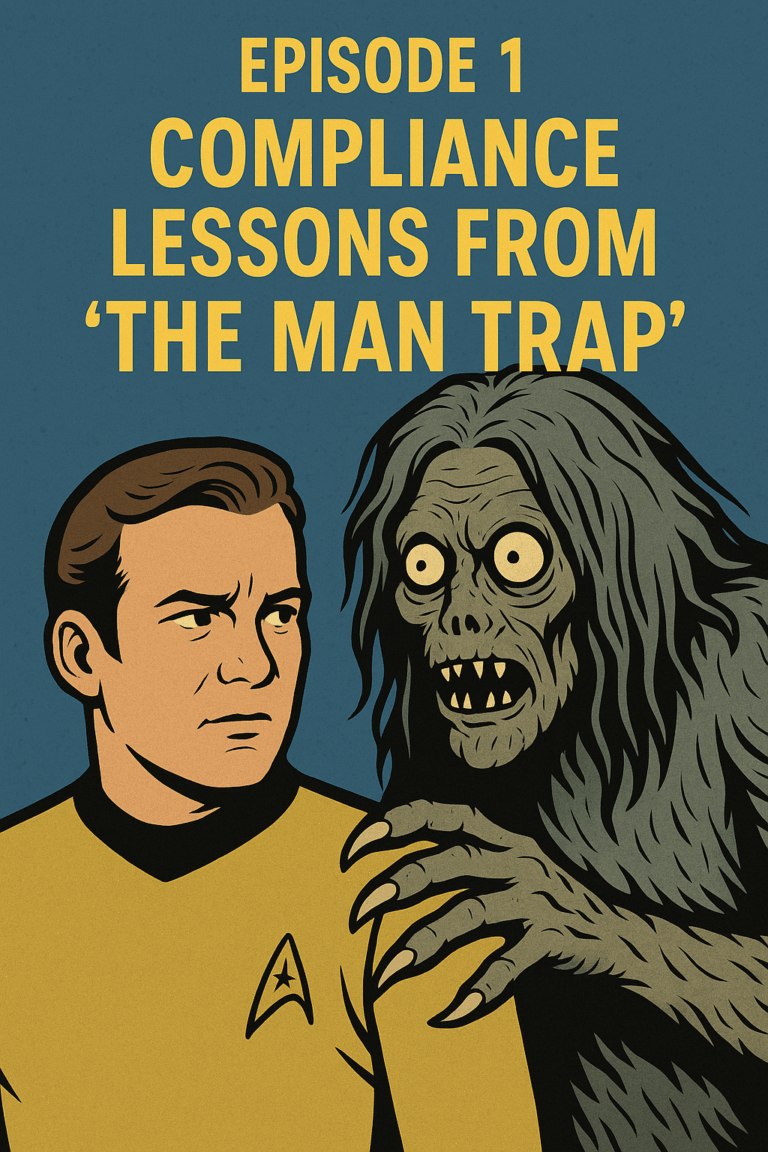
Today we consider the episode The Man Trap which aired on June 3, 1969, Star Date 5298.5. We begin by beaming down to Planet M113 with Captain Kirk and crew to uncover the compliance and leadership lessons buried in the salt-thirsty narrative of The Man Trap. This first aired Star Trek episode is not simply science fiction, rather it is a parable for today’s compliance professional. When a creature with the ability to shape-shift into anyone it wants hides among the crew, deception, emotional blind spots, and ethical hesitation threaten the integrity of the mission and the lives aboard the Enterprise.
Story
In this episode, a landing party from the Enterprise beams down to perform an annual checkup of scientist Bob Crater and his wife Nancy, who have lived on the planet M113 for 5 years. Dr. Crater and Nancy appear to be in good health, but Dr. Crater goes out of his way to request an additional salt supply from the Enterprise’s stores. A crewman wanders off and dies under mysterious circumstances. Further tests show that his body is completely devoid of salt.
Scanning the planet’s surface reveals only a single life form, so Spock and Kirk realize that Nancy must have beamed aboard the Enterprise and started searching for her. They question Dr. Crater and learn that Nancy is dead and that her form has been taken over by the planet’s last remaining indigenous creature, which can assume any form and requires salt to live.
Kirk and Spock then beam Dr. Crater aboard the Enterprise, who prevents Kirk from killing the creature (which he still sees as Nancy Crater), and then stands idly by as she begins to drain the salt from Kirk’s body. At this juncture, Spock rushes in and demonstrates to McCoy that the woman attacking Kirk could not be Nancy by striking her repeatedly and forcefully. Nancy does not flinch, sending Spock flying across the room with a single counterblow. When the creature attacks Kirk again, its proper alien form is revealed, and Bones kills it with a phaser, even after it reverts to Nancy’s form.
Key Highlights:
1. Compliance and Leadership Lessons – The Cost of Denial
Key Scene- Dr. Crater’s refusal to acknowledge the danger posed by the creature impersonating his wife Nancy.
Leadership is about difficult truths, not convenient fantasies. Dr. Crater’s emotional attachment blinds him to reality, echoing the risks faced when leaders ignore clear signs of compliance breakdowns. Just as he stalls Kirk and enables the creature’s deception, real-world executives who refuse to confront corruption or misconduct endanger the entire ship.
2. Character Dynamics – Trust, Bias, and Team Decision-Making
Key Scene- The landing party’s conflicting views of Nancy—each member sees her differently.
This episode reminds us how biases cloud judgment. The creature manipulates the crew’s perceptions, much like a charismatic fraudster might mislead auditors or compliance officers. Effective compliance teams must cultivate objectivity and challenge assumptions, especially when red flags appear under familiar disguises.
3. Ethical Decision-Making and Vigilance – When Loyalty Becomes Liability
Key Scene- McCoy’s inability to act until it’s almost too late.
McCoy’s emotional paralysis shows the danger of misplaced loyalty in corporate settings. Compliance professionals must prioritize facts over feelings. Only when Spock physically assaults the creature and reveals its true nature does McCoy accept the need for lethal action. It’s a painful but powerful lesson in balancing empathy with professional duty.
4. Storytelling and Visual Branding – Make the Message Memorable
Key Scene- The unforgettable reveal of the creature’s true alien form.
The creature’s transformation is a visual metaphor for uncovering the truth beneath appearances. For compliance programs, this underscores the importance of storytelling, compelling visuals, and emotional engagement. Dry policies don’t stick—memorable messages do. Think of the salt vampire’s final scene as a compliance training module with bite.
5. Balancing Security and Compassion – Don’t Let the Monster in the Room Stay Hidden
Key Scene- The crew’s initial desire to give Nancy space, contrasted with the need for containment.
Compassion is vital, but so is security. The crew’s hesitation to confront “Nancy” creates a vulnerability that costs lives. In corporate compliance, this translates to having the courage to investigate suspicions swiftly and without prejudice. The longer you let a problem impersonate a solution, the greater the risk to your organization
Final ComplianceLog Reflections
As we wrap up this episode, we are reminded that illusions, whether born of nostalgia, bias, or fear; can be deadly in space and in the boardroom. “The Man Trap” teaches us that truth must be pursued with vigilance, that leaders must act decisively in the face of risk, and that compliance is not simply about rules, it is also about readiness.
Resources
