


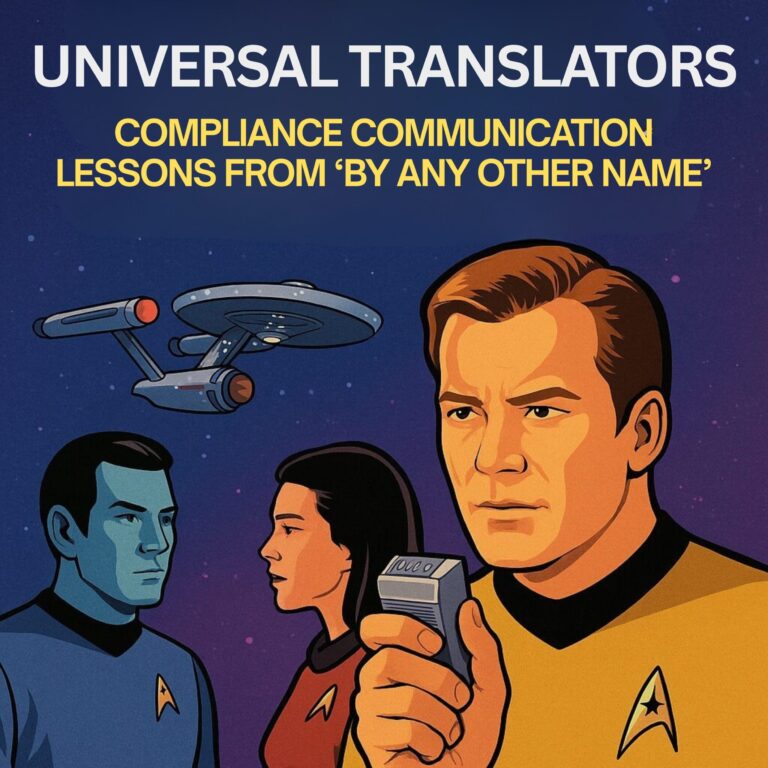
If you have been around the compliance world long enough, you have heard the refrain: “It all comes down to communication.” Whether you are launching a new code of conduct, rolling out an anti-bribery initiative, or navigating the choppy waters of a compliance investigation, your message, how it is crafted, delivered, and received, often determines your success.
There may be no better pop culture exploration of communication under pressure than Star Trek’s “By Any Other Name.” This episode, from Star Trek: The Original Series, places the crew of the Enterprise under the control of the Kelvans, alien beings with immense power, cold logic, and a total misunderstanding of what it means to be human. To survive, Kirk and his crew must out-communicate and outwit their captors, relying on every tool in their communication toolkit.
For the compliance professional, “By Any Other Name” offers a master class in the nuances of compliance communications, what works, what fails, and why the human element can never be discounted. Today, we explore five compliance communication lessons from this Star Trek classic.
Lesson 1: Know Your Audience—Tailor Your Message
Illustrated By: The Kelvans, led by Rojan, initially communicate only through blunt, logical directives. They expect total obedience from the Enterprise crew, failing to appreciate the crew’s emotional and cultural complexity. Their attempts at control falter because they don’t understand (or even attempt to understand) human motivation.
Compliance Lesson: Compliance messages cannot be one-size-fits-all. The Kelvans’ failure to adapt to their audience is a mistake compliance professionals should avoid. Employees come from diverse backgrounds, cultures, and generations; each absorbs messages differently. What motivates a finance executive in London may not resonate with a front-line worker in Houston or a vendor in Mumbai.
Effective compliance communication requires deep knowledge of your audience, their roles, their pressures, and their “language.” Avoid legalese and boilerplate. Instead, translate compliance requirements into practical, relevant, and relatable guidance. Segment your compliance communications. Use examples, languages, and platforms tailored for different employee groups and geographies. Regularly solicit feedback to ensure your message is landing as intended.
Lesson 2: Use Storytelling and Emotion—Facts Alone Don’t Move People
Illustrated By: Kirk and his crew realize the Kelvans, now in human form, are struggling with unfamiliar emotions and senses. Scotty, McCoy, and Kirk use humor, stories, and emotional appeals—not just facts—to disrupt the Kelvans’ cold logic. Scotty, famously, distracts one by sharing stories over drinks; McCoy pushes another to experience irritability and frustration.
Compliance Lesson: Compliance isn’t just about rules and policies; it’s about influencing behavior. Facts and regulations are essential, but they rarely inspire change on their own. Human beings respond to stories, emotions, and narratives. Scotty doesn’t just explain; he engages. Kirk doesn’t just threaten; he empathizes.
For compliance professionals, this means using storytelling, scenarios, and case studies in your communications. Connect compliance to employees’ values, experiences, and aspirations.
Incorporate real-world examples, ethical dilemmas, and stories, successes, and failures into your training and communications. Show how compliance makes a positive impact, not just what rules to follow.
Lesson 3: Active Listening and Feedback Loops—It’s Not Just About Talking
Illustrated By: While under Kelvan control, the Enterprise crew quietly listens, observes, and learns. They pay attention to subtle cues—the Kelvans’ confusion, discomfort, and shifting attitudes. Kirk’s plan only succeeds because he listens actively and adapts his approach based on feedback and changes in the Kelvans’ behavior.
Compliance Lesson: Too often, compliance communication is a one-way street, where policies are announced, emails are sent, and training is assigned without follow-up. But honest communication is two-way. Kirk’s ability to adapt is rooted in active listening, a skill compliance teams must master.
Effective compliance programs create channels for feedback and respond to what they learn. This can be achieved through hotlines, surveys, focus groups, or informal conversations when employees see that their input leads to change, they become more engaged and are more likely to trust the compliance function. Establishing feedback loops for every major compliance communication is also crucial. Track participation, collect questions, and respond publicly to common concerns. Use what you learn to refine your message and program continually.
Lesson 4: Adapt Communication Styles Under Pressure—Agility Matters
Illustrated By: Throughout the episode, the crew is under intense stress. Their regular routines are disrupted, and the stakes are existential. Yet Kirk and company adapt rapidly, sometimes using humor, occasionally confrontation, sometimes empathy, to keep lines of communication open and exploit cracks in Kelvan unity.
Compliance Lesson: In crises, such as investigations, enforcement actions, or cyber incidents, your standard communications playbook may not be practical. Employees will be anxious, distracted, or fearful. The best compliance communicators are agile: they adjust tone, content, and delivery to fit the moment.
This may involve more frequent updates, simpler language, or a more empathetic tone. It may also require new channels such as video messages from leadership, town halls, or direct conversations with affected teams. Develop a crisis communication plan as part of your compliance program. Practice scenario planning: How will you communicate if the unexpected happens? Build templates and train your team in flexible, adaptive messaging.
Lesson 5: Build Trust and Relationships—Compliance is Ultimately Human
Illustrated By: In the end, the crew’s success comes not from outgunning or outwitting the Kelvans through brute force, but from forging relationships. They appeal to the Kelvans’ newly awakened humanity, earning trust, and ultimately persuading Rojan to abandon conquest in favor of collaboration.
Compliance Takeaway:
All the policies and training in the world are ineffective without trust. Compliance communication is not just about transmitting information; it’s about building relationships, credibility, and psychological safety. Employees must believe that compliance is there to help them succeed, not to police or punish.
Trust is built over time, through transparency, consistency, and authenticity. It is maintained by owning up to mistakes, sharing “the why” behind decisions, and treating employees as partners in compliance. Empower compliance champions in every business unit. Provide them with the tools and support they need to model ethical behavior, answer questions, and cultivate a culture of trust. Regularly spotlight these champions and celebrate examples of “doing the right thing.”
Final ComplianceLog Reflections
“By Any Other Name” is a Star Trek episode that explores boundaries between worlds, cultures, and even species. For the compliance professional, it’s a reminder that communication is our own Universal Translator: it connects people, overcomes obstacles, and paves the way for shared understanding.
In our world, the stakes are just as high. The “aliens” we face may not come from Andromeda, but from new markets, new regulations, or emerging technologies. To navigate these challenges, compliance professionals must master the art and science of communication.
So, as you chart your course through your organization’s next compliance initiative, remember that it is not just what you say, but also how you say it, who you say it to, and how you listen, that makes all the difference.
Resources:
