


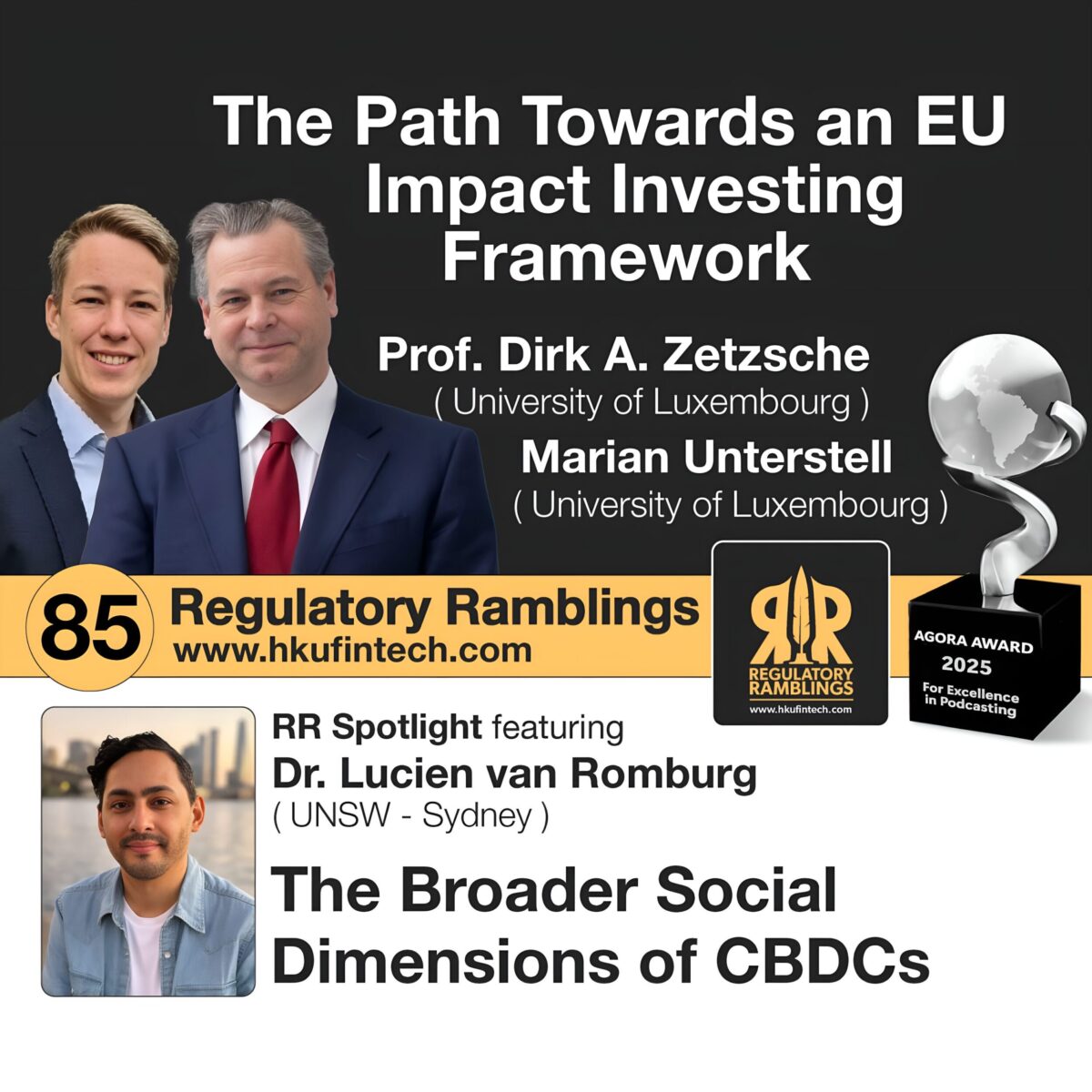
Today’s episode starts with a spotlight discussion with Dr. Lucien van Romburg of UNSW on an article he recently co-authored with Scientia Professor Ross Buckley that examines the broader social dimensions of the decision to issue central bank digital currencies (CBDC). After that, we chat with Professor Dirk Zetzsche and Marian Unterstell, both from the University of Luxembourg, about their article on the road to a European Union impact-investing framework.
Biography:
Dr. Lucien Van Romburg is a postdoctoral research fellow at the School of Private and Commercial Law and a member of the Faculty of Law & Justice at UNSW.
Professor Dirk Zetzsche is a professor of financial law, the ADA Chair in Financial Law (Inclusive Finance), and co-lead at the University of Luxembourg’s National Centre of Excellence in Financial Technology Research & Innovation. He is also coordinator of the House of Sustainable Governance & Markets and a member of the University’s Faculty of Law, Economics, and Finance, as well as head of its Law Department.
Marian Unterstell is a doctoral researcher, ADA Chair in Financial Law (Inclusive Finance), and a member of the University of Luxembourg’s Faculty of Law, Economics, and Finance.
Discussion:
The spotlight chat commences with Lucien sharing with Regulatory Ramblings host Ajay Shamdasani why broader social dimensions should be considered before central banks issue CBDC. His recent article on the matter, co-written with UNSW Scientia Professor Ross Buckley, is entitled “The Need to Address the Broader Social Dimensions in Any Decision to Issue A Retail Central Bank Digital Currency” and appears in Volume 48(3) of the UNSW Law Journal.
The abstract to the article states, “Central banks, in deciding to issue a Central Bank Digital Currency (‘CBDC’), tend to focus on how it might best support their policy objectives. While central banks typically view themselves as being in the service of society, the ‘need’ for a CBDC will usually be assessed within the scope of their primary mandates, traditionally concerned
with monetary policy. This is problematic, as grounds for issuing a CBDC that fall outside this scope may not be fully considered. We suggest that the broader societal needs and the effects of a retail CBDC should be given substantial weight in decisions about a potential CBDC. States should collaborate with central banks and other diverse sources of expertise to ensure broad public engagement and participation in deciding whether there is an actual need for a CBDC, as well as its design.”
Lucien proceeds to explain why he and Ross decided to write the article, what he believes it adds to an already large and growing body of literature on CBDC, and why it is problematic to view CBDC issuance primarily through the lens of monetary policy.
As Lucien and Ross stress in their article, “States should collaborate with central banks and other diverse sources of expertise to ensure broad public engagement and participation in deciding whether there is an actual need for a CBDC, as well as its design,” to emphasize that a CBDC may not always be recommended.
They cite the experience of the Bank of Finland’s issuance of its Avant Smart Card (often dubbed the world’s ‘first’ CBDC—although no Distributed Ledger Technology or Blockchain Technology was used in its development) as a cautionary tale of the importance of clarity about the precise reasons for issuing a retail CBDC.
“We ultimately argue that, as CBDC issuance will have society-wide effects, decisions concerning a potential CBDC, including whether there is an actual need for one, should involve multiple agencies within government and broad public engagement and participation. It should not be a process driven only by central banks and directed only through the lens of their monetary policy mandates,” they say.
Lucien takes great care to distinguish between wholesale and retail CBDCs by saying, “The arguments for a wholesale CBDC are quite different, with wholesale CBDCs potentially offering substantial efficiency gains in cross-border trade transaction payments and capital market transactions…This article focuses on retail CBDCs—those designed for use by the general population rather than by major banks and corporations. Whereas households and businesses could use a retail CBDC to effect online transactions and transfers of funds to family and friends, a wholesale CBDC would only be accessible to a limited range of market participants, such as commercial banks, and would be used to effect wholesale payments and settlements.”
Lucien and Ross’ analysis shows that although central banks serve the general public in performing their mandates, “their perceptions on the need for a CBDC may be restricted by the scope of their primary mandates, which are traditionally concerned with monetary policy and financial stability. This is problematic, as the grounds for and consequences of a CBDC issuance that fall outside this scope may not be fully considered.”
The discussion concludes with Lucien articulating the policy positions he and his co-author advocate.
Following that, we chat with Dirk and Marian about their recent article entitled “Towards an EU Impact Investing Framework,” co-authored with Ross and Professor Douglas Arner of the University of Hong Kong’s Faculty of Law and team leader of this podcast.
The abstract to their article notes: “Sustainability-oriented investors want to pay for impact, not compliance. We analyze the regulatory challenges and opportunities of impact investing. We find that advancing impact investing requires a departure from the EU Sustainable Finance Framework’s (EUSFF) prevailing input orientation and an adjustment of EU asset management law towards an EU Impact Finance Framework.”
“In its current form, the EUSFF overemphasizes exclusion, using rule-based ex ante definitions of sustainable business (herein termed input). If a large share of global capital follows these rules, the capital costs of unsustainable firms will increase, thereby furthering the development of sustainable alternatives. However, the EUSFF alone cannot prevent global capital flows into unsustainable investments, and non-EU countries follow different approaches. Although the EUSFF effectively encourages the sale of unsustainable EU businesses to non-EU firms, its input orientation has not helped the planet: the same activities continue elsewhere, often under weaker environmental and social standards, leaving the planet worse off. Further, the EUSFF’s disregard for proven ex post impacts risks large-scale capital misallocation and “impact washing.” Worse, the input focus comes at the cost of investments paired with audited evidence of positive ESG impacts ex post.”
“We argue for shifting EU financial regulation from input to (proven) impact. Yet, rather than adding a new product category, we propose recognizing positive impacts through five fine-tuned steps that simplify EU financial regulation, taking into account regulatory developments in the United Kingdom and Switzerland. These include abolishing the link between “do no significant harm” under the Taxonomy Regulation and the Sustainable Finance Disclosure Regulation, simplified reporting aligned with product materials and the emerging IFRS Disclosure Standards, introducing a new proportionality threshold for mid-sized AIFMs, and revising ESMA’s rules on fund names.”
Dirk and Marian share with Ajay the timing of their article, their intended audience, and the policy outcomes they would ideally like to see. Dirk acknowledged the burdens EU companies face in reporting on multiple variables and noted that, when it comes to European legislative reform, it was intriguing that the EU’s draft was released 10 days after the publication of their article.
The Regulatory Ramblings podcast is brought to you by The University of Hong Kong – Reg/Tech Lab, HKU-SCF Fintech Academy, Asia Global Institute, and HKU-edX Professional Certificate in Fintech, with support from the HKU Faculty of Law.
Useful links in this episode:
-
Follow Dirk Zetzsche on LinkedIn
-
Follow Marian Unterstell on LinkedIn
-
Follow Lucien van Romburg on LinkedIn
Connect with RR Podcast at:
LinkedIn: https://hk.linkedin.com/company/hkufintech
Facebook: https://www.facebook.com/hkufintech.fb/
Instagram: https://www.instagram.com/hkufintech/
Twitter: https://twitter.com/HKUFinTech
Threads: https://www.threads.net/@hkufintech
Website: https://www.hkufintech.com/regulatoryramblings
Connect with the Compliance Podcast Network at:
LinkedIn: https://www.linkedin.com/company/compliance-podcast-network/
Facebook: https://www.facebook.com/compliancepodcastnetwork/
YouTube: https://www.youtube.com/@CompliancePodcastNetwork
Twitter: https://twitter.com/tfoxlaw
Instagram: https://www.instagram.com/voiceofcompliance/
Website: https://compliancepodcastnetwork.net
