


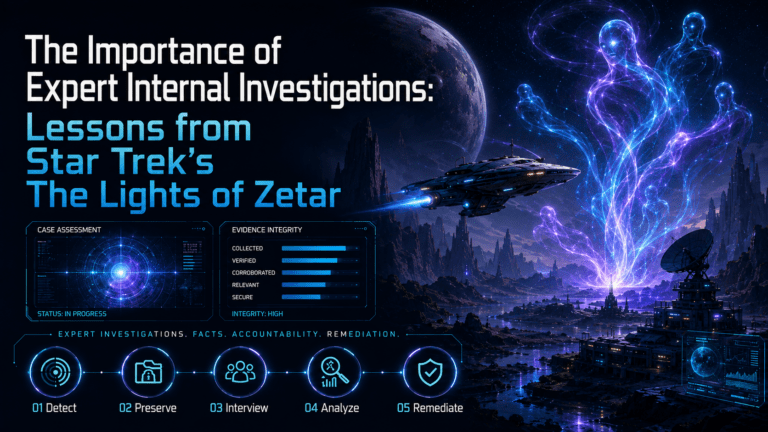
In the corporate compliance world, an internal investigation is often the moment of truth. Whether triggered by a whistleblower complaint, a regulatory inquiry, or a suspicious transaction, the investigation’s quality can determine whether the organization resolves the matter cleanly or faces prolonged legal, financial, and reputational damage.
Star Trek: The Original Series’ “The Lights of Zetar” offers a surprisingly apt allegory for why skilled professionals must handle these investigations. In this episode, the Enterprise is on its way to Memory Alpha, the Federation’s central library, when it encounters a mysterious, pulsating light phenomenon. The lights incapacitate crew members, damage ship systems, and, most dangerously, invade the mind of Lieutenant Mira Romaine, who is accompanying the mission.
The crew must determine what the lights are, what they want, and how to neutralize them before they destroy both Romaine and Memory Alpha’s priceless archives. In doing so, they conduct what is, in effect, a complex and high-stakes investigation. Their approach yields five lessons that every compliance professional should apply when running an internal investigation.
Lesson 1: Preserve and Protect Critical Evidence Immediately
Illustrated by. When the lights first strike, the Enterprise experiences sudden and unexplained system failures. The crew immediately records sensor data, secures operational logs, and isolates the damage.
Compliance Lesson. In corporate investigations, the “scene of the incident” may be a server containing emails, a ledger of transactions, or a manager’s office with physical records. Without swift action, crucial evidence can be lost, whether through routine data overwrites, deliberate destruction, or simple mishandling.
How to apply this to investigations?
- Secure relevant electronic and physical records as soon as the investigation begins.
- Suspend auto-delete protocols and ensure data preservation orders are issued.
- Document the chain of custody for all materials.
In The Lights of Zetar, the crew’s rapid evidence capture gave them the information needed to trace the lights’ origins and capabilities. Without it, they would have been operating blind.
Lesson 2: Bring in the Right Expertise Early
Illustrated by: Once Mira Romaine exhibits strange symptoms, Dr. McCoy, Spock, and Scotty each contribute their specialized knowledge, medical science, Vulcan telepathy, and engineering diagnostics to piece together what is happening.
Compliance Lesson. A proper internal investigation is rarely a one-person job. Complex matters often require diverse expertise: forensic accounting, cybersecurity, HR policy, legal analysis, and industry-specific regulatory knowledge. Relying solely on generalists can miss critical nuances.
How to apply this to investigations?
- Assemble a multidisciplinary team at the outset, including internal experts and outside specialists if needed.
- Ensure each team member understands their role and investigative boundaries.
- Involve counsel early to maintain privilege over sensitive findings.
Just as the Enterprise crew leveraged multiple skill sets to solve a problem no one discipline could crack alone, compliance officers should make strategic use of the right expertise from day one.
Lesson 3: Keep an Open Mind—The First Explanation May Be Wrong
Illustrated by: Initially, the crew assumes the lights are a natural space phenomenon. Only after gathering more evidence do they realize the lights are disembodied intelligences, survivors of the destroyed planet Zetar, seeking a human host.
Compliance Lesson. In corporate investigations, jumping to conclusions based on initial appearances can lead to flawed outcomes. What looks like simple employee misconduct may be part of a larger systemic control failure; what appears to be a minor accounting error may conceal intentional fraud.
How to apply this to investigations?
- Form working hypotheses, but treat them as provisional until confirmed by evidence.
- Explore alternative explanations, even if they seem less likely.
- Allow the facts, not convenience or organizational pressure, to drive conclusions.
Expert investigators, like the Enterprise crew, pivot their theories as new facts emerge.
Lesson 4: Protect the People Involved Throughout the Process
Illustrated by: Mira Romaine is not treated merely as a subject of inquiry; she is a valued crew member whose well-being is a priority. The investigation’s goal is not just to “solve the problem” but to save her life. Kirk ensures she receives medical care and emotional support even as they work to understand her condition.
Compliance Lesson. In internal investigations, individuals, whether complainants, witnesses, or subjects, must be treated with dignity and fairness. Mishandling these relationships can result in legal claims, loss of employee trust, and reputational harm.
How to apply this to investigations?
- Maintain confidentiality to the fullest extent possible.
- Protect against retaliation for cooperation.
- Provide updates when feasible to those affected, balancing transparency with investigative integrity.
A humane approach builds trust in the compliance function and encourages future reporting.
Lesson 5: Deliver Actionable Solutions, Not Just Findings
Illustrated by: Once the crew determines that the Zetarians are inhabiting Lt. Romaine’s body, they devise a targeted plan to remove them using controlled atmospheric pressure in a medical isolation chamber. They do not stop at identifying the cause; they implement the cure.
Compliance Lesson. An investigation that ends with a report but no corrective action is a missed opportunity. The ultimate measure of success is not uncovering what happened but ensuring it does not happen again.
How to apply this to investigations?
- Pair findings with concrete, practical recommendations for remediation.
- Address both the immediate problem and any systemic weaknesses uncovered.
- Follow up to confirm that corrective actions are implemented and effective.
The Enterprise crew’s solution not only saved Mira but also prevented the Zetarians from posing a future threat, exemplifying the kind of preventive mindset compliance investigations should aim for.
Why “The Lights of Zetar” Resonates for Compliance
In The Lights of Zetar, the stakes were both personal and institutional: the survival of a crew member and the preservation of Memory Alpha’s vast knowledge. The investigation had to be thorough, rapid, multidisciplinary, and compassionate, precisely the hallmarks of a high-quality corporate internal investigation.
An expert investigation:
- Safeguards evidence before it’s lost.
- Leverages the right mix of skills.
- Keeps the fact-finding process objective.
- Protects people while uncovering the truth.
- Produces actionable, lasting solutions.
When these principles are followed, the compliance function not only resolves incidents but also strengthens the organization’s overall resilience.
Final ComplianceLog Reflections
The Lights of Zetar reminds us that investigations are not abstract exercises—they are missions with real people, high stakes, and long-term consequences. The Enterprise crew approached their challenge with urgency, thoroughness, and empathy.
For compliance officers, the lesson is clear: every internal investigation is an opportunity to demonstrate integrity, competence, and leadership. The quality of your investigative process will be remembered long after the incident itself fades from memory.
In other words, be the Enterprise—methodical, humane, and relentless in pursuit of the truth.
Resources:
Excruciatingly Detailed Plot Summary by Eric W. Weisstein