Categories
AI Today in 5

AI Today in 5: August 12, 2026, The Small Language Model Edition

Welcome to AI Today in 5, the newest addition to the Compliance Podcast Network. Each day, Tom Fox will bring you 5 stories about AI to start your day. Sit back, enjoy a cup of morning coffee, and listen in to AI Today in 5. All from the Compliance Podcast Network. Each day, we consider five stories from the business world, compliance, ethics, risk management, leadership, or general interest about AI.

Top AI stories include:

  1. AI in a complex risk world. (Financier Worldwide)
  2. Preventing AI-generated compliance violations. (Silicon Angle)
  3. AI reshaping enterprise communications compliance. (UC Today)
  4. Payroll reshaped by compliance and AI. (FinTech Global)
  5. Target hires first AI Chief. (WSJ)

For more information on the use of AI in compliance programs, Tom Fox’s new book, Upping Your Game, is available. You can purchase a copy of the book on ⁠Amazon.com⁠.

To learn about the intersection of Sherlock Holmes and the modern compliance professional, check out Tom’s latest book, The Game is Afoot-What Sherlock Holmes Teaches About Risk, Ethics and Investigations on ⁠Amazon.com⁠.

Categories
Compliance Into the Weeds

Compliance into the Weeds: Ted Lasso, Culture and Compliance

The award winning, Compliance into the Weeds is the only weekly podcast which takes a deep dive into a compliance related topic, literally going into the weeds to more fully explore a subject. Looking for some hard-hitting insights on compliance? Look no further than Compliance into the Weeds! In this episode of Compliance into the Weeds, Tom Fox and Matt Kelly celebrate the return of Ted Lasso for Season 4.

Tom and Matt begin with why Ted Lasso resonates with compliance officers as a study of workplace dynamics, leadership, and building a culture of trust. They highlight how Ted focuses on coaching people and shaping club-wide culture through “thousands of imperceptible moments,” culminating in “total football,” where shared expectations and mutual support enable improvisation and performance. They connect this to compliance goals of embedding ethics so employees can handle new situations on the fly, and to Jim Collins’ “level five” leadership and humility, illustrated by Ted renaming Trent Crimm’s book from “The Ted Lasso Way” to “The Richmond Way.” They also link the show to the military OODA loop (observe, orient, decide, act) as a model for empowered decision-making within clear objectives and boundaries, and preview Season 4’s shift to Ted coaching a women’s team.

Key Highlights

  • Ted Lasso Returns Season Four
  • Culture and Trust at Richmond
  • Total Football and Compliance
  • The Richmond Way Leadership Lesson
  • Level Five Humility
  • OODA Loop Meets Compliance

Resources

Matt in Radical Compliance

Tom

Instagram

Facebook

YouTube

Twitter

LinkedIn

A multi-award winning podcast, Compliance into the Weeds was most recently honored as one of a Top 25 Regulatory Compliance Podcast and a Top 10 Business Law Podcast, and a Top 12 Risk Management Podcast. Compliance into the Weeds has been conferred a Davey, Communicator and w3 Award, all for podcast excellence.

Categories
Daily Compliance News

Daily Compliance News: August 12, 2026, The Judge Chastizes the DOJ (yet again) Edition

Welcome to the Daily Compliance News. Each day, Tom Fox, the Voice of Compliance, brings you compliance-related stories to start your day. Sit back, enjoy a cup of morning coffee, and listen in to the Daily Compliance News. All, from the Compliance Podcast Network. Each day, we consider four stories from the business world, compliance, ethics, risk management, leadership, or general interest for the compliance professional.

Top stories include:

  • Heat, smoke, and fire as business risks. (NYT)
  • Adani case dismissed. (Reuters)
  • White House wants new charges brought on the reflecting pool. (WSJ)
  • Corruption crackdown in Thailand. (Bangkok Post)

To learn about the intersection of Sherlock Holmes and the modern compliance professional, check out Tom’s latest book, The Game is Afoot-What Sherlock Holmes Teaches About Risk, Ethics and Investigations on Amazon.com.

Categories
Trekking Through Compliance

Trekking Through Compliance: Episode 73 – From Zetar to the C-Suite: Why Expertise Matters in Internal Investigations

In the corporate compliance world, an internal investigation is often the moment of truth. Whether triggered by a whistleblower complaint, a regulatory inquiry, or a suspicious transaction, the investigation’s quality can determine whether the organization resolves the matter cleanly or faces prolonged legal, financial, and reputational damage.

Star Trek: The Original Series’ “The Lights of Zetar” offers a surprisingly apt allegory for why skilled professionals must handle these investigations. The crew must conduct what is, in effect, a complex and high-stakes investigation. Their approach yields five lessons that every compliance professional should apply when running an internal investigation.

Lesson 1: Preserve and Protect Critical Evidence Immediately

Illustrated by. When the lights first strike, the Enterprise experiences sudden and unexplained system failures. The crew immediately records sensor data, secures operational logs, and isolates the damage.

Compliance Lesson. Without swift action, crucial evidence can be lost, whether through routine data overwrites, deliberate destruction, or simple mishandling.

Lesson 2: Bring in the Right Expertise Early

Illustrated by: Once Mira Romaine exhibits strange symptoms, Dr. McCoy, Spock, and Scotty each contribute their specialized knowledge, medical science, Vulcan telepathy, and engineering diagnostics to piece together what is happening.

Compliance Lesson. A proper internal investigation is rarely a one-person job. Complex matters often require diverse expertise: forensic accounting, cybersecurity, HR policy, legal analysis, and industry-specific regulatory knowledge.

Lesson 3: Keep an Open Mind—The First Explanation May Be Wrong

Illustrated by: Only after gathering more evidence do they realize the lights are disembodied intelligences, survivors of the destroyed planet Zetar, seeking a human host.

Compliance Lesson. In corporate investigations, jumping to conclusions based on initial appearances can lead to flawed outcomes.

Lesson 4: Protect the People Involved Throughout the Process

Illustrated by: Mira Romaine is not treated merely as a subject of inquiry; she is a valued crew member whose well-being is a priority. The investigation’s goal is not just to “solve the problem” but to save her life.

Compliance Lesson. In internal investigations, individuals, whether complainants, witnesses, or subjects, must be treated with dignity and fairness. Mishandling these relationships can result in legal claims, loss of employee trust, and reputational harm.

Lesson 5: Deliver Actionable Solutions, Not Just Findings

Illustrated by: Once the crew determines that the Zetarians are inhabiting Lt. Romaine’s body, they devise a targeted plan to remove them using controlled atmospheric pressure in a medical isolation chamber.

Compliance Lesson. An investigation that ends with a report but no corrective action is a missed opportunity. The ultimate measure of success is not uncovering what happened but ensuring it does not happen again.

Final ComplianceLog Reflections

The Lights of Zetar reminds us that investigations are not abstract exercises; they are missions with real people, high stakes, and long-term consequences. The Enterprise crew approached their challenge with urgency, thoroughness, and empathy. For compliance officers, the lesson is clear: every internal investigation is an opportunity to demonstrate integrity, competence, and leadership. The quality of your investigative process will be remembered long after the incident itself fades from memory.

Resources:

⁠⁠Excruciatingly Detailed Plot Summary by Eric W. Weisstein⁠⁠

⁠⁠MissionLogPodcast.com⁠⁠

⁠⁠Memory Alpha

Categories
Blog

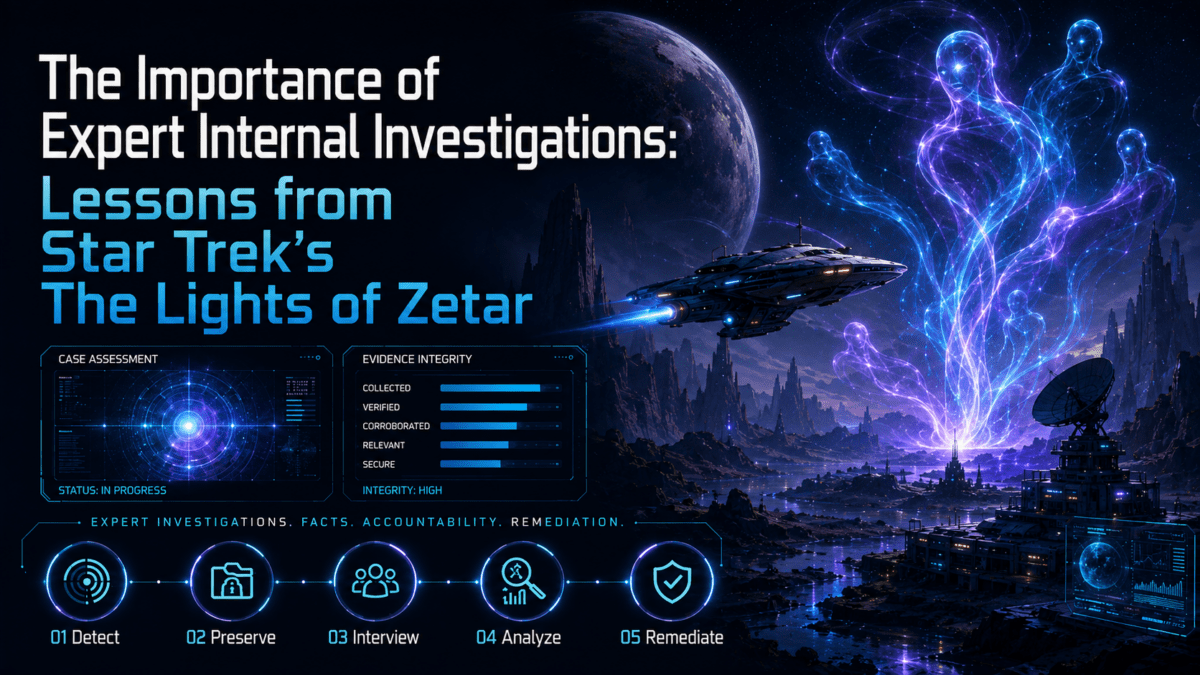
The Importance of Expert Internal Investigations: Lessons from Star Trek’s The Lights of Zetar

In the corporate compliance world, an internal investigation is often the moment of truth. Whether triggered by a whistleblower complaint, a regulatory inquiry, or a suspicious transaction, the investigation’s quality can determine whether the organization resolves the matter cleanly or faces prolonged legal, financial, and reputational damage.

Star Trek: The Original Series’ “The Lights of Zetar” offers a surprisingly apt allegory for why skilled professionals must handle these investigations. In this episode, the Enterprise is on its way to Memory Alpha, the Federation’s central library, when it encounters a mysterious, pulsating light phenomenon. The lights incapacitate crew members, damage ship systems, and, most dangerously, invade the mind of Lieutenant Mira Romaine, who is accompanying the mission.

The crew must determine what the lights are, what they want, and how to neutralize them before they destroy both Romaine and Memory Alpha’s priceless archives. In doing so, they conduct what is, in effect, a complex and high-stakes investigation. Their approach yields five lessons that every compliance professional should apply when running an internal investigation.

Lesson 1: Preserve and Protect Critical Evidence Immediately

Illustrated by. When the lights first strike, the Enterprise experiences sudden and unexplained system failures. The crew immediately records sensor data, secures operational logs, and isolates the damage.

Compliance Lesson. In corporate investigations, the “scene of the incident” may be a server containing emails, a ledger of transactions, or a manager’s office with physical records. Without swift action, crucial evidence can be lost, whether through routine data overwrites, deliberate destruction, or simple mishandling.

How to apply this to investigations?

  • Secure relevant electronic and physical records as soon as the investigation begins.
  • Suspend auto-delete protocols and ensure data preservation orders are issued.
  • Document the chain of custody for all materials.

In The Lights of Zetar, the crew’s rapid evidence capture gave them the information needed to trace the lights’ origins and capabilities. Without it, they would have been operating blind.

Lesson 2: Bring in the Right Expertise Early

Illustrated by: Once Mira Romaine exhibits strange symptoms, Dr. McCoy, Spock, and Scotty each contribute their specialized knowledge, medical science, Vulcan telepathy, and engineering diagnostics to piece together what is happening.

Compliance Lesson. A proper internal investigation is rarely a one-person job. Complex matters often require diverse expertise: forensic accounting, cybersecurity, HR policy, legal analysis, and industry-specific regulatory knowledge. Relying solely on generalists can miss critical nuances.

How to apply this to investigations?

  • Assemble a multidisciplinary team at the outset, including internal experts and outside specialists if needed.
  • Ensure each team member understands their role and investigative boundaries.
  • Involve counsel early to maintain privilege over sensitive findings.

Just as the Enterprise crew leveraged multiple skill sets to solve a problem no one discipline could crack alone, compliance officers should make strategic use of the right expertise from day one.

Lesson 3: Keep an Open Mind—The First Explanation May Be Wrong

Illustrated by: Initially, the crew assumes the lights are a natural space phenomenon. Only after gathering more evidence do they realize the lights are disembodied intelligences, survivors of the destroyed planet Zetar, seeking a human host.

Compliance Lesson. In corporate investigations, jumping to conclusions based on initial appearances can lead to flawed outcomes. What looks like simple employee misconduct may be part of a larger systemic control failure; what appears to be a minor accounting error may conceal intentional fraud.

How to apply this to investigations?

  • Form working hypotheses, but treat them as provisional until confirmed by evidence.
  • Explore alternative explanations, even if they seem less likely.
  • Allow the facts, not convenience or organizational pressure, to drive conclusions.

Expert investigators, like the Enterprise crew, pivot their theories as new facts emerge.

Lesson 4: Protect the People Involved Throughout the Process

Illustrated by: Mira Romaine is not treated merely as a subject of inquiry; she is a valued crew member whose well-being is a priority. The investigation’s goal is not just to “solve the problem” but to save her life. Kirk ensures she receives medical care and emotional support even as they work to understand her condition.

Compliance Lesson. In internal investigations, individuals, whether complainants, witnesses, or subjects, must be treated with dignity and fairness. Mishandling these relationships can result in legal claims, loss of employee trust, and reputational harm.

How to apply this to investigations?

  • Maintain confidentiality to the fullest extent possible.
  • Protect against retaliation for cooperation.
  • Provide updates when feasible to those affected, balancing transparency with investigative integrity.

A humane approach builds trust in the compliance function and encourages future reporting.

Lesson 5: Deliver Actionable Solutions, Not Just Findings

Illustrated by: Once the crew determines that the Zetarians are inhabiting Lt. Romaine’s body, they devise a targeted plan to remove them using controlled atmospheric pressure in a medical isolation chamber. They do not stop at identifying the cause; they implement the cure.

Compliance Lesson. An investigation that ends with a report but no corrective action is a missed opportunity. The ultimate measure of success is not uncovering what happened but ensuring it does not happen again.

How to apply this to investigations?

  • Pair findings with concrete, practical recommendations for remediation.
  • Address both the immediate problem and any systemic weaknesses uncovered.
  • Follow up to confirm that corrective actions are implemented and effective.

The Enterprise crew’s solution not only saved Mira but also prevented the Zetarians from posing a future threat, exemplifying the kind of preventive mindset compliance investigations should aim for.

Why “The Lights of Zetar” Resonates for Compliance

In The Lights of Zetar, the stakes were both personal and institutional: the survival of a crew member and the preservation of Memory Alpha’s vast knowledge. The investigation had to be thorough, rapid, multidisciplinary, and compassionate, precisely the hallmarks of a high-quality corporate internal investigation.

An expert investigation:

  • Safeguards evidence before it’s lost.
  • Leverages the right mix of skills.
  • Keeps the fact-finding process objective.
  • Protects people while uncovering the truth.
  • Produces actionable, lasting solutions.

When these principles are followed, the compliance function not only resolves incidents but also strengthens the organization’s overall resilience.

Final ComplianceLog Reflections

The Lights of Zetar reminds us that investigations are not abstract exercises—they are missions with real people, high stakes, and long-term consequences. The Enterprise crew approached their challenge with urgency, thoroughness, and empathy.

For compliance officers, the lesson is clear: every internal investigation is an opportunity to demonstrate integrity, competence, and leadership. The quality of your investigative process will be remembered long after the incident itself fades from memory.

In other words, be the Enterprise—methodical, humane, and relentless in pursuit of the truth.

Resources:

⁠⁠Excruciatingly Detailed Plot Summary by Eric W. Weisstein⁠⁠

⁠⁠MissionLogPodcast.com⁠⁠

⁠⁠Memory Alpha

Categories
Great Women in Compliance

Great Women in Compliance: Beyond the Balance Sheet: Ethics Lessons from Australia’s Accounting Scandals

For this #GWIC roundtable episode, Lisa Fine and Ellen Hunt spoke with two renowned experts, Francine McKenna and Ursula Schmidt, about what Ethics & Compliance professionals should learn from recent accounting firm scandals in Australia.

Listen in as our guests help us unravel:

  • why similar scandals keep happening,
  • how the incentives and pressure at play in these scandals are universal,
  • the important role that culture plays,
  • how auditors and others should live up to their professional standards, and
  • why we still ignore those that bring issues forward.

There are lessons in these scandals for every #Ethics and #Compliance professional on how to improve your culture and program. A huge thank you to Francine and Ursula for sharing their insights, expertise, and wisdom with us.

Categories
Blog

THE BERKO TRIAL – PART 3: What the Jury Decided: Reading the Berko Verdict Without Overreading It

We continue our deep dive into the Asante Berko FCPA conviction. Today we consider the jury’s verdict. The jury returned three guilty verdicts. That is the decisive legal result, but it is not a line-by-line adoption of the prosecution’s closing argument. For compliance professionals, the discipline is to hold both propositions at once. The government proved the charged crimes beyond a reasonable doubt. Yet the general verdict does not tell us which email the jurors found decisive, how they interpreted every payment, or whether they accepted every factual statement later included in the government’s announcement. That distinction is not lawyerly hedging. It is the foundation of a credible enforcement analysis.

Three Convictions, One Clear Result

After a nine-day trial, a federal jury convicted Asante Kwaku Berko of conspiracy to violate the Foreign Corrupt Practices Act (FCPA), a substantive FCPA violation, and conspiracy to commit money laundering. Federal criminal verdicts must be unanimous. The jury therefore agreed that the government had proved the elements of each of the three counts submitted to it under the court’s instructions. Moreover the jury convicted in just over three hours which in a major criminal case is an extraordinarily short jury deliberation.

At a high level, the conspiracy verdict established Berko’s knowing participation in an agreement to violate the FCPA. The substantive verdict established criminal responsibility for the charged corrupt-payment offense. The money laundering conspiracy verdict established participation in an agreement to move funds internationally to promote FCPA violations. The indictment identifies the statutory theories and alleged conduct, but it remains a charging document. It is not a substitute for the jury instructions or the verdict itself.

The result also defeated the defense’s central trial position. The defense argued that the government had not proved the last mile between funds paid to intermediaries and funds received by Ghanaian officials. No alleged recipient testified. No Ghanaian witness took the stand. No downstream bank record showed a payment to an official. The jury nevertheless found the government’s complete proof sufficient beyond a reasonable doubt. That is what the verdict establishes. The boundaries are equally important.

A General Verdict Is Not a Set of Special Findings

A general verdict answers the ultimate question on each count: guilty or not guilty. It does not ordinarily explain the jury’s reasoning. It does not identify which witness the jurors credited, which inference they drew from a particular email, or what weight they assigned to the undercover recording.

That means we should not write that the jury separately found every alleged recipient, every alleged payment amount, or every characterization of an intermediary to be true. We can say that prosecutors presented those facts and argued those inferences. We can say that the defense disputed them. We can say that the jury convicted on all three counts. Those are distinct propositions, and sound compliance writing should keep them distinct.

The same rule applies to intent. The jury’s verdict necessarily reflects a finding of the criminal intent required by the instructions for each count. It does not disclose whether jurors inferred that intent primarily from off-channel communications, milestone-timed payments, cash withdrawals, the recorded lunch, Berko’s alleged personal compensation, the interaction with Goldman’s compliance process, or the cumulative force of all of them. The verdict is conclusive as to guilt at this stage. It is silent about the internal path the jury took to reach that result.

How the Mosaic Answered the Missing Last Mile

The government’s case did not depend on one witness producing a receipt for a bribe. It offered multiple streams of circumstantial evidence: more than 300 emails, separate personal and corporate communication channels, transfers to intermediaries, financial-flow charts, payments aligned with government approvals, compliance questions, cash discussions, and a secretly recorded lunch.

The defense tested each stream separately. Emails lacked testimony from their participants. Payments stopped short of the alleged officials. The confidential source had potential incentives. The recorded conversation involved prompting, translation, and hypothetical facts. Goldman’s withdrawal reflected a corporate risk judgment, not the criminal burden of proof.

The jury rejected reasonable doubt. The most supportable inference is that the combined evidence overcame the defense’s missing-link argument. That remains an inference because the jurors did not issue an explanation. Still, it offers an important proof lesson: independent evidence streams can corroborate one another even when no single item tells the whole story. For a compliance investigation, that lesson cuts both ways. A red flag is not a legal element, and a collection of suspicions does not automatically prove misconduct. But communications, transaction timing, money flows, control circumvention, and personal benefit can become mutually reinforcing. The analytical task is to test whether the pieces converge, conflict, or merely sit beside one another.

Three Dollar Figures, Three Source Regimes

The amounts associated with the case show why attribution matters. The 2020 indictment alleged that Berko and others caused more than $700,000 in bribes to be transferred to Ghanaian officials. DOJ stated after the verdict that the government proved more than $1 million in bribes at trial. The SEC’s civil complaint alleged that the Turkish energy company transferred at least $2.5 million to a Ghana-based intermediary, all or most of which was used for bribes. Those are not interchangeable totals. They arise from different documents, legal proceedings, time periods, and descriptions of the money flow. The $2.5 million figure concerns transfers to an intermediary. The other figures describe alleged or trial-proven bribes. Some sums may overlap, but the public sources do not support collapsing them into one number.

The SEC matter adds another essential qualifier. Berko consented to the 2021 final judgment without admitting or denying the complaint’s allegations, except as specifically provided for bankruptcy purposes. The judgment imposed an injunction and required $275,000 in disgorgement plus $54,163.92 in prejudgment interest. It did not convert every allegation in the SEC complaint into a generally admitted fact. This source discipline is central to compliance credibility. Indictments allege. Trial evidence supports arguments. Advocates characterize. Verdicts decide counts. Civil settlements may resolve claims without admissions. A strong analysis identifies the category before drawing the lesson.

The Verdict Is an Endpoint and a Starting Point

The trial reporting states that the jury deliberated for approximately three hours and that sentencing was scheduled for November 10, 2026. Berko was remanded pending sentencing. Post-trial motions, sentencing proceedings, and any appeal could add to the record, so the procedural status should be checked again before publication. Things do not bode well for Asante at this point.

For now, the legal conclusion is clear. Berko was convicted on all three counts submitted to the jury. The editorial conclusion should be equally clear. The verdict establishes criminal liability at trial, not a special finding on every email, payment, witness, amount, or corporate-control question in the surrounding narrative. That is not a limitation on the importance of the case. It is how serious compliance professionals preserve trust. They distinguish what is known, what was argued, what was disputed, what was decided, and what remains an inference.

Join us tomorrow for Part 4 as we will move from verdict discipline to transaction discipline: whether a functioning compliance program could have identified and interrupted the pattern earlier.

Resources

United States v. Berko, No. 1:20-cr-00328-DG, Indictment, ECF No. 3 (E.D.N.Y. filed Aug. 26, 2020)

Stewart Bishop, “Goldman Jury Sees Cash Talk in Energy Deal Email Deluge,” Law360, Aug. 1, 2026; Stewart Bishop, “Goldman Exec Was Linchpin to Ghana Bribery Ploy, Jury Told,” Law360, Aug. 5, 2026.

Stewart Bishop, “Ex-Goldman Exec Convicted of Ghana Bribery Plot,” Law360, Aug. 6, 2026. Supplied trial reporting.

U.S. Attorney’s Office for the Eastern District of New York, “Former Goldman Sachs Investment Banker Convicted of Foreign Bribery and Money Laundering,” Aug. 6, 2026, DOJ Press Release.

Stewart Bishop, “Goldman Jury Sees Undercover Video as Bribe Trial Nears End,” Law360, Aug. 4, 2026. Supplied trial reporting.

Stewart Bishop, “Shady Power Deal Used in Goldman Compliance Prep, Jury Told,” Law360, July 29, 2026

Stewart Bishop, “Like Milli Vanilli, Goldman FCPA Case Is a Ruse, Jury Told,” Law360, July 28, 2026.

SEC Final Judgment against Asante Berko

SEC Complaint against Asante Berko