Categories
Blog

Where No Man Has Gone Before: Power, Ego, and the Ethics of Control

In this episode of Trekking Through Compliance, we consider Where No Man Had Gone Before, which aired on September 22, 1966, Star Date 1312.4. We board the Enterprise as it breaches the edge of the galaxy and the boundaries of ethical power. When a mysterious force transforms navigator Gary Mitchell into a godlike being with unchecked telepathic abilities, his rapid descent into tyranny presents a sobering metaphor for the compliance professional. With rising powers come rising risks, and Kirk must choose between loyalty to a friend and duty to his crew. Today, we explore five key compliance takeaways from Where No Man Has Gone Before, showing how early-stage risk, power imbalances, and ethical hesitation can transform even trusted employees into existential threats for your organization.

Story

This is the first Star Trek episode made (not counting the pilot episode, The Cage), although not the first aired. It differs from subsequent episodes in that there is no “Space, the final frontier” voice-over during the theme song at the beginning.

The Enterprise discovers a 200-year-old ship recorder from the SS Valiant near the galaxy’s edge. Shortly after, the Enterprise passes through an unknown phenomenon that causes major damage and knocks out navigators Gary Mitchell and Dr. Elizabeth Dehner (both of whom have high ESP ratings). When Gary recovers, he begins to acquire telepathic and telekinetic powers. Kirk, alarmed at the prospect of having his ship taken over by an increasingly powerful and tyrannical Mitchell, is convinced by Spock to maroon Mitchell at the lithium cracking plant of Delta Vega. Dr. Piper has no explanation for what is happening. Gary kills Lee Kelso and escapes from his imprisonment. Kirk follows him and can destroy him with the help of Dr. Dehner, who is also beginning to acquire the power but kills herself in the process.

Key highlights:

1. Emerging Risks – Early Signs Should Trigger Action, Not Complacency

🖖 Illustrated by: Gary Mitchell’s glowing eyes and ESP abilities appearing shortly after the Enterprise crosses the galactic barrier.

The moment Mitchell begins reading faster, manipulating objects, and demonstrating control over ship systems, it’s clear something’s wrong. But initial responses are muted—like many corporate environments where emerging risks are downplayed. Compliance teams must be trained to treat anomalies seriously, regardless of the individual’s charisma or seniority.

2. Leadership and Ethical Courage – Friendship vs Responsibility

🖖 Illustrated by: Kirk’s emotional struggle to deal with Mitchell, his long-time friend.

Kirk hesitates—understandably so—because of his relationship with Mitchell. But ultimately, he chooses duty over sentiment. Compliance officers are often put in a similar spot: when someone close to leadership violates ethical norms, will the organization act? Ethical courage means prioritizing institutional integrity over personal comfort.

3. Power Without Accountability – Why Guardrails Matter

🖖 Illustrated by: Mitchell’s growing powers and his assertion of superiority over the crew.

With no checks on his abilities, Mitchell quickly develops a god complex. This is a chilling representation of what happens when key employees—CFOs, procurement officers, or engineers—operate without oversight. Just because someone is brilliant or “indispensable” doesn’t mean they’re beyond the reach of your compliance program.

4. Escalation Protocols and the Role of Outside Advisers

🖖 Illustrated by: Spock’s insistence that Mitchell be isolated and marooned.

Spock serves as outside counsel—offering unemotional advice grounded in logic. Every company needs this voice. Internal politics often cloud judgment; a good compliance officer, like Spock, keeps the focus on what must be done to protect the enterprise. His advice to act decisively is what ultimately saves the crew.

5. Shared Risk and Collective Action – The Role of Allies in Enforcement

🖖 Illustrated by: Dr. Dehner’s decision to sacrifice herself to stop Mitchell.

Dehner, who initially defends Mitchell, comes to see the threat he poses and joins Kirk in neutralizing him. Her journey mirrors that of employees who shift from enabling bad behavior to becoming whistleblowers or allies in enforcement. Compliance success depends on empowering people like Dehner to act before it’s too late.

Final StarLog Reflections

Where No Man Has Gone Before gives us a blueprint for compliance at the edge of the unknown. It reminds us that rapid change, whether from new tech, new hires, or new business environments, demands rapid, courageous compliance responses. Waiting too long to act can mean the difference between course correction and catastrophe.

Resources:

Excruciatingly Detailed Plot Summary by Eric W. Weisstein

MissionLogPodcast.com

Memory Alpha

Categories
Trekking Through Compliance

Trekking Through Compliance: Episode 2 – Leadership and Training Lessons from Charlie X

In this episode of Trekking Through Compliance for 2026, we consider leadership and training lessons from Charlie X, which aired on September 15, 1966, Star Date 1533.6.

Story

The USS Enterprise meets the merchant vessel Antares to take charge of Charlie Evans, the sole survivor of a transport ship that crashed on Thasus. For fourteen years, seventeen-year-old Charlie grew up alone, stranded in the wreckage, learning to communicate with the ship’s computer systems, which remained intact.

Despite his eagerness to please, Charlie becomes obnoxious because his lack of upbringing has left him without knowledge of social norms or control over his emotions. He latches on to Captain Kirk as a father figure and develops an infatuation with Yeoman Janice Rand. He demonstrates extraordinary telepathic and matter-transmutation powers. When the Antares is nearly out of sensor range, it transmits a message to the Enterprise. The message is cut off before it can convey a warning. Scanners show that Antares has been reduced to debris.

Realizing Charlie’s powers are too great to be controlled, Kirk opts to divert from Alpha V to at least keep Charlie away from a civilized world where he would wreak havoc. Charlie discovers Kirk’s plans and takes control of the Enterprise.

A Thasian ship approaches and restores the Enterprise and its crew to their proper forms. The Thasian commander says that his race gave Charlie his powers so he could survive in their world, but these powers (which they can’t remove from him) make him too dangerous to live among humans. Charlie begs Kirk not to let the aliens have him since the Thasians lack any physical form or capacity for love. However, the Thasians reject Kirk’s argument that Charlie belongs with his kind, with a final echoing wail of “I wanna stay!

Commentary

The episode explores the story of Charlie Evans, a young man with dangerous telekinetic powers, and draws parallels to modern compliance and mental health issues. Tom discusses the responsibilities that come with power, the importance of training and supervision, handling unpredictable behavior, clear communication, crisis management, and addressing misconduct. He also reflects on recent real-world events, such as the Uvalde school shooting and the challenges of addressing mental health in compliance programs.

Key highlights:

1. The Responsibilities of Power—Strength Without Structure

🖖 Illustrated by: Charlie turning crew members into nothingness when they anger him.

Charlie is gifted with tremendous abilities but lacks any ethical framework or boundaries. This is a vivid metaphor for what happens when individuals inside an organization gain influence or access without training or accountability. Think of an unmonitored executive with access to financial controls or an engineer with override access but no compliance training—a ticking time bomb.

2. Training and Supervision—It’s Not Optional, It’s Essential

🖖 Illustrated by: Kirk’s attempt to guide Charlie and his later regret at not recognizing the full scope of the risk.

Charlie’s guardianship was left to chance: no proper onboarding, no safety protocols. Sound familiar? In corporate compliance, onboarding isn’t just about day one—it’s about culture shaping. Organizations must ensure that individuals with a higher risk potential receive both guidance and oversight from the outset.

3. Unpredictable Behavior and Ethical Culture—From Red Flag to Alarm Bell

🖖 Illustrated by: Charlie’s mood swings and escalating aggression, which are repeatedly ignored until it’s too late.

The crew notices early signs—jealousy, possessiveness, emotional outbursts—but tolerates them. This reflects the real-world danger of brushing off early signs of a toxic culture. A strong compliance function identifies behavioral red flags before they escalate into corporate crises.

4. Communication and Escalation Protocols—Say Something, Do Something

🖖 Illustrated by: Janice Rand’s discomfort and unease around Charlie, which she initially tries to manage on her own.

Rand’s growing fear underscores the difficulty of speaking up, especially when someone powerful appears to be protected. Her reluctance reminds us that a speak-up culture is not automatic. Companies must establish genuine channels for complaints, empower employees to utilize them, and respond promptly and transparently.

5. Crisis Management—Too Late is Still Too Late

🖖 Illustrated by: The crew’s loss of control over the Enterprise, forcing alien intervention to remove Charlie.

The crew fails to contain the situation internally. It takes external, godlike beings to restore order—a cautionary tale for compliance leaders. If a company waits until the crisis has gone public or regulatory bodies step in, internal credibility is lost. Crisis planning and early intervention are crucial in protecting the organization before outside authorities are required to intervene.

Resources:

Excruciatingly Detailed Plot Summary by Eric W. Weisstein

MissionLogPodcast.com

Memory Alpha

Categories
Blog

Charlie X: Power Without Boundaries – A Compliance Nightmare

Today, we explore the explosive volatility of Charlie X—a story about unchecked power, emotional instability, and the dire consequences of failing to enforce rules and structure. Charlie Evans, a teenage orphan raised by aliens, is taken aboard the Enterprise, possessing extraordinary telekinetic abilities but lacking social training, emotional discipline, and accountability. That combination proves disastrous. We consider how Charlie’s descent into violence mirrors risks faced by compliance professionals when misconduct is ignored, misbehavior is tolerated, and power is given without oversight. In today’s corporate world, “Charlie X” is less about space and more about leadership responsibility, psychological safety, and early intervention.

Key Highlights and Star Trek Case Studies:

1. The Responsibilities of Power—Strength Without Structure

This is illustrated by Charlie turning crew members into nothingness when they anger him.

Charlie is gifted with tremendous abilities but lacks any ethical framework or boundaries. This is a vivid metaphor for what happens when individuals inside an organization gain influence or access without training or accountability. Think of an unmonitored executive with access to financial controls or an engineer with override access but no compliance training—a ticking time bomb.

2. Training and Supervision—It’s Not Optional, It’s Essential

This is illustrated by Kirk’s attempt to guide Charlie and his later regret at not recognizing the full scope of the risk.

Charlie’s guardianship was left to chance, with no proper onboarding and no safety protocols. Sound familiar? In corporate compliance, onboarding isn’t just about day one—it’s about culture shaping. Organizations must ensure that individuals with a higher risk potential receive both guidance and oversight from the outset.

3. Unpredictable Behavior and Ethical Culture—From Red Flag to Alarm Bell

This is illustrated by Charlie’s mood swings and escalating aggression, which are repeatedly ignored until it’s too late.

The crew notices early signs, such as jealousy and possessiveness, but tolerates them. This reflects the real-world danger of brushing off early signs of a toxic culture. A strong compliance function identifies behavioral red flags before they escalate into corporate crises.

4. Communication and Escalation Protocols—Say Something, Do Something

This is illustrated by Janice Rand’s discomfort and unease around Charlie, which she initially tries to manage on her own.

Rand’s growing fear underscores the difficulty of speaking up, especially when someone powerful appears to be protected. Her reluctance reminds us that a speak-up culture is not automatic. Companies must establish genuine channels for complaints, empower employees to utilize them, and respond promptly and transparently.

5. Crisis Management—Too Late is Still Too Late

This is illustrated by the crew’s loss of control of the Enterprise, which forced alien intervention to remove Charlie.

The crew fails to contain the situation internally. It takes external, godlike beings to restore order—a cautionary tale for compliance leaders. If a company waits until the crisis has gone public or regulatory bodies step in, internal credibility is lost. Crisis planning and early intervention are crucial in protecting the organization before outside authorities are required to intervene.

Final ComplianceLog Reflections

Charlie X reminds us that power without oversight is perilous, that emotional and psychological health must be part of our compliance focus, and that red flags must not be ignored simply because they come wrapped in charm or vulnerability. Compliance is not simply about policies, procedures, or even rules but rather readiness, responsiveness, and respect for the human element.

Resources:

Excruciatingly Detailed Plot Summary by Eric W. Weisstein

MissionLogPodcast.com

Memory Alpha

Categories
Blog

The Man Trap: Salt Vampires, Soft Controls, and the Price of Inaction

Today, we consider the Star Trek: TOS episode “The Man Trap,” which aired on June 3, 1969, Star Date 5298.5. We mine it for compliance and leadership lessons.  We begin by beaming down to Planet M113 with Captain Kirk and crew to uncover the compliance and leadership lessons buried in the salt-thirsty narrative of The Man Trap. This first-aired Star Trek episode is not simply science fiction; rather, it is a parable for today’s compliance professional. When a creature with the ability to shapeshift into anyone it wants hides among the crew, deception, emotional blind spots, and ethical hesitation threaten the mission’s integrity and the lives aboard the Enterprise.

Story

In this episode, a landing party from the Enterprise beams down to perform an annual checkup of scientist Bob Crater and his wife Nancy, who have lived on the planet M113 for 5 years. Dr. Crater and Nancy appear to be in good health, but Dr. Crater goes out of his way to request an additional salt supply from the Enterprise’s stores. A crewman wanders off and dies under mysterious circumstances. Further tests show that his body is completely devoid of salt.

Scanning the planet’s surface reveals only a single life form, so Spock and Kirk realize that Nancy must have beamed aboard the Enterprise and started searching for her. They question Dr. Crater and learn that Nancy is dead and that her form has been taken over by the planet’s last remaining indigenous creature, which can assume any form and requires salt to live.

Kirk and Spock then beam Dr. Crater aboard the Enterprise, who prevents Kirk from killing the creature (which he still sees as Nancy Crater), and then stands idly by as she begins to drain the salt from Kirk’s body. At this juncture, Spock rushes in and demonstrates to McCoy that the woman attacking Kirk could not be Nancy by striking her repeatedly and forcefully. Nancy does not flinch, sending Spock flying across the room with a single counterblow. When the creature attacks Kirk again, its proper alien form is revealed, and Bones kills it with a phaser, even after it reverts to Nancy’s form.

Key highlights:

1. Compliance and Leadership Lessons – The Cost of Denial

Key Scene—Dr. Crater’s refusal to acknowledge the danger posed by the creature impersonating his wife, Nancy.

Leadership is about difficult truths, not convenient fantasies. Dr. Crater’s emotional attachment blinds him to reality, echoing the risks faced when leaders ignore clear signs of compliance breakdowns. Just as he stalls Kirk and enables the creature’s deception, real-world executives who refuse to confront corruption or misconduct endanger the entire ship.

2. Character Dynamics – Trust, Bias, and Team Decision-Making

Key Scene—The landing party’s conflicting views of Nancy—each member sees her differently.

This episode reminds us how biases cloud judgment. The creature manipulates the crew’s perceptions, much like a charismatic fraudster might mislead auditors or compliance officers. Effective compliance teams must cultivate objectivity and challenge assumptions, especially when red flags appear under familiar disguises.

3. Ethical Decision-Making and Vigilance – When Loyalty Becomes Liability

Key Scene—McCoy’s inability to act until it’s almost too late.

McCoy’s emotional paralysis shows the danger of misplaced loyalty in corporate settings. Compliance professionals must prioritize facts over feelings. Only when Spock physically assaults the creature and reveals its true nature does McCoy accept the need for lethal action. It’s a painful but powerful lesson in balancing empathy with professional duty.

4. Storytelling and Visual Branding – Make the Message Memorable

Key Scene—The unforgettable reveal of the creature’s true alien form.

The creature’s transformation is a visual metaphor for uncovering the truth beneath appearances. For compliance programs, this underscores the importance of storytelling, compelling visuals, and emotional engagement. Dry policies don’t stick—memorable messages do. Think of the salt vampire’s final scene as a compliance training module with bite.

5. Balancing Security and Compassion – Don’t Let the Monster in the Room Stay Hidden

Key Scene—The crew’s initial desire to give Nancy space, contrasted with the need for containment.

Compassion is vital, but so is security. The crew’s hesitation to confront “Nancy” creates a vulnerability that costs lives. In corporate compliance, this translates to having the courage to investigate suspicions swiftly and without prejudice. The longer you let a problem impersonate a solution, the greater the risk to your organization

Final ComplianceLog Reflections

As we wrap up this episode, we are reminded that illusions, whether born of nostalgia, bias, or fear, can be deadly in space and in the boardroom. “The Man Trap” teaches us that truth must be pursued with vigilance, that leaders must act decisively in the face of risk, and that compliance is not simply about rules; it is also about readiness.

Resources:

Excruciatingly Detailed Plot Summary by Eric W. Weisstein

MissionLogPodcast.com

Memory Alpha
Categories
Trekking Through Compliance

Trekking Through Compliance: Episode 79 – Beneath the Surface: Turnabout Intruder and the Hunt for Root Causes

One of the Department of Justice’s most consistent themes in its 2024 Update to the Evaluation of Corporate Compliance Programs (ECCP) is the need for companies to conduct effective root cause analysis following misconduct or control failures. It’s not enough to just identify what went wrong; you must understand why it happened and implement measures to prevent it from happening again.

For compliance professionals, the episode is a surprisingly apt case study in the perils of failing to dig past the surface when something seems off. Just as the crew needed to piece together the real cause of their captain’s strange behavior, compliance teams must be adept at peeling back layers to discover the true root cause of problems. Here are five key root cause analysis lessons from Turnabout Intruder.

Lesson 1: Unusual Behavior Should Trigger an Investigation

Illustrated by: Shortly after the mind swap, “Kirk” begins making uncharacteristic decisions, belittling subordinates, ignoring Starfleet protocols, and punishing dissent in ways that are completely out of character for the captain.

Compliance Lesson:

Behavior that deviates from established patterns should be a red flag. In corporate compliance, abrupt changes, whether in employee conduct, financial reporting patterns, or transaction activity, often indicate deeper issues.

Lesson 2: Multiple Data Points Build a Stronger Case

Illustrated by: Several crew members—Spock, McCoy, Scotty—each notice something odd about “Kirk.” Only when they share information do they begin to see a pattern that suggests something is seriously wrong.

Compliance Lesson.  Root cause analysis is stronger when it integrates multiple perspectives and sources of data. If you rely on a single source, one audit, one complaint, you risk drawing incomplete or biased conclusions.

Lesson 3: Be Alert to Hidden Motives

Illustrated by: In Kirk’s body, Lester uses her new authority to sideline suspected opponents, reassigning or threatening crew who question her behavior.

Compliance Lesson. The apparent cause of a problem may mask deeper personal or organizational motives. Misconduct often occurs because someone is pursuing goals that conflict with corporate policy, whether financial gain, personal vendettas, or reputational enhancement.

Lesson 4: Authority Structures Can Delay Recognition of the Problem

Illustrated by: Even when evidence mounts, the crew is reluctant to challenge “Kirk” because of the chain of command.

Compliance Lesson. In organizations, hierarchy can be a barrier to identifying root causes. Employees may hesitate to report misconduct by senior leaders, or they may assume questionable directives are “above their pay grade” to question.

Lesson 5: Validate Assumptions Before Acting

Illustrated by Spock, eventually confronts “Kirk” and demands an explanation. Through logical analysis and a mind meld, he confirms the body-swap truth.

Compliance Lesson. One of the biggest pitfalls in root cause analysis is acting on unverified assumptions. If you jump to conclusions too early, you may “fix” the wrong problem—or make it worse.

Final ComplianceLog Reflections

In Turnabout Intruder, the crew’s slow realization of the true problem nearly cost them their captain and perhaps the Enterprise itself. In the compliance arena, a slow or shallow root cause analysis can allow misconduct to persist, control weaknesses to remain unaddressed, and systemic issues to metastasize. Effective compliance leadership means not just spotting what’s wrong but relentlessly pursuing why it went wrong. That’s how you fix the problem in a way that prevents recurrence.

 Resources:

⁠⁠Excruciatingly Detailed Plot Summary by Eric W. Weisstein⁠⁠

⁠⁠MissionLogPodcast.com⁠⁠

⁠⁠Memory Alpha

Categories
Trekking Through Compliance

Trekking Through Compliance: Episode 77 – Through the Atavachron: Risk Management Insights from All Our Yesterdays

When you think of Star Trek: The Original Series, certain episodes stand out for their moral clarity, exploration of ethics, and leadership lessons. Others, like All Our Yesterdays, are more subtle but no less rich in compliance and risk management insights.

As the story unfolds, the episode reveals more than just a sci-fi adventure; it presents a compelling case study in the importance of preparation, situational awareness, adaptability, and decision-making under pressure. For the compliance professional, All Our Yesterdays offers five key risk management lessons that are as relevant in the boardroom as they are in a time-portal crisis.

Lesson 1: Understand the Operating Environment Before You Act

Illustrated by: Kirk, Spock, and McCoy don’t fully grasp that the Atavachron sends people into different periods, permanently altering them to survive there, until after they have stepped through the portals.

Compliance Lesson. One of the most preventable compliance failures happens when leaders act without fully understanding the operational landscape.

Lesson 2: Know the Long-Term Consequences of Your Decisions

Illustrated by: Atoz explains that once a traveler passes through the Atavachron, they undergo physiological changes to survive in the chosen period. Returning without those adaptations can be fatal.

Compliance Lesson. Compliance decisions, especially around risk tolerance, often have long-term and sometimes irreversible consequences. For example, approving a high-risk third party because “we need them for this deal” can embed systemic vulnerabilities that are difficult to unwind later.

Lesson 3: Adapt Your Strategy to Changing Conditions

Illustrated by: Spock, under the influence of the prehistoric era, begins to revert to the more emotional mindset of ancient Vulcans, displaying anger, impatience, and even affection for Zarabeth, a woman trapped in that time

Compliance Lesson. Risk environments are dynamic. Market conditions shift, laws change, counterparties evolve, and cultural contexts can reshape behavior, sometimes subtly, sometimes dramatically.

Lesson 4: Factor in Human Behavior When Assessing Risk

Illustrated by: Zarabeth tells Spock and McCoy they can never return to their own time, a claim that at first appears to be based on Atoz’s rules but is also shaped by her emotional motives.

Compliance Lesson. Risk management isn’t just about numbers, metrics, or legal frameworks—it’s about people, their incentives, and their biases.

Lesson 5: Time Is a Critical Risk Variable

Illustrated by: The central urgency in All Our Yesterdays comes from the imminent nova of Sarpeidon’s sun. For Kirk, Spock, and McCoy, the clock is ticking.

Compliance Lesson. In compliance risk management, timing is often the difference between proactive control and reactive crisis.

Final Compliance Reflections

All Our Yesterdays may be set in a science fiction universe, but its lessons are firmly grounded in the reality of corporate compliance. Every compliance officer will, at some point, face the equivalent of a ticking sun about to go nova, a high-stakes situation where incomplete information, shifting conditions, human bias, and the relentless march of time intersect.

Remember, you may not have an Atavachron in your compliance toolkit, but you do have the power to choose which “yesterday” you’ll prepare for today. The right risk management approach ensures that, when the heat is on, your organization is not scrambling for the exit portal, as it’s already where it needs to be.

Resources:

⁠⁠Excruciatingly Detailed Plot Summary by Eric W. Weisstein⁠⁠

⁠⁠MissionLogPodcast.com⁠⁠

⁠⁠Memory Alpha

Categories
Blog

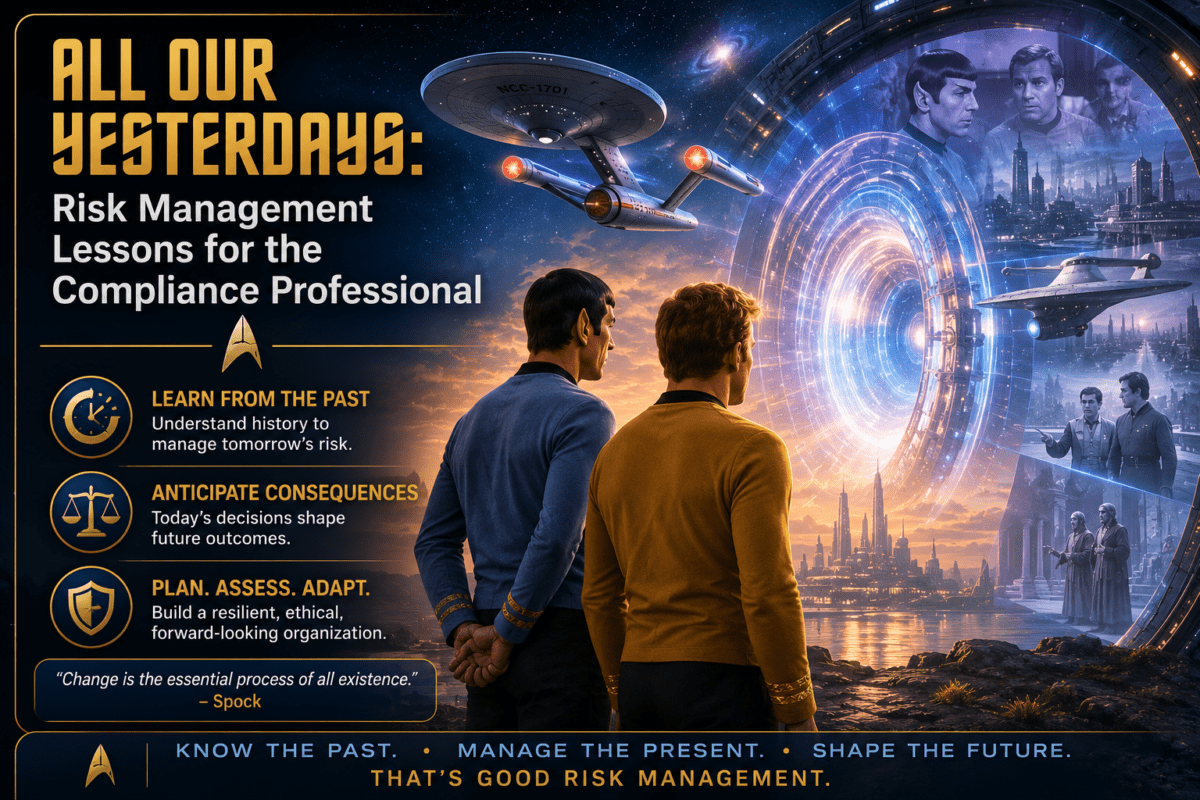
All Our Yesterdays:Risk Management Lessons for the Compliance Professional

When you think of Star Trek: The Original Series, certain episodes stand out for their moral clarity, exploration of ethics, and leadership lessons. Others, like All Our Yesterdays, are more subtle but no less rich in compliance and risk management insights.

In this episode, Captain Kirk, Mr. Spock, and Dr. McCoy beam down to the planet Sarpeidon just before its sun is about to go nova. They find the planet seemingly deserted except for a mysterious librarian named Mr. Atoz. He explains that the people have escaped into the planet’s past using a time travel device called the Atavachron. Unfortunately, in true Star Trek fashion, the landing party becomes separated; Kirk into a duel-filled era resembling the late Middle Ages, and Spock and McCoy into a frozen prehistoric wilderness.

As the story unfolds, the episode reveals more than just a sci-fi adventure; it presents a compelling case study in the importance of preparation, situational awareness, adaptability, and decision-making under pressure. For the compliance professional, All Our Yesterdays offers five key risk management lessons that are as relevant in the boardroom as they are in a time-portal crisis.

Lesson 1: Understand the Operating Environment Before You Act

Illustrated by: When Kirk, Spock, and McCoy first arrive, they assume the library is a static place in the present day. They don’t fully grasp that the Atavachron sends people into different periods, permanently altering them to survive there, until after they have stepped through the portals.

Compliance Lesson. One of the most preventable compliance failures happens when leaders act without fully understanding the operational landscape. Just as Kirk should have gathered more intelligence before stepping through the portal, compliance officers must conduct thorough due diligence before making high-impact decisions, especially in new markets or with new business models.

Jumping into a jurisdiction with unfamiliar regulatory structures or cultural norms without advance research can leave your compliance program operating with blind spots. A robust risk assessment, stakeholder mapping, and regulatory scan are your “Atavachron briefing”; without them, you’re walking through the wrong portal unprepared.

Lesson 2: Know the Long-Term Consequences of Your Decisions

Illustrated by: Atoz explains that once a traveler passes through the Atavachron, they undergo physiological changes to survive in the chosen period. Returning without those adaptations can be fatal. This means each journey into the past is not just a visit—it’s a permanent commitment.

Compliance Lesson. Compliance decisions, especially around risk tolerance, often have long-term and sometimes irreversible consequences. For example, approving a high-risk third party because “we need them for this deal” can embed systemic vulnerabilities that are difficult to unwind later.

Spock and McCoy’s plight in the ice age is a reminder that once certain paths are chosen, backing out may be impossible or costly. Before green-lighting any strategy or business partner, ask: What will be the long-term compliance footprint? Are we setting ourselves up for future exposure? Risk management is not just about the next quarter; it’s about the next decade.

Lesson 3: Adapt Your Strategy to Changing Conditions

Illustrated by Spock, under the influence of the prehistoric era, begins to revert to the more emotional mindset of ancient Vulcans, displaying anger, impatience, and even affection for Zarabeth, a woman trapped in that time. McCoy, ill from the cold, must rely on Spock’s shifting judgment to survive.

Compliance Lesson. Risk environments are dynamic. Market conditions shift, laws change, counterparties evolve, and cultural contexts can reshape behavior, sometimes subtly, sometimes dramatically. The compliance officer must be alert to these shifts and recalibrate strategies accordingly.

Like Spock, even seasoned professionals can find themselves influenced by their environment in ways they don’t immediately recognize. Compliance teams need to build monitoring systems that not only track external risk factors but also assess how those factors may be affecting decision-makers internally. Adaptation is not a sign of weakness—it’s a core competency in sustainable risk management.

Lesson 4: Factor in Human Behavior When Assessing Risk

Illustrated by: Zarabeth tells Spock and McCoy they can never return to their own time, a claim that at first appears to be based on Atoz’s rules but is also shaped by her emotional motives. Her loneliness influences how she frames the “facts.”

Compliance Lesson. Risk management isn’t just about numbers, metrics, or legal frameworks—it’s about people, their incentives, and their biases. Vendors may hide problems to protect their contracts. Employees may omit details in self-reporting to avoid blame. Executives may downplay risk to push through a deal.

Zarabeth’s well-intentioned but self-serving misinformation underscores the need for independent verification of claims. Compliance programs should be designed to collect and validate facts from multiple sources, reducing the risk of being swayed by the partial truths of a single stakeholder.

Lesson 5: Time Is a Critical Risk Variable

Illustrated by: The central urgency in All Our Yesterdays comes from the imminent nova of Sarpeidon’s sun. The people had to evacuate into the past before the moment of destruction; anyone left behind would perish. For Kirk, Spock, and McCoy, the clock is ticking.

Compliance Lesson. In compliance risk management, timing is often the difference between proactive control and reactive crisis. Delaying a decision, such as suspending a suspicious transaction, escalating a whistleblower report, or halting engagement with a questionable vendor, can mean the difference between a manageable incident and a reputational disaster.

The episode reinforces the importance of early detection and swift action. Compliance teams should have rapid-response protocols, much like an evacuation plan, that can be activated the moment credible risk signals appear. The longer you wait, the narrower your options become.

Final Compliance Reflections

All Our Yesterdays may be set in a science fiction universe, but its lessons are firmly grounded in the reality of corporate compliance. Every compliance officer will, at some point, face the equivalent of a ticking sun about to go nova, a high-stakes situation where incomplete information, shifting conditions, human bias, and the relentless march of time intersect.

The episode reminds us that effective risk management is not simply about having a well-written policy. It’s about equipping yourself and your team to:

  • Anticipate the terrain.
  • Weigh long-term consequences before stepping through the “portal.”
  • Stay agile under environmental pressures.
  • Test assumptions and verify information.
  • Act decisively when the moment demands it.

In All Our Yesterdays, Kirk, Spock, and McCoy return to the present just in time, thanks to quick thinking, adaptability, and the ability to work within and around constraints. In the corporate compliance world, those same skills can mean the difference between a controlled risk event and a full-blown regulatory disaster.

Remember, you may not have an Atavachron in your compliance toolkit, but you do have the power to choose which “yesterday” you’ll prepare for today. The right risk management approach ensures that, when the heat is on, your organization is not scrambling for the exit portal as it’s already where it needs to be.

 Resources:

⁠⁠Excruciatingly Detailed Plot Summary by Eric W. Weisstein⁠⁠

⁠⁠MissionLogPodcast.com⁠⁠

⁠⁠Memory Alpha

Categories
Trekking Through Compliance

Trekking Through Compliance: Episode 76 – Compliance Lessons from The Savage Curtain

“Risk is our business.” That famous Star Trek line could have been the mission statement for the crew of the USS Enterprise, but in The Savage Curtain, the stakes go beyond exploration. In this third-season episode, Captain Kirk and Mr. Spock find themselves on an alien world where the inhabitants are exceedingly powerful rock-like beings called the Excalbians. They wish to understand the human concept of “good” versus “evil.”

For compliance professionals, this episode is not simply entertaining television. It is a cautionary tale about strategy, values, and decision-making under artificial constraints. Let’s break down five key compliance lessons drawn from specific scenes in this episode.

Lesson 1: Don’t Let Others Define Your Risk Framework

Illustrated by: The Excalbians set the rules: neither side chooses the battle or the stakes; an outside force imposes the game. 

Compliance Lesson. In corporate compliance, outside parties, whether regulators, counterparties, or even internal leadership, will often try to define the rules of engagement for you. The DOJ, SEC, or FCA may issue guidance, but how you operationalize compliance must be tailored to your actual risk environment.

Lesson 2: Values Are Not Negotiable—Even in Crisis

Illustrated by: Surak refuses to fight, insisting on diplomacy, even in the face of certain danger.

Compliance Lesson. Surak’s actions remind us that integrity is not situational. Compliance officers are often tested during crises, such as internal investigations, regulatory inquiries, or public scandals.

Lesson 3: Understand the Motivation of Counterparties

Illustrated by: Colonel Green’s playbook is deception, appearing cooperative while preparing for betrayal.

Compliance Lesson. Whether in third-party due diligence or merger negotiations, understanding your counterpart’s motivations is critical. Many compliance failures stem from taking partners at their word without sufficient verification.

Lesson 4: Artificial Constraints Can Lead to Poor Decision-Making

Illustrated by: The Excalbians insist on the “fight to the death” framework, creating an artificial zero-sum game.

Compliance Lesson. In corporate life, artificial constraints abound, such as budgets, headcount limits, and executive impatience, which can all restrict compliance’s ability to operate effectively. But as in Kirk’s case, the right move may be to challenge the premise rather than just optimize within it.

Lesson 5: Your Team Matters as Much as Your Tactics

Illustrated by: Kirk’s team, himself, Spock, Lincoln, and Surak are thrown together without preparation. The balance between them becomes the key to surviving long enough to disrupt the “game.”

Compliance Lesson. A compliance program’s strength is often determined by the diversity and capability of the team executing it. You need investigators who can dig into allegations, trainers who can communicate policy effectively, and analysts who can interpret data for early risk detection.

Final ComplianceLog Reflections 

The Savage Curtain is a study in imposed frameworks, moral steadfastness, and tactical adaptability. It challenges the viewer and the compliance professional to think beyond the rules handed down by external forces and to operate from a foundation of values and strategic thinking.

Compliance is not a spectator sport. One cannot simply sit back and hope “good” will automatically prevail over “evil.” Like Kirk, you must assess the terrain, understand your adversaries, hold fast to your principles, and adapt your strategy as the situation evolves.

Resources:

⁠⁠Excruciatingly Detailed Plot Summary by Eric W. Weisstein⁠⁠

⁠⁠MissionLogPodcast.com⁠⁠

⁠⁠Memory Alpha

Categories
Blog

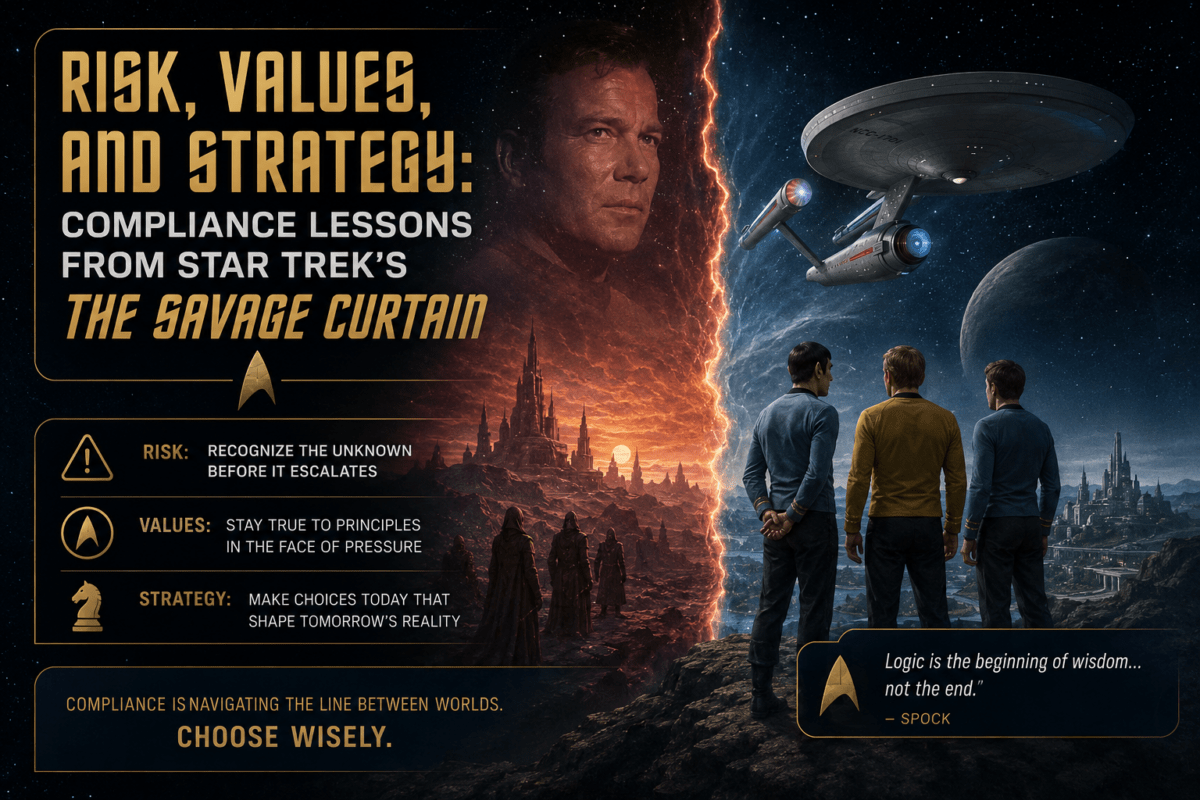
Risk, Values, and Strategy: Compliance Lessons from Star Trek’s The Savage Curtain

“Risk is our business.” That famous Star Trek line could have been the mission statement for the crew of the USS Enterprise, but in The Savage Curtain, the stakes go beyond exploration. In this third-season episode, Captain Kirk and Mr. Spock find themselves on an alien world where the inhabitants are exceedingly powerful rock-like beings called the Excalbians. They wish to understand the human concept of “good” versus “evil.”

Their method? Stage a brutal live-fire exercise. Kirk and Spock are joined by simulacra of Abraham Lincoln and Vulcan philosopher Surak to face off against history’s worst villains, including Genghis Khan, Colonel Green, and the infamous Kahless the Unforgettable. The “experiment” is framed as an even match: good versus evil, winner takes all.

For compliance professionals, this episode is not simply entertaining television. It is a cautionary tale about strategy, values, and decision-making under artificial constraints. Let’s break down five key compliance lessons drawn from specific scenes in this episode.

Lesson 1: Don’t Let Others Define Your Risk Framework 

Illustrated by: The Excalbians set the rules: “Good” and “Evil” must fight to the death to determine which is stronger. Neither side chooses the battle or the stakes; an outside force imposes the game. 

Compliance Lesson. In corporate compliance, outside parties, whether regulators, counterparties, or even internal leadership, will often try to define the rules of engagement for you. The DOJ, SEC, or FCA may issue guidance, but how you operationalize compliance must be tailored to your actual risk environment.

Just as Kirk recognizes that the “good versus evil” frame is oversimplified, compliance officers must resist one-size-fits-all risk frameworks. For example, your anti-bribery program should be proportionate to your industry, geographic exposure, and transaction types, not simply modeled after someone else’s checklist. Engage in your risk assessment rather than allowing external expectations to be your sole guide. If you let others set the terms without challenge, you may fight the wrong battle.

Lesson 2: Values Are Not Negotiable—Even in Crisis

Illustrated by: Surak refuses to fight, insisting on diplomacy, even in the face of certain danger. He walks into the enemy camp to seek peace, believing in the Vulcan principle that violence is never the solution.

Compliance Lesson. Compliance officers are often tested during crises, such as internal investigations, regulatory inquiries, or public scandals. It’s tempting to compromise core values for short-term survival, but history shows that cutting ethical corners rarely pays off.

Surak’s actions remind us that integrity is not situational. If your code of conduct says zero tolerance for harassment, then “business necessity” cannot be used as an excuse to retain a high-revenue-producing employee who violates policy. Upholding your organization’s stated values during pressure situations is what gives a compliance program credibility. Abandoning them for expediency sends the message that values are negotiable. 

Lesson 3: Understand the Motivation of Counterparties

Illustrated by Colonel Green, a historical war criminal known for treachery, tries to lure Surak into a trap under the guise of negotiation. His playbook is deception, appearing cooperative while preparing betrayal.

Compliance Lesson. Whether in third-party due diligence or merger negotiations, understanding your counterpart’s motivations is critical. Many compliance failures stem from taking partners at their word without sufficient verification. Colonel Green’s tactics mirror real-world fraud: a vendor may present clean paperwork while secretly using sub-vendors in high-risk jurisdictions. A merger target may tout strong compliance policies while quietly ignoring them in practice. Always conduct independent verification. Trust, but verify, and if the counterpart has a history of misconduct, verify twice.

Lesson 4: Artificial Constraints Can Lead to Poor Decision-Making 

Illustrated by: The Excalbians insist on the “fight to the death” framework, creating an artificial zero-sum game. Kirk must operate under these imposed constraints, but he constantly probes for alternatives, looking for ways to change the rules rather than just playing along.

Compliance Lesson. In corporate life, artificial constraints abound—budgets, headcount limits, and executive impatience can all restrict compliance’s ability to operate effectively. But as in Kirk’s case, the right move may be to challenge the premise rather than optimize within it.

If management tells you, “We can only afford bare-minimum training,” the compliance leader’s job is to show why more robust training mitigates costly enforcement risk, potentially saving multiples of its cost. Don’t let imposed constraints blind you to creative solutions. Sometimes, the most compliant and most business-savvy move is to reframe the problem.

Lesson 5: Your Team Matters as Much as Your Tactics

Illustrated by: Kirk’s team, himself, Spock, Lincoln, and Surak are thrown together without preparation. Each has different skills: Kirk’s tactical thinking, Spock’s logic, Lincoln’s leadership, and Surak’s diplomacy. The balance between them becomes the key to surviving long enough to disrupt the “game.”

Compliance Lesson. A compliance program’s strength is often determined by the diversity and capability of the team executing it. You need investigators who can dig into allegations, trainers who can communicate policy effectively, and analysts who can interpret data for early risk detection.

In the episode, when Surak is lost, the team becomes less effective, underscoring how the absence of one skillset can weaken the whole effort. In compliance, losing your data analytics capacity or your investigative lead without a succession plan can leave your program vulnerable. Build a multidisciplinary compliance team and invest in cross-training to ensure no single point of failure.

Final ComplianceLog Reflections 

The Savage Curtain is a study in imposed frameworks, moral steadfastness, and tactical adaptability. It challenges the viewer and the compliance professional to think beyond the rules handed down by external forces and to operate from a foundation of values and strategic thinking.

Compliance is not a spectator sport. One cannot simply sit back and hope “good” will automatically prevail over “evil.” Like Kirk, you must assess the terrain, understand your adversaries, hold fast to your principles, and adapt your strategy as the situation evolves.

In the end, the Excalbians learn little from their experiment, but the audience knows a lot. For compliance professionals, the lesson is that our “games” are not staged for the benefit of alien observers; they’re real, with real consequences for people, businesses, and reputations. And unlike Kirk, we can choose the rules we operate under, if we dare to assert them.

Resources:

⁠⁠Excruciatingly Detailed Plot Summary by Eric W. Weisstein⁠⁠

⁠⁠MissionLogPodcast.com⁠⁠

⁠⁠Memory Alpha

Categories
Trekking Through Compliance

Trekking Through Compliance: Episode 75 – Bridging the Gap: Compliance Lessons on Justice and Fairness from “The Cloud Minders”

Institutional justice and institutional fairness are not abstract ideals. They are operational requirements in a corporate compliance program. They define how policies are enforced, how decisions are made, and how employees perceive the integrity of their workplace. One of the most vivid illustrations of the dangers of systemic injustice and perceived unfairness comes from Star Trek: The Original Series in “The Cloud Minders.”

From this story, we can extract five compliance lessons on institutional justice and institutional fairness.

Lesson 1: Consistency in Standards Is Non-Negotiable

Illustrated by:  The leaders of Stratos apply rules differently depending on social status.

Compliance Lesson. The DOJ has repeatedly emphasized that policies and disciplinary measures must be applied consistently.

Lesson 2: Address Root Causes, Not Just Symptoms

Illustrated by: The Troglytes’ performance and health are impaired because mining zenite exposes them to toxic vapors. The elites interpret this as proof of inferiority, ignoring the environmental cause.

Compliance Lesson. Organizations sometimes treat compliance failures as isolated misconduct rather than symptoms of deeper issues, such as inadequate training, unrealistic sales targets, or flawed incentive structures.

Lesson 3: Perceived Fairness Matters as Much as Actual Fairness

Illustrated by: Even when Kirk offers protective gear to the Troglytes, they are slow to trust his intentions. Years of mistreatment have convinced them that promises from the elites are empty.

Compliance Parallel: Employees judge compliance programs not only by their design but by how fair they feel in practice. If people believe investigations are biased or that whistleblowers will be punished, they will avoid reporting, even if the official policy says otherwise.

Lesson 4: Leadership Must Model Ethical Behavior

Illustrated by: Stratos’s leaders speak about justice and stability, but are unwilling to live under the same risks or hardships as the Troglytes. Their detachment from the reality of mining life fuels the unrest.

Compliance Lesson. Leaders who preach ethics but cut corners for themselves undermine institutional fairness. Employees take cues from the top; if executives are exempt from rules, the rest of the organization will follow suit.

Lesson 5: Dialogue and Inclusion Are Tools for Justice

Illustrated by: Spock approaches the Troglytes with genuine respect, listening to their grievances and acknowledging their intelligence. His willingness to engage earns him credibility that Stratos leaders lack.

Compliance Parallel: Institutional fairness is strengthened when employees feel heard and included in shaping solutions.

Final ComplianceLog Reflections

The Cloud Minders is more than a parable about class division; it is a warning for any institution that neglects fairness and justice. In Ardana, injustice created resentment, distrust, and rebellion. In a corporation, those same dynamics can lead to silent disengagement, hidden misconduct, and public scandal.

The DOJ’s message is clear: fairness and justice are not optional add-ons to compliance; they are the foundation of a program that works. As compliance leaders, our role is to be the “Spock” in the room, listening, respecting, and bridging divides while ensuring that the rules are fair, transparent, and consistently applied.

When we do that, we do not just comply with the DOJ’s expectations; we build organizations where people trust the system enough to make it work.

Resources:

⁠⁠Excruciatingly Detailed Plot Summary by Eric W. Weisstein⁠⁠

⁠⁠MissionLogPodcast.com⁠⁠

⁠⁠Memory Alpha