Categories
Blog

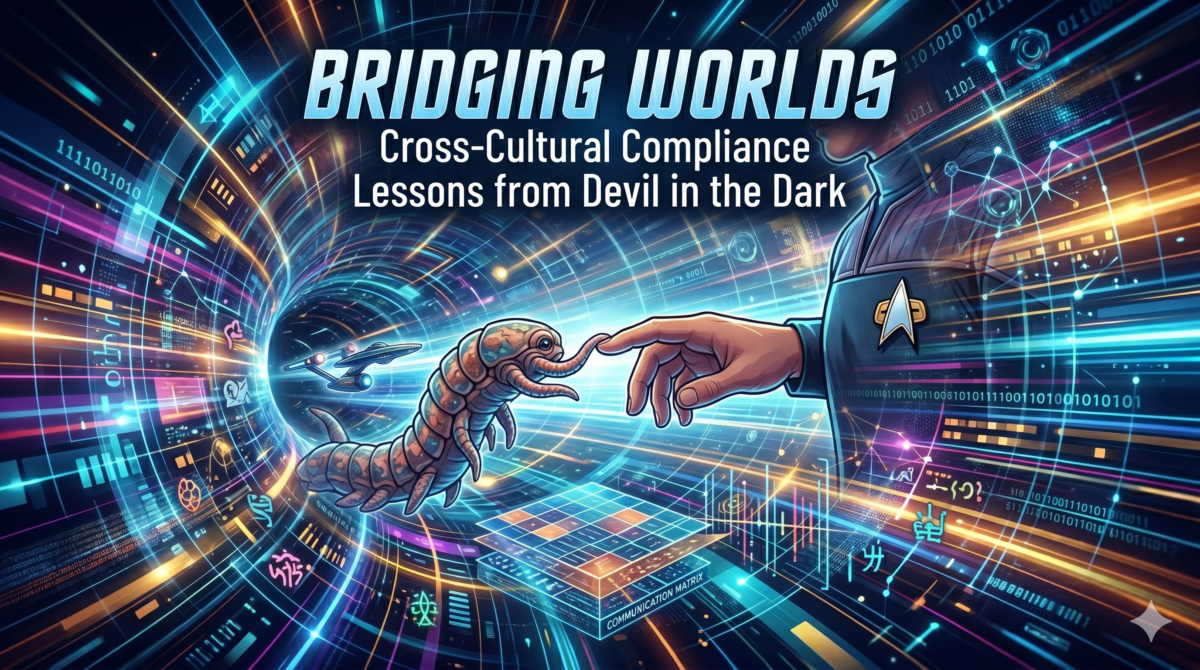
Bridging Worlds: Cross-Cultural Compliance Lessons from Devil in the Dark

Show Summary

Star Trek has always served as a powerful lens through which to view not just the potential future of humanity but the contemporary complexities we face today. The classic episode “Devil in the Dark” is a compelling exploration of misunderstandings, communication breakdowns, and reconciliation between vastly different cultures—lessons that resonate strongly with corporate compliance officers navigating today’s global marketplace.

In “Devil in the Dark,” the USS Enterprise is dispatched to investigate mysterious deaths in a mining colony. What initially seems like straightforward monster attacks turns out to be a profound misunderstanding between humans and an alien creature called the Horta. Today, we will examine five key compliance lessons that corporate professionals can learn from the iconic Star Trek episode.

Lesson 1: Recognize and Challenge Your Own Biases

Illustrated By: When the Enterprise crew arrives, the miners describe a monstrous creature attacking and killing miners, labeling it simply as a dangerous beast to be eliminated. Their preconceived notions blinded them to the possibility of understanding the creature.

Compliance Lesson: Like the miners’ initial response, corporate biases can obscure critical perspectives and valuable information. Compliance professionals must actively recognize and challenge their assumptions and biases. It’s critical to maintain impartiality, especially during investigations, risk assessments, or due diligence processes involving diverse international markets. Conducting training sessions on unconscious bias and regularly revisiting corporate procedures helps organizations maintain objectivity and fairness.

Lesson 2: Effective Communication Requires Genuine Effort and Empathy

Illustrated By: The turning point of the episode comes when Spock mind-melds with the Horta. Through genuine empathy and effort, he discovers that the Horta is not malevolent but is protecting its offspring, the silicon nodules that the miners had inadvertently been destroying.

Compliance Lesson: Effective communication across cultural boundaries requires empathy, openness, and genuine effort. Corporate compliance teams operating in multinational contexts must make sincere efforts to communicate effectively with global partners, subsidiaries, and stakeholders. Language barriers, differing business practices, and cultural nuances can lead to costly misunderstandings. Investing in cross-cultural training, employing bilingual staff, and engaging empathetically with diverse perspectives strengthens communication and helps prevent costly compliance failures.

Lesson 3: Cultural Awareness as a Risk Mitigation Strategy

Illustrated by: The miners’ failure to recognize the silicon nodules as living offspring stems from ignorance about the Horta’s culture and biology. This ignorance creates hostility and unnecessary conflict.

Compliance Lesson: Cultural ignorance significantly increases compliance risk, especially in international operations. Understanding local cultural norms, regulatory landscapes, and business ethics is vital for operating ethically and legally across jurisdictions. Companies must integrate cultural intelligence training into their compliance programs, conduct thorough risk assessments, and cultivate local relationships to enhance awareness and understanding. This proactive approach mitigates misunderstandings and ethical lapses, fostering respectful and legally compliant international operations.

Lesson 4: Embrace Diversity to Foster Innovation and Solutions

Illustrated By: The Enterprise crew’s diverse backgrounds and experiences enable them to devise innovative solutions. Spock’s unique Vulcan abilities allow communication with the Horta, transforming a volatile situation into a collaborative one.

Compliance Lesson: Diversity is not only ethically commendable but also strategically vital. Diverse compliance teams bring a range of varied experiences, perspectives, and problem-solving approaches, which are essential for effectively managing complex compliance challenges. Organizations should proactively recruit and empower diverse talent in compliance roles, ensuring a range of perspectives when assessing risks and resolving compliance-related issues. Embracing diversity fosters innovation and resilience in managing compliance across various markets.

Lesson 5: Seek Win-Win Solutions through Collaboration

Illustrated By: Ultimately, Captain Kirk brokers a cooperative agreement between the miners and the Horta, allowing peaceful coexistence and mutual benefit. The miners extracting resources and the Horta species continue unharmed.

Compliance Lesson: Effective compliance strategies often involve creative, collaborative solutions that benefit multiple stakeholders. Compliance professionals should adopt a win-win mindset, working collaboratively with regulatory authorities, local communities, employees, and third-party partners to align compliance objectives with mutual benefits. Encouraging collaborative dialogues rather than adversarial stances with stakeholders reduces friction, ensures sustainability, and promotes ethical business practices that benefit everyone involved.

Final ComplianceLog Reflections

Star Trek’s “Devil in the Dark” vividly illustrates the consequences of cross-cultural misunderstandings and the immense benefits of cultural empathy, clear communication, diversity, and collaborative problem-solving. For corporate compliance professionals, this episode serves as a powerful reminder that effective compliance programs necessitate intentional cross-cultural engagement, ongoing education, and empathy-driven interactions.

Navigating the global compliance landscape involves bridging cultural divides with sensitivity, understanding, and respect. Companies that prioritize cultural intelligence, diversity, and collaborative solutions not only minimize compliance risks—they also cultivate resilient, ethical, and respected global brands. Like the Enterprise crew, compliance professionals must boldly reach across cultural divides, ensuring business integrity thrives on mutual respect, innovation, and cooperative achievement.

Resources:

Excruciatingly Detailed Plot Summary by Eric W. Weisstein
MissionLogPodcast.com

Memory Alpha

Categories
Trekking Through Compliance

Trekking Through Compliance: Episode 61 – Unity on the Final Frontier: Cross-Cultural Compliance Insights from ‘Day of the Dove’

Modern compliance officers grapple with complexities arising from international business relationships, mergers, acquisitions, and partnerships, navigating disparate cultural expectations and norms. Star Trek TOS, especially the episode “Day of the Dove,” provides a surprisingly rich source of compliance insights into these challenges. In a globalized business environment, compliance professionals frequently encounter situations analogous to the manipulated hostilities between the Federation and Klingons. Misunderstandings, mistrust, and cross-cultural miscommunication can escalate tensions, threaten corporate integrity, and hinder operations. Let’s distill five critical compliance lessons from “Day of the Dove,” offering practical guidance to the compliance professional for cross-cultural scenarios.

Lesson 1: Recognize and Neutralize Bias and Stereotyping

Illustrated By: Early in the episode, the Enterprise crew and the Klingons instantly regard each other with suspicion and prejudice.

Compliance Lesson: For compliance officers, understanding and addressing implicit biases is crucial. Like the Enterprise crew, professionals often enter new markets or partnerships with preconceived ideas about cultural expectations, risk tolerance, or ethical behaviors. Such biases may cloud objective judgment and inadvertently fuel tension or compliance failures.

Lesson 2: Question Motives and Uncover Root Causes

Illustrated By: When Kirk realizes the ongoing conflict is unnatural, he questions its cause, eventually uncovering the entity exploiting their anger.

In compliance, cross-cultural misunderstandings often have deeper root causes than the surface-level tension suggests. Misaligned incentives, conflicting internal controls, and divergent perceptions of risk can escalate minor disagreements into full-blown compliance crises.

Lesson 3: Collaboration and Common Goals Overcome Conflict

Illustrated By: Ultimately, Kirk and Commander Kang set aside their rivalry, jointly recognizing their mutual enemy as the manipulative entity.

Compliance Lesson: Cross-cultural compliance similarly requires organizations to align clearly defined common objectives, shared values, and mutual benefit. Whether responding to anti-corruption regulations like the FCPA, managing third-party due diligence, or harmonizing diverse internal standards, clear communication and shared goals serve as the foundation for collaboration.

Lesson 4: Communication and Transparency are Critical

Illustrated By: Misunderstandings abound initially due to poor communication between the Klingons and the Federation.

Compliance Lesson: Compliance challenges arising from cross-cultural scenarios frequently result from misunderstandings or assumptions due to poor transparency or communication. Language barriers, culturally distinct reporting methods, and differing standards of directness or openness can lead to confusion and non-compliance.

Lesson 5: Leadership Sets the Tone and Culture

Illustrated By: Both Kirk and Kang exhibit strong leadership by openly demonstrating the willingness to reconsider their positions and lead their crews in jointly rejecting the entity’s divisive influence.

Compliance Lesson: Compliance leadership must similarly set the tone and demonstrate cultural competence. Leaders who visibly prioritize integrity, open dialogue, and mutual respect set a powerful compliance culture example. Cross-cultural scenarios particularly require compliance leaders to demonstrate humility, openness, and willingness to learn and adjust behaviors.

Final ComplianceLog Reflections

The global nature of today’s business operations makes cross-cultural competency not merely a nice-to-have, but an essential compliance skill set. “Day of the Dove,” through its compelling narrative and insightful conflict resolution, mirrors real-world compliance scenarios faced by international organizations.

By integrating these timeless lessons from “Day of the Dove,” compliance professionals are better equipped to navigate complex cross-cultural challenges, transforming potential conflicts into opportunities for collaboration, understanding, and compliance excellence.

Resources:

⁠⁠Excruciatingly Detailed Plot Summary by Eric W. Weisstein⁠⁠

⁠⁠MissionLogPodcast.com⁠⁠

⁠⁠Memory Alpha