Categories
Blog

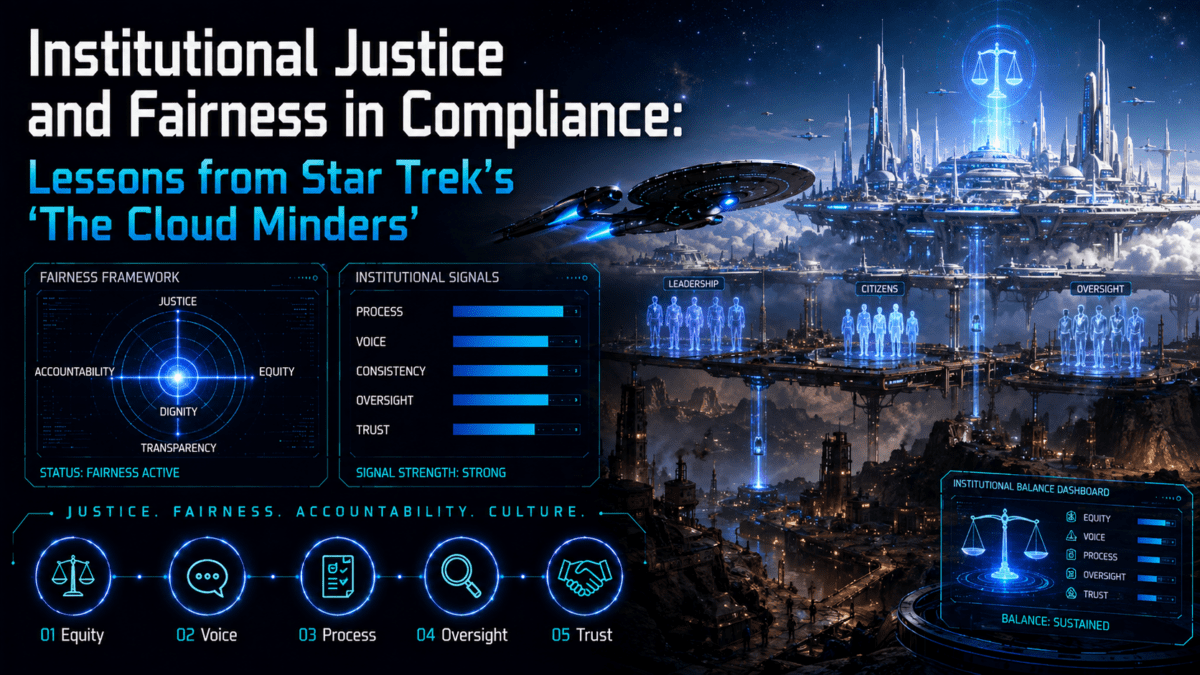
Institutional Justice and Fairness in Compliance: Lessons from Star Trek’s ‘The Cloud Minders’

Institutional justice and institutional fairness are not abstract ideals; they are operational requirements in a corporate compliance program. They define how policies are enforced, how decisions are made, and how employees perceive the integrity of their workplace. One of the most vivid illustrations of the dangers of systemic injustice and perceived unfairness comes from Star Trek: The Original Series in “The Cloud Minders.”

The DOJ’s 2024 Evaluation of Corporate Compliance Programs (ECCP) reinforces this point: for a compliance program to be effective, it must not only exist on paper but also operate fairly in practice. The DOJ expects companies to show that their compliance processes are applied consistently across the organization, regardless of seniority, revenue generation, or personal connections.

Why the DOJ Cares About Justice and Fairness in Compliance

In the ECCP, the DOJ focused on institutional justice and institutional fairness as key mandates for the compliance function. Why? It was rooted in practicality: a compliance program that is seen as biased or inconsistent will fail. Employees will not report misconduct, will hide mistakes, and will disengage from ethics initiatives.

Prosecutors know that when misconduct occurs in such an environment, it’s often a symptom of deeper cultural problems. That’s why, during investigations, they ask:

  • Are policies applied equally to all levels of the organization?
  • Is discipline consistent and documented?
  • Do employees believe the process is fair?
  • Has the company addressed the underlying causes of misconduct?

If the answers to these questions are unsatisfactory, the DOJ is more likely to view the compliance program as ineffective, regardless of its written policies.

The Tale 

The Enterprise is sent to the planet Ardana to collect zenite, a mineral needed to stop a plague on another world. Captain Kirk and Mr. Spock beam down to Stratos, a floating city inhabited by the planet’s elite, only to discover a deep societal divide. The surface of Ardana is worked by “Troglytes,” a laborer class forced to mine zenite under hazardous conditions, denied access to the comforts and education of Stratos.

The elites justify this arrangement as necessary for stability, while the Troglytes see it as systemic exploitation. The episode becomes a study in the consequences of entrenched inequality, distrust, and the refusal to address legitimate grievances, exactly the kinds of dynamics that can erode trust in a corporate compliance program if not addressed.

From this story, we can extract five compliance lessons on institutional justice and institutional fairness.

Lesson 1: Consistency in Standards Is Non-Negotiable

Illustrated by:  The leaders of Stratos apply rules differently depending on social status. The elite enjoy cultural and political freedoms, while Troglytes face restrictions and harsher punishments for similar conduct.

Compliance Lesson. The DOJ has repeatedly emphasized that policies and disciplinary measures must be applied consistently. If employees perceive that “rainmakers” or executives receive lighter sanctions, or none at all, for policy violations, trust in the compliance function evaporates. In The Cloud Minders, the double standard deepens resentment and drives conflict, precisely what can happen inside a company when justice is selective.

Why It Matters to DOJ: Prosecutors evaluate whether discipline is enforced “consistently across the organization, regardless of position or power.” Inconsistency is a red flag that the program is a paper exercise rather than a living system.

What should you do?

  • Establish clear, documented disciplinary protocols.
  • Apply them uniformly, with oversight from the compliance function.
  • Communicate to the workforce that no one is above the rules.

Lesson 2: Address Root Causes, Not Just Symptoms

Illustrated by: The Troglytes’ performance and health are impaired because mining zenite exposes them to toxic vapors. The elites interpret this as proof of inferiority, ignoring the environmental cause.

Compliance Lesson. Organizations sometimes treat compliance failures as isolated misconduct rather than symptoms of deeper issues, such as inadequate training, unrealistic sales targets, or flawed incentive structures. In Ardana, fixing the air quality in the mines would have solved much of the productivity gap, just as fixing systemic drivers of noncompliance prevents repeat issues.

Why It Matters to DOJ: The DOJ looks for root cause analysis after misconduct. They want to see whether the company took corrective action to address systemic issues, not just discipline the individuals involved.

What should you do?

  • Investigate not only “who” did something wrong, but “why” it happened.
  • Use findings to improve processes, incentives, and controls.
  • Share non-confidential lessons learned with the workforce to demonstrate fairness and transparency.

Lesson 3: Perceived Fairness Matters as Much as Actual Fairness

Illustrated by: Even when Kirk offers protective gear to the Troglytes, they are slow to trust his intentions. Years of mistreatment have convinced them that promises from the elites are empty.

Compliance Parallel: Employees judge compliance programs not only by their design but by how fair they feel in practice. If people believe investigations are biased or that whistleblowers will be punished, they will avoid reporting, even if the official policy says otherwise. On Ardana, the absence of trust kept both sides from engaging in good-faith solutions—something corporate leaders must avoid at all costs.

Why It Matters to DOJ: Prosecutors assess whether employees trust the compliance program enough to use it. A hotline no one calls is not evidence of a healthy culture—it may be proof of fear or cynicism.

What should you do?

  • Publicize examples where issues were raised and resolved fairly.
  • Protect whistleblowers from retaliation and make that protection visible.
  • Use employee surveys to measure trust in compliance processes.

Lesson 4: Leadership Must Model Ethical Behavior

Illustrated by: Stratos’s leaders speak about justice and stability, but are unwilling to live under the same risks or hardships as the Troglytes. Their detachment from the reality of mining life fuels the unrest.

Compliance Lesson. Leaders who preach ethics but cut corners for themselves undermine institutional fairness. Employees take cues from the top; if executives are exempt from rules, the rest of the organization will follow suit. In The Cloud Minders, the Stratos elite’s credibility collapses because they refuse to share the burdens of those they govern, a mistake no corporate leadership team should make.

Why It Matters to DOJ: The DOJ examines “tone at the top” and “conduct at the middle.” They want to see that leadership’s actions match their words and that managers reinforce the message through daily decisions.

What should you do?

  • Ensure executives participate in the same training and certifications as all employees.
  • Make leadership accountable for compliance metrics.
  • Publicly acknowledge when senior leaders are held to account for violations.

Lesson 5: Dialogue and Inclusion Are Tools for Justice

Illustrated by: Spock approaches the Troglytes with genuine respect, listening to their grievances and acknowledging their intelligence. His willingness to engage earns him credibility that Stratos leaders lack.

Compliance Parallel: Institutional fairness is strengthened when employees feel heard and included in shaping solutions. This doesn’t mean every request can be granted, but the act of listening and considering input builds trust. Just as Spock bridged the divide on Ardana, compliance leaders can bridge gaps in trust by treating all stakeholders with respect and dignity.

Why It Matters to DOJ: A compliance program is stronger when it incorporates feedback from the workforce. The DOJ favors companies that regularly assess the program’s effectiveness through interviews, surveys, and focus groups.

What should you do?

  • Include employee representatives in policy review committees.
  • Hold listening sessions for employees and other stakeholders after major incidents or policy changes.
  • Act on feasible suggestions and explain when ideas can’t be implemented.

Practical Compliance Takeaways from The Cloud Minders

  1. Apply Rules Equally: Avoid double standards by holding everyone—from the C-suite to front-line staff—to the exact requirements.
  2. Investigate Root Causes: Fix systemic issues, not just individual mistakes.
  3. Build Trust in the Process: Ensure employees perceive the program as fair and protective.
  4. Lead by Example: Leadership must model the ethical behavior expected of all.
  5. Listen and Include: Use dialogue to bridge divides and strengthen buy-in.

Final ComplianceLog Reflections

The Cloud Minders is more than a parable about class division; it is a warning for any institution that neglects fairness and justice. In Ardana, injustice created resentment, distrust, and rebellion. In a corporation, those same dynamics can lead to silent disengagement, hidden misconduct, and public scandal.

The DOJ’s message is clear: fairness and justice are not optional add-ons to compliance; they are the foundation of a program that works. As compliance leaders, our role is to be the “Spock” in the room, listening, respecting, and bridging divides while ensuring that the rules are fair, transparent, and consistently applied.

When we do that, we do not just comply with the DOJ’s expectations; we build organizations where people trust the system enough to make it work.

Resources:

⁠⁠Excruciatingly Detailed Plot Summary by Eric W. Weisstein⁠⁠

⁠⁠MissionLogPodcast.com⁠⁠

⁠⁠Memory Alpha

Categories
Trekking Through Compliance

Trekking Through Compliance: Episode 74 – Keeping the Crew Safe: Compliance Leadership Lessons from “The Way to Eden”

Few Star Trek episodes illustrate the complexity of leadership in the face of ideological fervor as vividly as “The Way to Eden.” In this story, the Enterprise encounters a group of spacefaring counterculture idealists led by Dr. Sevrin, a brilliant but unstable scientist. The trouble? Sevrin is a carrier of a deadly bacterium, and his quest puts both his followers and the Enterprise crew at risk. Captain Kirk, Spock, and McCoy must navigate a delicate balance, respecting personal freedoms while ensuring the safety of all. From this episode, compliance leaders can draw five practical lessons.

Lesson 1: Understand the Motivations Behind Risky Behavior

Illustrated by: Sevrin’s followers are not acting out of malice; a utopian vision of freedom from the constraints of modern society drives them.

Compliance Lesson. Employees and business units may engage in risky practices not because they want to harm the company, but because they believe their approach is better, faster, or more in line with their values.

Lesson 2: Clear Boundaries Protect Everyone

Illustrated by: Kirk’s role as captain means protecting the entire crew, not just indulging a vocal subgroup.

Compliance Lesson. Leaders must sometimes be the ones to say “no,” even in the face of enthusiasm or pressure from influential stakeholders. Boundaries, whether in anti-bribery rules, safety procedures, or cybersecurity protocols, exist to protect the organization as a whole.

Lesson 3: Engagement Is More Effective Than Suppression

Illustrated by: Spock earns the respect of Sevrin’s group by listening without judgment and showing genuine curiosity about their beliefs.

Compliance Lesson. By engaging respectfully, leaders can open channels for dialogue, uncover hidden risks, and sometimes win buy-in for compliance initiatives.

Lesson 4: The Allure of Shortcuts Can Blind People to Risks

Illustrated by: When Sevrin’s followers find the planet, they quickly discover that the vegetation is saturated with toxins, and stepping barefoot on the grass leads to deadly consequences.

Compliance Lesson. In business, “Eden” often takes the form of shortcuts, overseas markets with lax regulations, unvetted third parties who promise quick results, or aggressive accounting practices.

Lesson 5: Leadership Means Balancing Compassion with Accountability

Illustrated by: Accountability comes not in punishment, but in ensuring the survivors face the consequences of their decisions and understand the lessons learned.

Compliance Leadership Parallel: Leaders must respond to compliance breaches with a balance of firmness and empathy. Compliance leadership means leaving people with their dignity intact while making it clear that rules matter.

Final Thoughts

The Way to Eden is often remembered as a quirky Star Trek episode, with its counterculture overtones and space-hippie soundtrack. But beneath the surface, it’s a leadership case study: how to guide a diverse, passionate, and sometimes rebellious set of stakeholders toward a safe and sustainable outcome.

Compliance leaders face their own “Sevrins” and “Edens” every day, compelling visions that, if left unchecked, can lead to disaster. The key is to listen, understand, set boundaries, and lead with both compassion and resolve. In the end, leadership in compliance is not about keeping people from chasing their Eden; rather, it is about making sure they survive the journey.

Resources:

⁠⁠Excruciatingly Detailed Plot Summary by Eric W. Weisstein⁠⁠

⁠⁠MissionLogPodcast.com⁠⁠

⁠⁠Memory Alpha

Categories
Blog

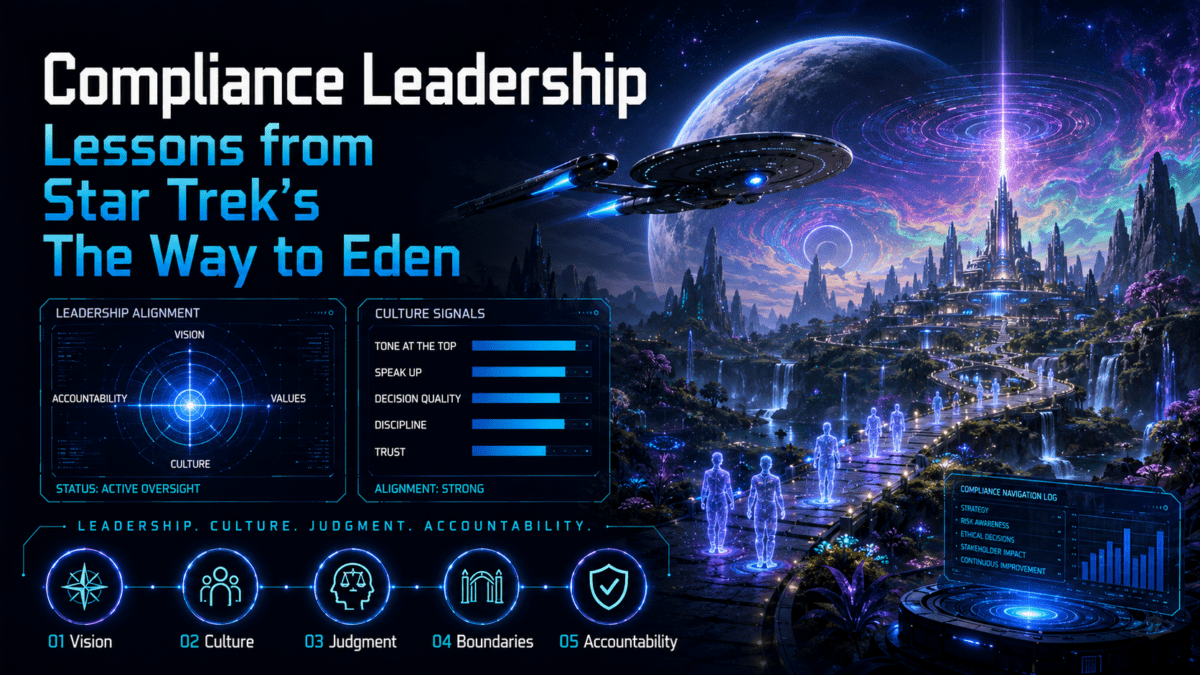
Compliance Leadership Lessons from Star Trek’s The Way to Eden

In compliance, leadership is not just about setting the tone at the top. It is about guiding an organization through competing values, disruptive influences, and well-intentioned but potentially dangerous shortcuts.

Few Star Trek episodes illustrate the complexity of leadership in the face of ideological fervor as vividly as “The Way to Eden.” In this story, the Enterprise encounters a group of spacefaring counterculture idealists led by Dr. Sevrin, a brilliant but unstable scientist. Sevrin and his followers reject modern technology and societal norms, seeking a mythical, untouched planet called “Eden” where they can live in what they believe will be pure harmony.

The trouble? Sevrin is a carrier of a deadly bacterium, and his quest puts both his followers and the Enterprise crew at risk. Captain Kirk, Spock, and McCoy must navigate a delicate balance, respecting personal freedoms while ensuring the safety of all. From this episode, compliance leaders can draw five practical lessons.

Lesson 1: Understand the Motivations Behind Risky Behavior

Illustrated By: Sevrin’s followers are not acting out of malice; a utopian vision of freedom from the constraints of modern society drives them. However, their rejection of medical science and safety protocols blinds them to the dangers they bring aboard the Enterprise.

Compliance Lesson. Employees and business units may engage in risky practices not because they want to harm the company, but because they believe their approach is better, faster, or more in line with their values. Leaders who dismiss these motivations outright risk alienating people whose energy could be channeled constructively. By understanding the drivers of noncompliance, leaders can redirect passion into safe, compliant channels.

What should you do?

  • Take time to understand why individuals resist compliance requirements.
  • Acknowledge the values behind dissent, even when you cannot endorse the methods.
  • Look for ways to align personal motivations with organizational ethics and risk frameworks.

Lesson 2: Clear Boundaries Protect Everyone

Illustrated By: Despite Sevrin’s charisma, Kirk sets firm boundaries: the Enterprise cannot simply abandon its mission to pursue Eden, and Sevrin’s health status requires quarantine protocols. Kirk’s role as captain means protecting the entire crew, not just indulging a vocal subgroup.

Compliance Lesson. Leaders must sometimes be the ones to say “no,” even in the face of enthusiasm or pressure from influential stakeholders. Boundaries, whether in anti-bribery rules, safety procedures, or cybersecurity protocols, exist to protect the organization as a whole.  Ethical leadership means knowing when flexibility is possible and when it would endanger the mission.

What should you do?

  • Communicate non-negotiable compliance requirements clearly and early.
  • Ensure all employees understand the rationale behind safety and regulatory protocols.
  • Stand firm when those boundaries are tested, even by high performers or senior leaders.

Lesson 3: Engagement Is More Effective Than Suppression

Illustrated By: Spock earns the respect of Sevrin’s group by listening without judgment and showing genuine curiosity about their beliefs. This rapport allows him to act as a bridge between the group and the Enterprise command staff, even though he ultimately disagrees with their methods.

Compliance Lesson. Dismissing dissenters as “problem employees” without engagement can deepen resistance. By engaging respectfully, leaders can open channels for dialogue, uncover hidden risks, and sometimes win buy-in for compliance initiatives. Effective compliance leadership values dialogue as a tool for both education and intelligence gathering.

What should you do?

  • Listen actively to dissenting voices.
  • Avoid treating all opposition as insubordination. Sometimes it is a signal of deeper organizational issues.
  • Use engagement to build trust, even when consensus is not possible.

Lesson 4: The Allure of Shortcuts Can Blind People to Risks

Illustrated By: When Sevrin’s followers find the planet, which they believe to be Eden, it initially appears beautiful and untouched. However, they quickly discover that the vegetation is saturated with toxins, and stepping barefoot on the grass leads to deadly consequences.

Compliance Lesson. In business, “Eden” often takes the form of shortcuts, overseas markets with lax regulations, unvetted third parties who promise quick results, or aggressive accounting practices. These may look enticing at first, but the hidden risks can be fatal to the organization. Part of a compliance leader’s role is to de-romanticize shortcuts and reveal the full risk landscape.

What should you do?

  • Teach employees to perform due diligence before pursuing new opportunities.
  • Make risk assessments an integral part of strategic decision-making.
  • Share examples of past corporate failures caused by seemingly “perfect” opportunities.

Lesson 5: Leadership Means Balancing Compassion with Accountability

Illustrated by: After the Eden disaster, Sevrin dies, but his followers are spared. Kirk and Spock treat the survivors with compassion, offering them care and safe passage, even though their actions had endangered the crew. Accountability comes not in punishment, but in ensuring the survivors face the consequences of their decisions and understand the lessons learned.

Compliance Leadership Parallel: Leaders must respond to compliance breaches with a balance of firmness and empathy. Punishment without compassion can breed resentment; compassion without accountability can encourage repeat behavior. Compliance leadership means leaving people with their dignity intact while making it clear that rules matter.

What should you do?

  • Address violations swiftly and fairly.
  • Provide education and corrective measures alongside disciplinary actions.
  • Use breaches as teaching moments for the broader organization.

Why “The Way to Eden” Matters for Compliance Leaders

The episode is a study in balancing values: freedom and safety, individuality and collective responsibility, compassion and firmness. Kirk, Spock, and McCoy each play a part: Kirk as the boundary-setter, Spock as the bridge-builder, and McCoy as the voice of science and evidence.

In a corporate setting, compliance leaders often find themselves in all three roles at once. They must:

  • Understand and respect differing viewpoints (Spock).
  • Set and enforce boundaries that protect the organization (Kirk).
  • Ground decisions in objective facts and regulations (McCoy).

When done well, this approach strengthens the organization’s ethical culture and reduces the likelihood of costly risk events.

Final Thought

The Way to Eden is often remembered as a quirky Star Trek episode, with its counterculture overtones and space-hippie soundtrack. But beneath the surface, it’s a leadership case study: how to guide a diverse, passionate, and sometimes rebellious set of stakeholders toward a safe and sustainable outcome.

Compliance leaders face their own “Sevrins” and “Edens” every day, compelling visions that, if left unchecked, can lead to disaster. The key is to listen, understand, set boundaries, and lead with both compassion and resolve. In the end, leadership in compliance is not about keeping people from chasing their Eden; rather, it is about making sure they survive the journey.

Resources:

⁠⁠Excruciatingly Detailed Plot Summary by Eric W. Weisstein⁠⁠

⁠⁠MissionLogPodcast.com⁠⁠

⁠⁠Memory Alpha

Categories
Trekking Through Compliance

Trekking Through Compliance: Episode 73 – Power, Secrecy, and Responsibility: Business Ethics Lessons from Requiem for Methuselah

In corporate life, ethical decision-making is not only a question of right and wrong. It is also a test of leadership, trust, and long-term vision. Missteps in ethics erode corporate culture, destroy reputations, and invite regulatory and shareholder scrutiny.

Few Star Trek episodes present an ethical crucible as layered as Requiem for Methuselah. The story unfolds into a complex web of secrecy, autonomy, manipulation, and unintended consequences, a rich territory for ethical reflection. From this episode, we can draw five business ethics lessons directly applicable to today’s corporate compliance environment.

Lesson 1: Transparency Is Essential to Trust

Illustrated by: Flint initially hides critical facts from Kirk, Spock, and McCoy about his true identity. His secrecy stems from a desire to control the situation, but it breeds mistrust and escalating tension.

Ethics Lesson. Stakeholders, whether employees, customers, or regulators, expect honesty. Concealing facts creates suspicion, damages credibility, and can lead to decisions made on false assumptions.

Lesson 2: Autonomy Must Be Respected, Even with Good Intentions

Illustrated by Flint, Rayna was designed to be his companion, controlling her environment and limiting her exposure to the outside world.

Ethics Lesson. Corporations sometimes restrict employee autonomy under the guise of protection, micromanaging, withholding career opportunities, or blocking external engagement. Ethical leadership means equipping people to act responsibly, not controlling every move they make.

Lesson 3: Ends Do Not Justify the Means

Illustrated by: To achieve his goal, Flint manipulates the Enterprise crew, withholds the cure they need until his conditions are met, and engineers circumstances to force emotional outcomes for Rayna.

Ethics Lesson. Compromising ethics for results can cause long-term damage far outweighing the immediate gain.

Lesson 4: Emotional Intelligence Is Critical in Ethical Decision-Making

Illustrated by: Kirk fails to foresee that forcing Rayna to choose between him and Kirk will overwhelm her, leading to her breakdown.

Ethics Lesson. Leaders may overlook red flags, delay action, or make decisions based on personal feelings rather than principles. Ethical clarity often requires stepping back and separating personal attachment from professional responsibility.

Lesson 5: Ethical Leadership Includes Considering Long-Term Impact

Illustrated by: Flint’s immortality has given him a unique long view of history, but in this episode, he fails to account for the long-term consequences of his actions toward Rayna and the Enterprise crew.

Ethics Lesson. Businesses that focus solely on short-term gains, without assessing long-term impacts, risk harming their reputation, eroding stakeholder trust, and creating systemic problems. Ethical leaders anticipate not just the next quarter, but the next decade.

Final ComplianceLog Reflections

Requiem for Methuselah is ultimately a cautionary tale about the cost of ethical missteps, even for someone with the wisdom of centuries. Flint’s intellect and resources could not compensate for a failure to act with transparency, respect, and foresight.

For today’s corporate leaders, the lesson is simple: ethical decision-making is not a luxury—it is the foundation of sustainable success. The compliance function’s role is to embed these values so deeply into the corporate DNA that they guide every choice, from the boardroom to the front line.

Resources:

⁠⁠Excruciatingly Detailed Plot Summary by Eric W. Weisstein⁠⁠

⁠⁠MissionLogPodcast.com⁠⁠

⁠⁠Memory Alpha

Categories
Blog

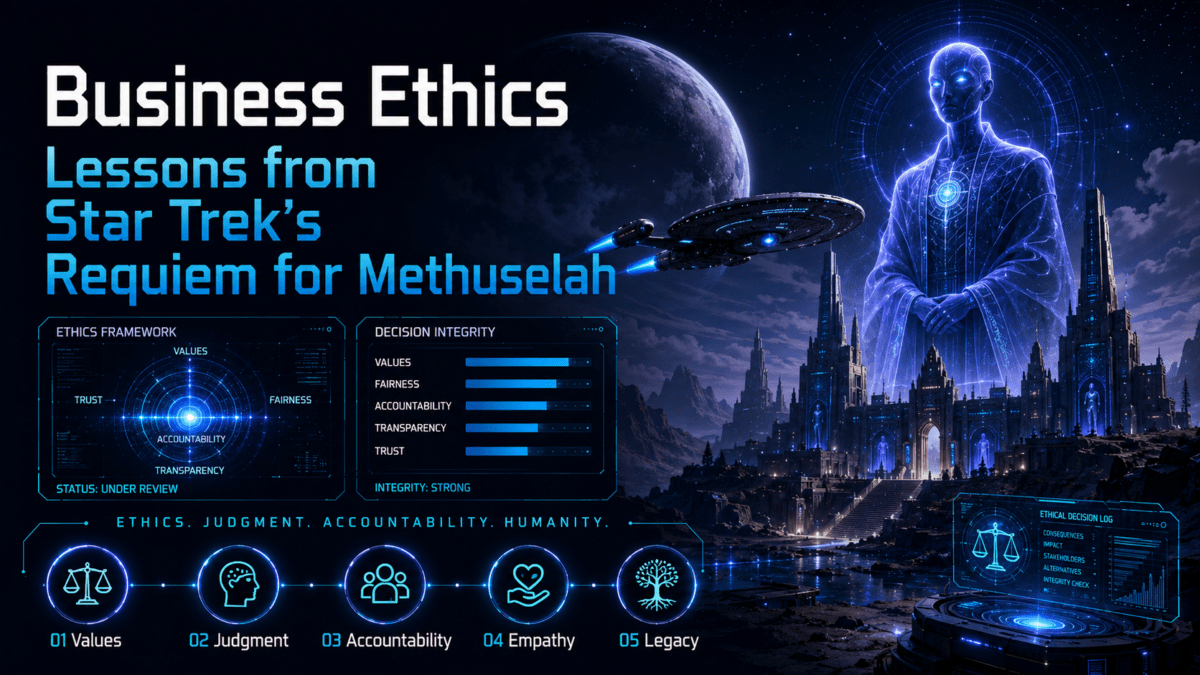
Business Ethics Lessons from Star Trek’s Requiem for Methuselah

In corporate life, ethical decision-making is not only a question of right and wrong. It is also a test of leadership, trust, and long-term vision. Missteps in ethics erode corporate culture, destroy reputations, and invite regulatory and shareholder scrutiny.

Few Star Trek episodes present an ethical crucible as layered as Requiem for Methuselah. In this episode, the Enterprise crew, seeking an urgently needed medical cure for a deadly illness sweeping the ship, beams down to a remote, seemingly uninhabited planet. There, they meet the enigmatic Flint, a man who turns out to be immortal, having lived for over 6,000 years under various identities, from Methuselah to Da Vinci. Flint lives with Rayna, a beautiful, brilliant young woman who, as the crew later learns, is not human but an android he has created.

The story unfolds into a complex web of secrecy, autonomy, manipulation, and unintended consequences, a rich territory for ethical reflection. From this episode, we can draw five business ethics lessons directly applicable to today’s corporate compliance environment.

Lesson 1: Transparency Is Essential to Trust

Illustrated By: Flint initially hides critical facts from Kirk, Spock, and McCoy: his true identity, the fact that Rayna is an android, and the location of the life-saving mineral ryetalyn they came to obtain. His secrecy stems from a desire to control the situation, but it breeds mistrust and escalating tension.

Ethics Lesson. In business, withholding material information, even with ostensibly good intentions, undermines trust—stakeholders, whether employees, customers, or regulators, expect honesty. Concealing facts creates suspicion, damages credibility, and can lead to decisions made on false assumptions. A compliance culture grounded in transparency prevents misunderstandings and reinforces stakeholder confidence.

What should you do?

  • Communicate openly about relevant facts, especially those impacting health, safety, or financial stability.
  • Establish disclosure protocols for potential conflicts of interest.
  • Recognize that partial truths can be as damaging as outright falsehoods.

Lesson 2: Autonomy Must Be Respected, Even with Good Intentions

Illustrated by Flint, Rayna was designed to be his companion, controlling her environment and limiting her exposure to the outside world. He claims to be protecting her, but in doing so, denies her agency. When she begins to form independent thoughts and feelings, particularly toward Kirk, Flint’s inability to let go leads to tragedy.

Ethics Lesson. Corporations sometimes restrict employee autonomy under the guise of protection, micromanaging, withholding career opportunities, or blocking external engagement. Even if the motive is to “protect” the employee or company, the result can stifle growth and foster resentment. Ethical leadership means equipping people to act responsibly, not controlling every move they make.

What should you do?

  • Empower individuals to make informed choices within ethical boundaries.
  • Provide access to opportunities and resources without paternalistic gatekeeping.
  • Respect the right of employees to voice concerns and explore options.

Lesson 3: Ends Do Not Justify the Means

Illustrated By: Flint’s primary objective, immortality, has allowed him to amass vast knowledge and wealth. Yet to achieve his goals in this episode, he manipulates the Enterprise crew, withholds the cure they need until his conditions are met, and engineers circumstances to force emotional outcomes for Rayna.

Ethics Lesson. In business, leaders may justify cutting corners or bending rules to achieve short-term results, winning a contract, securing market share, or hitting quarterly targets. But compromising ethics for results can cause long-term damage far outweighing the immediate gain. A sustainable corporate culture is built on the principle that ethical processes matter as much as business goals.

What should you do?

  • Evaluate not just what you achieve, but how you achieve it.
  • Build decision-making frameworks that weigh both outcomes and methods.
  • Reinforce that compliance and ethics are integral to success, not obstacles to it.

Lesson 4: Emotional Intelligence Is Critical in Ethical Decision-Making

Illustrated By: Kirk’s growing attachment to Rayna closes his eyes to the urgency of his mission. McCoy warns him about becoming too emotionally involved, but Kirk underestimates the impact on his judgment. Flint, likewise, fails to foresee that forcing Rayna to choose between him and Kirk will overwhelm her, leading to her breakdown.

Ethics Lesson. In corporate environments, emotions, whether loyalty, rivalry, or fear, can cloud ethical judgment. Leaders may overlook red flags, delay action, or make decisions based on personal feelings rather than principles. Ethical clarity often requires stepping back and separating personal attachment from professional responsibility.

What should you do?

  • Train leaders to recognize when emotions may be influencing decisions.
  • Encourage second opinions and peer review in high-stakes decisions.
  • Create safe spaces for voicing concerns about potential bias.

Lesson 5: Ethical Leadership Includes Considering Long-Term Impact

Illustrated By: Flint’s immortality has given him a unique long view of history, but in this episode, he fails to account for the long-term consequences of his actions toward Rayna and the Enterprise crew. His choices have immediate, tragic outcomes and lasting emotional scars.

Ethics Lesson. Businesses that focus solely on short-term gains, without assessing long-term impacts, risk harming their reputation, eroding stakeholder trust, and creating systemic problems. Ethical leaders anticipate not just the next quarter, but the next decade. Considering long-term consequences ensures ethical decisions hold up under the scrutiny of time.

What should you do?

  • Incorporate long-term risk and ethical impact into strategic planning.
  • Assess how today’s decisions will be perceived by future employees, customers, and regulators.
  • Prioritize sustainability, both in environmental and cultural terms.

Why “Requiem for Methuselah” Matters for Business Ethics

The drama in Requiem for Methuselah is driven not by alien threats or galactic battles, but by human (and android) ethical dilemmas: secrecy, autonomy, manipulation, emotional entanglement, and shortsightedness. These are the same challenges corporate leaders face when navigating business ethics in the modern era.

An ethical corporate culture:

  • Practices transparency to build trust.
  • Respects the autonomy of individuals.
  • Rejects “ends justify the means” thinking.
  • Recognizes and manages the role of emotions in decision-making.
  • Considers the long-term legacy of choices made today.

The compliance department is not just a rules enforcer. According to the DOJ, it is the ethics steward of the organization, ensuring that decisions at every level meet both legal and moral standards.

Final ComplianceLog Reflections

Requiem for Methuselah is ultimately a cautionary tale about the cost of ethical missteps, even for someone with the wisdom of centuries. Flint’s intellect and resources could not compensate for a failure to act with transparency, respect, and foresight.

For today’s corporate leaders, the lesson is simple: ethical decision-making is not a luxury—it is the foundation of sustainable success. The compliance function’s role is to embed these values so deeply into the corporate DNA that they guide every choice, from the boardroom to the front line.

Resources:

⁠⁠Excruciatingly Detailed Plot Summary by Eric W. Weisstein⁠⁠

⁠⁠MissionLogPodcast.com⁠⁠

⁠⁠Memory Alpha

Categories
Trekking Through Compliance

Trekking Through Compliance: Episode 72 – From Zetar to the C-Suite: Why Expertise Matters in Internal Investigations

In the corporate compliance world, an internal investigation is often the moment of truth. Whether triggered by a whistleblower complaint, a regulatory inquiry, or a suspicious transaction, the investigation’s quality can determine whether the organization resolves the matter cleanly or faces prolonged legal, financial, and reputational damage.

Star Trek: The Original Series’ “The Lights of Zetar” offers a surprisingly apt allegory for why skilled professionals must handle these investigations. The crew must conduct what is, in effect, a complex and high-stakes investigation. Their approach yields five lessons that every compliance professional should apply when running an internal investigation.

Lesson 1: Preserve and Protect Critical Evidence Immediately

Illustrated By. When the lights first strike, the Enterprise experiences sudden and unexplained system failures. The crew immediately records sensor data, secures operational logs, and isolates the damage.

Compliance Lesson. Without swift action, crucial evidence can be lost, whether through routine data overwrites, deliberate destruction, or simple mishandling.

Lesson 2: Bring in the Right Expertise Early

Illustrated By: Once Mira Romaine exhibits strange symptoms, Dr. McCoy, Spock, and Scotty each contribute their specialized knowledge, medical science, Vulcan telepathy, and engineering diagnostics, to piece together what is happening.

Compliance Lesson. A proper internal investigation is rarely a one-person job. Complex matters often require diverse expertise: forensic accounting, cybersecurity, HR policy, legal analysis, and industry-specific regulatory knowledge.

Lesson 3: Keep an Open Mind—The First Explanation May Be Wrong

Illustrated By: Only after gathering more evidence do they realize the lights are disembodied intelligences, survivors of the destroyed planet Zetar, seeking a human host.

Compliance Lesson. In corporate investigations, jumping to conclusions based on initial appearances can lead to flawed outcomes.

Lesson 4: Protect the People Involved Throughout the Process

Illustrated By: Mira Romaine is not treated merely as a subject of inquiry; she is a valued crew member whose well-being is a priority. The investigation’s goal is not just to “solve the problem” but to save her life.

Compliance Lesson. In internal investigations, individuals, whether complainants, witnesses, or subjects, must be treated with dignity and fairness. Mishandling these relationships can result in legal claims, loss of employee trust, and reputational harm.

Lesson 5: Deliver Actionable Solutions, Not Just Findings

Illustrated By: Once the crew determines that the Zetarians are inhabiting Lt. Romaine’s body, they devise a targeted plan to remove them using controlled atmospheric pressure in a medical isolation chamber.

Compliance Lesson. An investigation that ends with a report but no corrective action is a missed opportunity. The ultimate measure of success is not uncovering what happened but ensuring it does not happen again.

Final ComplianceLog Reflections

The Lights of Zetar reminds us that investigations are not abstract exercises; they are missions with real people, high stakes, and long-term consequences. The Enterprise crew approached their challenge with urgency, thoroughness, and empathy. For compliance officers, the lesson is clear: every internal investigation is an opportunity to demonstrate integrity, competence, and leadership. The quality of your investigative process will be remembered long after the incident itself fades from memory.

Resources:

⁠⁠Excruciatingly Detailed Plot Summary by Eric W. Weisstein⁠⁠

⁠⁠MissionLogPodcast.com⁠⁠

⁠⁠Memory Alpha

Categories
Blog

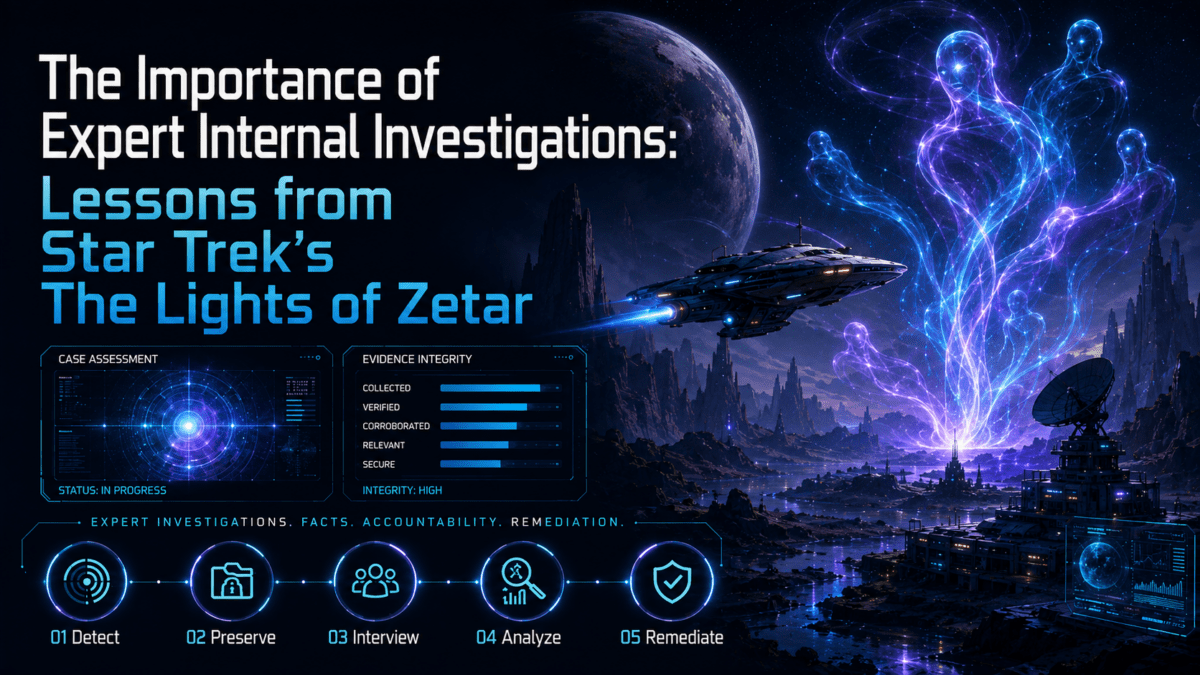
The Importance of Expert Internal Investigations: Five Lessons from Star Trek’s The Lights of Zetar

In the corporate compliance world, an internal investigation is often the moment of truth. Whether triggered by a whistleblower complaint, a regulatory inquiry, or a suspicious transaction, the investigation’s quality can determine whether the organization resolves the matter cleanly or faces prolonged legal, financial, and reputational damage.

Star Trek: The Original Series’ “The Lights of Zetar” offers a surprisingly apt allegory for why skilled professionals must handle these investigations. In this episode, the Enterprise is on its way to Memory Alpha, the Federation’s central library, when it encounters a mysterious, pulsating light phenomenon. The lights incapacitate crew members, damage ship systems, and, most dangerously, invade the mind of Lieutenant Mira Romaine, who is accompanying the mission.

The crew must determine what the lights are, what they want, and how to neutralize them before they destroy both Romaine and Memory Alpha’s priceless archives. In doing so, they conduct what is, in effect, a complex and high-stakes investigation. Their approach yields five lessons that every compliance professional should apply when running an internal investigation.

Lesson 1: Preserve and Protect Critical Evidence Immediately

Illustrated By. When the lights first strike, the Enterprise experiences sudden and unexplained system failures. The crew immediately records sensor data, secures operational logs, and isolates the damage.

Compliance Lesson. In corporate investigations, the “scene of the incident” may be a server containing emails, a ledger of transactions, or a manager’s office with physical records. Without swift action, crucial evidence can be lost, whether through routine data overwrites, deliberate destruction, or simple mishandling.

How to apply this to investigations?

  • Secure relevant electronic and physical records as soon as the investigation begins.
  • Suspend auto-delete protocols and ensure data preservation orders are issued.
  • Document the chain of custody for all materials.

In The Lights of Zetar, the crew’s rapid evidence capture gave them the information needed to trace the lights’ origins and capabilities. Without it, they would have been operating blind.

Lesson 2: Bring in the Right Expertise Early

Illustrated By: Once Mira Romaine exhibits strange symptoms, Dr. McCoy, Spock, and Scotty each contribute their specialized knowledge, medical science, Vulcan telepathy, and engineering diagnostics to piece together what is happening.

Compliance Lesson. A proper internal investigation is rarely a one-person job. Complex matters often require diverse expertise: forensic accounting, cybersecurity, HR policy, legal analysis, and industry-specific regulatory knowledge. Relying solely on generalists can miss critical nuances.

How to apply this to investigations?

  • Assemble a multidisciplinary team at the outset, including internal experts and outside specialists if needed.
  • Ensure each team member understands their role and investigative boundaries.
  • Involve counsel early to maintain privilege over sensitive findings.

Just as the Enterprise crew leveraged multiple skill sets to solve a problem no one discipline could crack alone, compliance officers should make strategic use of the right expertise from day one.

Lesson 3: Keep an Open Mind—The First Explanation May Be Wrong

Illustrated By: Initially, the crew assumes the lights are a natural space phenomenon. Only after gathering more evidence do they realize the lights are disembodied intelligences, survivors of the destroyed planet Zetar, seeking a human host.

Compliance Lesson. In corporate investigations, jumping to conclusions based on initial appearances can lead to flawed outcomes. What looks like simple employee misconduct may be part of a larger systemic control failure; what appears to be a minor accounting error may conceal intentional fraud.

How to apply this to investigations?

  • Form working hypotheses, but treat them as provisional until confirmed by evidence.
  • Explore alternative explanations, even if they seem less likely.
  • Allow the facts, not convenience or organizational pressure, to drive conclusions.

Expert investigators, like the Enterprise crew, pivot their theories as new facts emerge.

Lesson 4: Protect the People Involved Throughout the Process

Illustrated By: Mira Romaine is not treated merely as a subject of inquiry; she is a valued crew member whose well-being is a priority. The investigation’s goal is not just to “solve the problem” but to save her life. Kirk ensures she receives medical care and emotional support even as they work to understand her condition.

Compliance Lesson. In internal investigations, individuals, whether complainants, witnesses, or subjects, must be treated with dignity and fairness. Mishandling these relationships can result in legal claims, loss of employee trust, and reputational harm.

How to apply this to investigations?

  • Maintain confidentiality to the fullest extent possible.
  • Protect against retaliation for cooperation.
  • Provide updates when feasible to those affected, balancing transparency with investigative integrity.

A humane approach builds trust in the compliance function and encourages future reporting.

Lesson 5: Deliver Actionable Solutions, Not Just Findings

Illustrated By: Once the crew determines that the Zetarians are inhabiting Lt. Romaine’s body, they devise a targeted plan to remove them using controlled atmospheric pressure in a medical isolation chamber. They do not stop at identifying the cause; they implement the cure.

Compliance Lesson. An investigation that ends with a report but no corrective action is a missed opportunity. The ultimate measure of success is not uncovering what happened but ensuring it does not happen again.

How to apply this to investigations?

  • Pair findings with concrete, practical recommendations for remediation.
  • Address both the immediate problem and any systemic weaknesses uncovered.
  • Follow up to confirm that corrective actions are implemented and effective.

The Enterprise crew’s solution not only saved Mira but also prevented the Zetarians from posing a future threat, exemplifying the kind of preventive mindset compliance investigations should aim for.

Why “The Lights of Zetar” Resonates for Compliance

In The Lights of Zetar, the stakes were both personal and institutional: the survival of a crew member and the preservation of Memory Alpha’s vast knowledge. The investigation had to be thorough, rapid, multidisciplinary, and compassionate, precisely the hallmarks of a high-quality corporate internal investigation.

An expert investigation:

  • Safeguards evidence before it’s lost.
  • Leverages the right mix of skills.
  • Keeps the fact-finding process objective.
  • Protects people while uncovering the truth.
  • Produces actionable, lasting solutions.

When these principles are followed, the compliance function not only resolves incidents but also strengthens the organization’s overall resilience.

Final ComplianceLog Reflections

The Lights of Zetar reminds us that investigations are not abstract exercises—they are missions with real people, high stakes, and long-term consequences. The Enterprise crew approached their challenge with urgency, thoroughness, and empathy.

For compliance officers, the lesson is clear: every internal investigation is an opportunity to demonstrate integrity, competence, and leadership. The quality of your investigative process will be remembered long after the incident itself fades from memory.

In other words, be the Enterprise—methodical, humane, and relentless in pursuit of the truth.

Resources:

⁠⁠Excruciatingly Detailed Plot Summary by Eric W. Weisstein⁠⁠

⁠⁠MissionLogPodcast.com⁠⁠

⁠⁠Memory Alpha

Categories
Trekking Through Compliance

Trekking Through Compliance: Episode 71 – Surviving the Unknown: Risk Management Lessons from “That Which Survives”

In compliance, risk management is more than a checklist. It is the ongoing discipline of identifying threats, assessing their potential impact, and implementing measures to mitigate or neutralize them before they cause harm.

Few Star Trek episodes illustrate the escalating consequences of underestimated risks as effectively as That Which Survives. In it, the Enterprise crew encounters a seemingly lifeless planet guarded by Losira, an alien projection who can kill with a single touch. Her purpose is to protect the planet’s secrets, but her method is indiscriminate, deadly, and poorly aligned to the situation at hand.

For compliance professionals, this episode offers five important lessons on anticipating, assessing, and responding to risks, both known and unknown, within an organization.

Lesson 1: Identify Risks Before Engaging in New Ventures

Illustrated By: The Enterprise arrives at an uncharted planet. Within moments, a mysterious woman materializes and kills a crew member simply by touching him.

Compliance Lesson. Too often, companies rush into new markets, partnerships, or projects without conducting a thorough risk assessment. This can expose the organization to sanctions violations, corruption risks, cybersecurity vulnerabilities, or operational failures.

Lesson 2: Understand That Some Risks Are Intelligent and Adaptive

Illustrated By: Losira targets specific individuals and adapts her approach to their vulnerabilities.

Compliance Lesson. Not all risks are static. Fraudsters change tactics, cyber threats evolve, and corrupt third parties find new ways to conceal misconduct. A compliance program must anticipate that some risks will actively seek to bypass controls.

Lesson 3: Don’t Dismiss Low-Probability, High-Impact Threats

Illustrated By: At first, the crew assumes Losira’s appearances are isolated incidents, but they quickly realize she poses an existential threat.

Compliance Lesson. Rare events, such as a single high-value bribery transaction, a lone rogue employee, or a targeted cyberattack, can have catastrophic consequences. Organizations sometimes underprepare for these scenarios because they seem unlikely.

Lesson 4: Risk Mitigation Requires Cross-Functional Coordination

Illustrated By: The landing party on the planet and the Enterprise crew in orbit are each facing threats from Losira, but their survival depends on sharing information and coordinating responses. Without clear communication, both groups would be doomed.

Compliance Lesson. Compliance cannot manage risk in isolation. It must work with legal, internal audit, operations, IT, and HR to identify threats and implement controls.

Lesson 5: Address the Root Cause, Not Just the Symptoms

Illustrated By: The crew eventually discovers that Losira is an automated defense mechanism left behind by an extinct race. Once the crew understands her origin and purpose, they can neutralize the threat.

Compliance Lesson. In risk management, addressing surface-level problems without finding the underlying cause only delays future incidents. Compliance should integrate root cause analysis into all investigations.

Final ComplianceLog Reflections

That Which Survives is more than a suspense episode; it is a cautionary tale about the dangers of underestimating risk. Losira was not inherently evil; she was a misunderstood, unexamined part of an environment the crew did not fully assess before engagement.

The compliance officer’s mandate is to ensure the company doesn’t make the same mistake: to scan for threats before beaming in, to adapt to risks that evolve, to prepare for unlikely but devastating events, to coordinate across the enterprise, and to address the root cause when problems arise. Risk management is not just about surviving; it is about ensuring that your organization thrives in any environment, whether it’s an unexplored planet or a rapidly changing market.

Resources:

⁠⁠Excruciatingly Detailed Plot Summary by Eric W. Weisstein⁠⁠

⁠⁠MissionLogPodcast.com⁠⁠

⁠⁠Memory Alpha

Categories
Blog

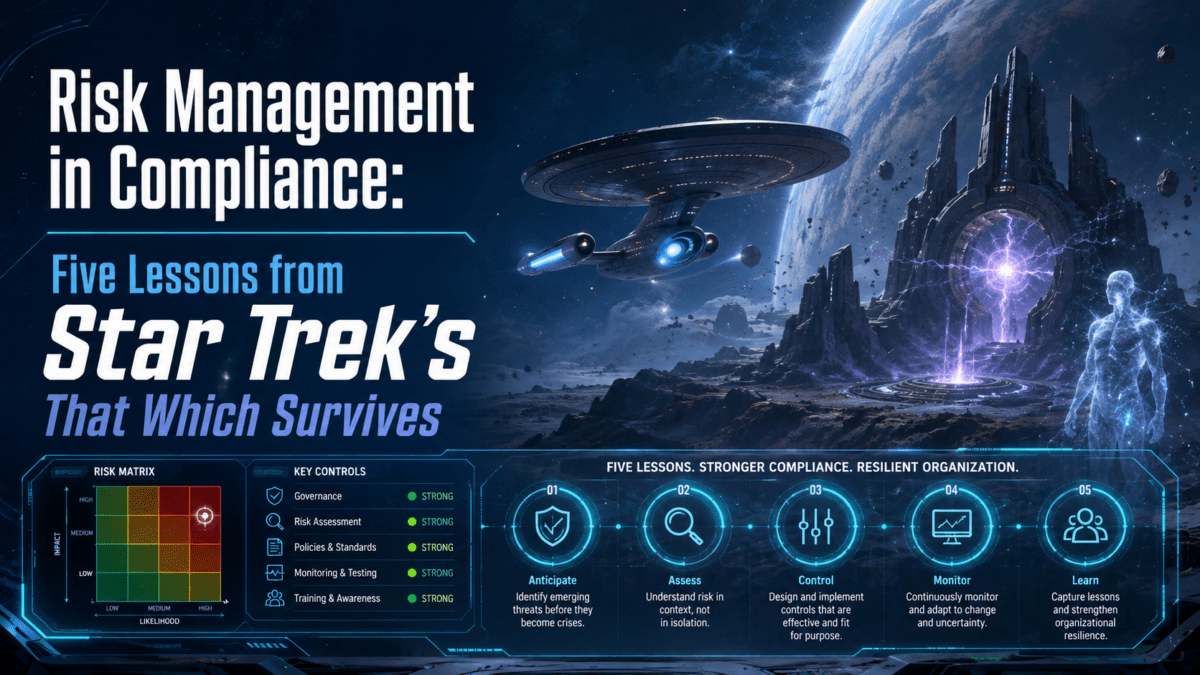
Risk Management in Compliance: Five Lessons from Star Trek’s That Which Survives

In compliance, risk management is more than a checklist. It is the ongoing discipline of identifying threats, assessing their potential impact, and implementing measures to mitigate or neutralize them before they cause harm.

Few Star Trek episodes illustrate the escalating consequences of underestimated risks as effectively as That Which Survives. In it, the Enterprise crew encounters a seemingly lifeless planet guarded by Losira, an alien projection who can kill with a single touch. Her purpose is to protect the planet’s secrets, but her method is indiscriminate, deadly, and poorly aligned to the situation at hand.

For compliance professionals, this episode offers five important lessons on anticipating, assessing, and responding to risks, both known and unknown, within an organization.

Lesson 1: Identify Risks Before Engaging in New Ventures

Illustrated By: The Enterprise arrives at an uncharted planet, scans it briefly, and beams down a landing party. Within moments, a mysterious woman materializes and kills a crew member simply by touching him.

Compliance Lesson. Too often, companies rush into new markets, partnerships, or projects without conducting a thorough risk assessment. This can expose the organization to sanctions violations, corruption risks, cybersecurity vulnerabilities, or operational failures. Compliance should lead or be deeply involved in pre-engagement risk assessments. Before “beaming down” into a new business environment, map potential threats—regulatory, operational, reputational—and identify safeguards. Skipping this step can lead to preventable harm and costly remediation.

Lesson 2: Understand That Some Risks Are Intelligent and Adaptive

Illustrated By: Losira’s ability to appear anywhere, both on the planet and aboard the Enterprise, shows she is not a passive hazard. She targets specific individuals and adapts her approach to their vulnerabilities.

Compliance Lesson. Not all risks are static. Fraudsters change tactics, cyber threats evolve, and corrupt third parties find new ways to conceal misconduct. A compliance program must anticipate that some risks will actively seek to bypass controls. Build adaptive monitoring into your compliance systems. Use continuous transaction monitoring, real-time alerts, and data analytics to detect changes in patterns. A one-time risk assessment is not enough—ongoing vigilance is essential.

Lesson 3: Don’t Dismiss Low-Probability, High-Impact Threats

Illustrated By: At first, the crew assumes Losira’s appearances are isolated incidents, but they quickly realize she poses an existential threat. Even though she is only one individual, her capabilities could destroy the Enterprise if not addressed.

Compliance Lesson. Rare events, such as a single high-value bribery transaction, a lone rogue employee, or a targeted cyberattack, can have catastrophic consequences. Organizations sometimes underprepare for these scenarios because they seem unlikely. Compliance departments should incorporate low-probability, high-impact risks into the risk register. Conduct tabletop exercises to simulate rare but potentially devastating events, ensuring the organization has both prevention and response plans in place.

Lesson 4: Risk Mitigation Requires Cross-Functional Coordination

Illustrated By: The landing party on the planet and the Enterprise crew in orbit are each facing threats from Losira, but their survival depends on sharing information and coordinating responses. Without clear communication, both groups would be doomed.

Compliance Lesson. Compliance cannot manage risk in isolation. It must work with legal, internal audit, operations, IT, and HR to identify threats and implement controls. Silos breed blind spots, and blind spots breed crises. Establish cross-functional risk committees or working groups. Ensure that incident reporting and escalation procedures are well understood across departments. Make compliance the hub of a collaborative risk network, not a separate spoke.

Lesson 5: Address the Root Cause, Not Just the Symptoms

Illustrated By: The crew eventually discovers that Losira is an automated defense mechanism left behind by an extinct race. She’s not malicious—she’s simply executing a program without context or adaptability. Once the crew understands her origin and purpose, they can neutralize the threat.

Compliance Lesson. In risk management, addressing surface-level problems without finding the underlying cause only delays future incidents. For example, punishing an employee for violating a policy without examining why the policy was ignored leaves the organization vulnerable to repeat violations. Compliance should integrate root cause analysis into all investigations. Whether it’s a process flaw, cultural issue, or oversight gap, solving the real problem is the only way to reduce recurrence.

The Enterprise as a Risk Management Model

Captain Kirk and his crew succeed not because they are lucky, but because they adapt quickly, share intelligence, and dig deeper to understand the nature of the threat. These are precisely the attributes a corporate compliance department needs to lead risk management:

  • Proactive assessment before engagement.
  • Adaptive controls that respond to evolving risks.
  • Preparation for rare but high-impact events.
  • Collaboration across organizational functions.
  • Root cause remediation for lasting solutions.

Practical Compliance Takeaways

From That Which Survives, compliance professionals can draw these operational insights:

  1. Integrate Compliance Early—Risk management starts before contracts are signed or operations begin, not after.
  2. Invest in Technology—Data analytics, AI monitoring, and continuous auditing tools make adaptive risk management possible.
  3. Conduct Scenario Planning—Practice responding to “Losira-like” threats: targeted, intelligent, and hard to predict.
  4. Build Risk Alliances—Partner with all departments to create a unified threat picture.
  5. Close the Loop—Use each incident to strengthen your program against future threats.

Final ComplianceLog Reflections

That Which Survives is more than a suspense episode; it is a cautionary tale about the dangers of underestimating risk. Losira was not inherently evil; she was a misunderstood, unexamined part of an environment the crew did not fully assess before engagement.

The compliance officer’s mandate is to ensure the company doesn’t make the same mistake: to scan for threats before beaming in, to adapt to risks that evolve, to prepare for unlikely but devastating events, to coordinate across the enterprise, and to address the root cause when problems arise.

In other words, risk management is not just about surviving; it is about ensuring that your organization thrives in any environment, whether it’s an unexplored planet or a rapidly changing market.

Resources:

⁠⁠Excruciatingly Detailed Plot Summary by Eric W. Weisstein⁠⁠

⁠⁠MissionLogPodcast.com⁠⁠

⁠⁠Memory Alpha

Categories
Trekking Through Compliance

Trekking Through Compliance: Episode 70 – Beaming Down Blind: Compliance Lessons on Third-Party Due Diligence from “The Mark of Gideon”

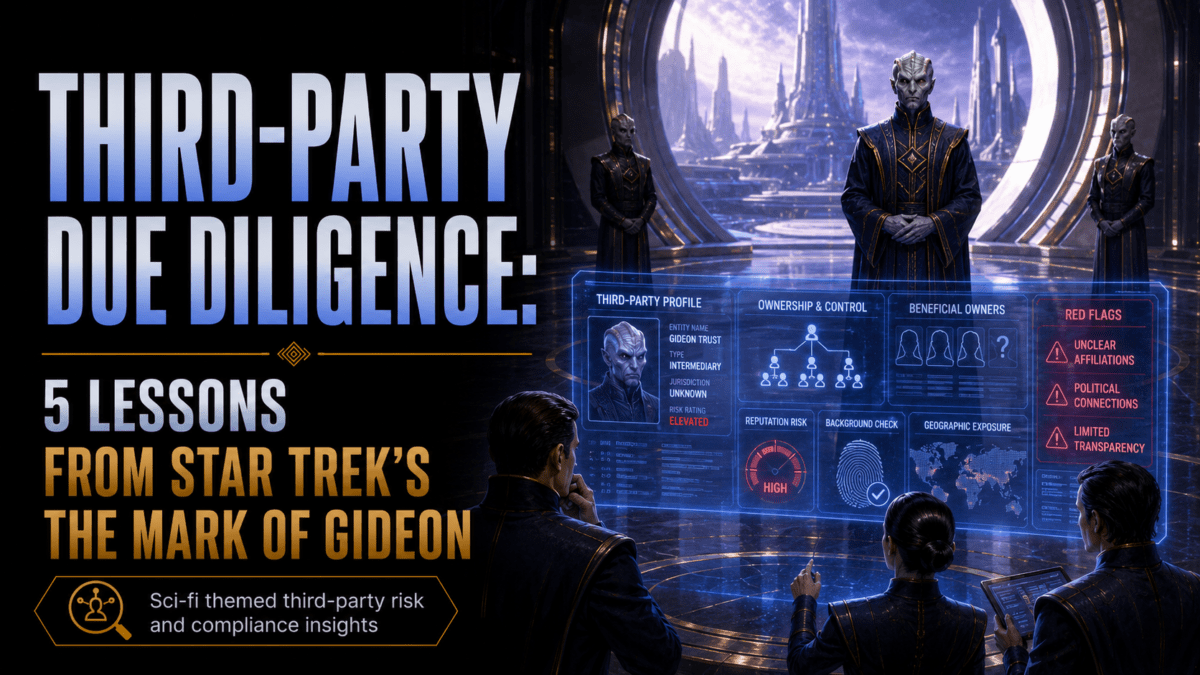
Few pop culture moments capture the risks of blind engagement as vividly as Star Trek: The Original Series’ “The Mark of Gideon.” In this episode, Captain Kirk beams down to what he believes is the planet Gideon for diplomatic talks—only to find himself aboard what appears to be an empty Enterprise. What follows is a masterclass in the dangers of walking into a deal without verifying the facts. For compliance professionals, Gideon’s deception is the perfect allegory for the hazards of onboarding a third party without a thorough vetting process. Let’s break down five key lessons.

Lesson 1: Verify the True Identity of Your Counterparty

Illustrated By: When Kirk believes he is beamed down to Gideon, he is actually inside a replica of the Enterprise. The Gideonites have created this fake environment to isolate him for their purposes.

Compliance Lesson. If you do not confirm the true identity of a third party, you may find yourself dealing with a façade. Shell companies, undisclosed beneficial owners, and entities with misleading corporate registrations are the corporate world’s “empty Enterprise.”

Lesson 2: Understand the Real Motives Behind the Partnership

Illustrated By: The Gideonites present their plan as a noble solution to their problem, but it’s built on deception and exploitation.

Compliance Lesson. Third parties sometimes have agendas that differ sharply from what they present. They may seek access to your brand to legitimize questionable practices, gain entry to restricted markets, or launder illicit funds.

Lesson 3: Never Rely Solely on What the Other Party Tells You

Illustrated By: Kirk repeatedly asks the Gideonites to explain what is happening, but their answers are vague, evasive, and occasionally contradictory. They hope his lack of information will keep him compliant long enough to serve their plan.

Compliance Lesson. Self-reported information from a potential third party should be viewed as one data point, not the whole picture. Misrepresentations are common, whether deliberate or due to internal ignorance.

Lesson 4: Assess the Operating Environment Before Engagement

Illustrated By: The Gideonites hide the actual conditions on their planet. Kirk learns later that Gideon is overcrowded to the point of people standing shoulder-to-shoulder, unable to move freely.

Compliance Lesson. Entering into a business relationship without assessing this environment is akin to beaming down blind.

Lesson 5: Build Exit Strategies Into the Relationship

Illustrated By: Once Kirk understands the Gideonites’ true intentions, he must escape the replica Enterprise to stop their plan.

Compliance Lesson. Some third-party relationships turn sour, and you need a plan to disengage without disrupting your operations. Include termination clauses tied to compliance breaches in your contracts.

Final ComplianceLog Reflections

In The Mark of Gideon, the Enterprise crew’s lack of verified intelligence before Kirk’s “beam down” mirrors what happens when companies rush into a third-party relationship to seize a perceived opportunity. The Gideonites knew how to manipulate the Federation’s diplomatic eagerness. Likewise, unscrupulous partners today exploit companies’ urgency to enter new markets or secure rare supply chains.

The lesson? Due diligence is not a delay; it is a safeguard. The few extra weeks spent vetting a partner can prevent years of litigation, regulatory penalties, and reputational damage.

Resources:

⁠⁠Excruciatingly Detailed Plot Summary by Eric W. Weisstein⁠⁠

⁠⁠MissionLogPodcast.com⁠⁠

⁠⁠Memory Alpha