Categories
Blog

Third-Party Due Diligence: Five Lessons from Star Trek’s The Mark of Gideon

In the modern compliance landscape, third-party due diligence is not optional but essential. Regulators from the DOJ to the SFO have made it clear: if your business partner is involved in misconduct, you are on the hook if you did not take reasonable steps to know who you were dealing with.

Few pop culture moments capture the risks of blind engagement as vividly as Star Trek: The Original Series’ “The Mark of Gideon.” In this episode, Captain Kirk beams down to what he believes is the planet Gideon for diplomatic talks—only to find himself aboard what appears to be an empty Enterprise. What follows is a masterclass in the dangers of walking into a deal without verifying the facts. For compliance professionals, Gideon’s deception is the perfect allegory for the hazards of onboarding a third party without a thorough vetting process. Let’s break down five key lessons.

Lesson 1: Verify the True Identity of Your Counterparty

Illustrated By: When Kirk believes he is beamed down to Gideon, he is actually inside a replica of the Enterprise. The Gideonites have created this fake environment to isolate him for their purposes.

Compliance Lesson. If you do not confirm the true identity of a third party, you may find yourself dealing with a façade. Shell companies, undisclosed beneficial owners, and entities with misleading corporate registrations are the corporate world’s “empty Enterprise.”Always confirm a third party’s corporate existence and ownership through independent sources. This means checking official registries, using reliable due diligence databases, and, when needed, engaging investigative firms to trace beneficial ownership. Without these checks, you risk contracting with a front for illicit activity.

Lesson 2: Understand the Real Motives Behind the Partnership

Illustrated By: The Gideonites’ true purpose is not peaceful diplomacy; instead, they want to infect their overpopulated planet with a deadly virus carried by Kirk. They present their plan as a noble solution to their problem, but it’s built on deception and exploitation.

Compliance Lesson. Third parties sometimes have agendas that differ sharply from what they present. They may seek access to your brand to legitimize questionable practices, gain entry to restricted markets, or launder illicit funds. Beyond standard questionnaires, compliance teams should assess the commercial rationale for the relationship. Why do they want to work with you? Who else do they do business with? Are their financials consistent with the scale of the deal? If their motives don’t align with your values and compliance commitments, that is a red flag.

Lesson 3: Never Rely Solely on What the Other Party Tells You

Illustrated By: Kirk repeatedly asks the Gideonites to explain what is happening, but their answers are vague, evasive, and occasionally contradictory. They hope his lack of information will keep him compliant long enough to serve their plan.

Compliance Lesson. Self-reported information from a potential third party should be viewed as one data point, not the whole picture. Misrepresentations are common, whether deliberate or due to internal ignorance. Cross-verify all claims with independent checks, customer references, industry reputation research, litigation and sanctions screening, and on-site visits when possible. If the only source for a claim is the counterparty itself, your risk exposure rises dramatically.

Lesson 4: Assess the Operating Environment Before Engagement

Illustrated By: The Gideonites hide the actual conditions on their planet. Kirk learns later that Gideon is overcrowded to the point of people standing shoulder-to-shoulder, unable to move freely. Had this been disclosed, he would have understood the real risks before arriving.

Compliance Lesson. A third party’s operating environment, political stability, corruption levels, and regulatory enforcement directly affect your compliance risk. Entering into a business relationship without assessing this environment is akin to beaming down blind. Incorporate country risk analysis into your process. Use resources like Transparency International’s Corruption Perceptions Index, U.S. State Department human rights reports, and local legal counsel. An otherwise legitimate partner in a high-risk jurisdiction requires enhanced due diligence and monitoring.

Lesson 5: Build Exit Strategies Into the Relationship

Illustrated By: Once Kirk understands the Gideonites’ true intentions, he must escape the replica Enterprise to stop their plan. Without a clear route back to his crew, he risks being trapped indefinitely.

Compliance Lesson. Some third-party relationships turn sour despite your best due diligence efforts. Whether due to leadership changes, shifts in political conditions, or the surfacing of previously hidden misconduct, you need a plan to disengage without disrupting your operations. Include termination clauses tied to compliance breaches in your contracts. Maintain operational flexibility so you can pivot to alternate suppliers or partners if needed. Regularly re-screen third parties to ensure ongoing compliance, not just a one-time check at onboarding.

Final ComplianceLog Reflections

In The Mark of Gideon, the Enterprise crew’s lack of verified intelligence before Kirk’s “beam down” mirrors what happens when companies rush into a third-party relationship to seize a perceived opportunity. The Gideonites knew how to manipulate the Federation’s diplomatic eagerness. Likewise, unscrupulous partners today exploit companies’ urgency to enter new markets or secure rare supply chains.

The lesson? Due diligence is not a delay; it is a safeguard. The few extra weeks spent vetting a partner can prevent years of litigation, regulatory penalties, and reputational damage.

The Mark of Gideon” is not just a quirky Star Trek morality tale. It is a warning for every compliance professional. Without thorough third-party due diligence, you risk waking up in a corporate “replica Enterprise,” surrounded by partners whose true motives only become clear when it’s too late.

Your job as a compliance officer is to ensure the company doesn’t act blindly. By verifying identities, probing motives, cross-checking information, assessing environments, and building exit strategies, you safeguard your organization’s reputation and operational integrity. In short: trust, but verify, especially when the other side is as smooth-talking as the people of Gideon.

Resources:

⁠⁠Excruciatingly Detailed Plot Summary by Eric W. Weisstein⁠⁠

⁠⁠MissionLogPodcast.com⁠⁠

⁠⁠Memory Alpha

Categories
Trekking Through Compliance

Trekking Through Compliance: Episode 69: Lessons from Let That Be Your Last Battlefield: Building Justice and Fairness into Corporate Culture

Few episodes capture the destructive power of bias, systemic injustice, and the refusal to see common humanity as vividly as Star Trek: The Original Series’ “Let That Be Your Last Battlefield.” From a compliance perspective, the episode provides an unflinching mirror: organizations that fail to ensure fairness in their systems—whether in investigations, promotions, whistleblower treatment, or discipline—risk breeding internal hostilities just as destructive as Cheron’s. Today, we unpack five key compliance lessons for embedding institutional justice and fairness into the corporate DNA.

Lesson 1: Bias—Even When Invisible to Some—Can Destroy Organizational Cohesion

Illustrated By: When Bele first encounters Lokai aboard the Enterprise, he describes him as “obviously inferior.”

Compliance Lesson. Bias often hides in plain sight to those not affected by it. In corporate settings, decision-makers may not recognize that promotion patterns, discipline rates, or resource allocations favor certain groups until a whistleblower, audit, or public scandal exposes it.

Lesson 2: Enforcement Must Be Fair, Consistent, and Transparent

Illustrated By: Bele claims the right to arrest Lokai for crimes committed on Cheron. Lokai, in turn, accuses Bele of genocide. Neither offers verifiable evidence; instead, both rely on their moral certainty.

Compliance Lesson. Internal enforcement that rests on vague accusations or uneven application destroys trust in compliance systems.

Lesson 3: Leaders Must Refuse to Be Drawn into Partisan Vendettas

Illustrated By: Kirk insists on the Enterprise’s code of conduct and rules of evidence.

Compliance Lessons. Senior leaders are often pressured, subtly or overtly, to “pick a side” in internal disputes.

Lesson 4: Systemic Injustice Can Persist Until It Consumes the Organization

Illustrated By: When Bele and Lokai finally return to Cheron, they find their planet in ruins, destroyed by centuries of hatred. Yet, even faced with the extinction of their people, they continue their pursuit, consumed by the need to destroy the other.

Compliance Lesson. Corporate cultures that allow systemic injustice, favoritism in promotions, discriminatory pay structures, retaliation against whistleblowers, risk not only reputational harm but the destruction of the organization’s ability to function cohesively. Over time, injustice becomes normalized, making reform nearly impossible without significant disruption.

Lesson 5: Without a Shared Framework for Fairness, Conflict Has No Resolution

Illustrated By: Spock, ever the voice of logic, tries to point out that the two aliens are more alike than different. To them, justice is entirely defined by the defeat of the other.

Compliance Lesson. In corporations, the absence of a clear, visible framework for fairness, along with policies, expectations, and trusted reporting channels, leads to conflicts that devolve into zero-sum games.

Final ComplianceLog Reflections

Let That Be Your Last Battlefield ends on a tragic note: the two survivors beam down to a dead world, still locked in mutual hatred. It’s a cautionary tale for corporate life. Without institutional justice and fairness, even the most advanced organizations can collapse into destructive internal conflict.

Resources:

⁠⁠Excruciatingly Detailed Plot Summary by Eric W. Weisstein⁠⁠

⁠⁠MissionLogPodcast.com⁠⁠

⁠⁠Memory Alpha

Categories
Blog

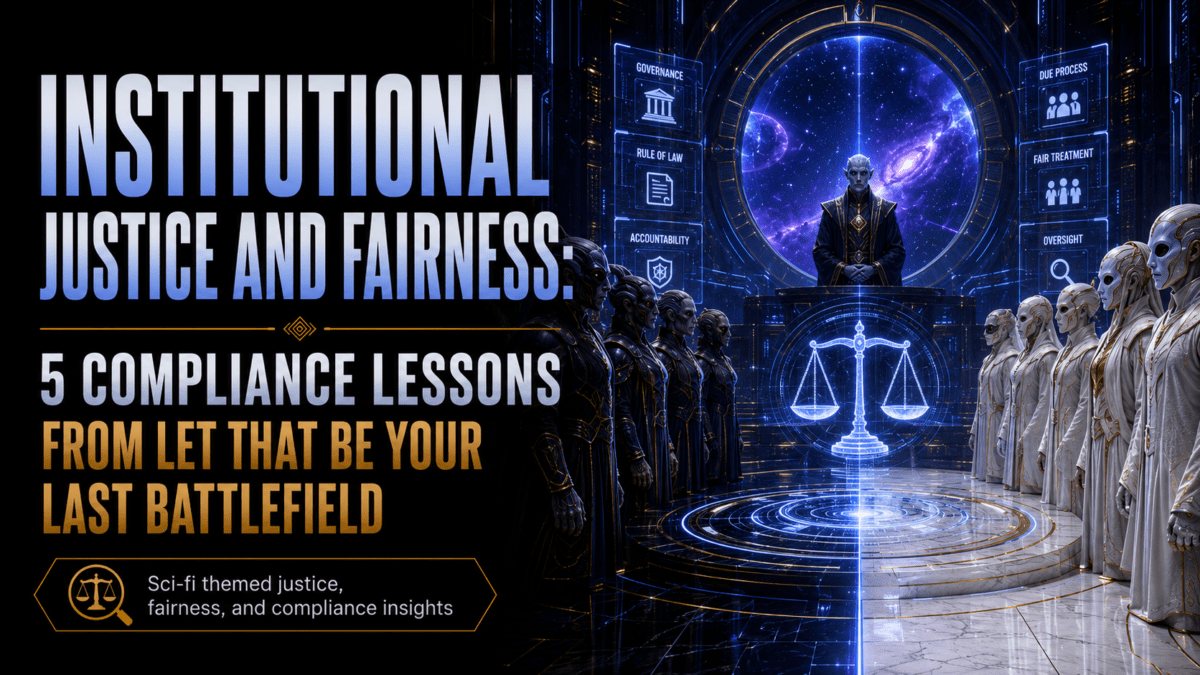
Institutional Justice and Fairness: Five Compliance Lessons from Let That Be Your Last Battlefield

In the realm of corporate compliance, institutional justice and fairness are not mere aspirational slogans; they are operational imperatives. These principles govern how decisions are made, how investigations are conducted, how employees are treated, and how corporate culture sustains itself over time.

Few pop culture allegories capture the destructive power of bias, systemic injustice, and the refusal to see common humanity as vividly as Star Trek: The Original Series’ “Let That Be Your Last Battlefield.”

In the episode, the Enterprise rescues Bele and Lokai, two survivors from the planet Cheron, each half black and half white, split vertically, but on opposite sides. To them, this difference is not a curiosity but the basis for deep-seated hatred. Their mutual enmity has destroyed their planet, leaving only the two of them to perpetuate the feud.

From a compliance perspective, the episode provides an unflinching mirror: organizations that fail to ensure fairness in their systems—whether in investigations, promotions, whistleblower treatment, or discipline—risk breeding internal hostilities just as destructive as Cheron’s. Let’s unpack five key compliance lessons for embedding institutional justice and fairness into the corporate DNA.

Lesson 1: Bias—Even When Invisible to Some—Can Destroy Organizational Cohesion

Illustrated By: When Bele first encounters Lokai aboard the Enterprise, he describes him as “obviously inferior.” Captain Kirk and the crew, however, are baffled. To them, both aliens appear the same, half black, half white. The difference only matters to Bele because, in his mind, the “correct” coloration is black on the right side.

Compliance Lesson. Bias often hides in plain sight to those not affected by it. In corporate settings, decision-makers may not recognize that promotion patterns, discipline rates, or resource allocations favor certain groups until a whistleblower, audit, or public scandal exposes it.

What should you do now? Compliance departments must proactively identify and address these “invisible” biases. This means collecting and analyzing workforce data by role, pay, and demographics, conducting blind résumé reviews where appropriate, and building bias-awareness training into leadership development. A fair institution does not wait for bias to erode morale. It works to neutralize it before it becomes a fault line.

Lesson 2: Enforcement Must Be Fair, Consistent, and Transparent

Illustrated By: Bele claims the right to arrest Lokai for crimes committed on Cheron. When Kirk asks what those crimes are, Bele offers only vague accusations about theft and rebellion. Lokai, in turn, accuses Bele of genocide. Neither offers verifiable evidence; instead, both rely on their moral certainty.

Compliance Lesson. Internal enforcement that rests on vague accusations or uneven application destroys trust in compliance systems. If some employees are disciplined harshly for minor infractions while others escape consequences for major violations, especially if those others are high performers or senior executives, perceptions of injustice spread quickly.

What should you do now? Enforcement must be rule-based, not personality-based. Compliance should establish clear investigation protocols, document evidence, and apply sanctions proportionately and consistently. Transparency, within the limits of privacy and confidentiality, builds credibility. Employees are more likely to accept outcomes they disagree with if they understand the process was impartial.

Lesson 3: Leaders Must Refuse to Be Drawn into Partisan Vendettas

Illustrated By: Bele demands that Kirk turn Lokai over to him, citing his authority as a law enforcer from Cheron. Kirk, recognizing the apparent personal animosity, refuses to take sides without due process. He insists on the Enterprise’s code of conduct and rules of evidence.

Compliance Lessons. Senior leaders are often pressured, subtly or overtly, to “pick a side” in internal disputes. This may come from managers trying to protect their teams, high-value employees attempting to shield themselves from accountability, or executives wanting to “make a problem go away” by sacrificing someone quickly.

What should you do now? A compliance function must stand apart from internal politics. Its legitimacy rests on applying the same standards to all, regardless of power, popularity, or tenure. This requires independence, direct reporting lines to the board, and documented procedures that prevent political influence from steering outcomes.

Lesson 4: Systemic Injustice Can Persist Until It Consumes the Organization

Illustrated By: When Bele and Lokai finally return to Cheron, they find their planet in ruins, destroyed by centuries of hatred. Yet, even faced with the extinction of their people, they continue their pursuit, consumed by the need to destroy the other.

Compliance Lesson. Corporate cultures that allow systemic injustice, favoritism in promotions, discriminatory pay structures, retaliation against whistleblowers, risk not only reputational harm but the destruction of the organization’s ability to function cohesively. Over time, injustice becomes normalized, making reform nearly impossible without significant disruption.

What should you do now? Compliance must act early and decisively when patterns of inequity appear. This requires the courage to challenge entrenched practices and the authority to recommend systemic changes, whether in hiring pipelines, procurement policies, or leadership evaluations. Just as Cheron’s destruction was preventable had action been taken earlier, organizations that ignore inequity may find themselves fighting to save something already beyond repair.

Lesson 5: Without a Shared Framework for Fairness, Conflict Has No Resolution

Illustrated By: Spock, ever the voice of logic, tries to point out that the two aliens are more alike than different. Bele and Lokai, however, reject any suggestion of commonality because they lack a shared concept of fairness. To them, justice is entirely defined by the defeat of the other.

Compliance Lesson. In corporations, the absence of a clear, visible framework for fairness, along with policies, expectations, and trusted reporting channels, leads conflicts to devolve into zero-sum games. Each side seeks to “win” rather than to resolve issues constructively.

What should you do now? Compliance departments must provide that shared framework. Review, update if appropriate, and retrain on your

  • Code of Conduct.
  • Independent investigation procedures.
  • A commitment to non-retaliation.
  • Mechanisms for appeal and review.

When fairness is institutionalized, disputes have a pathway to resolution that doesn’t rely on destroying the other side.

The Enterprise Model: Compliance as the Guardian of Fairness

Captain Kirk’s approach in the episode offers a leadership model for compliance officers. He listens, gathers facts, refuses to be drawn into personal vendettas, applies established rules, and seeks to uphold the Enterprise’s standards above external political pressures.

That’s the role compliance must play in institutional justice:

  • Guardian of fairness, ensuring that rules apply equally to all.
  • Protector of process, resisting shortcuts for expediency.
  • Champion of independence, immune to political or personal influence.

When these principles are embedded in an organization, they do more than prevent misconduct; they create a culture where employees believe in the integrity of the system itself.

Final ComplianceLog Reflections

Let That Be Your Last Battlefield ends on a tragic note: the two survivors beam down to a dead world, still locked in mutual hatred. It’s a cautionary tale for corporate life. Without institutional justice and fairness, even the most advanced organizations can collapse into destructive internal conflict.

The compliance department’s mandate is clear: be the Enterprise, not Cheron. Build systems that see beyond superficial differences, enforce rules fairly, resist partisan pressures, confront systemic inequity, and provide a shared framework for fairness. In doing so, you give your organization something Bele and Lokai never had: a future worth fighting for together.

Resources:

⁠⁠Excruciatingly Detailed Plot Summary by Eric W. Weisstein⁠⁠

⁠⁠MissionLogPodcast.com⁠⁠

⁠⁠Memory Alpha

Categories
Blog

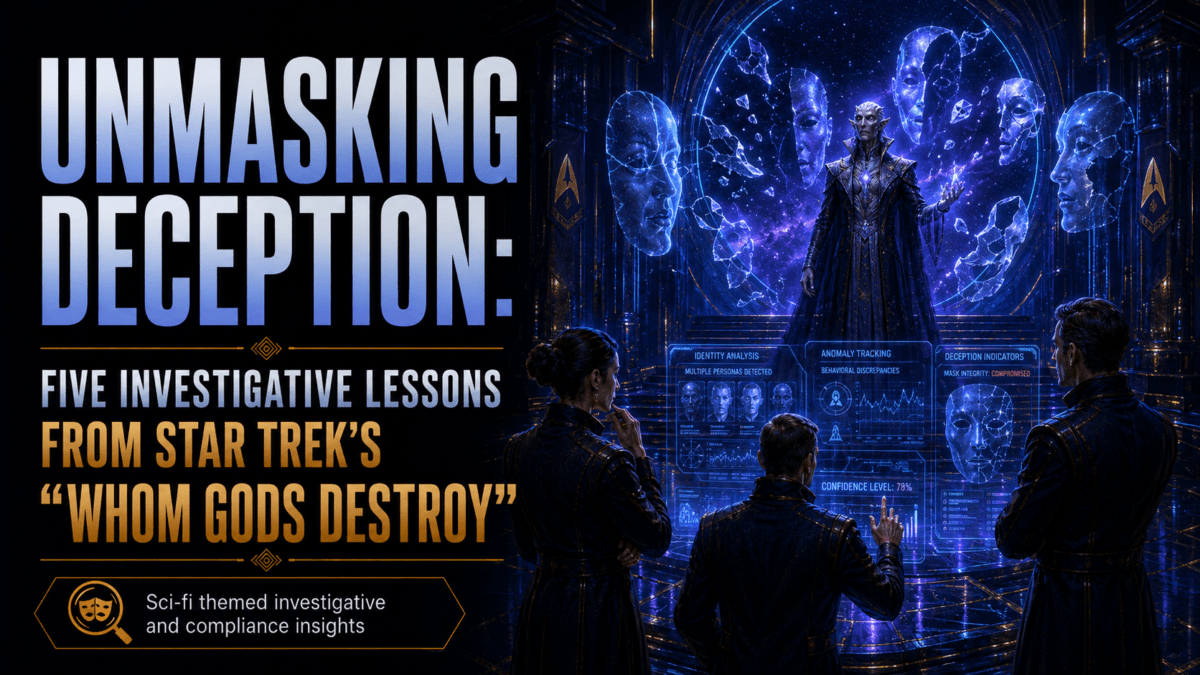
Unmasking Deception: Five Investigative Lessons from Star Trek’s “Whom Gods Destroy”

Today, let’s take a journey to one of Star Trek: The Original Series’ most intense psychological dramas: “Whom Gods Destroy.” On its surface, this episode is a tale of madness, manipulation, and peril. But for the vigilant compliance professional, it’s a trove of investigative lessons on dealing with deception, managing risk, and safeguarding your organization in an unpredictable world.

In “Whom Gods Destroy,” Captain Kirk and Mr. Spock arrive at the maximum-security facility on Elba II to deliver a new medicine. They quickly fall prey to the cunning Garth of Izar, a former starship fleet captain now criminally insane. Garth seizes control of the asylum using his shapeshifting ability and manipulates everyone around him with a series of deceptions, impersonations, and psychological games. For Kirk and Spock, survival means uncovering the truth in a maze of misdirection.

Let’s beam down to Elba II, a remote asylum for the galaxy’s most dangerous criminally insane, to examine what this wild ride can teach us about effective corporate investigations.

1. Never Accept Surface Appearances—Verify, Then Trust

Illustrated By: Kirk and Spock are greeted by what appears to be the asylum’s director, Governor Cory. He acts normally and reassures them that all is well. Only later do they discover that Garth, using his ability to alter his appearance, is impersonating Cory and is, in fact, in control of the facility.

Compliance Lesson. In investigations, never accept things at face value. Documents can be forged, credentials fabricated, and even trusted individuals may act under duress or with hidden motives. Just as Garth’s impersonation deceived Kirk, compliance investigators must independently verify facts, corroborate stories, and challenge what seems obvious. Assume nothing—always test the evidence.

What should you do now? Establish robust protocols for evidence verification. Don’t simply trust, but verify, using multiple sources, forensic tools, and independent witness interviews. Always be alert to the possibility that someone may be playing a role.

2. Psychological Manipulation: Beware the Power of Charisma

Illustrated By: Garth, in his guise as both himself and others, uses his charisma and manipulation to sow confusion and loyalty among the other inmates. He persuades them to join his rebellion through promises, threats, and appeals to their egos.

Compliance Lesson. In many investigations, the most dangerous individuals are those who wield psychological influence. Charismatic leaders, managers, or employees can persuade others to cover up wrongdoing, falsify records, or sabotage investigative efforts. Investigators must be wary of undue influence and remember that even the most likable or persuasive people may have something to hide.

What should you do now?  Train your investigative team to recognize and resist psychological manipulation. Always seek independent corroboration and never let charm or status cloud your objectivity.

3. The Importance of Access Controls and Segregation of Duties

Illustrated By: Garth gains control over the asylum’s security systems, disabling communications and trapping Kirk and Spock. By centralizing control, he can manipulate everyone in the facility and thwart any rescue attempt.

Compliance Lesson: A key safeguard against fraud and misconduct is the principle of segregation of duties and strict access controls. If one individual or a small group can manipulate systems without oversight, your organization is vulnerable to abuse. Garth’s control of Elba II mirrors what can happen in a business when there are weak internal controls: a single rogue actor can wreak havoc before anyone notices.

What should you do now? Regularly review and test your access controls and segregation of duties. Ensure that no single person has unchecked power and regularly audit system logs to detect unusual activity. Prevent the “Garth scenario” by building multiple layers of oversight.

4. Recognize Red Flags and Act on Them Swiftly

Illustrated By: Despite several warning signs, unusual behavior from the “director,” cryptic comments from the staff, and security lapses, Kirk and Spock hesitate before taking decisive action. Only after the deception becomes undeniable do they shift into crisis mode.

Compliance Lesson. Every investigation reveals red flags. The question is: will your team recognize them early and act decisively? All too often, subtle signals, changes in behavior, delayed responses, or gaps in documentation are ignored until the situation escalates. In “Whom Gods Destroy,” the cost of delay is nearly fatal.

What should you do now? Create a culture where red flags are escalated and investigated immediately. Encourage open reporting and ensure investigators are empowered to follow up on their instincts. Quick action can prevent a minor issue from becoming a crisis.

5. Collaboration Is the Key to Outwitting Deception

Illustrated By: Ultimately, Kirk and Spock overcome Garth’s deceptions through close teamwork, communication, and the use of a prearranged security code that only the honest Kirk would know. Spock’s skepticism and methodical approach are essential to cutting through the confusion and revealing the truth.

Compliance Lesson. Investigations should never be a solo endeavor. Collaboration, clear communication, and checks and balances are essential to unmasking sophisticated schemes. Like Spock and Kirk, compliance teams must establish protocols—such as “safe words,” confirmation codes, or independent review processes—to prevent impersonation, collusion, or false confessions.

What should you do now? Build cross-functional investigative teams with diverse skill sets. Foster a culture of transparency, and ensure all findings are independently reviewed and validated. Teamwork and process discipline are your best defenses against deception.

Final ComplianceLog Reflections

“Whom Gods Destroy” may be set in a galaxy far away, but its lessons are as relevant to the compliance investigator as they are to any starship captain. In a world where deception can take many forms, such as charisma, forged documents, technological manipulation, or even trusted colleagues, your best defense is disciplined skepticism, rigorous process, and a commitment to the truth above all else.

In corporate investigations, the price of being deceived is high, but the rewards of vigilance, skepticism, and teamwork are higher. So, as you face your own “Elba II,” remember the lessons of Kirk and Spock: Trust the process, trust your team, and always keep your eyes open for the masks that others might wear.

Resources:

⁠⁠Excruciatingly Detailed Plot Summary by Eric W. Weisstein⁠⁠

⁠⁠MissionLogPodcast.com⁠⁠

⁠⁠Memory Alpha

Categories
Trekking Through Compliance

Trekking Through Compliance: Episode 68 – Deception in the Asylum: 5 Compliance Investigation Insights from “Whom Gods Destroy

Today, we take a journey to one of Star Trek: The Original Series’ most intense psychological dramas: “Whom Gods Destroy.” On its surface, this episode is a tale of madness, manipulation, and peril. But for the vigilant compliance professional, it’s a trove of investigative lessons on dealing with deception, managing risk, and safeguarding your organization in an unpredictable world. Let’s beam down to Elba II, a remote asylum for the galaxy’s most dangerous criminally insane, to examine what this wild ride can teach us about effective corporate investigations.

1. Never Accept Surface Appearances—Verify, Then Trust

Illustrated By: Kirk and Spock are greeted by what appears to be the asylum’s director. Only later do they discover that Garth, using his ability to alter his appearance, is impersonating Cory and is, in fact, in control of the facility.

Compliance Lesson. In investigations, never accept things at face value.

2. Psychological Manipulation: Beware the Power of Charisma

Illustrated By: Garth, in his guise as both himself and others, uses his charisma and manipulation to sow confusion and loyalty among the other inmates.

Compliance Lesson. In many investigations, the most dangerous individuals are those who wield psychological influence. Charismatic leaders, managers, or employees can persuade others to cover up wrongdoing, falsify records, or sabotage investigative efforts.

3. The Importance of Access Controls and Segregation of Duties

Illustrated By: By centralizing control, Garth can manipulate everyone in the facility and thwart any rescue attempt.

Compliance Lesson: A key safeguard against fraud and misconduct is the principle of segregation of duties and strict access controls. If one individual or a small group can manipulate systems without oversight, your organization is vulnerable to abuse.

4. Recognize Red Flags and Act on Them Swiftly

Illustrated By: Despite several warning signs, unusual behavior from the “director,” cryptic comments from the staff, and security lapses, Kirk and Spock hesitate before taking decisive action.

Compliance Lesson. Every investigation reveals red flags. The question is, will your team recognize them early and act decisively?

5. Collaboration Is the Key to Outwitting Deception

Illustrated By: Spock’s skepticism and methodical approach are essential to cutting through the confusion and revealing the truth.

Compliance Lesson. Investigations should never be a solo endeavor. Collaboration, clear communication, and checks and balances are essential to unmasking sophisticated schemes.

Final ComplianceLog Reflections

“Whom Gods Destroy” may be set in a galaxy far away, but its lessons are as relevant to the compliance investigator as they are to any starship captain. In a world where deception can take many forms, such as charisma, forged documents, technological manipulation, or even trusted colleagues, your best defense is disciplined skepticism, rigorous process, and a commitment to the truth above all else.

In corporate investigations, the price of being deceived is high, but the rewards of vigilance, skepticism, and teamwork are higher. So, as you face your own “Elba II,” remember the lessons of Kirk and Spock: Trust the process, trust your team, and always keep your eyes open for the masks that others might wear.

Resources:

⁠⁠Excruciatingly Detailed Plot Summary by Eric W. Weisstein⁠⁠

⁠⁠MissionLogPodcast.com⁠⁠

⁠⁠Memory Alpha

Categories
Trekking Through Compliance

Trekking Through Compliance: Episode 67 – The Dangers of Assumption: How Star Trek’s “Elaan of Troyius” Proves Due Diligence Is Essential

Today, let’s set our phasers to “analyze” and travel back to one of Star Trek: The Original Series’ most underrated diplomatic dramas: “Elaan of Troyius.” This episode is not just a space opera of culture clashes, hidden agendas, and diplomatic peril; it is a near-perfect parable for compliance professionals wrestling with the eternal question: Why is due diligence mandatory when considering a new business partner?

Let’s get into the heart of the episode and draw out five compliance lessons that every organization should heed before it signs that next contract.

1. First Impressions Are Deceptive: Always Probe Deeper

Illustrated By: Elaan’s arrival is marked by dramatic displays of power, arrogance, and cultural superiority.

Compliance Lesson. How many times have we seen organizations swept off their feet by a potential partner’s surface credentials, market reputation, or charismatic leadership? Due diligence is your organization’s safeguard against falling for the “Elaan effect”: the temptation to trust a partner’s public image without digging into their true character, operational practices, or hidden risks.

2. Cultural Blind Spots: Understand the Landscape Before You Leap

Illustrated By: Misunderstandings abound, from differing customs around authority and gender to fundamental misalignments in values.

Compliance Lesson. Entering into any partnership without understanding your partner’s culture, whether corporate, regional, or national, is asking for trouble.

3. Hidden Agendas and Sabotage: Trust, But Verify

Illustrated By: The mission is sabotaged by Elaan’s retinue, her bodyguard conspires with the Klingons, hiding a device that compromises the Enterprise’s defenses.

Compliance Lesson. When evaluating new partners, you must assume that unseen risks may be lurking just below the surface.

4. Emotional Reactions Cloud Judgment: Stay Objective

Illustrated By: Kirk finds himself emotionally entangled with Elaan after being exposed to her tears, which act as a potent love potion.

Compliance Lesson. In real-world business, emotional bias can cause teams to overlook red flags, downplay risks, or shortcut due diligence.

5. The Price of Ignorance: Remediation Is Harder Than Prevention

Illustrated By: Only after chaos erupts do Kirk and the crew scramble to uncover the source of their problems, a hidden device sabotaging the Enterprise’s engines.

Compliance Lesson. If you do not invest in rigorous due diligence up front, you will inevitably spend much more time, money, and resources cleaning up the mess after something goes wrong.

Final ComplianceLog Reflections

Elaan of Troyius” is a warning to any organization tempted to “wing it” when evaluating a new business partner. Diplomacy, optimism, and trust are essential, but they are not substitutes for due diligence. Hidden risks, cultural misunderstandings, and emotional biases can turn opportunity into disaster in a heartbeat. Kirk and the crew of the Enterprise ultimately succeed not because of luck, but because they confront hard truths, adapt, and persevere. In the world of corporate compliance, the same rules apply.

Resources:

⁠⁠Excruciatingly Detailed Plot Summary by Eric W. Weisstein⁠⁠

⁠⁠MissionLogPodcast.com⁠⁠

⁠⁠Memory Alpha

Categories
Blog

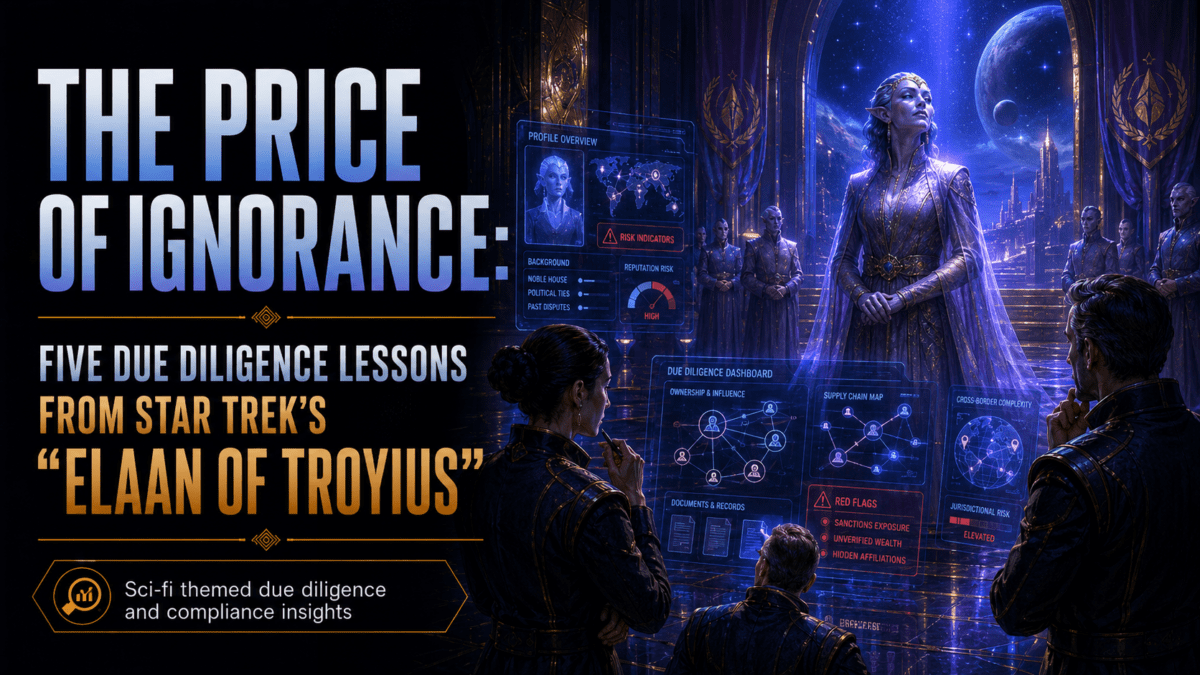
The Price of Ignorance: Five Due Diligence Lessons from Star Trek’s “Elaan of Troyius”

Today, let’s set our phasers to “analyze” and travel back to one of Star Trek: The Original Series’ most underrated diplomatic dramas: “Elaan of Troyius.” This episode is not just a space opera of culture clashes, hidden agendas, and diplomatic peril; it is a near-perfect parable for compliance professionals wrestling with the eternal question: Why is due diligence mandatory when considering a new business partner?

For those who have not revisited this classic, the USS Enterprise is assigned a high-stakes diplomatic mission: transport Elaan, the tempestuous Dohlman of Elas, to the planet Troyius, where her arranged marriage will seal a peace treaty between two warring worlds. As tensions flare between Elaan’s culture and that of the Federation, Captain Kirk, Spock, and the crew quickly realize that more than just a wedding is at stake; hidden motivations, subterfuge, and cross-cultural misunderstandings threaten to unravel the entire peace process. What seems a straightforward escort mission rapidly reveals layers of complexity and risk.

Let’s get into the heart of the episode and draw out five compliance lessons that every organization should heed before it signs that next contract.

1. First Impressions Are Deceptive: Always Probe Deeper

Illustrated By: Elaan’s arrival is marked by dramatic displays of power, arrogance, and cultural superiority. The Federation diplomats are immediately intimidated and distracted by her forceful presence and sharp temperament.

Compliance Lesson. How many times have we seen organizations swept off their feet by a potential partner’s surface credentials, market reputation, or charismatic leadership? In “Elaan of Troyius,” Kirk and his crew quickly learn that initial impressions, whether good or bad, can conceal much deeper realities. Due diligence is your organization’s safeguard against falling for the “Elaan effect”: the temptation to trust a partner’s public image without digging into their true character, operational practices, or hidden risks.

What should you do now? Do not accept a new partner at face value. Investigate their ownership structure, past conduct, litigation history, financial health, and compliance record. Unmasking the reality behind the reputation is the first step.

2. Cultural Blind Spots: Understand the Landscape Before You Leap

Illustrated By: The cultural gap between Elaan and the Federation nearly derails the mission. Misunderstandings abound, from differing customs around authority and gender to fundamental misalignments in values. The crew is blindsided by these gaps, leading to avoidable conflict.

Compliance Lesson. Entering into any partnership without understanding your partner’s culture, whether corporate, regional, or national, is asking for trouble. Seemingly minor cultural mismatches can lead to miscommunication, legal violations, or ethical lapses. In cross-border or third-party relationships, this risk is magnified: local customs may hide corrupt practices, labor abuses, or anti-competitive behaviors.

What should you do now? Include cultural and ethical risk assessments as part of your due diligence. Engage local experts, conduct interviews, and be ready to adapt your approach to fit the landscape without compromising your core values.

3. Hidden Agendas and Sabotage: Trust, But Verify

Illustrated By: The mission is sabotaged by Elaan’s retinue, her bodyguard conspires with the Klingons, hiding a device that compromises the Enterprise’s defenses. Kirk is nearly assassinated, and the entire mission teeters on the brink of disaster because no one anticipated internal betrayal.

Compliance Lesson. When evaluating new partners, you must assume that unseen risks may be lurking just below the surface. These could take the form of undisclosed beneficial ownership, connections to sanctioned parties, or corrupt insiders. Even a trusted contact within a partner organization can turn out to be a risk factor if not properly vetted. In “Elaan of Troyius,” failure to probe the intentions and backgrounds of all involved parties nearly results in catastrophe.

What should you do now? Conduct background checks not just on the company, but also on key personnel, agents, and ultimate beneficial owners. Use open-source intelligence, watchlists, and external investigators as needed. “Trust, but verify” is not simply good (Ronald Reagan) advice; it is mandatory.

4. Emotional Reactions Cloud Judgment: Stay Objective

Illustrated By: Kirk finds himself emotionally entangled with Elaan after being exposed to her tears, which act as a potent love potion. His objectivity and command judgment are compromised at a critical moment, nearly dooming the ship.

Compliance Lesson. Emotional responses, from excitement about a lucrative new market to personal connections with a partner’s leadership, can cloud even the best compliance professional’s judgment. In “Elaan of Troyius,” emotional manipulation nearly brings down the Federation’s flagship. In real-world business, emotional bias can cause teams to overlook red flags, downplay risks, or shortcut due diligence.

What should you do now? Build structured, objective processes for due diligence that minimize the risk of bias. Use checklists, outside counsel, and independent reviews to ensure no one is “drunk on the deal.” Compliance must be immune to infatuation.

5. The Price of Ignorance: Remediation Is Harder Than Prevention

Illustrated By: Only after chaos erupts do Kirk and the crew scramble to uncover the source of their problems, a hidden device sabotaging the Enterprise’s engines. They’re forced into a desperate race against time to fix what could have been prevented.

Compliance Lesson. If you do not invest in rigorous due diligence up front, you will inevitably spend much more time, money, and resources cleaning up the mess after something goes wrong. Investigations, regulatory fines, lost business opportunities, and reputational damage are all far more expensive than preventative action. Just as Kirk would rather have found the sabotage before launch, compliance professionals must treat prevention as their first line of defense.

What should you do now? View due diligence as an investment, not a cost. The price of ignorance, missed risks, surprise violations, or regulatory enforcement will always exceed the price of preparedness.

Final ComplianceLog Reflections

Elaan of Troyius” is a warning to any organization tempted to “wing it” when evaluating a new business partner. Diplomacy, optimism, and trust are essential, but they are not substitutes for due diligence. Hidden risks, cultural misunderstandings, and emotional biases can turn opportunity into disaster in a heartbeat. Kirk and the crew of the Enterprise ultimately succeed not because of luck, but because they confront hard truths, adapt, and persevere. In the world of corporate compliance, the same rules apply.

So, the next time your organization eyes a shiny new partnership, ask yourself: Are we seeing only what we want to see? Or are we committed to the hard work of real due diligence, the only sure path to success, and to a future where both sides prosper?

Resources:

⁠⁠Excruciatingly Detailed Plot Summary by Eric W. Weisstein⁠⁠

⁠⁠MissionLogPodcast.com⁠⁠

⁠⁠Memory Alpha

Categories
Trekking Through Compliance

Trekking Through Compliance: Episode 64 – Breaking the Silence: Navigating Difficult Conversations with Wisdom from ‘Plato’s Step-Children’

There is no substitute for courage and candor in the world of corporate compliance. Some of the most vital and uncomfortable moments we encounter come when we must have conversations on difficult topics. It can be about misconduct, bias, bullying, or toxic behavior that threatens our organization’s culture and integrity. Yet, all too often, leaders and compliance professionals look for a way around these tough talks, hoping problems will resolve themselves.

Few television episodes confront the consequences of unchecked power, humiliation, and silence more starkly than Star Trek: The Original Series’ “Plato’s Step-Children.” Let’s draw five critical compliance lessons, grounded in five key scenes, from this infamous episode to guide our approach to conversations on difficult topics.

Lesson 1: Name the Unacceptable—Don’t Look Away

Illustrated By: Alexander, the only member without telekinetic power, is humiliated and abused by his peers and is often forced to grovel or perform for their amusement.

Compliance Lesson: The first, hardest step in any conversation on difficult topics is to acknowledge unacceptable behavior. The compliance professional must name the unacceptable, break the code of silence, and show the courage to call out abuse—even when it makes others uncomfortable.

Lesson 2: Empathize with the Vulnerable—Center Their Voice

Illustrated By: Alexander, the outcast, repeatedly begs Kirk and the crew for help, expressing pain and isolation. His vulnerability is palpable; he has suffered for years, dismissed by his peers and unseen by those in power.

Compliance Lesson: In every organization, there are individuals, often in less powerful positions, who experience harm most acutely. When confronting a difficult subject, the compliance leader’s job is to center the voices and experiences of those most at risk, not the comfort of those in power.

Lesson 3: Address Abuse of Power—Challenge the Bully

Illustrated By: The Platonians, particularly Parmen, take delight in using their power to force Kirk, Spock, and others to perform degrading acts.

Compliance Lesson: One of the most challenging conversations in compliance is confronting those who abuse their authority. Power imbalances often shield perpetrators from scrutiny. “Plato’s Step-Children” is an explicit reminder that leadership’s job is to challenge, not enable, bullying, coercion, or harassment.

Lesson 4: Support Each Other—Build Allies in Conversations on Complex Topics

Illustrated By: Even when stripped of control, Kirk and Spock’s teamwork and solidarity allow them to resist psychological breaking and maintain a sense of dignity.

Compliance Lesson: When addressing complex topics, it’s essential to build a coalition, including HR, legal, or trusted colleagues, to provide the necessary strength, perspective, and support to sustain the effort.

Lesson 5: Restore Dignity—End the Cycle of Harm

Illustrated By: In one of the episode’s most disturbing scenes, Kirk, Spock, Uhura, and Chapel are forced into humiliating, non-consensual acts. The Enterprise crew refuses to retaliate in kind when they gain the upper hand. The episode concludes not with vengeance, but with an insistence on dignity and ethical conduct.

Compliance Lesson: The ultimate goal of any conversation on difficult topics, especially those about harm or misconduct, is restoration and prevention.

Final ComplianceLog Reflections

Conversations on difficult topics are not just a leadership skill; they are the very foundation of a culture of integrity. When we name abuse, center the vulnerable, challenge power, support each other, and restore dignity, we transform moments of pain into turning points for progress.

Resources:

⁠⁠Excruciatingly Detailed Plot Summary by Eric W. Weisstein⁠⁠

⁠⁠MissionLogPodcast.com⁠⁠

⁠⁠Memory Alpha

Categories
Blog

Facing the Hard Truth: Conversations on Difficult Topics – Lessons from Star Trek’s “Plato’s Step-Children”

There is no substitute for courage and candor in the world of corporate compliance. Some of the most vital and uncomfortable moments we encounter come when we must have conversations on difficult topics. It can be about misconduct, bias, bullying, or toxic behavior that threatens our organization’s culture and integrity. Yet, all too often, leaders and compliance professionals look for a way around these tough talks, hoping problems will resolve themselves.

Few television episodes confront the consequences of unchecked power, humiliation, and silence more starkly than Star Trek: The Original Series’ “Plato’s Step-Children.” Known for its disturbing content, this episode puts the crew of the Enterprise through psychological and physical abuse at the hands of the Platonians—beings who wield telekinetic power and treat others as playthings. While hard to watch, the episode is a masterclass in why, when, and how we must speak up, even when the topic is profoundly uncomfortable.

Let’s draw five critical compliance lessons, grounded in five key scenes, from this infamous episode to guide our approach to conversations on difficult topics.

Lesson 1: Name the Unacceptable—Don’t Look Away

Illustrated By: Upon beaming down to Platonius, Captain Kirk, Spock, and Dr. McCoy are quickly subjected to the Platonians’ mind control. Alexander, the only member without telekinetic power, is humiliated and abused by his peers and is often forced to grovel or perform for their amusement.

Compliance Lesson: The first, hardest step in any conversation on difficult topics is to acknowledge unacceptable behavior. Like many organizations, the Platonians have built a culture of silence around mistreatment. The compliance professional’s duty is to name the unacceptable, break the code of silence, and show the courage to call out abuse—even when it makes others uncomfortable.

What should you do now? Document and report abusive behavior, no matter how entrenched or overlooked it seems. Use specific, direct language: “This conduct is not appropriate here.” Refuse to let fear of “rocking the boat” keep you silent, for silence only enables further harm.

Lesson 2: Empathize with the Vulnerable—Center Their Voice

Illustrated By: Alexander, the outcast, repeatedly begs Kirk and the crew for help, expressing pain and isolation. His vulnerability is palpable; he has suffered for years, dismissed by his peers and unseen by those in power.

Compliance Lesson: In every organization, there are individuals, often in less powerful positions, who experience harm most acutely. When confronting a difficult subject, the compliance leader’s job is to center the voices and experiences of those most at risk, not the comfort of those in power.

What should you do now? Listen deeply and actively to those who report mistreatment, without minimizing or redirecting. Create safe, confidential channels for reporting. Amplify the voices of the vulnerable, ensuring their stories shape policy and response, not just the narratives of the powerful.

Lesson 3: Address Abuse of Power—Challenge the Bully

Illustrated By: The Platonians, particularly Parmen, take delight in using their power to force Kirk, Spock, and others to perform degrading acts: Kirk is made to bark like a dog; Spock is forced to express emotions he cannot control; and Nurse Chapel and Uhura are compelled to embrace against their will, all for the Platonians’ entertainment.

Compliance Lesson: One of the most challenging conversations in compliance is confronting those who abuse their authority. Power imbalances often shield perpetrators from scrutiny. “Plato’s Step-Children” is an explicit reminder that leadership’s job is to challenge, not enable, bullying, coercion, or harassment.

What should you do now? Do not shy away from confronting senior leaders or high performers who engage in toxic behavior. Apply policies and consequences evenly, regardless of rank. Be prepared to escalate if leadership is complicit or unwilling to address abuse.

Lesson 4: Support Each Other—Build Allies in Conversations on Complex Topics

Illustrated By: As the torment intensifies, Kirk, Spock, and McCoy lean on each other for moral and emotional support. Even when stripped of control, their teamwork and solidarity allow them to resist psychological breaking and maintain a sense of dignity.

Compliance Lesson: Conversations on complex topics should not be approached alone, especially when dealing with entrenched cultures or intimidating figures. Building a coalition, whether HR, legal, or trusted colleagues, can provide the strength, perspective, and backup needed to sustain the effort.

What should you do now? Bring allies into the conversation: co-investigators, HR, or outside experts. Debrief regularly to process emotional stress and strategize next steps. Model support for those who come forward; visibly stand together against toxic behavior.

Lesson 5: Restore Dignity—End the Cycle of Harm

Illustrated By: In one of the episode’s most disturbing scenes, Kirk, Spock, Uhura, and Chapel are forced into humiliating, non-consensual acts as the Platonians laugh. Yet, by the end, the Enterprise crew refuses to retaliate in kind when they gain the upper hand. Instead, Kirk rebukes Parmen and demands Alexander be treated with respect and freedom. The episode concludes not with vengeance, but with an insistence on dignity and ethical conduct.

Compliance Lesson: The ultimate goal of any conversation on difficult topics, especially those about harm or misconduct, is restoration and prevention. Retaliation and blame may feel satisfying in the moment, but the compliance leader’s job is to break the cycle, restore dignity to those harmed, and lay the groundwork for a healthier culture going forward.

What should you do now? Focus on solutions, accountability, and healing, not just punishment. Provide support resources for those affected by misconduct. Reiterate the organization’s commitment to dignity, respect, and safety.

Final ComplianceLog Reflections

“Plato’s Step-Children” remains one of the most controversial and instructive episodes in Star Trek history. It confronts viewers with the ugly realities of unchecked power, silence in the face of abuse, and the moral responsibility to speak and act, even when it is dangerous or uncomfortable. As compliance professionals, we must take these lessons to heart.

Conversations on difficult topics are not just a leadership skill; they are the very foundation of a culture of integrity. When we name abuse, center the vulnerable, challenge power, support each other, and restore dignity, we transform moments of pain into turning points for progress.

May we all have the courage of the Enterprise crew to face uncomfortable truths, advocate for those who cannot, and insist on a culture where everyone’s dignity is protected.

Resources:

⁠⁠Excruciatingly Detailed Plot Summary by Eric W. Weisstein⁠⁠

⁠⁠MissionLogPodcast.com⁠⁠

⁠⁠Memory Alpha

Categories
Blog

Investigative Integrity in a Web of Uncertainty: Compliance Lessons from Star Trek’s “The Tholian Web”

If you ask any veteran compliance professional what separates the ordinary from the extraordinary, the answer is almost always the same: the ability to investigate under pressure. In a world of shifting facts, unseen dangers, and cross-functional confusion, actual investigative skill is what keeps organizations ethical, transparent, and resilient. Few stories illustrate this as vividly as “The Tholian Web,” an iconic episode from Star Trek: The Original Series.

Set against the backdrop of interdimensional crisis and escalating hostilities, “The Tholian Web” tests the Enterprise crew’s resourcefulness, resolve, and unity. As compliance professionals, we can draw rich lessons from how Captain Spock, Dr. McCoy, and their team navigate uncertainty, gather facts, resist outside interference, and stick to the investigative process. Let’s step into the anomaly-riddled void and explore five key investigative lessons every compliance officer should internalize, drawn directly from the plot, dialogue, and drama of “The Tholian Web.”

While answering a distress call from the USS Defiant, the Enterprise finds the missing starship phasing in and out of reality, trapped in a deadly interdimensional rift. Captain Kirk vanishes while leading a boarding party, leaving Spock in command just as the hostile Tholians appear and begin constructing their mysterious, menacing web. The crew must contend not only with Kirk’s disappearance but also with mounting pressure, psychological stress, and a complex puzzle that puts lives and the ship itself at risk.

Lesson 1: Investigate With a Cool Head—Leadership Under Duress

Illustrated By: After Kirk’s sudden disappearance, Spock assumes command. Crew anxiety spikes, tempers flare, and Dr. McCoy challenges Spock’s decisions. Instead of reacting emotionally, Spock insists on sticking to established protocol and methodical investigation.

Compliance Lesson: In crises, whether a whistleblower allegation, data breach, or fraud discovery, panic is a natural response. The best investigators, like Spock, recognize that emotional decision-making clouds judgment. They follow procedure, remain analytical, and never let pressure override the investigative process.

What should you do now? Train compliance teams to default to protocols, not panic. Create and rehearse “crisis checklists” so responses become second nature. Encourage a culture of mutual respect, even under stress, so disputes are resolved constructively, not destructively.

Lesson 2: Document Everything—The Importance of the Record

Illustrated By: Early in the investigation, Spock reviews and references Captain Kirk’s standing orders and last log entries. He later records his log, explicitly noting the crew’s condition, the timeline, and his rationale for each major decision.

Compliance Lesson: Thorough documentation is the lifeblood of effective investigations. Records create an objective narrative, protect the organization, and provide transparency for auditors, regulators, or stakeholders. If Spock had not documented his actions, later review, internal or external, would have been impossible.

What should you do now? Require contemporaneous notes during all investigative interviews and key meetings. Preserve all relevant evidence (emails, logs, CCTV, etc.). Institute a system for secure, indexed investigative files accessible only to authorized personnel.

Lesson 3: Test Hypotheses—Don’t Jump to Conclusions

Illustrated By: McCoy believes the interdimensional “space sickness” is a kind of infection, while Spock hypothesizes it is a function of spatial instability. Rather than making snap judgments, both test their theories with scientific rigor, running medical scans, experiments, and simulations until they converge on the facts.

Compliance Lesson: The temptation to accept the first “obvious” answer is strong, especially under time pressure. But good investigators approach every matter as a hypothesis to be tested—not a foregone conclusion. By seeking corroborating (or conflicting) evidence, compliance professionals ensure they arrive at the truth, not just a convenient story.

What should you do now? Create a habit of brainstorming multiple plausible causes for any compliance breach or allegation. Use data analytics, forensic testing, and independent interviews to verify facts. Foster an environment where challenging assumptions is seen as diligence, not defiance.

Lesson 4: Manage External Interference—Defend the Integrity of the Investigation

Illustrated By: The Tholians appear and begin imposing their agenda, demanding that the Enterprise leave the area. Under threat, Spock must weigh the crew’s safety against the risk of abandoning the investigation and Kirk. He stands firm, communicating clearly with the Tholians but refusing to let external pressure dictate internal process.

Compliance Lesson: Investigations are rarely free from outside influence. Legal, business, or even cultural pressures can tempt organizations to curtail, rush, or steer investigations for expediency or self-protection. The role of compliance is to defend the integrity of the process, ensuring objectivity, completeness, and independence even when it’s inconvenient.

What should you do now? Define clear boundaries between the investigative team and external stakeholders. Ensure compliance has direct, independent reporting lines to the Board or Audit Committee. Communicate the investigation’s process, milestones, and rationale to key internal/external parties without compromising confidentiality.

Lesson 5: Foster Teamwork and Resilience—No One Investigates Alone

Illustrated By: Tension between Spock and McCoy is palpable, but when faced with Kirk’s absence and the ship’s peril, they collaborate—combining scientific and medical expertise, pooling resources, and supporting one another. When Kirk’s last message appears, it provides encouragement and guidance, reinforcing the importance of unity.

Compliance Lesson: Investigative work can be isolating, especially under duress or when the stakes are high. However, the most effective compliance investigations harness the diverse skills and perspectives of a multidisciplinary team. Unity, support, and open communication are force multipliers in a web of uncertainty.

What should you do now? Build cross-functional investigation teams that blend legal, compliance, audit, HR, and IT expertise. Create channels for confidential peer support and knowledge sharing. Celebrate examples of effective teamwork in post-investigation reviews and training.

Final ComplianceLog Reflections

The Tholian Web” is more than a science fiction adventure. It is a case study in investigative excellence under extraordinary pressure. The crew’s ability to stick to process, document facts, test hypotheses, defend their mission against outside interference, and come together as a team mirrors the best practices in modern compliance investigations.

As compliance professionals, we often find ourselves navigating webs of ambiguity, complexity, and risk. Our mission, like that of the Enterprise, is to ensure integrity, discover truth, and protect the greater good even when the pressure mounts and the path ahead seems uncertain.

Remember: It’s not about avoiding the “webs”; rather, it is about learning to move through them with courage, clarity, and commitment to the investigative craft.

Resources:

⁠⁠Excruciatingly Detailed Plot Summary by Eric W. Weisstein⁠⁠

⁠⁠MissionLogPodcast.com⁠⁠

⁠⁠Memory Alpha