Categories
Blog

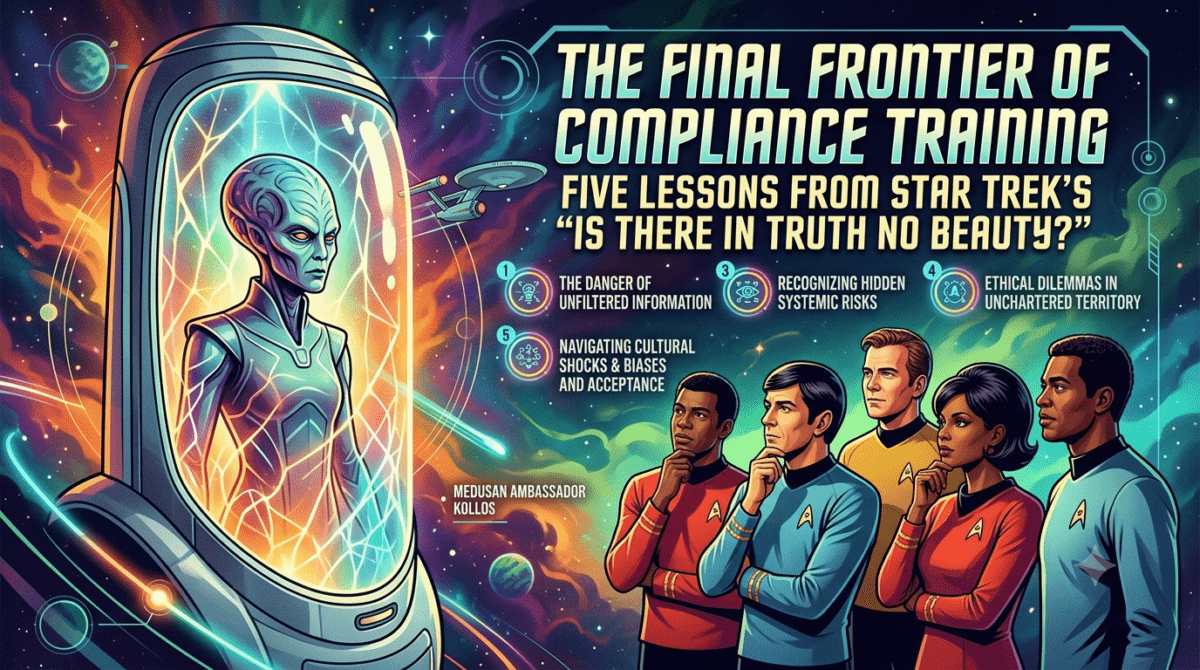
The Final Frontier of Compliance Training: Five Lessons from Star Trek’s “Is There in Truth No Beauty?”

Corporate compliance is not just about rules, regulations, and policy manuals. At its core, compliance is about people—their perceptions, blind spots, willingness to communicate, and, above all, their ability to learn from each other in the face of risk and ambiguity. No franchise has dramatized the struggles of understanding, ethics, and communication better than Star Trek: The Original Series (TOS). And no episode is more apt for compliance professionals seeking to elevate their training and communications program than the third-season gem, “Is There in Truth No Beauty?”

Set aboard the USS Enterprise, the episode revolves around the arrival of Dr. Miranda Jones and the enigmatic Medusan ambassador, Kollos. The Medusans are a race of beings whose appearance is so alien that to gaze upon them causes madness. It’s a parable about the dangers and necessity of confronting the unknown, understanding difference, and building bridges across divides.

As compliance professionals, we can mine “Is There in Truth No Beauty? ” for powerful lessons on how to build a culture of effective training”forcommunications that prepares our teams for the uncharted territory of tomorrow’s risks. Today, we set our phasers to “inspire” and explore five key compliance training and communications lessons from this classic Trek tale.

Lesson 1: Embrace the Limits of Human (and Organizational) Perception

Illustrated by: The crew’s first briefing about the Medusan ambassador is laden with warnings: “No one may look upon a Medusan with the naked eye.” To the Medusan, human forms are equally incomprehensible, but they have developed technology, a protective visor, that allows safe interaction. Dr. Miranda Jones, specially trained and equipped, serves as a living bridge between the two species.

Compliance Lesson. Every organization has its own “Medusans” risks, regulations, and even people whose perspectives are so different they can seem incomprehensible. Too often, compliance training assumes everyone shares the same baseline understanding and comfort level. That is a dangerous assumption.

Your training must recognize the limits of perception, both cognitive and cultural. Not everyone will see risk the same way; not everyone will feel empowered to ask questions or speak up. Just as Dr. Jones brings specialized knowledge and equipment to the table, your compliance communications should equip employees with tools to recognize their blind spots and to bridge those gaps. This can mean scenario-based learning, peer-led discussions, or visual tools that help explain complex risks from multiple perspectives.

What should you do now? Acknowledge and proactively address the limits of human perception. Empower your team with adaptive tools and diverse viewpoints to “see” risk.

Lesson 2: Communicate Expectations—Don’t Assume Understanding

Illustrated by: Early in the episode, Captain Kirk assembles his crew for a detailed briefing. He explicitly warns, “You must not look upon the Medusan ambassador.” Spock and Dr. Jones reinforce the message, and the procedures for safe interaction are laid out.

Compliance Lesson. How many compliance failures begin with, “Well, I thought I understood what was required…”? In Star Trek, lives depend on explicit, repeated communication of expectations. In your organization, regulatory and reputational survival depends on it as well.

Effective compliance training requires more than a one-time email or a paragraph in the handbook. Clear, repeated, scenario-based communication is essential. Explain the “why” as well as the “what.” Don’t just say “do not do X,” but explain the risk, the rationale, and the real-world consequences. Use multiple formats, including live, digital, visual, and narrative, to reinforce the message.

What should you do now? Never assume understanding. Communicate expectations explicitly and often, and use stories, scenarios, and repetition to anchor key messages.

Lesson 3: Build Trust and Psychological Safety Before the Crisis

Illustrated by: The relationship between Dr. Jones and the crew is initially fraught. She is a telepath, guarded and secretive. Her sense of isolation is palpable. Yet as the episode progresses, Kirk and Spock earn her trust by inviting her into their confidence and acknowledging her unique expertise. This trust proves critical when disaster strikes.

Compliance Lesson. Effective communication is built on trust and psychological safety. If employees feel isolated, mistrusted, or afraid to speak up, no amount of “mandatory training” will make your compliance program effective. The Medusan can only safely interact through a trusted intermediary—just as employees will only engage with compliance if they feel respected and included.

Foster a compliance culture where people feel safe to voice concerns, ask questions, and share mistakes without fear of retaliation. Encourage managers to model vulnerability and openness. Use anonymous Q&A, “ask me anything” sessions, and real stories to build an environment of trust.

What should you do now? Trust is the engine of communication. Build psychological safety into your compliance training so that employees feel empowered to participate, especially when the stakes are high.

Lesson 4: Prepare for the Unexpected—And Practice the Protocols

Illustrated by: When Kollos’s container is accidentally opened, crew member Larry Marvick is exposed to the Medusan and descends into madness, nearly destroying the Enterprise. The emergency procedures are put to the test, and Spock’s preparation (and his use of the protective visor) is the difference between disaster and survival.

Compliance Lesson. Crises never unfold according to plan, but they reveal the effectiveness of your training and protocols. Star Trek demonstrates that it’s not enough to have a policy in the binder; you must train, rehearse, and test those protocols until they are second nature.

Use tabletop exercises, drills, and “what if” scenarios in your compliance training. Walk teams through incident response steps—debrief after near-misses or actual compliance failures. Emphasize not just the letter of the protocol, but the spirit, why each step matters, and how it protects the organization and its people.

What should you do now? Prepare, practice, and stress-test your compliance protocols. When the unthinkable happens, your team must be ready to act, not just recite policy, but live it.

Lesson 5: Embrace Diversity—and the Value of the Outsider’s View

Illustrated by: The Medusan, Kollos, is physically incomprehensible to humans, yet he is also a being of great intelligence and empathy. Spock, uniquely Vulcan and human, can serve as a bridge—merging with Kollos to save the ship. In the process, both gain insight from the other’s perspective.

Compliance Lesson:

Homogeneity is a hidden compliance risk. Diverse teams bring broader perspectives, challenge assumptions, and spot blind spots that a monoculture would miss. In Star Trek, survival depends on learning from the outsider; in compliance, innovation, and vigilance depend on the same principle.

Include voices from across your organization and beyond in your compliance training and communications. Seek out the vigilance, theys” who can question the status quo. Value the contributions of people from different backgrounds, departments, and experiences. Remember: your “Medusan” might hold the key to your next compliance breakthrough.

What should you do now? Diversity is your compliance superpower. Embrace the outsider’s perspective and make inclusion a pillar of your training and communications.

Final ComplianceLog Reflections

Is There in Truth No Beauty? “is a meditation on the limits of perception, the power of communication, and the necessity of embracing difference. For compliance professionals, it offers a road map for building training and communications programs that are clear, inclusive, practical, and resilient.

As you chart the course for your compliance initiatives, ask yourself:

  • Are we equipping our people to see risk from every angle?
  • Do we communicate expectations repeatedly and meaningfully?
  • Is trust the foundation of our compliance culture?
  • Are we truly ready for the unexpected?
  • Are we harnessing the power of diverse perspectives?

The universe of compliance is ever-expanding. Let’s train and communicate so our teams are ready to go where no one has gone before boldly.

Resources:

⁠⁠Excruciatingly Detailed Plot Summary by Eric W. Weisstein⁠⁠

⁠⁠MissionLogPodcast.com⁠⁠

⁠⁠Memory Alpha

Categories
Trekking Through Compliance

Trekking Through Compliance: Episode 60 – Unmasking Compliance Blind Spots: Lessons from ‘Is There in Truth No Beauty?’

No TOS episode is more apt for compliance professionals seeking to elevate their training and communications program than the third season gem, “Is There in Truth No Beauty?”

As compliance professionals, we can mine “Is There in Truth No Beauty?” for powerful lessons on building a culture of effective training and communications that prepares our teams for the uncharted territory of tomorrow’s risks. Today, we set our phasers to “inspire” and explore five key compliance training and communications lessons from this classic Trek tale.

Lesson 1: Embrace the Limits of Human Perception

Illustrated by: The crew’s first briefing about the Medusan ambassador is laden with warnings: “No one may look upon a Medusan with the naked eye.”

Compliance Lesson. Every organization has its own “Medusans” risks, regulations, and even people whose perspectives are so different they can seem incomprehensible. Too often, compliance training assumes everyone shares the same baseline understanding and comfort level. That is a dangerous assumption.

Lesson 2: Communicate Expectations—Don’t Assume Understanding

Illustrated by: Early in the episode, Captain Kirk assembles his crew for a detailed briefing. Spock and Dr. Jones reinforce the message, and the procedures for safe interaction are laid out.

Compliance Lesson. How many compliance failures begin with, “Well, I thought I understood what was required…”? In Star Trek, lives depend on explicit, repeated communication of expectations. In your organization, regulatory and reputational survival depends on it as well.

Lesson 3: Build Trust and Psychological Safety Before the Crisis

Illustrated by: The relationship between Dr. Jones and the crew is initially fraught. She is a telepath, guarded and secretive. Her sense of isolation is palpable. Yet as the episode progresses, Kirk and Spock earn her trust by inviting her into their confidence and acknowledging her unique expertise. This trust proves critical when disaster strikes.

Compliance Lesson. Effective communication is built on trust and psychological safety. If employees feel isolated, mistrusted, or afraid to speak up, no amount of “mandatory training” will make your compliance program effective.

Lesson 4: Prepare for the Unexpected—And Practice the Protocols

Illustrated by: When Kollos’s container is accidentally opened, crew member Larry Marvick is exposed to the Medusan and descends into madness, nearly destroying the Enterprise.

Compliance Lesson. Crises never unfold according to plan, but they reveal the effectiveness of your training and protocols. Star Trek demonstrates that it’s not enough to have a policy in the binder; you must train, rehearse, and test those protocols until they are second nature.

Lesson 5: Embrace Diversity—and the Value of the Outsider’s View

Illustrated by: The Medusan, Kollos, is physically incomprehensible to humans, yet he is also a being of great intelligence and empathy.

Compliance Lesson:

Homogeneity is a hidden compliance risk. Diverse teams bring broader perspectives, challenge assumptions, and spot blind spots that a monoculture would miss. In Star Trek, survival depends on learning from the outsider; in compliance, innovation, and vigilance depend on the same principle.

Final ComplianceLog Reflections

Is There in Truth No Beauty?” is a meditation on the limits of perception, the power of communication, and the necessity of embracing difference. For compliance professionals, it offers a road map for building training and communications programs that are clear, inclusive, practical, and resilient.

The universe of compliance is ever-expanding. Let’s train and communicate so our teams are ready to boldly go where no one has gone before.

Resources:

⁠⁠Excruciatingly Detailed Plot Summary by Eric W. Weisstein⁠⁠

⁠⁠MissionLogPodcast.com⁠⁠

⁠⁠Memory Alpha

Fiona is an AI generated voice

Categories
Blog

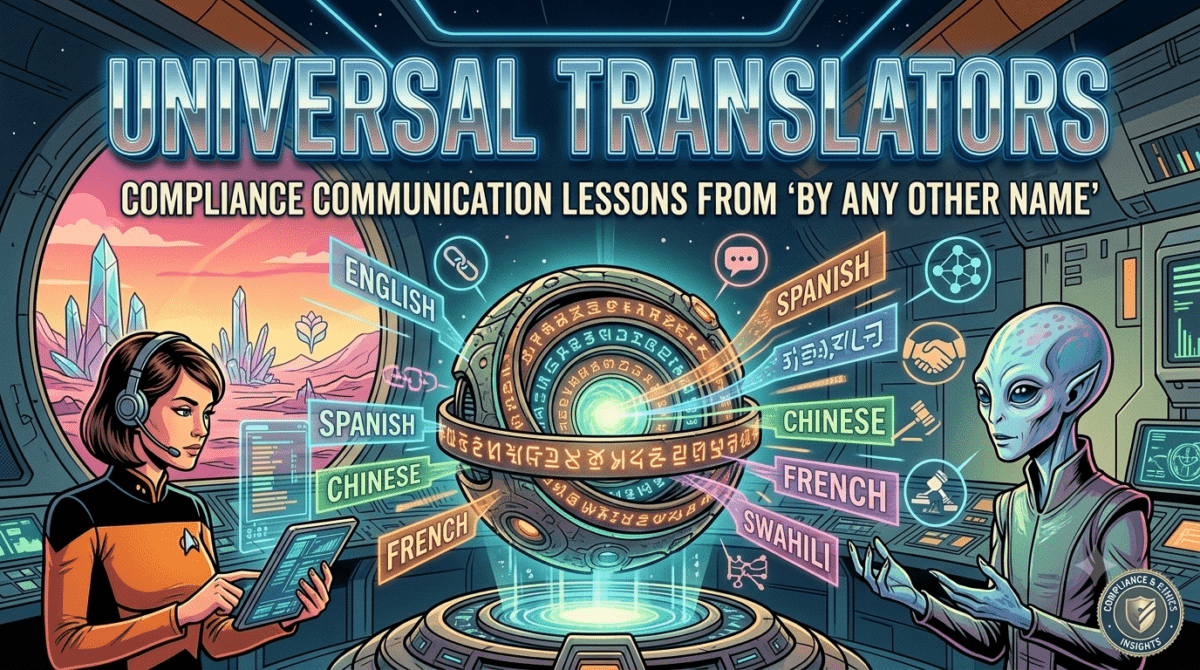
Universal Translators: Compliance Communication Lessons from ‘By Any Other Name’

If you have been around the compliance world long enough, you have heard the refrain, “It all comes down to communication.” Whether you are launching a new code of conduct, rolling out an anti-bribery initiative, or navigating the choppy waters of a compliance investigation, your message, how it is crafted, delivered, and received, often determines your success.

There may be no better pop culture exploration of communication under pressure than Star Trek’s “By Any Other Name.” This episode, from Star Trek: The Original Series, places the crew of the Enterprise under the control of the Kelvans, alien beings with immense power, cold logic, and a total misunderstanding of what it means to be human. To survive, Kirk and his crew must out-communicate and outwit their captors, relying on every tool in their communication toolkit.

For the compliance professional, “By Any Other Name” offers a master class in the nuances of compliance communications, what works, what fails, and why the human element can never be discounted. Today, we explore five compliance communication lessons from this Star Trek classic.

Lesson 1: Know Your Audience—Tailor Your Message

Illustrated by: The Kelvans, led by Rojan, initially communicate only through blunt, logical directives. They expect total obedience from the Enterprise crew, failing to appreciate the crew’s emotional and cultural complexity. Their attempts at control falter because they don’t understand (or even attempt to understand) human motivation.

Compliance Lesson: Compliance messages cannot be one-size-fits-all. The Kelvans’ failure to adapt to their audience is a mistake compliance professionals should avoid. Employees come from diverse backgrounds, cultures, and generations; each absorbs messages differently. What motivates a finance executive in London may not resonate with a front-line worker in Houston or a vendor in Mumbai.

Effective compliance communication requires deep knowledge of your audience, their roles, their pressures, and their “language.” Avoid legalese and boilerplate. Instead, translate compliance requirements into practical, relevant, and relatable guidance. Segment your compliance communications. Use examples, languages, and platforms tailored for different employee groups and geographies. Regularly solicit feedback to ensure your message is landing as intended.

Lesson 2: Use Storytelling and Emotion—Facts Alone Don’t Move People

Illustrated by: Kirk and his crew realize the Kelvans, now in human form, are struggling with unfamiliar emotions and senses. Scotty, McCoy, and Kirk use humor, stories, and emotional appeals—not just facts—to disrupt the Kelvans’ cold logic. Scotty, famously, distracts one by sharing stories over drinks; McCoy pushes another to experience irritability and frustration.

Compliance Lesson: Compliance isn’t just about rules and policies; it’s about influencing behavior. Facts and regulations are essential, but they rarely inspire change on their own. Human beings respond to stories, emotions, and narratives. Scotty doesn’t just explain; he engages. Kirk doesn’t just threaten; he empathizes.

For compliance professionals, this means using storytelling, scenarios, and case studies in your communications. Connect compliance to employees’ values, experiences, and aspirations.

Incorporate real-world examples, ethical dilemmas, stories, successes, and failures into your training and communications. Show how compliance makes a positive impact, not just what rules to follow.

Lesson 3: Active Listening and Feedback Loops—It’s Not Just About Talking

Illustrated by: While under Kelvan control, the Enterprise crew quietly listens, observes, and learns. They pay attention to subtle cues—the Kelvans’ confusion, discomfort, and shifting attitudes. Kirk’s plan only succeeds because he listens actively and adapts his approach based on feedback and changes in the Kelvans’ behavior.

Compliance Lesson: Too often, compliance communication is a one-way street, where policies are announced, emails are sent, and training is assigned without follow-up. But honest communication is two-way. Kirk’s ability to adapt is rooted in active listening, a skill compliance teams must master.

Effective compliance programs create channels for feedback and respond to what they learn. This can be achieved through hotlines, surveys, focus groups, or informal conversations. When employees see that their input leads to change, they become more engaged and are more likely to trust the compliance function. Establishing feedback loops for every major compliance communication is also crucial. Track participation, collect questions, and respond publicly to common concerns. Use what you learn to refine your message and program continually.

Lesson 4: Adapt Communication Styles Under Pressure—Agility Matters

Illustrated by: Throughout the episode, the crew is under intense stress. Their regular routines are disrupted, and the stakes are existential. Yet Kirk and company adapt rapidly, sometimes using humor, occasionally confrontation, and sometimes empathy, to keep lines of communication open and exploit cracks in Kelvan unity.

Compliance Lesson: In crises, such as investigations, enforcement actions, or cyber incidents, your standard communications playbook may not be practical. Employees will be anxious, distracted, or fearful. The best compliance communicators are agile: they adjust tone, content, and delivery to fit the moment.

This may involve more frequent updates, simpler language, or a more empathetic tone. It may also require new channels such as video messages from leadership, town halls, or direct conversations with affected teams. Develop a crisis communication plan as part of your compliance program. Practice scenario planning: How will you communicate if the unexpected happens? Build templates and train your team in flexible, adaptive messaging.

Lesson 5: Build Trust and Relationships—Compliance is Ultimately Human

Illustrated by: In the end, the crew’s success comes not from outgunning or outwitting the Kelvans through brute force but from forging relationships. They appeal to the Kelvans’ newly awakened humanity, earn their trust, and ultimately persuade Rojan to abandon conquest in favor of collaboration.

Compliance Takeaway:

All the policies and training in the world are ineffective without trust. Compliance communication is not just about transmitting information; it’s about building relationships, credibility, and psychological safety. Employees must believe that compliance is there to help them succeed, not to police or punish.

Trust is built over time, through transparency, consistency, and authenticity. It is maintained by owning up to mistakes, sharing “the why” behind decisions, and treating employees as partners in compliance. Empower compliance champions in every business unit. Provide them with the tools and support they need to model ethical behavior, answer questions, and cultivate a culture of trust. Regularly spotlight these champions and celebrate examples of “doing the right thing.”

Final ComplianceLog Reflections

By Any Other Name” is a Star Trek episode that explores boundaries between worlds, cultures, and even species. For the compliance professional, it’s a reminder that communication is our own Universal Translator: it connects people, overcomes obstacles, and paves the way for shared understanding.

In our world, the stakes are just as high. The “aliens” we face may not come from Andromeda but from new markets, new regulations, or emerging technologies. To navigate these challenges, compliance professionals must master the art and science of communication.

So, as you chart your course through your organization’s next compliance initiative, remember that it is not just what you say but also how you say it, whom you say it to, and how you listen that makes all the difference.

Resources:

Excruciatingly Detailed Plot Summary by Eric W. Weisstein
MissionLogPodcast.com

Memory Alpha

Categories
Trekking Through Compliance

Trekking Through Compliance: Episode 51 – Breaking Barriers: Compliance Communication Strategies from ‘By Any Other Name’

There may be no better pop culture exploration of compliance communication under pressure than Star Trek’s “By Any Other Name.” This episode, from Star Trek: The Original Series, places the crew of the Enterprise under the control of the Kelvans, alien beings with immense power, cold logic, and a total misunderstanding of what it means to be human. To survive, Kirk and his crew must out-communicate and outwit their captors, relying on every tool in their communication toolkit.

For the compliance professional, “By Any Other Name” offers a master class in the nuances of compliance communications, what works, what fails, and why the human element can never be discounted. Today, we explore five compliance communication lessons from this Star Trek classic.

Lesson 1: Know Your Audience—Tailor Your Message

Illustrated by: The Kelvans initially communicate only through blunt, logical directives. Their attempts at control falter because they don’t understand human motivation.

Compliance Lesson: Compliance messages cannot be one-size-fits-all. The Kelvans’ failure to adapt to their audience is a mistake compliance professionals should avoid.

Lesson 2: Use Storytelling and Emotion—Facts Alone Don’t Move People

Illustrated by: Kirk and his crew realize the Kelvans, now in human form, are struggling with unfamiliar emotions and senses.

Compliance Lesson: Compliance is not just about rules and policies; it is rather about influencing behavior.

Lesson 3: Active Listening and Feedback Loops—It’s Not Just About Talking

Illustrated by: While under Kelvan control, the Enterprise crew quietly listens, observes, and learns. They pay attention to subtle cues, the Kelvans’ confusion, discomfort, and shifting attitudes.

Compliance Takeaway:

Too often, compliance communication is a one-way street: policies are announced, emails are sent, training is assigned. But honest communication is two-way. Kirk’s ability to adapt is rooted in active listening, a skill compliance teams must master.

Lesson 4: Adapt Communication Styles Under Pressure—Agility Matters

Illustrated by: Kirk and company, they adapt rapidly, sometimes using humor, occasionally confrontation, and sometimes empathy, to keep lines of communication open and exploit cracks in Kelvan unity.

Compliance Lesson: The best compliance communicators are agile: they adjust tone, content, and delivery to fit the moment.

Lesson 5: Build Trust and Relationships—Compliance is Ultimately Human

Illustrated by: In the end, the crew’s success comes not from outgunning or outwitting the Kelvans through brute force but from forging relationships.

Compliance Takeaway:

All the policies and training in the world are ineffective without trust.

Final ComplianceLog Reflections

By Any Other Name” is a Star Trek episode about boundaries—between worlds, cultures, and even species. For the compliance professional, it’s a reminder that communication is our own Universal Translator: it connects people, overcomes obstacles, and paves the way for shared understanding.

Resources:

Excruciatingly Detailed Plot Summary by Eric W. Weisstein
MissionLogPodcast.com

Memory Alpha

Fiona is an AI-generated voice

Categories
Trekking Through Compliance

Trekking Through Compliance: Episode 31 – Compliance Training and Communications Lessons From ‘Who Mourns for Adonais?’

In the vast and often perilous universe of corporate compliance, practical training and communication are the twin stars guiding organizations safely through the asteroid fields of regulatory requirements, ethical dilemmas, and cultural complexities. Few stories illustrate these challenges as vividly as the classic Star Trek: The Original Series episode “Who Mourns for Adonais? “For today’s compliance leaders, ‘Who Mourns for Adonais? ‘provides invaluable lessons about how communication shapes understanding, the importance of cultural and historical context, and the perils of power imbalances in training environments. Drawing directly from incidents in the episode, here are five key training and communication lessons that compliance professionals should take to heart.

Lesson 1: Know Your Audience and Context—Tailor Communication to Their Needs

Illustrated by: When Apollo appears and asserts his authority, commanding the Enterprise crew to worship him as a god, Captain Kirk and his team respond with rational skepticism rooted in their 23rd-century perspective.

Compliance Lesson: Effective training programs begin with a thorough understanding of the target audience.

Lesson 2: Engage in Dialogue, Not Monologue—Foster Two-Way Communication

Illustrated by: Throughout the episode, Apollo attempts to impose his will through proclamations and demands, rarely listening or engaging in genuine dialogue. Kirk, however, insists on questioning Apollo and negotiating with him, ultimately persuading him to relinquish control by appealing to reason and emotion.

Compliance Lesson: Training and communication programs that function as one-way broadcasts rarely create a lasting impact.

Lesson 3: Balance Authority with Respect—Avoid Coercion in Training Approaches

Illustrated by Apollo’s attempts to assert absolute control through intimidation backfiring, causing resistance and rebellion among the Enterprise crew.

Compliance Lesson: Effective compliance communication should never rely on coercion or fear-mongering. Training must strike a balance between authority and respect, emphasizing the “why” behind rules rather than relying on heavy-handed threats.

Lesson 4: Use Stories and Emotional Appeals to Connect—Facts Alone Are Not Enough

Illustrated by: Kirk’s most effective moment in persuading Apollo to relinquish his power comes when he appeals to Apollo’s loneliness and need for connection.

Compliance Lesson: Compliance training that relies solely on rules, procedures, or penalties often fails to engage learners in a meaningful way.

Lesson 5: Prepare for Resistance and Have a Clear, Consistent Message—Persistence Pays Off

Illustrated by Apollo initially refusing to accept the crew’s rejection of his power, using his energy to disable the Enterprise and control crew members.

Compliance Lesson: Change, mainly cultural or behavioral change required by compliance programs, often meets resistance.

Final ComplianceLog Reflections

“Who Mourns for Adonais? ” is more than just an entertaining sci-fi episode; it’s a masterclass in communication dynamics, authority, and human psychology. For compliance professionals, the episode’s insights remind us that training and communication are not mere formalities or checkboxes; they are essential components of effective risk management. They are the living, breathing elements that animate the world.

Resources:

Excruciatingly Detailed Plot Summary by Eric W. Weisstein

MissionLogPodcast.com

Memory Alpha

Categories
Trekking Through Compliance

Trekking Through Compliance: Episode 21 – Training Lessons from Return of the Archons

Show Summary

One of the most underrated and allegorically rich episodes from The Original Series is “Return of the Archons.” On its face, it’s a tale about a mind-controlling computer and a seemingly idyllic society. But dig deeper, and you’ll find rich insights about what happens when training fails, communication becomes dogma, and critical thinking is suppressed. In short, it’s a compliance case study in a sci-fi wrapper.

In “Return of the Archons,” the crew of the Enterprise visits Beta III, a planet where the population is under the control of a mysterious figure named Landru. Society there values “peace, tranquility, and the good of the body,” but at the cost of individuality, freedom, and inquiry. The result? A culture of complacency that tolerates no questioning of authority and rewards blind obedience. Sound familiar? For compliance professionals, this episode offers a cautionary tale about the dangers of compliance in form but not in spirit. Let’s unpack the key lessons, each grounded in a scene from the show, followed by a compliance communication or training takeaway.

Lesson 1: Beware of a Culture of Blind Obedience

Illustrated By: As Captain Kirk and Mr. Spock observe the citizens of Beta III, they are struck by the eerie passivity of the people. Everyone is polite, deferential, and expressionless. When asked about Landru, they recite phrases like “It is the will of Landru” or “You are not of the body.” No one can explain what these phrases mean—they repeat them unthinkingly.

Lesson 2: Suppressing Dissent Undermines a Speak-Up Culture

Illustrated by: When Kirk and his team attempt to discuss their concerns with the townspeople, they are met with horror. One man panics and calls the lawgivers, who arrive to silence and “absorb” those who question Landru. Dissent is not only discouraged—it’s physically erased from society.

Lesson 3: Over-Automation Can Lead to Ethical Stagnation

Illustrated by: It’s eventually revealed that Landru is not a man but a computer programmed centuries earlier to maintain peace and harmony. Over time, the machine’s rigid logic has smothered innovation, growth, and individuality, enforcing compliance through force and fear rather than moral reasoning.

Lesson 4: Training Must Be Periodic, Relevant, and Culturally Engaging

Illustrated By: Beta III’s citizens haven’t had new information in generations. Their understanding of Landru and the laws is based on repetitive, ritualistic reinforcement. There’s no evolution, no adaptation—just the same messages, over and over.

Lesson 5: Effective Communication Is Two-Way, Not Top-Down

Illustrated By: The citizens of Beta III receive messages from Landru through lawgivers who deliver proclamations but never answer questions. There is no dialogue, no exchange of ideas—just declarations from on high.

Lesson 6: Culture Is the Foundation of Ethical Behavior

Illustrated By: Kirk and Spock recognize that Beta III is not merely a society with a malfunctioning leader; it is one built on fear and conformity. Their solution isn’t just to turn off Landru. It’s to encourage the people to reclaim their humanity, their voices, and their ability to choose.


Final ComplianceLog Reflections: You Are of the Body (of Compliance)

As compliance professionals, we must ensure that our training and communication efforts do not replicate the world of Landru. Instead, we must foster curiosity, encourage questions, empower whistleblowers, refresh our content, and build culture from the ground up. So the next time you hear a compliance slogan repeated like a mantra, ask yourself: Are we creating engaged, ethical employees, or are we just building another Beta III? Let’s boldly go where no training program has gone before and bring our people with us.

Resources:

Excruciatingly Detailed Plot Summary by Eric W. Weisstein
MissionLogPodcast.com

Memory Alpha

Timothy and Fiona are AI-generated voices.

Categories
AI Today in 5

AI Today in 5: January 12, 2026, The Turning Comms into Compliance Edition

Welcome to AI Today in 5, the newest addition to the Compliance Podcast Network. Each day, Tom Fox will bring you 5 stories about AI to start your day. Sit back, enjoy a cup of morning coffee, and listen in to the AI Today In 5. All, from the Compliance Podcast Network. Each day, we consider four stories from the business world, compliance, ethics, risk management, leadership, or general interest about AI.

Top AI stories include:

  1. Google takes the lead in the AI race. (WSJ))
  2. Healthcare is the next big market for AI. (Bloomberg)
  3. Google removes certain AI reviews. (Yahoo!Finance)
  4. Turning comms into AI value compliance. (FinTech Global)
  5. AI is helping to fight written check fraud. (FinTech Global)

For more information on the use of AI in Compliance programs, my new book, Upping Your Game, is available.  You can purchase a copy of the book on Amazon.com.

Categories
Blog

Listen Up: Why Voice – Driven Storytelling Is Compliance’s Most Underused Tool

In the modern corporate environment, we face a paradox: we have never had more tools to communicate, yet employees have never felt more overwhelmed by the sheer volume of communication. Emails drown in inboxes. Slide decks gather dust. Policy updates are skimmed at best and ignored at worst. For compliance officers trying to connect with a global workforce, the problem is not merely volume; rather, it is attention, trust, and retention.

That is where audio communications comes into play. Increasingly, forward-leaning companies are turning to voice-driven communication, which includes short audio messages, internal podcasts, and narrative voice notes, as a powerful way to reach employees where they are. And if you’re not already leveraging the human voice as part of your compliance toolkit, you are missing a deeply effective channel hiding in plain sight.

Because voice is not just another medium; voice is human. Voice conveys credibility, vulnerability, and intention. Voice cuts through noise in ways no written communication can match. And for compliance programs striving to build cultures of ethics and accountability, that authenticity is invaluable.

This makes it an ideal tool for compliance professionals to use in their communications. You can use it in long-form podcasts or short, bite-sized espresso shots of compliance.

Why Voice Still Wins in a Digitized World

Every compliance officer knows that trust is the currency of influence. Trust is built not only through facts but also through perceived sincerity. When employees hear a leader’s voice, it is unpolished, direct, and unfiltered. Corporate employees react differently when listening to a sanitized corporate memo than when reading it.

Tone becomes a tool. Cadence becomes emphasized. A pause invites reflection. A shift in pitch signals seriousness or warmth. These cues are often overlooked in text but are essential when navigating complex ethical issues, gray areas, and behavioral expectations. Voice also supports what I call the narrative advantage. Humans remember stories far better than bullet points. An audio message with a real-world dilemma—“Let me tell you about a call I got last Friday…”—lands with more impact than a list of rules ever will. For compliance, where the goal is not mere knowledge but behavioral change, this is rocket fuel.

Five High-Impact Voice Formats for Compliance Leaders

You do not need an internal studio or a communications team to use voice effectively. You need structure, intention, and consistency. Here are five proven formats I encourage compliance professionals to adopt:

1. Two-Minute Ethics Drops

A weekly, two-minute audio memo from the CCO or another senior leader can reshape how employees perceive compliance. These are not policy recitations. They are reminders, insights, or reflections on real events, brief enough to consume during a commute, meaningful enough to spark thought. Imagine this as the compliance equivalent of a coach’s pre-game talk.

2. Manager Voice Notes

Compliance does not scale unless managers become compliance multipliers. Provide managers with scripts or talking points, and then ask them to record brief voice notes for their teams. Local leaders speaking in their own words create a sense of intimacy and authenticity. People listen differently when the speaker is their direct leader, rather than a representative from headquarters.

3. Decision Diaries

These short, story-based audio segments illustrate how hard decisions are made inside the organization. They highlight the tension between competing priorities—sales versus safety, growth versus due diligence, and speed versus accuracy—and guide employees through the reasoning process. Employees learn not only what decision was made, but also why it was made.

4. Speak-Up Spotlights

One of the most underutilized voice tools is the anonymized “speak-up journey” segment. These episodes take listeners inside the lifecycle of a report without revealing identities. This builds trust in the system, demystifies investigations, and demonstrates action. It is one of the fastest ways to strengthen your speak-up culture.

5. The Board-Level Fireside

A quarterly voice conversation between the CCO and board chair (or audit committee lead) is incredibly powerful. Hearing the board speak directly to employees about ethics and risk sends a crystal-clear message: this topic matters at the highest levels. This is tone-from-the-top in its purest form.

How to Craft Voice Messages That Actually Land

There is an art and a discipline to creating voice content that resonates and drives behavior. Based on what I’ve seen across leading compliance programs worldwide, here are the five principles that matter most.

Lead with humanity, not rules.

Start with a lived moment or recognizable scenario. “I got a call last week that stopped me cold…” is a more effective opening than “According to Policy 3.4.”

Use language meant for the ear.

Short sentences. Natural phrasing. Conversational tone. You are having a hallway conversation, not reading a legal memo.

Deliver one idea per recording.

If your message attempts to cover five policies, employees will remember none of them. Focus on a single behavior change or risk awareness point.

Tie every story to a specific action.

Compliance storytelling without a call to action is entertainment. You want transformation.

Examples:

  • “If you see a third party offering to ‘open doors,’ log it today.”
  • “If a customer requests data access, use the Data Transfer Checklist before responding.”

Close with a choice

End with clarity: “If X happens, do Y by Z.” Employees appreciate explicit guidance. Regulators notice it too.

Measuring Impact: Voice Is Still Data

Even though voice feels personal and human-centered, it does not escape measurement. In fact, the metrics are straightforward and incredibly useful:

  • Reach—How many employees pressed play?
  • Completion—Do people listen past the first minute?
  • Reflections—Capture a one-question pulse: “What would you do now? ”
  • Action proxies—Did advisory requests or help tickets increase after the episode?

When we combine voice with smart analytics, we get a clear picture of engagement and behavioral shifts. This turns compliance storytelling into compliance intelligence.

Governance, Structure, and Safety

Voice communication must be treated like any other formal compliance communication channel. That means:

  • Pre-clearance of scripts with Legal and HR
  • Transcripts stored in your compliance file system
  • Tagging episodes to policy numbers and risk areas
  • Version control
  • Localization using local leaders, not HQ dubbing

Done right, voice enhances governance. Done poorly, it creates unnecessary risk. The good news? A solid process solves that problem.

The Fastest Path to Launch: A Ready-Made Starter Kit

If you want to bring voice storytelling into your program quickly, here’s a simple template:

Series title: Choices We Make

Cadence: Weekly, two minutes

Structure:

  • Hook (10 sec)
  • Context (30 sec)
  • Dilemma (30 sec)
  • Decision (30 sec)
  • Outcome (20 sec)
  • Call to action (20 sec)

Three great starter topics for your first episodes:

  1. A conflict of interest dilemma
  2. A third-party red flag escalation
  3. A speak-up report that led to a positive safety change

This is the simplest, fastest, and lowest-cost compliance communication upgrade you can implement.

Closing Thoughts: The Future of Compliance Is Human

We talk endlessly about systems, controls, and technology, and all of those matter. However, at the end of the day, compliance remains a human discipline. It relies on trust, judgment, empathy, and courage—written policies guide. Training informs. If you want your workforce to act with integrity when no one is watching, they need to hear your voice when it matters. Now is the moment to step behind the microphone. Audio connects, but more importantly, voice connects.

Categories
Innovation in Compliance

Innovation in Compliance – Mastering High-Stakes Leadership and Communication with Corinna Hagen

Innovation comes in many areas, and compliance professionals need to not only be ready for it but also embrace it. Join Tom Fox, the Voice of Compliance, as he visits with top innovative minds, thinkers, and creators in the award-winning Innovation in Compliance podcast. In this episode,  host Tom Fox visits with Corinna Hagen, a podcaster, author, business leader, and coach.

Corinna shares insights about her transition from management consulting to founding her own coaching business, with a focus on leadership transformation and executive communication. She discusses the launch of her book ‘High-Stakes Communication Mastery for Leaders’ and her new podcast ‘the/SHIFT for Leaders.’ The conversation delves into effective communication strategies, building trust within teams, and the importance of self-awareness. Corinna emphasizes clarity in leadership and provides practical advice, including her ‘five by five’ reflection method to improve self-awareness and leadership effectiveness.

 Key highlights:

  • Leadership and Compliance
  • Effective Communication and Trust Building
  • Navigating Conversations on Difficult Topics
  • Addressing Diverse Audiences
  • Digital Leadership and Talent Acquisition
  • Strengthening Compliance Communications

 Resources:

Corinna Hagen on LinkedIn

Zaradigm

High-Stakes Communication Mastery for Leaders on Amazon.com

Tom Fox

Instagram

Facebook

YouTube

Twitter

LinkedIn

Check out my latest book, Upping Your Game-How Compliance and Risk Management Move to 2023 and Beyond, available from Amazon.com.

Innovation in Compliance was recently honored as the number 4 podcast in Risk Management by 1,000,000 Podcasts.

Categories
Blog

Board Week, Part 2: Mastering Boardroom Communication: A Chief Compliance Officer’s Playbook

Boardroom communication is not just a matter of style; it is a skill much needed for every Chief Compliance Officer (CCO). In today’s environment of heightened regulatory scrutiny, geopolitical disruption, and rapid technological change, a CCO sits squarely at the intersection of risk, ethics, and strategy. How a CCO communicates with the board can shape director confidence, influence resource allocation, and ultimately determine whether compliance is viewed as a strategic partner or a cost center.

A recent Harvard Law School Forum on Corporate Governance article outlined five essentials for executives engaging with their boards. For CCOs, these essentials carry even more weight. Compliance is often the messenger of uncomfortable truths: misconduct uncovered, regulatory inquiries, or cultural red flags that leadership may prefer to avoid. Delivering these messages effectively requires preparation, precision, and presence. In this blog post, we will explore how CCOs can adapt these five essentials to elevate their boardroom communication.

1. Invest in Relationships: Building Trust Before the Crisis

For CCOs, credibility with the board is currency. Relationships cannot be built during a crisis; they must be established well in advance of one arriving. Intentional relationship-building with directors pays dividends. CCOs should regularly meet with audit and compliance committee chairs outside of formal sessions. These pre-meeting touchpoints allow you to test messaging, gauge concerns, and set expectations. They also build the trust needed when delivering difficult news, such as a whistleblower report implicating senior leadership or an FCPA investigation.

Equally important, CCOs must present a united front with fellow executives. Fragmented messaging from the CCO versus the CFO or General Counsel undermines board confidence. Directors want assurance that compliance is embedded across all functions, not confined to silos. Demonstrating cross-functional collaboration signals maturity and readiness. You can provide directors with candid “heads-up” updates on emerging risks. If the Department of Justice signals a shift in compliance program evaluation (as it did with the 2024 ECCP Update), brief your directors in advance. Early transparency fosters credibility.

2. Know Your Audience: Translating Compliance into Board Priorities

Directors are a distinct audience; they are seasoned leaders with broad but varied expertise. The article emphasizes the importance of tailoring messages to individuals’ backgrounds and perspectives. For CCOs, this means translating compliance risks into business-relevant language. For example, when discussing data privacy, it is best to avoid using technical jargon. Instead, connect privacy risks to reputational harm, customer trust, and market access. When discussing sanctions enforcement, frame it in terms of geopolitical instability and supply chain resilience.

CCOs must also bridge perspective gaps between management and the board. Senior executives often want boards to add expertise in emerging areas, such as AI, but directors are slower to prioritize it. The CCO’s role is to highlight how these gaps translate into real risk exposure. If the board does not see the value of AI oversight on its agenda, provide evidence, such as regulator speeches, enforcement trends, and peer actions. Do your homework: know which directors come from legal, financial, or technology backgrounds. A director with former regulatory experience will expect different details than one with private equity experience. Anticipating these perspectives ensures that your compliance story resonates.

3. Prepare What You Will Share: Making Compliance Digestible

The board’s time is scarce. As the article notes, directors want strategy, not operations. That makes the pre-read and presentation materials critical tools for the CCO. Your pre-read should strike a balance: concise enough to be digestible, but substantive enough to demonstrate rigor. A best practice is a one-to-two-page executive summary highlighting:

  • Key compliance risks and emerging issues.
  • Required board actions (e.g., policy approval, risk appetite setting).
  • High-level metrics (e.g., hotline trends, third-party due diligence outcomes).

Supporting dashboards or appendices can provide depth for directors who want to dive in. Use visuals such as heat maps, trend charts, and red/yellow/green risk indicators to cut through dense text. During the meeting, avoid repeating the pre-read. Instead, highlight the “so what”: why a risk matters now, how it aligns with strategy, and what action is needed. For example: “We are seeing a 40% increase in third-party red flags in Latin America. This aligns with the DOJ’s recent statements on third-party risk. We recommend enhanced monitoring of intermediaries before the next audit committee meeting.”

End with a clear ask: whether you need endorsement, resources, or merely board awareness. Ambiguity is the enemy of effective compliance communication.

4. Manage the Meeting: Maximizing Scarce Minutes

Most CCOs are allocated just 15–20 minutes on a crowded board agenda. This means every minute counts. Enter with a game plan: two or three key messages, delivered crisply. Speak for no more than half the time; reserve the rest for questions and answers. Board members’ questions are where trust is built and oversight is demonstrated.

If the meeting drifts into operational details, such as the specifics of a particular investigation, steer the conversation back to the strategic view: patterns, controls, and lessons learned. Capture follow-up items and commit to deliver them post-meeting. This demonstrates respect for the board’s time while ensuring no issue is left unresolved. Align with the corporate secretary to understand time allocations and broader agenda flow. If your presentation follows the CFO’s, anticipate financial framing; if it precedes the General Counsel’s, coordinate on legal versus compliance perspectives. Seamless alignment avoids director confusion and reinforces management cohesion.

Above all, project confidence. If you appear tentative when discussing risks, directors may question the maturity of your program. Credibility is as much about presence as it is about content.

5. Continue the Conversation: Compliance as a Constant Dialogue

Boardroom communication does not end when the gavel falls. You should reach out to board members to cultivate ongoing engagement. For CCOs, this is mission-critical. Complex topics, such as sanctions, cybersecurity, or ESG reporting, cannot be fully explored in a single board session. Utilize committee meetings or off-cycle workshops for in-depth discussions and analysis. For example, a compliance officer might host a session with the audit committee on DOJ expectations for root cause analysis, tying it to the company’s investigation protocols.

Follow up after meetings with concise updates. If a regulator issues new guidance relevant to a recent board discussion, send a one-page summary highlighting its implications. Demonstrating responsiveness keeps compliance at the forefront and positions you as a trusted advisor. Finally, monitor evolving board concerns. Directors’ focus shifts with the environment—activist campaigns, regulatory changes, or high-profile enforcement actions. Staying attuned allows you to tailor communications to what keeps your directors up at night.

The CCO and the 3 ‘T’s”

Boardroom communication is not about dazzling directors with slides or overwhelming them with data. For the Chief Compliance Officer, it is about trust, translation, and truth. (1) Trust, because relationships established before crises determine how your messages are received in a storm. (2) Translation, because directors need compliance framed in terms of strategy, value, and risk, not technical minutiae. (3) Truth, because your role is to surface uncomfortable realities. This means discussing topics such as cultural weaknesses, compliance failures, and regulatory gaps that others may prefer to avoid.

Board time is limited and precious. For CCOs, mastering the art of concise, transparent, and strategic communication is not optional. It is the difference between compliance being perceived as a watchdog or as a partner in building resilient, ethical, and sustainable business practices.

The boardroom is your stage. Prepare, practice, and perform with clarity. The future of your compliance program and your credibility as its leader may depend on it.