Categories
Blog

Universal Translators: Compliance Communication Lessons from ‘By Any Other Name’

If you have been around the compliance world long enough, you have heard the refrain: “It all comes down to communication.” Whether you are launching a new code of conduct, rolling out an anti-bribery initiative, or navigating the choppy waters of a compliance investigation, your message, how it is crafted, delivered, and received, often determines your success.

There may be no better pop culture exploration of communication under pressure than Star Trek’s “By Any Other Name.” This episode, from Star Trek: The Original Series, places the crew of the Enterprise under the control of the Kelvans, alien beings with immense power, cold logic, and a total misunderstanding of what it means to be human. To survive, Kirk and his crew must out-communicate and outwit their captors, relying on every tool in their communication toolkit.

For the compliance professional, “By Any Other Name” offers a master class in the nuances of compliance communications, what works, what fails, and why the human element can never be discounted. Today, we explore five compliance communication lessons from this Star Trek classic.

Lesson 1: Know Your Audience—Tailor Your Message

Illustrated By: The Kelvans, led by Rojan, initially communicate only through blunt, logical directives. They expect total obedience from the Enterprise crew, failing to appreciate the crew’s emotional and cultural complexity. Their attempts at control falter because they don’t understand (or even attempt to understand) human motivation.

Compliance Lesson: Compliance messages cannot be one-size-fits-all. The Kelvans’ failure to adapt to their audience is a mistake compliance professionals should avoid. Employees come from diverse backgrounds, cultures, and generations; each absorbs messages differently. What motivates a finance executive in London may not resonate with a front-line worker in Houston or a vendor in Mumbai.

Effective compliance communication requires deep knowledge of your audience, their roles, their pressures, and their “language.” Avoid legalese and boilerplate. Instead, translate compliance requirements into practical, relevant, and relatable guidance. Segment your compliance communications. Use examples, languages, and platforms tailored for different employee groups and geographies. Regularly solicit feedback to ensure your message is landing as intended.

Lesson 2: Use Storytelling and Emotion—Facts Alone Don’t Move People

Illustrated By: Kirk and his crew realize the Kelvans, now in human form, are struggling with unfamiliar emotions and senses. Scotty, McCoy, and Kirk use humor, stories, and emotional appeals—not just facts—to disrupt the Kelvans’ cold logic. Scotty, famously, distracts one by sharing stories over drinks; McCoy pushes another to experience irritability and frustration.

Compliance Lesson: Compliance isn’t just about rules and policies; it’s about influencing behavior. Facts and regulations are essential, but they rarely inspire change on their own. Human beings respond to stories, emotions, and narratives. Scotty doesn’t just explain; he engages. Kirk doesn’t just threaten; he empathizes.

For compliance professionals, this means using storytelling, scenarios, and case studies in your communications. Connect compliance to employees’ values, experiences, and aspirations.

Incorporate real-world examples, ethical dilemmas, and stories, successes, and failures into your training and communications. Show how compliance makes a positive impact, not just what rules to follow.

Lesson 3: Active Listening and Feedback Loops—It’s Not Just About Talking

Illustrated By: While under Kelvan control, the Enterprise crew quietly listens, observes, and learns. They pay attention to subtle cues—the Kelvans’ confusion, discomfort, and shifting attitudes. Kirk’s plan only succeeds because he listens actively and adapts his approach based on feedback and changes in the Kelvans’ behavior.

Compliance Lesson: Too often, compliance communication is a one-way street, where policies are announced, emails are sent, and training is assigned without follow-up. But honest communication is two-way. Kirk’s ability to adapt is rooted in active listening, a skill compliance teams must master.

Effective compliance programs create channels for feedback and respond to what they learn. This can be achieved through hotlines, surveys, focus groups, or informal conversations when employees see that their input leads to change, they become more engaged and are more likely to trust the compliance function. Establishing feedback loops for every major compliance communication is also crucial. Track participation, collect questions, and respond publicly to common concerns. Use what you learn to refine your message and program continually.

Lesson 4: Adapt Communication Styles Under Pressure—Agility Matters

Illustrated By: Throughout the episode, the crew is under intense stress. Their regular routines are disrupted, and the stakes are existential. Yet Kirk and company adapt rapidly, sometimes using humor, occasionally confrontation, sometimes empathy, to keep lines of communication open and exploit cracks in Kelvan unity.

Compliance Lesson: In crises, such as investigations, enforcement actions, or cyber incidents, your standard communications playbook may not be practical. Employees will be anxious, distracted, or fearful. The best compliance communicators are agile: they adjust tone, content, and delivery to fit the moment.

This may involve more frequent updates, simpler language, or a more empathetic tone. It may also require new channels such as video messages from leadership, town halls, or direct conversations with affected teams. Develop a crisis communication plan as part of your compliance program. Practice scenario planning: How will you communicate if the unexpected happens? Build templates and train your team in flexible, adaptive messaging.

Lesson 5: Build Trust and Relationships—Compliance is Ultimately Human

Illustrated By: In the end, the crew’s success comes not from outgunning or outwitting the Kelvans through brute force, but from forging relationships. They appeal to the Kelvans’ newly awakened humanity, earning trust, and ultimately persuading Rojan to abandon conquest in favor of collaboration.

Compliance Takeaway:

All the policies and training in the world are ineffective without trust. Compliance communication is not just about transmitting information; it’s about building relationships, credibility, and psychological safety. Employees must believe that compliance is there to help them succeed, not to police or punish.

Trust is built over time, through transparency, consistency, and authenticity. It is maintained by owning up to mistakes, sharing “the why” behind decisions, and treating employees as partners in compliance. Empower compliance champions in every business unit. Provide them with the tools and support they need to model ethical behavior, answer questions, and cultivate a culture of trust. Regularly spotlight these champions and celebrate examples of “doing the right thing.”

Final ComplianceLog Reflections

By Any Other Name” is a Star Trek episode that explores boundaries between worlds, cultures, and even species. For the compliance professional, it’s a reminder that communication is our own Universal Translator: it connects people, overcomes obstacles, and paves the way for shared understanding.

In our world, the stakes are just as high. The “aliens” we face may not come from Andromeda, but from new markets, new regulations, or emerging technologies. To navigate these challenges, compliance professionals must master the art and science of communication.

So, as you chart your course through your organization’s next compliance initiative, remember that it is not just what you say, but also how you say it, who you say it to, and how you listen, that makes all the difference.

Resources:

Excruciatingly Detailed Plot Summary by Eric W. Weisstein

MissionLogPodcast.com

Memory Alpha

Categories
Trekking Through Compliance

Trekking Through Compliance: Episode 31 – Compliance Training and Communications Lessons From ‘Who Mourns for Adonais?’

In the vast and often perilous universe of corporate compliance, practical training and communication are the twin stars guiding organizations safely through the asteroid fields of regulatory requirements, ethical dilemmas, and cultural complexities. Few stories illustrate these challenges as vividly as the classic Star Trek: The Original Series episode “Who Mourns for Adonais? ” For today’s compliance leaders, ‘Who Mourns for Adonais?’ provides invaluable lessons about how communication shapes understanding, the importance of cultural and historical context, and the perils of power imbalances in training environments. Drawing directly from incidents in the episode, here are five key training and communication lessons that compliance professionals should take to heart.

Lesson 1: Know Your Audience and Context—Tailor Communication to Their Needs

Illustrated By: When Apollo appears and asserts his authority, commanding the Enterprise crew to worship him as a god, Captain Kirk and his team respond with rational skepticism rooted in their 23rd-century perspective.

Compliance Lesson: Effective training programs begin with a thorough understanding of the target audience.

Lesson 2: Engage in Dialogue, Not Monologue—Foster Two-Way Communication

Illustrated By: Throughout the episode, Apollo attempts to impose his will through proclamations and demands, rarely listening or engaging in genuine dialogue. Kirk, however, insists on questioning Apollo and negotiating, ultimately persuading him to relinquish control by appealing to reason and emotion.

Compliance Lesson: Training and communication programs that function as one-way broadcasts rarely create a lasting impact.

Lesson 3: Balance Authority with Respect—Avoid Coercion in Training Approaches

Illustrated by Apollo’s attempts to assert absolute control through intimidation backfiring, causing resistance and rebellion among the Enterprise crew.

Compliance Lesson: Effective compliance communication should never rely on coercion or fear-mongering. Training must strike a balance between authority and respect, emphasizing the “why” behind rules rather than relying on heavy-handed threats.

Lesson 4: Use Stories and Emotional Appeals to Connect—Facts Alone Are Not Enough

Illustrated By: Kirk’s most effective moment in persuading Apollo to relinquish his power comes when he appeals to Apollo’s loneliness and need for connection.

Compliance Lesson: Compliance training that relies solely on rules, procedures, or penalties often fails to engage learners in a meaningful way.

Lesson 5: Prepare for Resistance and Have a Clear, Consistent Message—Persistence Pays Off

Illustrated by Apollo initially refusing to accept the crew’s rejection of his power, using his energy to disable the Enterprise and control crew members.

Compliance Lesson: Change, mainly cultural or behavioral change required by compliance programs, often meets resistance.

Final ComplianceLog Reflections

“Who Mourns for Adonais? ” is more than just an entertaining sci-fi episode; it’s a masterclass in communication dynamics, authority, and human psychology. For compliance professionals, the episode’s insights remind us that training and communication are not mere formalities or checkboxes; they are essential components of effective risk management. They are the living, breathing elements that animate the world.

Resources:

Excruciatingly Detailed Plot Summary by Eric W. Weisstein

MissionLogPodcast.com

Memory Alpha

Categories
Adventures in Compliance

Adventures in Compliance: The Sign of Four – Holmes Revealed: Communication and Training Insights

In this new season of Adventures in Compliance, we take a deep dive into the Sherlock Holmes novels. Today, we conclude our four-part exploration of the novel The Sign of Four with a deep dive into communication and training lessons for the compliance professional. Timothy and Fiona dissect Holmes’ meticulous methods of deduction, uncovering essential strategies for clear, effective, and engaging communication. Key topics include forensic clarity, varied reinforcement, tailored messaging, the importance of transparency, setting clear expectations, interactive training techniques, and crisis communication preparedness. Learn how these principles can enhance your professional interactions and build a more resilient, informed culture within your organization.

Highlights include:

  • Exploring Sherlock Holmes’ Communication Lessons
  • Forensic Clarity in Communication
  • The Power of Repetition and Reinforcement
  • Tailoring Messages for Different Audiences
  • Building Trust Through Transparency
  • Setting Clear Expectations

Resources:

The New Annotated Sherlock Holmes

Sherlock Holmes FAQ by Dave Thompson

Connect with Tom Fox

Instagram

Facebook

YouTube

Twitter

LinkedIn

Categories
Creativity and Compliance

Creativity and Compliance – Nourish Your Audience: A New Approach to Compliance Training

Where does creativity fit into compliance? In more places than you think. Problem-solving, accountability, communication, and connection – they all take creativity. Join Tom Fox and Ronnie Feldman on the award-winning Creativity and Compliance. Ronnie’s company, Learnings and Entertainment, leverages the entertainment devices people use to consume information in their everyday, non-work lives and applies them to important topics related to compliance and ethics. It’s not just about being funny. It’s about changing the tone of your compliance communications and messaging to make your compliance program, policies, and resources more accessible and engaging.

In this episode, Tom and Ronnie discuss the balance between evidencing compliance training and ensuring its effectiveness through employee engagement. Ronnie expresses concerns about the focus on measurement to the detriment of engagement. He emphasizes the need for training that is engaging, short, and relevant to influence behavior and mitigate risk truly. They suggest approaches to create a compliance program that combines engagement with measurement, including regular and interesting communications, as well as more targeted training. The podcast also explores how to make a compliance calendar and the importance of adjusting content to reflect current events and practical considerations.

Key highlights:

  • The Debate: Evidence vs. Engagement in Training
  • The Importance of Nourishing Your Audience
  • Strategies for Effective Compliance Training
  • Addressing Compliance Fatigue
  • Mapping Out a Compliance Program

Resources: 

Ronnie

  • Learnings & Entertainments (Website)
  • Compliance Confessions – inspired by “Mean Tweets,” these 90-second commercials address misconceptions and excuses to promote a speak up culture and the E&C team as positive and helpful.
  • E&C Training Jams – a soulful singer banters with ethics & compliance explaining policies, sharing examples, and debunking excuses. 
  • Tales from the Hotline – Real speak-up-themed stories about workplace behavior gone wrong.
  • Workplace Tonight Show! – E&C meets SNL Weekend Update, explaining corporate risk topics and why employees should care.
  • 60-Second Communication & Awareness Shorts – A variety of short, customizable, music and multimedia, quick-hitter “commercials” promoting integrity, compliance, speaking up, and the E&C team as helpful advisors and coaches.
  • Custom Live & Digital Programing – Custom creative programming that balances the seriousness of the subject matter with a more engaging delivery. After all, you can’t bore people into learning.

 Tom

Instagram

Facebook

YouTube

Twitter

LinkedIn

Creativity and Compliance was recently honored as one of the Top 35 Podcasts on Creativity by Feedspot.

Categories
The Hill Country Podcast

The Hill Country Podcast – Exploring Media Studies and Communication with Dr. Adolfo Mora

Welcome to the award-winning The Hill Country Podcast. The Texas Hill Country is one of the most beautiful places on earth. In this podcast, Hill Country resident Tom Fox visits with the people and organizations that make this the most unique area of Texas. This week, Tom welcomes Dr. Adolfo Mora, an Associate Professor of Communication at Schreiner University.

Dr. Mora shares insights into his academic journey, from high school media projects to his PhD. He discusses his research on colorblindness and ethnic representation in media and details his teaching philosophy and method at Schreiner University. The conversation delves into the practical and theoretical aspects of communication studies, the evolution of media, and the digital divide influenced by geographic, socioeconomic, and generational factors. Dr. Mora also reflects on the differences between teaching at a large university like UT Austin and a smaller institution like Schreiner, emphasizing the importance of personalized education and student engagement.

Key highlights:

  • Dr. Mora’s Academic Journey
  • Exploring Colorblindness in Media
  • Media and Communication Classes
  • Generational Media Experiences
  • Digital Divide and Media Studies

Resources:

De. Adolfo Mora

Nancy Huffman Fine Art

Other Hill Country-Focused Podcasts

Hill Country Authors Podcast

Hill Country Artists Podcast

Texas Hill Country Podcast Network

Categories
Creativity and Compliance

Creativity and Compliance – Adding Spice to Compliance Programs

Where does creativity fit into compliance? In more places than you think. Problem-solving, accountability, communication, and connection—they all take creativity. Join Tom Fox and Ronnie Feldman on Creativity and Compliance, part of the award-winning Compliance Podcast Network.

Ronnie’s company, Learnings and Entertainment, utilizes the entertainment devices people use to consume information in their everyday, non-work lives and apply it to important topics around compliance and ethics. It is not only about being funny. It is about changing the tone of your compliance communications and messaging to make your compliance program, policies, and resources more accessible.

In this episode of Creativity and Compliance, Tom Fox and Ronnie Feldman take up the challenge of adding spice to your compliance program and discuss the importance of adding creativity and ‘spice’ to corporate compliance programs. They explore how standard compliance elements like policies, training, and communications often fail to engage employees effectively. By integrating playful, positive, and humorous elements, companies can make their compliance programs more digestible and engaging, leading to better adherence and fewer issues. Examples include short videos, infographics, and interactive games to convey important messages. They emphasize the need for regular, engaging content that employees will look forward to, transforming the compliance department into a trusted, supportive resource.

Key highlights:

  • The Epiphany: Ingredients for Compliance
  • Adding Spice to Compliance Programs
  • Different Ways to Spice Up Compliance
  • Creative Approaches to Compliance Training
  • Engaging and Fun Compliance Strategies

Resources:

Ronnie

  • Learnings & Entertainments (Website)
  • Compliance Confessions – inspired by “Mean Tweets,” these 90-second commercials address misconceptions and excuses to promote speak-up culture and the E&C team as positive and helpful.
  • E&C Training Jams – a soulful singer banters with ethics & compliance, explaining policies, sharing examples, and debunking excuses. 
  • Tales from the Hotline – Real speak-up-themed stories about workplace behavior gone wrong.
  • Workplace Tonight Show! – E&C meets SNL Weekend Update, explaining corporate risk topics and why employees should care.
  • 60-Second Communication & Awareness Shorts – A variety of short, customizable music and multimedia, quick-hitter “commercials” promoting integrity, compliance, speaking up, and the E&C team as helpful advisors and coaches.
  • Custom Live & Digital Programing – Custom creative programming that balances the seriousness of the subject matter with a more engaging delivery. After all, you can’t bore people into learning.

Tom

Instagram

Facebook

YouTube

Twitter

LinkedIn

Creativity and Compliance was recently honored as one of the Top 35 Podcasts on Creativity by Feedspot.

Categories
Great Women in Compliance

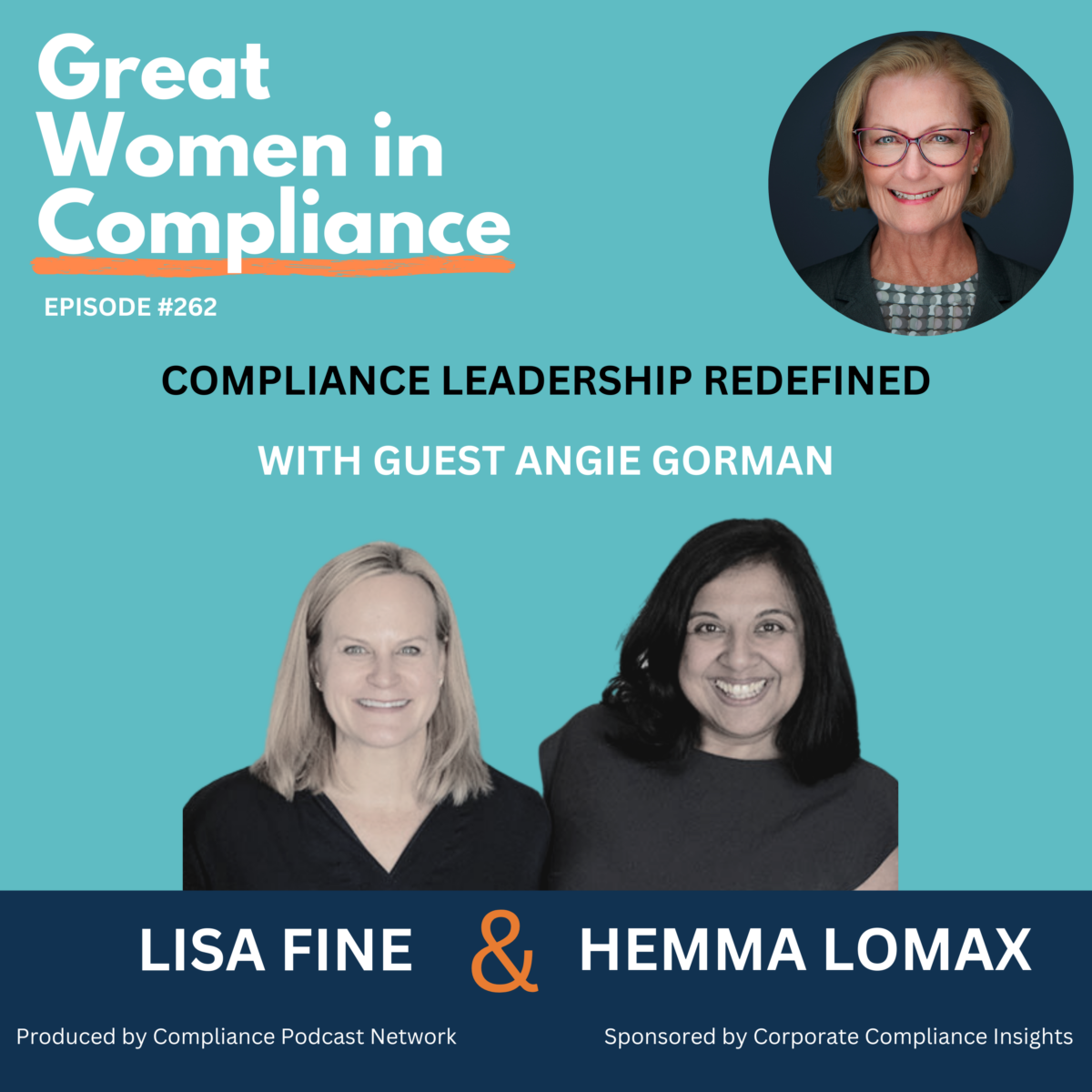
Great Women in Compliance – Compliance Leadership Redefined with Angie Gorman

In this episode of the Great Women in Compliance podcast, Lisa speaks with Angie Gorman, a Managing Director at FTI Consulting. Angie is an expert in communications and change management, and she discusses her work in communications and how this evolved into her work in ethics and compliance.

Angie highlights some key elements for building an effective communications strategy for building a culture of compliance. These include integrating compliance into the organization’s larger culture, connecting it to the company’s purpose, values, and business strategy, and consistently communicating a positive and supportive message at all levels of an organization.

Angie shares insights from the recently released FTI Ethico Compliance Leadership Redefined Survey. She discusses some of the report’s key findings, which explore today’s challenges and opportunities for chief compliance officers. It is a very timely report about the state of our profession.

Categories
Creativity and Compliance

Creativity and Compliance – Upping Your Compliance Game

Where does creativity fit into compliance? In more places than you think. Problem-solving, accountability, communication, and connection—they all take creativity. Join Tom Fox and Ronnie Feldman on Creativity and Compliance, part of the award-winning Compliance Podcast Network.

Ronnie’s company, Learnings and Entertainment, utilizes the entertainment devices people use to consume information in their everyday, non-work lives and apply it to important topics around compliance and ethics. It is not only about being funny. It is about changing the tone of your compliance communications and messaging to make your compliance program, policies, and resources more accessible. In this episode of Creativity and Compliance, Tom Fox and Ronnie Feldman take up the challenge handed down by Hui Chen in light of the administration’s suspension of FCPA enforcement to up their compliance game.

Ronnie begins by advocating for a transformation in compliance training, suggesting a shift from traditional e-learning methods to engaging communication campaigns emphasizing a Speak Up Culture and seamlessly integrating compliance into daily business operations. He believes that by using short, entertaining formats and training leaders to present content playfully, compliance can become more interesting and effective, positioning compliance professionals as valuable assets through proactive engagement and collaboration. Tom underscores the importance of compliance professionals being approachable and communicative, serving as problem solvers who collaborate with business units to achieve unexpected, beneficial outcomes. Both experts agree that by humanizing the compliance function and focusing on values and behaviors, compliance professionals can enhance their programs and contribute significantly to organizational success.

Key highlights:

  • Engaging Communication Campaigns for Compliance Training
  • Strategic Communication for Compliance Professionals
  • Cultivating Proactive Compliance Culture through Training Programs
  • Strategic Engagement for Compliance Professionals

Resources:

Ronnie

  • Learnings & Entertainments (Website)
  • Compliance Confessions – inspired by “Mean Tweets” these 90-second commercials address misconceptions and excuses to promote speak up culture and the E&C team as positive and helpful.
  • E&C Training Jams – a soulful singer banters with ethics & compliance explaining policies, sharing examples and debunking excuses. 
  • Tales from the Hotline – Real speak up-themed stories about workplace behavior gone wrong.
  • Workplace Tonight Show! – E&C meets SNL Weekend Update explaining corporate risk topics and why employees should care.
  • 60-Second Communication & Awareness Shorts – A variety of short, customizable, music and multimedia, quick-hitter “commercials” promoting integrity, compliance, speaking up and the E&C team as helpful advisors and coaches.
  • Custom Live & Digital Programing – Custom creative programming that balances the seriousness of the subject matter with a more engaging delivery. After all, you can’t bore people into learning.

Tom

Instagram

Facebook

YouTube

Twitter

LinkedIn

For more information on the Ethico ROI Calculator and a free White Paper on the ROI of Compliance, click here.

Creativity and Compliance was recently honored as one of the Top 35 Podcasts on Creativity by Feedspot.

Categories
Blog

The Personalization Imperative: Lessons for Compliance Professionals 

Personalization has emerged as a transformative force in modern business and modern communications. Marketing is no longer about addressing a customer by name in an email but delivering tailored experiences at scale, powered by artificial intelligence (AI) and data-driven insights. In a recent article in the Harvard Business Review, entitled Personalization Done Right, authors Mark Abraham and David Edelman wrote about how companies like SonderMind, Spotify, and Sweetgreen lead the charge, using innovative personalization strategies to create value and delight their customers. However, personalization presents some interesting opportunities for compliance professionals to balance innovation with regulatory obligations, ethical considerations, and data privacy concerns.

Today, I want to examine the lessons that compliance professionals can draw from the personalization strategies outlined in the BCG Personalization Index. I will focus on maintaining compliance while enabling businesses to leverage personalization as a competitive advantage. 

The Five Promises of Personalization 

Personalization leaders succeed by fulfilling five implicit promises to their customers:

  1. Empower Me – Make my experience seamless and intuitive.
  2. Know Me – Use my data responsibly to understand my needs.
  3. Reach Me – Engage with me at the right time, on the right channel.
  4. Show Me – Provide relevant, tailored content.
  5. Delight Me – Continuously improve my experience through innovation.

Each of these promises presents opportunities and risks that compliance professionals must navigate.

  • Empower Me: Enhancing the Customer Journey 

Businesses like SonderMind demonstrate how personalization can empower users. SonderMind’s mental wellness app analyzes individual data to suggest actionable steps, such as meditation or journaling, and arm therapists with anonymized insights to optimize treatment plans. This results in better outcomes for patients and reduced costs for insurers.

For the compliance professional empowering employees (the customers of compliance), Personalization leaders start by asking: How can I make the employee’s experience better by personalizing it? For a compliance professional, this means understanding an employee’s unique needs at every step of their journey and deciding how personalization can best help them. The Department of Justice calls this ‘targeted’ training and communications.

  • Know Me: Building Trust Through Data 

The authors point to Sweetgreen, “a newcomer to the restaurant business relative to the largest chains,” which illustrates this point well. Right from its start, in 2007, it invested in building digital customer relationships. It launched a mobile app in 2013, ahead of many large restaurant chains, and progressively added features such as mobile ordering, delivery, personalized offers and challenges, and a loyalty program to drive digital engagement.

Here, the compliance professional can not only stream compliance communications more efficiently but also use those same communications to build relationships and trust with your employees. Obviously, this is directly in the compliance wheelhouse, as data governance is paramount. Compliance teams must oversee the integration of customer data across systems, ensuring it is accurate, secure, and used in accordance with stated policies.

  • Reach Me: Engaging Responsibly 

Having the data to know the customer is not enough. Your organization must use AI to identify triggers to reach out, such as when a customer browses online or inquires. Then, orchestrate touches across channels and use smart frequency management to ensure their touches are coordinated and not overwhelming. The authors pointed to Cisco, whom they said is “a personalization leader. Its sales team knows whom to contact, when, and about what and comes armed with relevant content and demos. Because Cisco’s sales and marketing teams are closely linked, customers get coordinated exposure to content that supports their needs and that opens up sales dialogues.”

This is precisely how compliance professionals should think about targeted and effective training and communications. This type of coordinated approach, based on employee needs or questions, can pay off with big compliance benefits. Overreach will turn off employees if the communications are bad, useless, and overwhelming. You do not want to cause ‘compliance communication fatigue.’ Compliance professionals must monitor how AI models are recommended, ensuring they align with legal standards and ethical norms.

  • Show Me: Tailoring Content 

Pandora shows how generative AI can create personalized content, reducing production times and improving engagement. The authors noted, “The global jewelry brand Pandora thrives by sparking customer interest with inspirational content. As part of its strategy, it uses AI-generated content to tailor its messaging to each customer and cut cycle times for certain types of content creation from 12 to 14 months to a mere 10 days. The company learned that personalizing the background and model image for each individual—and coordinating how the customer sees those images across emails, websites, and other ads—substantially improved conversion rates.”

This speaks to the DOJ mandate for tailored training. However, you should also consider the business ethics message you can give customers. It can be similar to that of other companies that have gotten into FCPA or other regulatory trouble, celebrating your employees who have done the right thing or consistent messages from your CEO or senior executive about doing business ethically and in compliance.

  • Delight Me: Driving Continuous Improvement 

Personalization leaders adopt agile working methods to accelerate testing and learning, improving the intelligence behind each customer interaction. Companies like DoorDash epitomize the “delight me” promise by running hundreds of micro-experiments to refine their personalization efforts. This agile approach enables rapid innovation but requires robust oversight to ensure compliance with regulations.

Continuous improvement is directly in the wheelhouse of compliance. You should be able to take the feedback you receive from your employees and incorporate that information into your future communications. Even more exciting is the opportunity to have employees individually improve their ways of doing business ethically and in compliance. Compliance professionals should collaborate with product teams to ensure experiments respect privacy laws and customer expectations.

Key Lessons for Compliance Professionals 

  1. Embrace the Role of Enabler. Compliance should not be a roadblock to innovation. Instead, compliance professionals can enable responsible personalization by embedding themselves in cross-functional teams and offering solutions aligning with business goals and regulatory requirements.
  2. Prioritize Data Privacy. As personalization relies heavily on customer data, compliance teams must prioritize data privacy and security. This includes ensuring compliance with global regulations like GDPR, CCPA, and industry-specific standards.
  3. Establish AI Governance. AI is a cornerstone of modern personalization. Compliance professionals must develop and enforce governance frameworks to ensure AI is used ethically and transparently.
  4. Foster a Culture of Transparency. Customers are more likely to trust companies that are upfront about how their data is used. Compliance teams should advocate for clear and accessible privacy policies.
  5. Monitor Regulatory Trends. Personalization efforts are subject to evolving regulations. Compliance professionals must stay informed about changes in data privacy, AI ethics, and advertising standards to guide their organizations effectively.

The Future of Compliance is Personalization 

The rise of personalization presents compliance professionals with a unique opportunity to lead. By ensuring that personalization efforts are ethical, transparent, and compliant, they can help their organizations build trust, drive innovation, and achieve sustainable growth.

As the BCG Personalization Index shows, companies that excel in personalization delight their customers and create significant business value. The same applies to a corporate compliance function and its customers, IE., employees. Compliance professionals are essential to realizing this potential, ensuring businesses can innovate responsibly and thrive in an increasingly competitive landscape.

Compliance is not simply about preventing wrongdoing but enabling your organization to do things correctly. Personalization of compliance is no exception. Compliance professionals should embrace this opportunity and take charge of a future where personalization and compliance go hand in hand.

Categories
Creativity and Compliance

Creativity and Compliance – 10 Creative Tips for 2025

Where does creativity fit into compliance? In more places than you think. Problem-solving, accountability, communication, and connection—they all take creativity. Join Tom Fox and Ronnie Feldman on Creativity and Compliance, part of the award-winning Compliance Podcast Network.

Ronnie’s company, Learnings and Entertainment, utilizes the entertainment devices people use to consume information in their everyday, non-work lives and applies it to important topics around compliance and ethics. It is not only about being funny. It is about changing the tone of your compliance communications and messaging to make your compliance program, policies, and resources more accessible. In this episode of Creativity and Compliance, host Tom Fox and Ronnie Feldman review their top 10 lessons learned from creative compliance initiatives for 2025.

They discuss the importance of keeping communication short and simple, the value of frequent reminders over extensive training, and making compliance resources easily accessible. They also cover leveraging positivity and a mix of rewards and penalties to engage employees. They highlight the significance of psychological safety, the role of influencers in promoting compliance, and the necessity for variety in communication methods. Lastly, they emphasize the power of fun in making compliance messages memorable and effective. Join them for an insightful and entertaining recap aimed at making compliance both engaging and effective in the year to come.

Key highlights:

1: Keep It Short and Simple (KISS)

2: Forget Me Not

3: Where’s Waldo?

4: Positivity in Compliance

5: Carrots and Sticks

6: Safety First

7: Be an Influencer

8: Variety is the Spice of Life

9: You Can’t Be Serious

10: The Power of Fun

Resources:

Ronnie

  • Learnings & Entertainments (Website)
  • Compliance Confessions – inspired by “Mean Tweets” these 90-second commercials address misconceptions and excuses to promote speak up culture and the E&C team as positive and helpful.
  • E&C Training Jams – a soulful singer banters with ethics & compliance explaining policies, sharing examples and debunking excuses. 
  • Tales from the Hotline – Real speak up-themed stories about workplace behavior gone wrong.
  • Workplace Tonight Show! – E&C meets SNL Weekend Update explaining corporate risk topics and why employees should care.
  • 60-Second Communication & Awareness Shorts – A variety of short, customizable, music and multimedia, quick-hitter “commercials” promoting integrity, compliance, speaking up and the E&C team as helpful advisors and coaches.
  • Custom Live & Digital Programing – Custom creative programming that balances the seriousness of the subject matter with a more engaging delivery. After all, you can’t bore people into learning.

Tom

Instagram

Facebook

YouTube

Twitter

LinkedIn

For more information on the Ethico ROI Calculator and a free White Paper on the ROI of Compliance, click here.