Categories
Blog

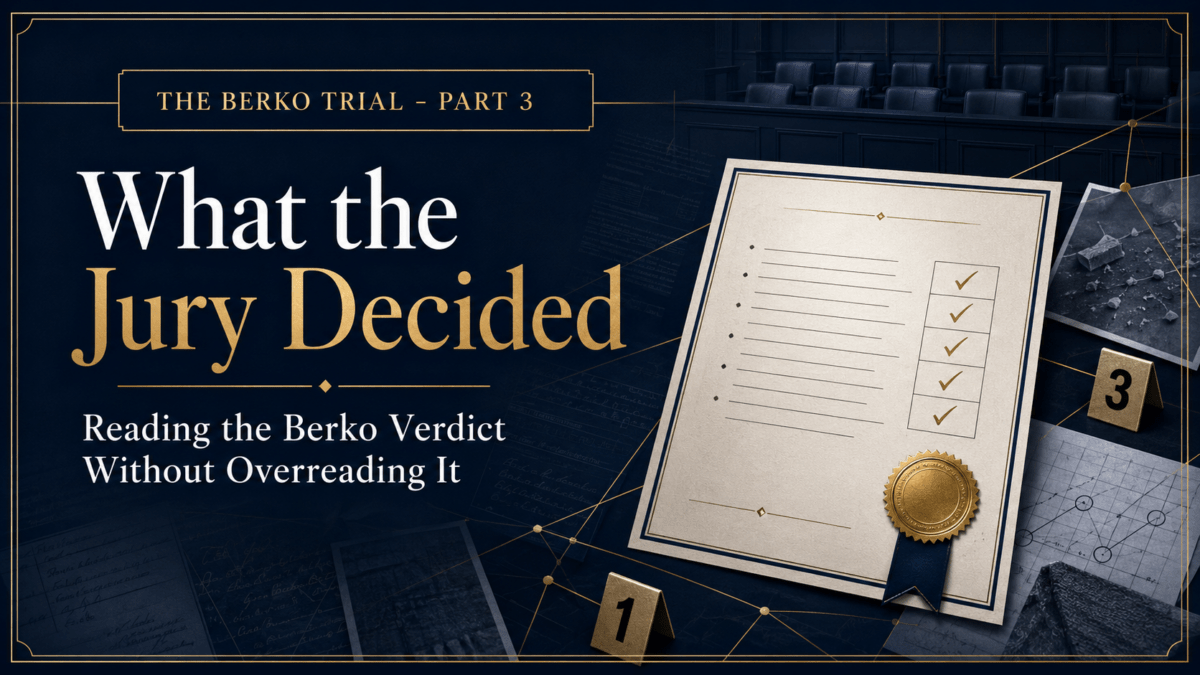
THE BERKO TRIAL – PART 3: What the Jury Decided: Reading the Berko Verdict Without Overreading It

We continue our deep dive into the Asante Berko FCPA conviction. Today we consider the jury’s verdict. The jury returned three guilty verdicts. That is the decisive legal result, but it is not a line-by-line adoption of the prosecution’s closing argument. For compliance professionals, the discipline is to hold both propositions at once. The government proved the charged crimes beyond a reasonable doubt. Yet the general verdict does not tell us which email the jurors found decisive, how they interpreted every payment, or whether they accepted every factual statement later included in the government’s announcement. That distinction is not lawyerly hedging. It is the foundation of a credible enforcement analysis.

Three Convictions, One Clear Result

After a nine-day trial, a federal jury convicted Asante Kwaku Berko of conspiracy to violate the Foreign Corrupt Practices Act (FCPA), a substantive FCPA violation, and conspiracy to commit money laundering. Federal criminal verdicts must be unanimous. The jury therefore agreed that the government had proved the elements of each of the three counts submitted to it under the court’s instructions. Moreover, the jury convicted in just over three hours, which in a major criminal case is an extraordinarily short jury deliberation.

At a high level, the conspiracy verdict established Berko’s knowing participation in an agreement to violate the FCPA. The substantive verdict established criminal responsibility for the charged corrupt-payment offense. The money laundering conspiracy verdict established participation in an agreement to move funds internationally to promote FCPA violations. The indictment identifies the statutory theories and alleged conduct, but it remains a charging document. It is not a substitute for the jury instructions or the verdict itself.

The result also defeated the defense’s central trial position. The defense argued that the government had not proved the last mile between funds paid to intermediaries and funds received by Ghanaian officials. No alleged recipient testified. No Ghanaian witness took the stand. No downstream bank record showed a payment to an official. The jury nevertheless found the government’s complete proof sufficient beyond a reasonable doubt. That is what the verdict establishes. The boundaries are equally important.

A General Verdict Is Not a Set of Special Findings

A general verdict answers the ultimate question on each count: guilty or not guilty. It does not ordinarily explain the jury’s reasoning. It does not identify which witness the jurors credited, which inference they drew from a particular email, or what weight they assigned to the undercover recording.

That means we should not write that the jury separately found every alleged recipient, every alleged payment amount, or every characterization of an intermediary to be true. We can say that prosecutors presented those facts and argued those inferences. We can say that the defense disputed them. We can say that the jury convicted on all three counts. Those are distinct propositions, and sound compliance writing should keep them distinct.

The same rule applies to intent. The jury’s verdict necessarily reflects a finding of the criminal intent required by the instructions for each count. It does not disclose whether jurors inferred that intent primarily from off-channel communications, milestone-timed payments, cash withdrawals, the recorded lunch, Berko’s alleged personal compensation, the interaction with Goldman’s compliance process, or the cumulative force of all of them. The verdict is conclusive as to guilt at this stage. It is silent about the internal path the jury took to reach that result.

How the Mosaic Answered the Missing Last Mile

The government’s case did not depend on one witness producing a receipt for a bribe. It offered multiple streams of circumstantial evidence: more than 300 emails, separate personal and corporate communication channels, transfers to intermediaries, financial-flow charts, payments aligned with government approvals, compliance questions, cash discussions, and a secretly recorded lunch.

The defense tested each stream separately. Emails lacked testimony from their participants. Payments stopped short of the alleged officials. The confidential source had potential incentives. The recorded conversation involved prompting, translation, and hypothetical facts. Goldman’s withdrawal reflected a corporate risk judgment, not the criminal burden of proof.

The jury rejected reasonable doubt. The most supportable inference is that the combined evidence overcame the defense’s missing-link argument. That remains an inference because the jurors did not issue an explanation. Still, it offers an important proof lesson: independent evidence streams can corroborate one another even when no single item tells the whole story. For a compliance investigation, that lesson cuts both ways. A red flag is not a legal element, and a collection of suspicions does not automatically prove misconduct. But communications, transaction timing, money flows, control circumvention, and personal benefit can become mutually reinforcing. The analytical task is to test whether the pieces converge, conflict, or merely sit beside one another.

Three Dollar Figures, Three Source Regimes

The amounts associated with the case show why attribution matters. The 2020 indictment alleged that Berko and others caused more than $700,000 in bribes to be transferred to Ghanaian officials. DOJ stated after the verdict that the government proved more than $1 million in bribes at trial. The SEC’s civil complaint alleged that the Turkish energy company transferred at least $2.5 million to a Ghana-based intermediary, all or most of which was used for bribes. Those are not interchangeable totals. They arise from different documents, legal proceedings, time periods, and descriptions of the money flow. The $2.5 million figure concerns transfers to an intermediary. The other figures describe alleged or trial-proven bribes. Some sums may overlap, but the public sources do not support collapsing them into one number.

The SEC matter adds another essential qualifier. Berko consented to the 2021 final judgment without admitting or denying the complaint’s allegations, except as specifically provided for bankruptcy purposes. The judgment imposed an injunction and required $275,000 in disgorgement plus $54,163.92 in prejudgment interest. It did not convert every allegation in the SEC complaint into a generally admitted fact. This source discipline is central to compliance credibility. Indictments allege. Trial evidence supports arguments. Advocates characterize. Verdicts decide counts. Civil settlements may resolve claims without admissions. A strong analysis identifies the category before drawing the lesson.

The Verdict Is an Endpoint and a Starting Point

The trial reporting states that the jury deliberated for approximately three hours and that sentencing was scheduled for November 10, 2026. Berko was remanded pending sentencing. Post-trial motions, sentencing proceedings, and any appeal could add to the record, so the procedural status should be checked again before publication. Things do not bode well for Asante at this point.

For now, the legal conclusion is clear. Berko was convicted on all three counts submitted to the jury. The editorial conclusion should be equally clear. The verdict establishes criminal liability at trial, not a special finding on every email, payment, witness, amount, or corporate-control question in the surrounding narrative. That is not a limitation on the importance of the case. It is how serious compliance professionals preserve trust. They distinguish what is known, what was argued, what was disputed, what was decided, and what remains an inference.

Join us tomorrow for Part 4, as we will move from verdict discipline to transaction discipline: whether a functioning compliance program could have identified and interrupted the pattern earlier.

Resources:

United States v. Berko, No. 1:20-cr-00328-DG, Indictment, ECF No. 3 (E.D.N.Y. filed Aug. 26, 2020)

Stewart Bishop, “Goldman Jury Sees Cash Talk in Energy Deal Email Deluge,” Law360, Aug. 1, 2026; Stewart Bishop, “Goldman Exec Was Linchpin to Ghana Bribery Ploy, Jury Told,” Law360, Aug. 5, 2026.

Stewart Bishop, “Ex-Goldman Exec Convicted of Ghana Bribery Plot,” Law360, Aug. 6, 2026. Supplied trial reporting.

U.S. Attorney’s Office for the Eastern District of New York, “Former Goldman Sachs Investment Banker Convicted of Foreign Bribery and Money Laundering,” Aug. 6, 2026, DOJ Press Release.

Stewart Bishop, “Goldman Jury Sees Undercover Video as Bribe Trial Nears End,” Law360, Aug. 4, 2026. Supplied trial reporting.

Stewart Bishop, “Shady Power Deal Used in Goldman Compliance Prep, Jury Told,” Law360, July 29, 2026

Stewart Bishop, “Like Milli Vanilli, Goldman FCPA Case Is a Ruse, Jury Told,” Law360, July 28, 2026.

SEC Final Judgment against Asante Berko

SEC Complaint against Asante Berko

Categories
Daily Compliance News

Daily Compliance News: July 1, 2026, The Salami Incident Edition

Welcome to the Daily Compliance News. Each day, Tom Fox, the Voice of Compliance, brings you compliance-related stories to start your day. Sit back, enjoy a cup of morning coffee, and listen in to the Daily Compliance News. All, from the Compliance Podcast Network. Each day, we consider four stories from the business world, compliance, ethics, risk management, leadership, or general interest for the compliance professional.

Top stories include:

  • Indonesian Tech founder found guilty in corruption case. (NYT)
  • Big banks want to rein in FINRA. (WSJ)
  • SEC fines BoA unit for failing to find enough suspicious activity. (Reuters)
  • Taiwan probes AI hardware smuggling. (WSJ)

To learn about the intersection of Sherlock Holmes and the modern compliance professional, check out Tom’s latest book, The Game is Afoot-What Sherlock Holmes Teaches About Risk, Ethics and Investigations on Amazon.com.

Categories
Daily Compliance News

Daily Compliance News: June 15, 2026 – The SBF Loses His Appeal Edition

Welcome to the Daily Compliance News. Each day, Tom Fox, the Voice of Compliance, brings you compliance-related stories to start your day. Sit back, enjoy a cup of morning coffee, and listen in to the Daily Compliance News. All, from the Compliance Podcast Network. Each day, we consider four stories from the business world, compliance, ethics, risk management, leadership, or general interest for the compliance professional.

Top stories include:

  • Corruption on the White House lawn. (Al Jazeera)
  • Hospices need ‘bulletproof’ compliance. (Hospice News)
  • Bond investor pleads guilty. (WSJ)
  • SBF loses appeal. (FT)

To learn about the intersection of Sherlock Holmes and the modern compliance professional, check out Tom’s latest book, The Game is Afoot-What Sherlock Holmes Teaches About Risk, Ethics and Investigations on Amazon.com.

Categories
Daily Compliance News

Daily Compliance News: June 5, 2026, The Profit Disgorgement Edition

Welcome to the Daily Compliance News. Each day, Tom Fox, the Voice of Compliance, brings you compliance-related stories to start your day. Sit back, enjoy a cup of morning coffee, and listen in to the Daily Compliance News. All, from the Compliance Podcast Network. Each day, we consider four stories from the business world, compliance, ethics, risk management, leadership, or general interest for the compliance professional.

Top stories include:

  • Sanctions gaps and ABC governance risks.  (JustSecurity)
  • SCt upholds SEC right to profit disgorgement. (NYT)
  • Top AI leaders call for a fight against Biological Weapons. (WSJ)
  • Gen Z in the office. (FT)

To learn about the intersection of Sherlock Holmes and the modern compliance professional, check out Tom’s latest book, The Game is Afoot-What Sherlock Holmes Teaches About Risk, Ethics and Investigations on Amazon.com.

Categories
Daily Compliance News

Daily Compliance News: June 1, 2026, The End of Climate Disclosure Rules Edition

Welcome to the Daily Compliance News. Each day, Tom Fox, the Voice of Compliance, brings you compliance-related stories to start your day. Sit back, enjoy a cup of morning coffee, and listen in to the Daily Compliance News. All, from the Compliance Podcast Network. Each day, we consider four stories from the business world, compliance, ethics, risk management, leadership, or general interest for the compliance professional.

Top stories include:

  • Corruption concerns hit Mexico, yet again.  (Bloomberg)
  • SEC wants to kill off climate disclosure rules. (NYT)
  • China threatens to launch trade probes against the EU. (WSJ)
  • Can Trump impose a $100K visa fee? (Reuters)

For more information on the use of AI in compliance programs, Tom Fox’s new book, Upping Your Game, is available. You can purchase a copy of the book on Amazon.com.

To learn about the intersection of Sherlock Holmes and the modern compliance professional, check out Tom’s latest book, The Game is Afoot-What Sherlock Holmes Teaches About Risk, Ethics and Investigations on Amazon.com.

Categories
2 Gurus Talk Compliance

2 Gurus Talk Compliance – Episode 77 – The Bullying Edition

What happens when two top compliance commentators get together? They talk compliance, of course. Join Tom Fox and Kristy Grant-Hart in 2 Gurus Talk Compliance as they discuss the latest compliance issues in this week’s episode!

Stories This Week Include:

  • End of SEC Gag Rule – Radical Compliance
  • Binance, Monitorship and Funding Iran – Bloomberg
  • Running an Effective Meeting – FT
  • Of big law and insider trading – Reuters
  • Adani case dropped – NYT
  • How I Choose Which Cloudflare Employees to Replace With AI – WSJ
  • BP ousts Chair Albert Manifold citing governance standards, oversight and conduct – Reuters
  • Four Big Takeaways From the FBI’s Report on Internet Crime – WSJ
  • Too Much Work to Do? Have Your Digital Twin Handle It – WSJ
  • Florida woman tries to eat counterfeit cash during arrest for Walmart scam, police say – FOX35 Orlando

Resources:

Kristy

Kristy Grant-Hart on LinkedIn

Order Kristy’s updated, at 10-years, new edition of How to Be a Wildly Effective Compliance Officer by clicking here.

Tom

Check out the top compliance handbook, The Compliance Handbook, 7th edition, published by LexisNexis. Visit the LexisNexis® Store at https://lexisnexis.com/fox20

To save 20% on The Compliance Handbook: A Guide to Operationalizing Your Compliance Program, please reference or enter promotion code: FOX20.

Offer expires December 31, 2026. Offer applies to new orders only, before shipping and taxes are calculated, and shipped to a U.S. address. Discount will be applied to each applicable product after code FOX20 is entered. Discount does not apply to current subscriptions, renewals or updates. Certain exclusions and other restrictions may apply. Void where prohibited. View full terms here.

Instagram

Facebook

YouTube

Twitter

LinkedIn

Categories
Compliance Into the Weeds

Compliance into the Weeds: An SEC Rollback and a Tribute to Barney Frank

The award-winning Compliance into the Weeds is the only weekly podcast that takes a deep dive into a compliance-related topic, literally going into the weeds to explore it more fully. Looking for some hard-hitting insights on compliance? Look no further than Compliance into the Weeds! In this episode of Compliance into the Weeds, Tom Fox and Matt Kelly discuss SEC Chair Paul Atkins’ proposals to overhaul filer categories and sharply reduce corporate reporting and governance obligations, including SOX 404B internal control testing and Dodd-Frank say-on-pay votes, alongside a companion proposal to allow semi-annual instead of quarterly reporting.

Matt explains the shift to only two categories, raising the large accelerated filer threshold to $2B market cap, eliminating smaller reporting company status, and leaving roughly 80% of public companies as non-accelerated filers with reduced disclosures (e.g., two years of audited financials). They note a five-year IPO grace period, dubbed the “Elon exemption”, that could cover large new issuers such as SpaceX, OpenAI, and Anthropic. They warn of weakened investor protection, reduced enforcement, and significant impacts on compliance and culture. The episode closes with reflections on Barney Frank’s intellect, style, and Dodd-Frank legacy.

Key highlights:

  • Atkins Rollback Overview
  • New Filer Categories and Elon Exemption
  • Investor Protection Fallout
  • Compliance Culture Impacts
  • Remembering Barney Frank

Resources:

Matt on Radical Compliance

Tom in Compliance Week

Tom

Instagram

Facebook

YouTube

Twitter

LinkedIn

A multi-award-winning podcast, Compliance into the Weeds was most recently honored as one of the Top 25 Regulatory Compliance Podcasts, a Top 10 Business Law Podcast, and a Top 12 Risk Management Podcast. Compliance into the Weeds has been conferred a Davey, a Communicator Award, and a W3 Award, all for podcast excellence.

Categories
Daily Compliance News

Daily Compliance News: May 11, 2026, The Tainted by Corruption or Collusion Edition

Welcome to the Daily Compliance News. Each day, Tom Fox, the Voice of Compliance, brings you compliance-related stories to start your day. Sit back, enjoy a cup of morning coffee, and listen in to the Daily Compliance News. All, from the Compliance Podcast Network. Each day, we consider four stories from the business world, compliance, ethics, risk management, leadership, or general interest for the compliance professional.

Top stories include:

  • Just says Musk owes $2.1bn for Twitter; SEC says $1.5MM.  (Reuters)
  • China hands suspended death sentences to former Defense Ministers. (WSJ)
  • Sri Lankan Airlines’ chief, embroiled in Airbus corruption scandal, found dead. (SCMP)
  • AI notetakers are making lawyers nervous. (NYT)

For more information on the use of AI in compliance programs, Tom Fox’s new book, Upping Your Game, is available. You can purchase a copy of the book on Amazon.com.

To learn about the intersection of Sherlock Holmes and the modern compliance professional, check out Tom’s latest book, The Game is Afoot-What Sherlock Holmes Teaches About Risk, Ethics and Investigations on Amazon.com.

Categories
Daily Compliance News

Daily Compliance News: April 23, 2026, The Who Gets Profit Disgorgement Edition

Welcome to the Daily Compliance News. Each day, Tom Fox, the Voice of Compliance, brings you compliance-related stories to start your day. Sit back, enjoy a cup of morning coffee, and listen in to the Daily Compliance News. All, from the Compliance Podcast Network. Each day, we consider four stories from the business world, compliance, ethics, risk management, leadership, or general interest for the compliance professional.

Top stories include:

  • Spain seeks to close the investigation into the wife of the Spanish PM. (Reuters)
  • Anthropic is investigating unauthorized use of Mythos. (FT)
  • Crypto billionaire accuses the Trump family’s Liberty World of ‘criminal extortion’. (WSJ)
  • Matt Levine explores who should get disgorged profits. (Bloomberg)

For more information on the use of AI in Compliance programs, my new book, Upping Your Game, is available. You can purchase a copy of the book on Amazon.com.

To learn about the intersection of Sherlock Holmes and the modern compliance professional, check out my latest book, The Game is Afoot-What Sherlock Holmes Teaches About Risk, Ethics and Investigations on Amazon.com.

Categories
Pod and Port

Pod and Port: Podcasting, Social Media and Yacht Rock – Instagram’s Long Game and the Yacht Rock Power of Kenny Loggins

In Episode 2 of Pod & Port: Podcasting, Social Media and Yacht Rock, Tom Fox and Jeff Dwoskin explore a major shift in how creators, marketers, podcasters, and business owners should think about Instagram: it is no longer just a closed social platform. With stronger Google indexing, Instagram content can now have a much longer life cycle, which means captions, keywords, file names, and value-driven content matter more than ever.

Jeff explains why this changes the game for creators. Instead of treating Instagram as a short-lived post-and-forget channel, listeners are encouraged to think of it as part of a broader search and content strategy. The discussion covers evergreen content, smarter SEO, descriptive file naming, calls to action, and repurposing content to keep valuable work visible without exhausting your audience.

Then the show turns to Yacht Rock, with Tom taking the lead on Kenny Loggins. From his transition out of Loggins and Messina to defining Yacht Rock tracks such as “This Is It,” “Whenever I Call You Friend,” and “Heart to Heart,” Tom makes the case that Loggins was a major force in the genre. The conversation also highlights how Loggins successfully leaped into the video era through blockbuster soundtrack hits like “Footloose,” “Danger Zone” from Top Gun, and “I’m Alright” from Caddyshack, showing how adaptability can extend both relevance and reach.

Key takeaways:

  • Instagram content now has a longer shelf life.
  • SEO is now part of social media strategy.
  • Descriptive file names matter.
  • Repurpose with intention.
  • Kenny Loggins shows the power of reinvention.

Resources

Jeff

Jeff Dwoskin on LinkedIn

Stampede Social Website

Kenny Loggins on Spotify

Tom

Instagram

Facebook

YouTube

Twitter

LinkedIn