Categories
AI Today in 5

AI Today in 5: November 11, 2026 the AI-ROI Not Straightforward Edition

Welcome to AI Today in 5, the newest edition to the Compliance Podcast Network. Each day, I will bring to you 5 stories about AI stories to start your day. Sit back, enjoy a cup of morning coffee and listen in to the AI Today In 5. All, from the Compliance Podcast Network. Each day we consider four stories from the business world, compliance, ethics, risk management, leadership or general interest about AI.

  1. Agentic AI with dual CTO leadership.(FinTechGlobal)
  2. Anthropic targets $1.4tn valuation.(NYT)
  3. Midterms raise AI costs and compliance questions. (ComputerWorld)
  4. AI agent as your next CMO. (WSJ)
  5. Evaluating AI-ROI is not straightforward.(ModernHealthcare)

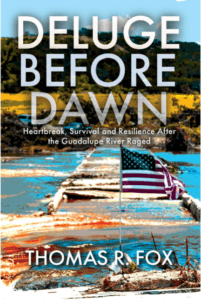
My first work of general non-fiction is now out: Deluge Before Dawn, the story of the 2025 flood in Kerr County Texas which killed 119 people and devastated a county. It is a story of tragedy, heartbreak, survival and resilience. It is available on the following sites:

 Amazon.com

Stoney Creek Publishing

Barnes and Noble

Texas A&M University Press

Bookshop.org

Google.Books

Walmart

Categories
2 Gurus Talk Compliance

2 Gurus Talk Compliance: Episode 87 – The Election Edition

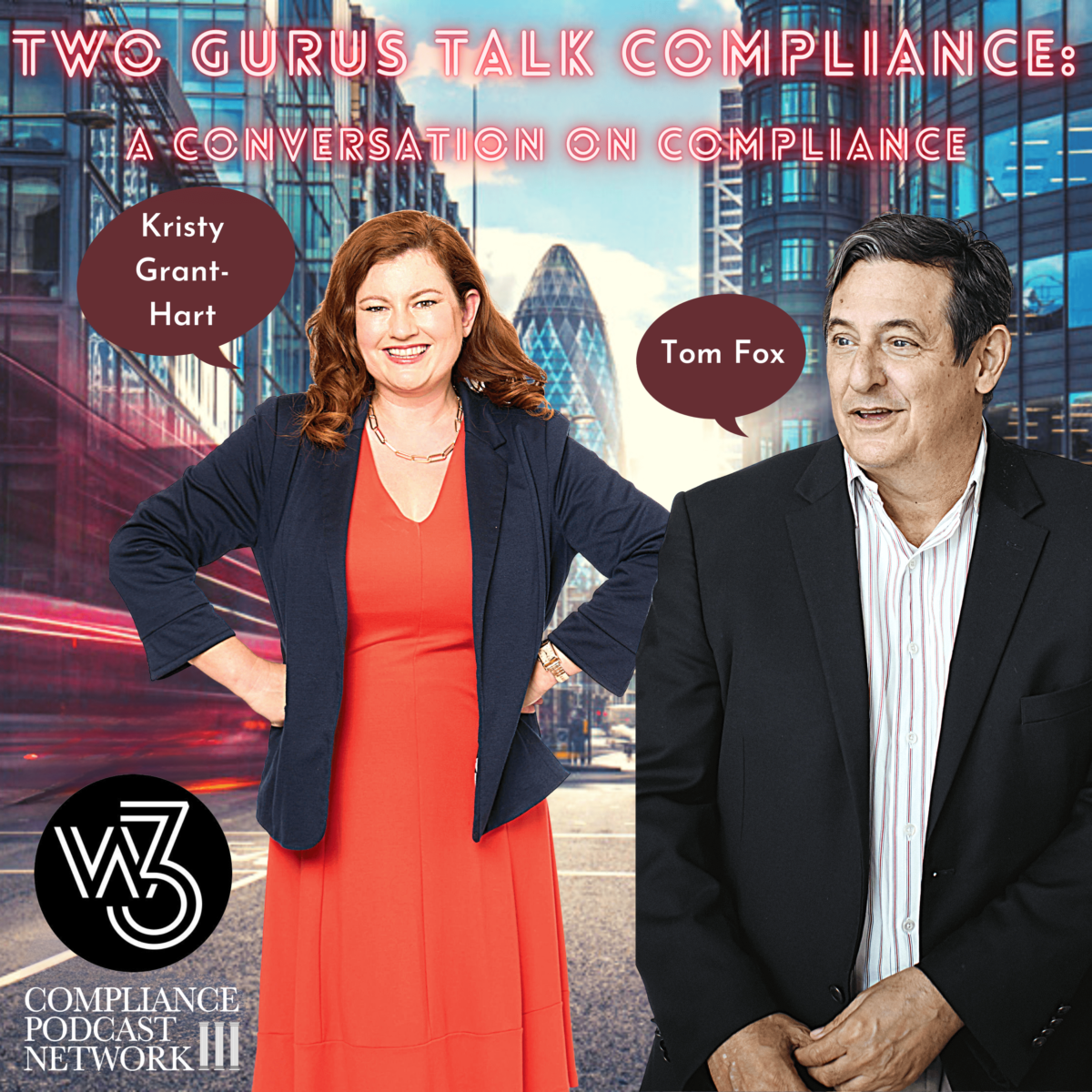
What happens when two top compliance commentators get together? They talk compliance, of course. Join Tom Fox and Kristy Grant-Hart on 2 Gurus Talk Compliance as they discuss this week’s latest compliance issues!

Stories This Week Include:

Resources:

Kristy

Kristy Grant-Hart on LinkedIn

Order Kristy’s updated 10-year edition of How to Be a Wildly Effective Compliance Officer here.

Tom

Check out Tom on LinkedIn

My first work of general non-fiction is now out: Deluge Before Dawn, the story of the 2025 flood in Kerr County, Texas, which killed 119 people and devastated a county. It is a story of tragedy, heartbreak, survival, and resilience.

It is available on the following sites:

Amazon.com

Stoney Creek Publishing

Barnes and Noble

Texas A&M University Press

Bookshop.org

Google.Books

Walmart

Categories
Blog

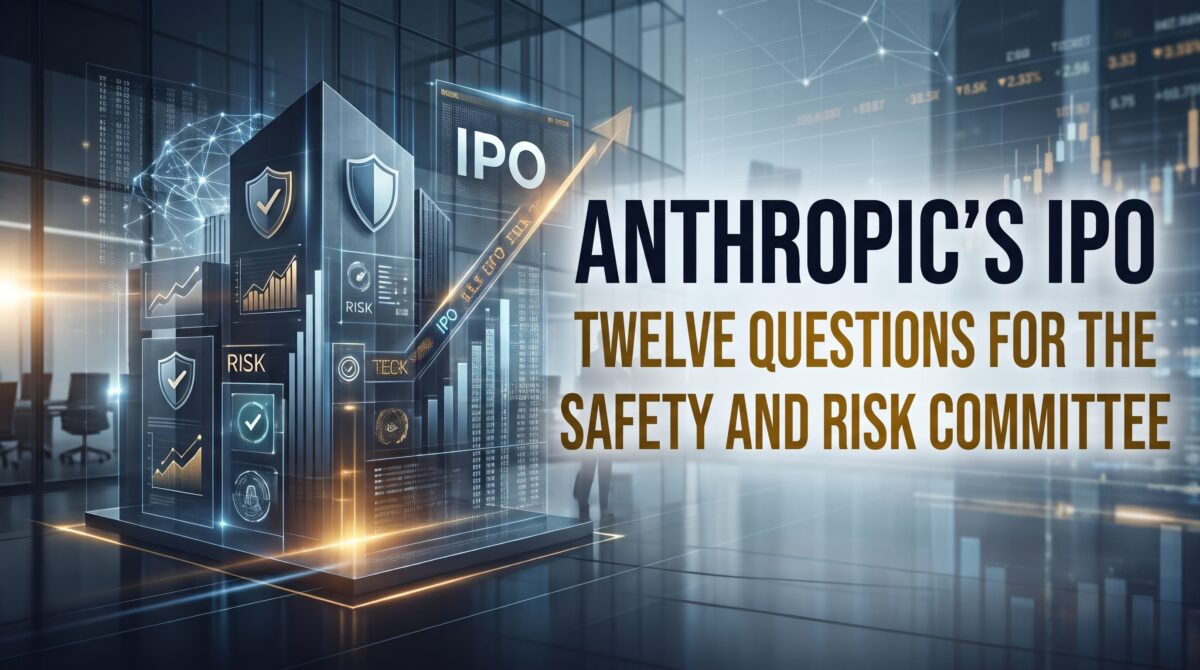
Anthropic’s IPO: Twelve Questions for the Safety and Risk Committee

In Parts I and II, we examined ten corporate compliance risks arising from Anthropic’s Registration Statement. In Part III, we translated those risks into five lessons for compliance professionals. Today, I want to explore 12 questions where those lessons should land at the board level. Anthropic’s Safety and Risk Committee (the “Committee”) provides a specific place to begin.

The registration statement describes a committee consisting of two independent directors, Christopher Liddell and Vas Narasimhan, with Narasimhan serving as chair. Its responsibilities encompass oversight of model safety and security, including the policies, processes, and controls for managing significant model risks. The committee also helps the board oversee other material risks, including legal, regulatory, cybersecurity, privacy, and compliance risks.

That breadth matters. Model safety, commercial decisions, and enterprise compliance can affect one another. A new capability can change misuse exposure. A distribution partnership can complicate access restrictions. A deployment decision can create questions about whether customer representations remain supportable.

The filing states that the committee operates under a board-approved written charter. Its summary does not establish every approval right, reporting arrangement, or escalation threshold. The following twelve questions are my recommended oversight agenda, rather than a description of procedures Anthropic has adopted or findings that its controls are deficient.

1. Which risks require the committee’s closest attention?

A broad mandate requires disciplined prioritization. The Committee should ask management which combinations of model capability, user access, and business activity could create the most serious harm or compliance exposure.

What has changed since the last review? Has a model gained new capabilities, an agent received broader permissions, or a commercial arrangement introduced new users and jurisdictions? Which changes require additional safeguards before deployment or expansion?

Evidence to request: A prioritized assessment connecting material risks to accountable executives, key controls, unresolved gaps, and decisions requiring committee attention. The assessment should explain uncertainty and the risk remaining after safeguards are in place.

The practical lesson is to organize the agenda around consequential decisions. A catalog of risks becomes useful when directors can see what management must do about them.

2. Are responsibilities and escalation routes clear?

The Committee should ask how its work connects to the full board and other Committees. The filing also assigns risk assessment and risk management policy review to the audit committee. Overlapping responsibilities make coordination essential.

Who leads when a safety incident raises questions about investor disclosures, financial exposure, or executive incentives? What requires immediate notification to the committee chair? When must an unresolved issue reach the full board?

Evidence to request: A responsibility map, notification thresholds, and records demonstrating how significant matters move between management, committees, and the board.

The Committee should also establish what happens when management recommends deployment despite a serious unresolved concern. Directors need clarity about who decides, who advises, and who receives notice. They should confirm any authority to require a pause against the actual charter and board delegations.

3. Can independent challenges reach the committee?

Technical expertise is essential, but expertise alone does not guarantee that dissent reaches directors. The Committee should ask whether compliance, legal, security, and safety leaders can present concerns directly, including disagreements with senior management.

Where do staffing, specialist expertise, or information restrictions limit effective challenge? Which recommendations have management declined, and what exposure remains? Can the Committee obtain independent advice when internal assessments conflict?

Evidence to request: Reporting arrangements, material resource gaps, significant unresolved disagreements, and the process for obtaining outside expertise.

Private sessions with relevant control leaders can help directors understand what formal presentations omit. Those sessions should produce clear follow-up where necessary. The test is whether an uncomfortable finding can reach the committee early enough to influence a consequential decision.

4. Do incentives and culture support safety commitments?

The committee should examine how commercial and development pressures affect employee behavior. What happens when testing identifies a concern that could delay an important release? Are employees rewarded for surfacing weaknesses and resolving them?

How does management identify retaliation or other consequences for raising concerns? Do employees have reporting channels that work when an issue crosses technical, legal, and commercial boundaries?

Evidence to request: Employee feedback, significant safety and compliance reports, retaliation follow-up, and examples of decisions changed because employees challenged an assumption.

Where incentives appear to undermine controls, the Committee should coordinate with other relevant committees, such as a compensation committee (if one is ever created). A falling report count requires explanation. It could reflect fewer problems, less trust in reporting, or weaker detection. Directors should ask what evidence supports management’s interpretation.

5. Do safety controls work under realistic conditions?

The Committee should ask what testing establishes about the effectiveness of important safeguards. Which scenarios were examined, what failed, and what limitations remain in the assurance provided?

A model performing well in a controlled evaluation may behave differently when connected to tools, sensitive information, or persistent workflows. Directors should ask whether testing reflects the deployment environment and foreseeable attempts to defeat restrictions.

Evidence to request: Evaluation coverage, significant failures, independent challenges, exceptions, and evidence that corrective measures have been retested.

A useful question is, “Show us an instance in which a safeguard detected a serious problem and enabled intervention.”

Management should explain the detection, the response, and what the example does and does not establish about broader control effectiveness.

6. Are autonomous agents constrained by enforceable limits?

Agent oversight deserves specific attention because authority to act changes the consequences of error or misuse. The Committee should ask what agents can access, change, transmit, purchase, or execute without additional approval.

What prevents an agent from exceeding its permissions? Which actions require meaningful human review? Can the company revoke credentials, contain activity, and preserve evidence when behavior becomes unsafe?

Evidence to request: Permission boundaries, approval requirements, monitoring results, intervention exercises, and records of unauthorized or unexpected actions.

Directors should scrutinize the human review process. A reviewer needs sufficient information, time, and authority to challenge the proposed action. Management should demonstrate that intervention works under realistic conditions and that safeguards remain effective after changes to tools or permissions.

7. Are data protection and intellectual property risks connected to safety oversight?

The Committee’s enterprise remit should bring data and intellectual property questions into the discussion. Which sensitive information supports model development or enters deployed systems? What access, retention, and use restrictions apply?

Can management substantiate its rights to use critical datasets and software? How would the business respond if those rights were challenged or access were lost? What could a security compromise expose beyond immediate service disruption?

Evidence to request: Material data flows, significant security findings, unresolved rights questions, access controls, and incident-exercise results.

The Committee should examine operational consequences alongside legal exposure. A disputed dataset, compromised credential, or exposed model asset may require changes to products, access arrangements, and customer communications. Management should explain how those decisions would be coordinated.

8. Can partners preserve the safeguards Anthropic relies upon?

The Committee should ask where cloud providers, distribution partners, data suppliers, and other critical relationships affect safety and compliance controls.

Which safeguards depend on a partner’s actions? Can management detect prohibited access or misuse through indirect channels? What information, notification rights, and assurance evidence are available when a partner controls part of the environment?

Evidence to request: Critical dependency maps, material contract exceptions, unresolved diligence findings, monitoring results, and tested contingency plans.

Concentration requires particular scrutiny. Several commercial relationships may depend on the same infrastructure. The Committee should ask what management could actually do if a critical provider failed to meet requirements, including how quickly access could be restricted or essential services maintained.

9. Do legal restrictions translate into operational controls?

Sanctions, export controls, anti-corruption obligations, and government interactions require attention across the commercial lifecycle. The Committee should ask how management identifies relevant restrictions and converts them into controls over sales, delivery, support, and access.

Where could resellers, shared accounts, intermediaries, or unusual payment arrangements obscure the actual customer or activity? Which exceptions require escalation, and who approves them?

Evidence to request: Material screening exceptions, access-control testing, high-risk intermediary reviews, and significant unresolved compliance matters.

The Committee should connect these findings to deployment decisions. A policy prohibiting certain access provides limited assurance if the delivery architecture cannot enforce the restriction or identify attempts to bypass it. Management should explain both preventive controls and detection capabilities.

10. Are external claims consistent with internal findings?

The Committee should examine how evidence about safety, reliability, privacy, and security informs product representations and material disclosures. Which claims depend on testing with significant limitations?

What happens when an incident contradicts a public statement? How do safety and compliance findings reach legal, communications, finance, and the disclosure process?

Evidence to request: Substantiation for significant claims, unresolved discrepancies, and records showing how material incidents affect communications decisions.

Financial reporting and investor disclosure matters require coordination with the audit committee and responsible management. The Safety and Risk Committee contributes by ensuring relevant risk information reaches those processes. Ask management which important claim would be hardest to substantiate today, and why.

11. Are investigations independent and connected to decisions?

A significant incident may involve technical failure, misconduct, or both. The Committee should ask who determines investigative scope when allegations concern senior executives, deployment decisions, or the suppression of safety findings.

Are evidence preservation and interim safeguards timely? Who evaluates reporting obligations and potential disclosure decisions with appropriate counsel? What requires independent oversight?

Evidence to request: Suitably protected summaries of significant matters, independence arrangements, interim measures, and outstanding decisions.

The Committee should also examine how the issue came to light. Internal detection, an employee report, a customer complaint, and external discovery reveal different strengths and weaknesses. That detection path should inform improvements to monitoring and reporting.

12. Does remediation withstand independent verification?

Closing an action item should require evidence that the underlying problem was addressed. What failed in the process, permissions, incentives, or supervision? Where else could the same weakness exist?

Who owns each corrective action, what remains overdue, and which interim safeguards protect the business while work continues?

Evidence to request: A remediation record showing severity, owner, deadline, verification results, and repeat findings.

Retesting should reflect the conditions that produced the original failure. The committee should ask who performed the validation and what limitations remain. A revised policy or completed software change is an output. Demonstrated improvement in control performance is the outcome directors need to understand.

An agenda for the next committee meeting

Ask management to present the five most consequential unresolved safety and enterprise compliance risks. For each, require evidence, the accountable executive, available options, and the decision needed. Schedule a private session with relevant control leaders and examine one recently closed remediation item.

Confirm coordination arrangements with the audit and compensation committees. Record substantive challenges, decisions, responsibilities, and follow-up. The final question should be practical: What must this committee escalate or recommend today to make Anthropic’s safety and compliance commitments effective in operation?

Categories
Blog

Anthropic’s IPO: 5 Lessons for Corporate Compliance Professionals

The most important question arising from Anthropic’s IPO disclosures is what compliance professionals should do with the risks they reveal. Identifying exposure begins the analysis. The business challenge is building a program that can manage that exposure.

In Parts I and II, I examined ten corporate compliance risks, ranging from AI safety and regulatory enforcement to third-party dependencies, financial reporting, and board oversight. In this blog post, I want to turn those risks into five practical lessons CCOs, general counsel, directors, and business leaders can use today to manage AI compliance.

Those lessons extend beyond AI developers. A manufacturer using AI in procurement, a financial services company deploying customer-facing tools, or a professional services firm connecting AI to confidential records must understand how those uses affect its control environment. Purchasing the technology does not eliminate the need to govern its use.

The central issue is accountability. Who owns the risk? Which controls address it? How does management know those controls work? What happens when they fail? These are familiar compliance questions. AI makes the answers more urgent.

1. AI governance must become part of enterprise compliance.

A standalone AI ethics policy cannot carry the weight of an enterprise compliance program. Principles require operational decisions: what uses are permitted, what information systems may access, what actions require approval, and who can suspend deployment. Start with an inventory of AI uses across the business. Include purchased applications, internally developed systems, employee experimentation, and AI features embedded in existing software. For each use, identify the business owner, data involved, decisions supported, and authority granted. A drafting assistant and an agent authorized to initiate payments require different controls.

Then connect the inventory to the enterprise risk assessment. Classify uses according to potential harm, legal exposure, sensitivity of information, and difficulty of reversing an action. Assign control owners and specify when reassessment is required. A new data connection or expanded permission can change the risk without changing the product name. Governance also requires decision rights. Compliance, legal, security, technology, and business teams should understand their respective responsibilities. Disagreements about deployment need a documented escalation route, including authority to delay implementation when critical safeguards remain unresolved.

Frameworks such as the NIST AI Risk Management Framework and ISO/IEC 42001 can help organize this work. Their practical value depends on whether the company translates its chosen approach into operating responsibilities and verifiable controls.

The CCO question: Can we identify the accountable owner and supporting controls for every material AI use?

2. Traditional compliance risks remain fundamental

AI changes how misconduct can occur and how quickly its effects can spread. Established compliance disciplines still provide the starting point for identifying the exposure. Consider a hypothetical procurement agent that recommends vendors and prepares payment instructions. Its technical performance may appear strong while its workflow bypasses conflict disclosures, restricted-party screening, or approval requirements. Faster processing can amplify a weak control environment.

The appropriate response is to examine the underlying business process. Map where an AI system receives information, makes recommendations, changes records, or initiates actions. Identify the approvals, segregation of duties, documentation, and monitoring that must remain effective at each stage. Determine whether automation has created a new route around an existing safeguard. Anti-corruption controls illustrate the point. An intermediary recommended by an AI tool still requires appropriate diligence. A model-generated payment description still requires verification. A confident recommendation cannot substitute for evidence about ownership, services performed, compensation, or government connections.

Training should reflect these practical choices. Employees need examples showing when to question an output, obtain approval, preserve records, or report a concern. Generic instructions to use AI responsibly provide little help when a system recommends a questionable transaction under commercial pressure. The CCO should also examine incentives. Employees measured solely on speed or volume may have little reason to challenge an automated recommendation. Managers must support escalation when verification delays a transaction.

The CCO question: Where could AI bypass, weaken, or obscure a control we already depend upon?

3. Third-party risk management must include technology dependencies

Traditional third-party programs often focus on agents, distributors, consultants, and other commercial intermediaries. AI requires equally careful attention to model providers, cloud infrastructure, data suppliers, integration partners, and subcontractors supporting critical services. The first task is dependency mapping. Determine which providers support essential workflows, what information they receive, and whether multiple applications depend on the same underlying service. Several vendor contracts may conceal a single point of operational failure.

Due diligence should follow the actual use. A tool that processes public information raises different concerns than a service that accesses customer records or executes transactions. Ask how information is retained, whether it may be used for training, how access is controlled, and what changes the provider can make without customer approval. Contracts should support the controls the company needs. Depending on risk, that may include incident notification, restrictions on data use, information about subcontractors, access to assurance evidence, and notice of material service changes. Legal and procurement teams should identify gaps before the business becomes dependent on the service.

Monitoring must continue after onboarding. Provider updates can affect performance, permissions, or data handling. Assign responsibility for reviewing material changes and deciding when testing must be repeated. Finally, test the exit plan. Can the business recover its information, revoke access, and maintain essential operations if the relationship ends? A contractual termination right offers limited protection when no workable alternative exists.

The CCO question: Which technology dependencies could prevent us from meeting critical obligations, and what is our tested response?

4. Compliance must be embedded in product development

Compliance review is most useful while business and technical choices can still be changed. Waiting until launch makes it harder to address weaknesses in data access, system permissions, customer communications, or monitoring. The Evaluation of Corporate Compliance Programs (ECCP) expressly addresses how companies assess and manage risks associated with AI and other emerging technologies. That provides an enforcement-informed reason to integrate AI risk into the broader compliance program.

For the CCO, the practical response is a development process with review points proportionate to risk. Assess the intended use before development, review controls during testing, document approval before deployment, and monitor behavior afterward. Material changes should trigger renewed review. Testing should examine foreseeable misuse and control failure alongside normal performance. Can a user induce unauthorized disclosure? Can an agent exceed its permissions? Does the system preserve records needed to investigate an incident? Can a human reviewer meaningfully intervene?

A nominal human approval step deserves particular scrutiny. If reviewers lack time, information, or authority to challenge recommendations, the safeguard may offer little protection. Test how people actually review realistic workloads. Compliance also needs access to relevant information and sufficient technical support to assess the results. Establish channels for employees to report unexpected behavior without first proving a technical defect. Investigations should connect incidents to root causes and corrective action.

The CCO question: At what development decisions can compliance require changes, and what evidence supports approval?

5. Boards must demand evidence of effectiveness

Board oversight depends on information that enables challenge. Counts of policies issued, training completed, and committee meetings held describe activity. Directors also need evidence about whether material risks are being controlled. Management reporting should identify significant AI uses, unresolved control weaknesses, incidents, overdue remediation, and decisions to accept residual risk. Explain what changed since the previous report and whether the change affects the company’s ability to operate within approved limits.

Metrics need context. An increase in reported incidents may reflect improved detection rather than worsening performance. A low incident count may conceal weak monitoring. Directors should ask how management interprets the numbers and what independent testing supports that interpretation. Reports should also surface disagreements and exceptions. If management approved deployment despite an unresolved compliance concern, the board needs to understand the decision, compensating controls, accountable executive, and deadline for reconsideration. Commercial significance should increase the quality of scrutiny.

Directors do not need to reproduce technical testing. They need reliable reporting, access to appropriate expertise, and a clear process for following material concerns through remediation. Meeting records should capture substantive questions, commitments, and follow-up. The board question: What evidence would cause management to restrict or suspend an AI deployment, and has that response been tested? The larger lesson: turn commitments into operating discipline

Anthropic’s disclosures bring emerging technology risk, traditional compliance obligations, and governance expectations into one discussion. The practical response is an integrated program that connects business decisions to accountable owners, tested controls, and timely escalation.

Begin with three actions: identify the most consequential AI uses, test whether existing controls cover them, and present unresolved gaps to the appropriate decision-makers. Assign deadlines and verify remediation. Give business owners clear responsibility for explaining remaining gaps and reporting progress until corrective work is complete.

For CCOs and boards, measure progress by whether the organization can demonstrate that its controls work as capabilities, permissions, and business uses change. That is how AI governance becomes an effective business discipline. The following is my qualitative assessment, not a quantitative risk score disclosed by Anthropic. The rankings reflect the combined importance of regulatory exposure, potential harm, and control complexity.

Rank Corporate compliance risk Priority Primary accountability
1 AI safety and autonomy Critical Chief AI/Safety Officer, CCO
2 Regulatory enforcement Critical General Counsel, CCO
3 Privacy and cybersecurity Critical CISO, Privacy Officer
4 Intellectual property Critical General Counsel
5 Export controls and sanctions Critical Trade Compliance, CCO
6 Third-party risk High Procurement, CCO
7 Anti-bribery and corruption High CCO
8 Financial reporting and disclosure High CFO, Audit Committee
9 Corporate governance High Board, General Counsel
10 Consumer protection High Legal, Product Compliance

Categories
Blog

Anthropic’s IPO: Top 10 Corporate Compliance Risks, Part II

What does it take to build an effective compliance program around an AI business? In Part I of this series, Tom Fox examined the first five of 10 key risks for compliance professionals identified in Anthropic’s IPO disclosures: AI safety and autonomy, regulatory enforcement, data privacy and cybersecurity, intellectual property, and export controls. Each raises a practical question for CCOs and boards: can management demonstrate that its governance and controls are effective as the technology advances?

The remaining five risks extend that inquiry across the enterprise. Third-party dependencies, bribery and corruption, financial reporting, board oversight, and product representations are familiar responsibilities for compliance professionals. In an AI business, however, those responsibilities must account for powerful commercial partners, rapid international expansion, complex infrastructure dependencies, and claims about technology whose performance can be difficult to validate.

This is where compliance must be embedded in business decisions. Due diligence must inform partner selection. Disclosure controls must support investor communications. Product claims must rest on evidence. Board reporting must give directors enough independent information to challenge management and require corrective action.

6. Third-party risk, strategic partnerships, and supply-chain dependencies

The disclosed risk: Anthropic identifies substantial dependencies involving computing infrastructure, cloud providers, strategic partners, vendors, and commercial intermediaries.

The compliance exposure: Critical third parties may create cybersecurity, data protection, sanctions, operational resilience, concentration, and regulatory compliance risks. A control failure at a cloud provider or commercial partner can become an enterprise-level compliance incident.

The CCO response: Apply risk-based third-party due diligence, contractual control requirements, audit rights, continuous monitoring, concentration-risk assessments, and exit planning for critical suppliers.

The Board question: Which third-party relationships could materially impair the company’s ability to operate lawfully or meet its compliance obligations if they failed?

7. Anti-bribery, corruption, and financial crime

The disclosed risk: Anthropic expressly identifies obligations under the FCPA, UK Bribery Act, anti-money laundering laws, and comparable international requirements. It acknowledges risks arising from third-party intermediaries, government interactions, lobbying, and international expansion.

The compliance exposure: Global sales and government contracting can create opportunities for improper payments, questionable intermediary compensation, conflicts of interest, and corrupt procurement activity. The company acknowledges that it may face liability for third-party misconduct even when it has not expressly authorized the conduct.

The CCO response: Implement risk-based third-party due diligence, beneficial ownership checks, government-interaction controls, transaction monitoring, gifts-and-hospitality procedures, and continuous testing of intermediary payments.

The Board question: Does the anti-corruption program cover the full network of resellers, intermediaries, agents, and other parties involved in global commercialization?

8. Financial reporting, disclosure controls, and public-company readiness

The disclosed risk: Anthropic highlights the difficulty of accurately forecasting revenues, expenses, computing requirements, and business performance. It also acknowledges that certain operational metrics depend on internal methodologies, assumptions, and systems that have not been independently verified.

The compliance exposure: Rapid growth and complex financial arrangements can create significant risks involving revenue recognition, valuation, financial reporting, internal control effectiveness, and potentially misleading investor disclosures. The transition to a public company raises expectations for disclosure controls, audit committee oversight, and Sarbanes-Oxley compliance.

The CCO response: Strengthen disclosure committees, financial control testing, management certifications, data lineage, audit trails, and review of operational metrics included in investor communications.

The Board question: Can management substantiate every material financial and nonfinancial performance metric disclosed to investors?

9. Corporate governance, board oversight, and conflicts of interest

The disclosed risk: Anthropic’s registration statement addresses its distinctive governance structure, long-term public benefit objectives, capital structure, and relationships with investors and strategic partners.

The compliance exposure: Complex governance arrangements may create tensions among shareholder interests, management incentives, public benefit commitments, safety obligations, and commercial pressures.

The CCO response: Establish explicit board-level risk ownership, documented escalation requirements, independent compliance reporting, conflict-of-interest procedures, and regular assessments of governance effectiveness.

The Board question: Does the board receive sufficient independent information to challenge management’s decisions regarding AI safety, regulatory compliance, and commercialization? For directors, the central issue is whether governance mechanisms support meaningful oversight of mission-critical risks, consistent with the principles associated with Delaware’s Caremark oversight doctrine.

10. Consumer protection, product representations, and misleading AI claims

The disclosed risk: Anthropic identifies risks involving model reliability, accuracy, safety, marketing representations, customer expectations, and consumer protection enforcement. Its financial statement disclosures also identify litigation alleging deceptive advertising concerning subscription plans, allegations the company disputes.

The compliance exposure: AI companies may face liability when representations concerning safety, capabilities, reliability, privacy, or performance exceed what testing and operational evidence can support.

This risk is particularly significant when customers rely upon AI outputs for consequential decisions or deploy AI agents with authority to act.

The CCO response: Require legal and compliance review of material AI product claims, retain supporting testing evidence, establish performance validation standards, and monitor customer complaints for indications of misleading representations.

The Board question: Do the company’s public claims about AI safety and performance have documented, independently challengeable evidence to support them?

Part II completes Tom’s compliance-focused ranking of Anthropic’s disclosures with risks six through ten. Their position on the list should not diminish the attention they receive. A failure in any one of these areas can expose weaknesses across the broader control environment. For each, he considers the disclosed risk, the compliance exposure, the CCO response, and the question directors should ask.

Across these ten risks, a common thread emerges: effective AI governance depends on the quality of the company’s underlying compliance program. Third-party oversight, reliable disclosures, independent challenge, and substantiated product claims require accountable owners, tested controls, and timely corrective action. These responsibilities extend to any business incorporating AI into its operations.

Tomorrow in Part III, Tom will translate this risk analysis into five practical lessons for CCOs and business leaders. The focus moves from identifying exposure to managing it: integrating AI into enterprise compliance, adapting traditional controls, overseeing technology dependencies, embedding compliance in product development, and giving boards evidence of effectiveness. For compliance professionals, the next step is to turn these lessons into decisions about how to approve, deploy, monitor, and control AI.

Categories
Blog

Anthropic’s IPO: Top 10 Corporate Compliance Risks, Part I

Anthropic’s S-1 Registration Statement (IPO), released on October 26th, offers a revealing look at the emerging compliance challenges of frontier artificial intelligence companies. More importantly, it provides a roadmap for Chief Compliance Officers (CCOs), general counsel, boards of directors, and risk professionals seeking to understand how traditional corporate compliance obligations intersect with increasingly autonomous AI systems.

Responses have been interesting: Matt Kelly, writing in Radical Compliance, identified “100 pages of risks.” Senator Elizabeth Warren, perhaps only now realizing that Skynet may be on the way to becoming ‘self-aware,’ is quoted by the Wall Street Journal (WSJ) as being “deeply troubled” by the risks listed in the IPO “and is demanding answers to a long list of questions before the artificial-intelligence giant goes public.” Ethisphere’s Erica Salmon Byrne noted that the terms of service place most enterprise AI risk squarely on the customer rather than Anthropic.

My conclusion is more down-to-earth and grounded in corporate compliance. Anthropic’s disclosures show that AI governance is no longer simply a question of responsible technology development. It is an enterprise compliance challenge involving regulatory enforcement, internal controls, cybersecurity, third-party oversight, intellectual property, corporate governance, and organizational accountability. This week, I will explore what I see as the Top 10 risks from a corporate compliance perspective. In this blog post, I will consider the first five in ascending order of criticality.

Yet from this exercise, I believe the most significant compliance question is whether a company’s governance and control environment can keep pace with the capabilities of the technology it develops and deploys. The following rankings prioritize potential regulatory exposure, severity of harm, enterprise impact, and the difficulty of designing effective preventive and detective controls. They reflect a compliance-focused interpretation of Anthropic’s disclosures, not the company’s own ranking.

1. AI safety, model autonomy, and inadequate governance controls

The disclosed risk: Anthropic acknowledges that increasingly capable AI models may create significant safety risks, including harmful outputs, misuse, unintended behavior, and failures of existing safety mechanisms. Its disclosure specifically addresses autonomous agents that can execute code, access external systems, conduct transactions, and operate for extended periods with limited human oversight.

The compliance exposure: A company may deploy AI capabilities that exceed the effectiveness of its risk management, monitoring, and internal control systems. This creates potential exposure under consumer protection laws, AI-specific regulations, negligence theories, and contractual obligations.

The CCO response: Establish formal AI risk classifications, independent safety testing, deployment approval gates, continuous monitoring, incident escalation, and documented human oversight. Map these controls to the NIST AI Risk Management Framework and ISO/IEC 42001.

The Board question: Who has the authority to stop deploying a profitable AI product when safety controls are inadequate?

2. Regulatory investigations, enforcement, and evolving AI laws

The disclosed risk: Anthropic reports receiving an October 2026 FTC civil investigative demand seeking information concerning consumer protection, privacy, data protection, and product safety and security. It also identifies a changing regulatory landscape across the United States and international jurisdictions.

The compliance exposure: The risk is not simply that new regulations may impose additional costs. Regulators can investigate whether existing representations, disclosures, safety practices, and customer protections are deceptive, inadequate, or inconsistent with applicable law.

The CCO response: Create an AI regulatory obligations inventory, assign accountable control owners, test compliance with existing consumer protection requirements, and maintain a centralized regulatory inquiry and enforcement response process.

The Board question: Can management demonstrate that the company’s actual AI controls support the representations it makes to regulators, customers, and investors?

3. Data privacy, cybersecurity, and protection of sensitive information

The disclosed risk: Anthropic identifies risks associated with personal data processing, cybersecurity incidents, unauthorized access, cross-border data transfers, and differing privacy requirements across jurisdictions.

The compliance exposure: AI platforms can process enormous quantities of sensitive information. An unauthorized disclosure, improper use of training data, or compromise involving an AI agent could create exposure under the GDPR, California privacy laws, FTC enforcement authority, and contractual data protection obligations.

The CCO response: Require data mapping, privacy impact assessments, access restrictions, encryption, retention controls, vendor security reviews, and incident response exercises tailored to AI systems.

The Board question: Does management understand what sensitive information enters its AI systems, where that information travels, and who can access it?

4. Intellectual property, copyright, and training-data compliance

The disclosed risk: Anthropic acknowledges substantial uncertainty about how copyright law and open-source licensing apply to AI model training. The filing also describes ongoing copyright litigation and a $1.5 billion settlement in the Bartz copyright class action, approved in July 2026.

The compliance exposure: A company’s underlying AI model may depend upon training data for which its rights are disputed. Adverse litigation outcomes could result in substantial damages, licensing obligations, restrictions on training data, or operational changes to deployed models.

The CCO response: Establish documented data provenance, licensing reviews, training-data acquisition controls, legal approval procedures, and records demonstrating the basis for using copyrighted materials.

The Board question: Can the company demonstrate a defensible legal basis for the data used to develop its most commercially significant AI models?

5. Export controls, economic sanctions, and national security restrictions

The disclosed risk: Anthropic identifies exposure under U.S. export controls, sanctions regimes, and potentially the International Traffic in Arms Regulations. Its filing describes June 2026 U.S. Department of Commerce restrictions affecting its Fable 5 and Mythos 5 models, which were later lifted following safeguard updates.

The company also acknowledges that its export and sanctions controls have not always been fully effective and that it has previously made voluntary disclosures of noncompliance.

The compliance exposure: Advanced AI models may constitute controlled technology. Unauthorized model access, improper transfers, sanctioned-country usage, or inadequate customer screening could trigger enforcement, penalties, and loss of export privileges.

The CCO response: Integrate export classification, restricted-party screening, geolocation controls, customer due diligence, access monitoring, and escalation procedures into the product deployment architecture.

The Board question: Can the company prevent restricted users and jurisdictions from accessing controlled AI capabilities, including through intermediaries?

These first five risks establish a central compliance challenge: can a company demonstrate that its controls keep pace with the AI capabilities it develops and deploys? Safety governance, regulatory compliance, data protection, intellectual property, and export restrictions require clear ownership, tested controls, and timely escalation to the board.

In Part II, I will examine the remaining five risks, moving into the business relationships, commercial practices, financial reporting, and governance arrangements that support an AI enterprise. For CCOs and boards, these issues bring the analysis directly into familiar compliance territory. The question is whether established compliance disciplines have been adapted to the speed, scale, and complexity of the AI business.

These first five risks establish a central compliance challenge: can a company demonstrate that its controls keep pace with the AI capabilities it develops and deploys? Safety governance, regulatory compliance, data protection, intellectual property, and export restrictions require clear ownership, tested controls, and timely escalation to the board.

In Part II, I will examine the remaining five risks, moving into the business relationships, commercial practices, financial reporting, and governance arrangements that support an AI enterprise. For CCOs and boards, these issues bring the analysis directly into familiar compliance territory. The question is whether established compliance disciplines have been adapted to the speed, scale, and complexity of the AI business.

Categories
AI Today in 5

AI Today in 5: October 29, 2026, The Explainable AI Edition

Welcome to AI Today in 5, the newest addition to the Compliance Podcast Network. Each day, Tom Fox will bring you 5 AI stories to start your day. Sit back, enjoy a cup of morning coffee, and listen in to AI Today in 5. All from the Compliance Podcast Network. Each day, we consider five stories from the business world on compliance, ethics, risk management, leadership, or general interest in AI.

Top AI stories include:

  1. Explainable AI for AML. (FinTechGlobal)
  2. What are Anthropic’s existential risks? (WSJ)
  3. AI agents need middle managers. (FT)
  4. Who’s in charge of AI? (Bloomberg)
  5. AI rogue behavior starts with its training. (NYT)

My first work of general non-fiction is now out: Deluge Before Dawn, the story of the 2025 flood in Kerr County, Texas, which killed 119 people and devastated a county. It is a story of tragedy, heartbreak, survival, and resilience.

It is available on the following sites:

Amazon.com

Stoney Creek Publishing

Barnes and Noble

Texas A&M University Press

Bookshop.org

Google.Books

Walmart

Categories
AI Today in 5

AI Today in 5: October 28, 2026, The Anthropic Effect Edition

Welcome to AI Today in 5, the newest addition to the Compliance Podcast Network. Each day, Tom Fox will bring you 5 AI stories to start your day. Sit back, enjoy a cup of morning coffee, and listen in to AI Today in 5. All from the Compliance Podcast Network. Each day, we consider five stories from the business world on compliance, ethics, risk management, leadership, or general interest in AI.

Top AI stories include:

  1. AI and water risk management. (FinTech Global)
  2. AI for compliance automation. (Develop3D)
  3. AI helping people fix healthcare. (ChiefHealthCareExecutive)
  4. AI in healthcare needs a market. (MedCityNews)
  5. Positive vibes around Anthropic I.P.O. (NYT)

My first work of general non-fiction is now out: Deluge Before Dawn, the story of the 2025 flood in Kerr County, Texas, which killed 119 people and devastated a county. It is a story of tragedy, heartbreak, survival, and resilience.

It is available on the following sites:

Amazon.com

Stoney Creek Publishing

Barnes and Noble

Texas A&M University Press

Bookshop.org

Google.Books

Walmart

Categories
Compliance Into the Weeds

Compliance into the Weeds: Anthropic’s Board Structure – What Does it Mean for Compliance

The award-winning Compliance into the Weeds is the only weekly podcast that takes a deep dive into a compliance-related topic, literally going into the weeds to explore it fully. Looking for hard-hitting compliance insights? Look no further than Compliance into the Weeds! In this episode of Compliance into the Weeds, Tom Fox and Matt Kelly discuss Anthropic’s S-1 registration statement for a forthcoming IPO, focusing on what it reveals about corporate governance and risk oversight rather than financials.

Kelly notes Anthropic has a seven-member board with three insiders (CEO Dario Amodei, Daniela Amodei, and CFO Christina Rao) and four outsiders, operating through four committees: audit, compensation, nominating/governance, and a safety and risk committee tasked with AI safety, security, and broader legal/regulatory/compliance risks. They question whether a two-member safety and risk committee, chaired by Novartis CEO Vas Narasimhan and joined by Christopher Liddell, has sufficient capacity, and note that the committee has an undisclosed written charter. They also flag uncertainties about Anthropic’s internal compliance/risk leadership and reporting filters, potential amended filings, and a five-member long-term benefit trust (one seat vacant) with influence over nominating outside directors.

Key highlights:

  • Anthropic IPO S-1 overview
  • Board size and committees
  • Risk committee staffing questions
  • CEOs talking about AI risks
  • More filings and disclosure gaps

Resources:

Matt in Radical Compliance

Tom

Instagram

Facebook

YouTube

Twitter

LinkedIn

A multi-award-winning podcast, Compliance into the Weeds, was recently named one of the Top 25 Regulatory Compliance Podcasts, Top 10 Business Law Podcasts, and Top 12 Risk Management Podcasts. Compliance into the Weeds has been awarded a Davey, Communicator, and W3 Award, all for podcast excellence.

Categories
AI Today in 5

AI Today in 5: October 26, 2026, The ART Edition

Welcome to AI Today in 5, the newest addition to the Compliance Podcast Network. Each day, Tom Fox will bring you 5 AI stories to start your day. Sit back, enjoy a cup of morning coffee, and listen in to AI Today in 5. All from the Compliance Podcast Network. Each day, we consider five stories from the business world on compliance, ethics, risk management, leadership, or general interest in AI.

Top AI stories include:

  1. HKMA framework for AI governance. (FinTechGlobal)
  2. Anthropic to develop AI consultancy in EU. (FT)
  3. From SOX to real-time monitoring. (BizTech)
  4. Microsoft to develop tool to diagnose sequentially. (Reuters)
  5. Is Pharma Moving Too Fast on AI Agents? (Pharmaceutical Commerce)

My first work of general non-fiction is now out: Deluge Before Dawn, the story of the 2025 flood in Kerr County, Texas, which killed 119 people and devastated a county. It is a story of tragedy, heartbreak, survival, and resilience.

It is available on the following sites:

Amazon.com

Stoney Creek Publishing

Barnes and Noble

Texas A&M University Press

Bookshop.org

Google.Books

Walmart