

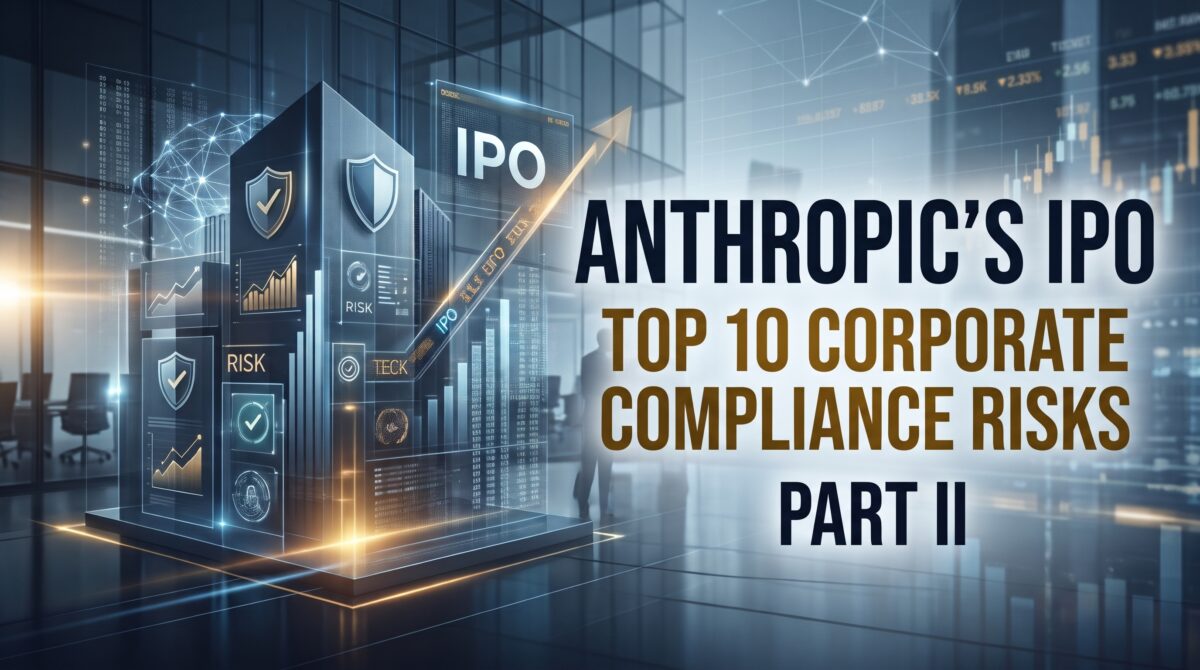
What does it take to build an effective compliance program around an AI business? In Part I of this series, Tom Fox examined the first five of 10 key risks for compliance professionals identified in Anthropic’s IPO disclosures: AI safety and autonomy, regulatory enforcement, data privacy and cybersecurity, intellectual property, and export controls. Each raises a practical question for CCOs and boards: can management demonstrate that its governance and controls are effective as the technology advances?
The remaining five risks extend that inquiry across the enterprise. Third-party dependencies, bribery and corruption, financial reporting, board oversight, and product representations are familiar responsibilities for compliance professionals. In an AI business, however, those responsibilities must account for powerful commercial partners, rapid international expansion, complex infrastructure dependencies, and claims about technology whose performance can be difficult to validate.
This is where compliance must be embedded in business decisions. Due diligence must inform partner selection. Disclosure controls must support investor communications. Product claims must rest on evidence. Board reporting must give directors enough independent information to challenge management and require corrective action.
6. Third-party risk, strategic partnerships, and supply-chain dependencies
The disclosed risk: Anthropic identifies substantial dependencies involving computing infrastructure, cloud providers, strategic partners, vendors, and commercial intermediaries.
The compliance exposure: Critical third parties may create cybersecurity, data protection, sanctions, operational resilience, concentration, and regulatory compliance risks. A control failure at a cloud provider or commercial partner can become an enterprise-level compliance incident.
The CCO response: Apply risk-based third-party due diligence, contractual control requirements, audit rights, continuous monitoring, concentration-risk assessments, and exit planning for critical suppliers.
The Board question: Which third-party relationships could materially impair the company’s ability to operate lawfully or meet its compliance obligations if they failed?
7. Anti-bribery, corruption, and financial crime
The disclosed risk: Anthropic expressly identifies obligations under the FCPA, UK Bribery Act, anti-money laundering laws, and comparable international requirements. It acknowledges risks arising from third-party intermediaries, government interactions, lobbying, and international expansion.
The compliance exposure: Global sales and government contracting can create opportunities for improper payments, questionable intermediary compensation, conflicts of interest, and corrupt procurement activity. The company acknowledges that it may face liability for third-party misconduct even when it has not expressly authorized the conduct.
The CCO response: Implement risk-based third-party due diligence, beneficial ownership checks, government-interaction controls, transaction monitoring, gifts-and-hospitality procedures, and continuous testing of intermediary payments.
The Board question: Does the anti-corruption program cover the full network of resellers, intermediaries, agents, and other parties involved in global commercialization?
8. Financial reporting, disclosure controls, and public-company readiness
The disclosed risk: Anthropic highlights the difficulty of accurately forecasting revenues, expenses, computing requirements, and business performance. It also acknowledges that certain operational metrics depend on internal methodologies, assumptions, and systems that have not been independently verified.
The compliance exposure: Rapid growth and complex financial arrangements can create significant risks involving revenue recognition, valuation, financial reporting, internal control effectiveness, and potentially misleading investor disclosures. The transition to a public company raises expectations for disclosure controls, audit committee oversight, and Sarbanes-Oxley compliance.
The CCO response: Strengthen disclosure committees, financial control testing, management certifications, data lineage, audit trails, and review of operational metrics included in investor communications.
The Board question: Can management substantiate every material financial and nonfinancial performance metric disclosed to investors?
9. Corporate governance, board oversight, and conflicts of interest
The disclosed risk: Anthropic’s registration statement addresses its distinctive governance structure, long-term public benefit objectives, capital structure, and relationships with investors and strategic partners.
The compliance exposure: Complex governance arrangements may create tensions among shareholder interests, management incentives, public benefit commitments, safety obligations, and commercial pressures.
The CCO response: Establish explicit board-level risk ownership, documented escalation requirements, independent compliance reporting, conflict-of-interest procedures, and regular assessments of governance effectiveness.
The Board question: Does the board receive sufficient independent information to challenge management’s decisions regarding AI safety, regulatory compliance, and commercialization? For directors, the central issue is whether governance mechanisms support meaningful oversight of mission-critical risks, consistent with the principles associated with Delaware’s Caremark oversight doctrine.
10. Consumer protection, product representations, and misleading AI claims
The disclosed risk: Anthropic identifies risks involving model reliability, accuracy, safety, marketing representations, customer expectations, and consumer protection enforcement. Its financial statement disclosures also identify litigation alleging deceptive advertising concerning subscription plans, allegations the company disputes.
The compliance exposure: AI companies may face liability when representations concerning safety, capabilities, reliability, privacy, or performance exceed what testing and operational evidence can support.
This risk is particularly significant when customers rely upon AI outputs for consequential decisions or deploy AI agents with authority to act.
The CCO response: Require legal and compliance review of material AI product claims, retain supporting testing evidence, establish performance validation standards, and monitor customer complaints for indications of misleading representations.
The Board question: Do the company’s public claims about AI safety and performance have documented, independently challengeable evidence to support them?
Part II completes Tom’s compliance-focused ranking of Anthropic’s disclosures with risks six through ten. Their position on the list should not diminish the attention they receive. A failure in any one of these areas can expose weaknesses across the broader control environment. For each, he considers the disclosed risk, the compliance exposure, the CCO response, and the question directors should ask.
Across these ten risks, a common thread emerges: effective AI governance depends on the quality of the company’s underlying compliance program. Third-party oversight, reliable disclosures, independent challenge, and substantiated product claims require accountable owners, tested controls, and timely corrective action. These responsibilities extend to any business incorporating AI into its operations.
Tomorrow in Part III, Tom will translate this risk analysis into five practical lessons for CCOs and business leaders. The focus moves from identifying exposure to managing it: integrating AI into enterprise compliance, adapting traditional controls, overseeing technology dependencies, embedding compliance in product development, and giving boards evidence of effectiveness. For compliance professionals, the next step is to turn these lessons into decisions about how to approve, deploy, monitor, and control AI.