Categories
Blog

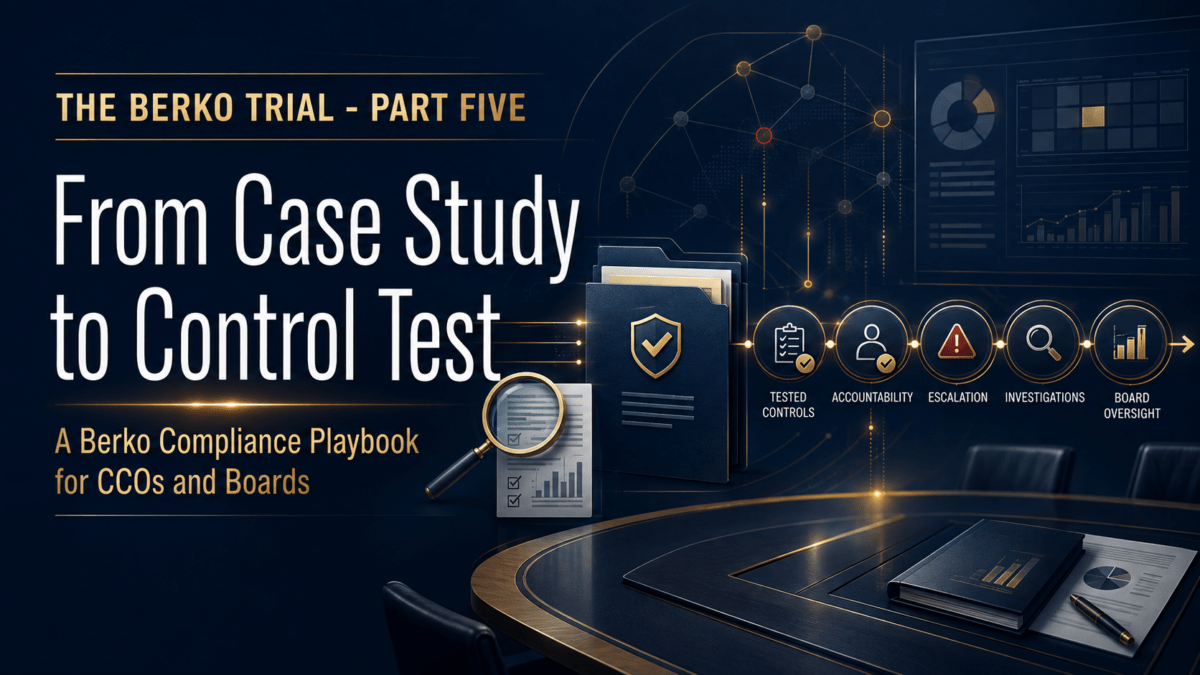
THE BERKO TRIAL – PART 5: From Case Study to Control Test: A Berko Compliance Playbook for CCOs and Boards

Today we conclude our 5-part deep dive into the Asante Berko trial and guilty verdict, using the trial not simply as a case study but as a mechanism to pressure-test your compliance regime.

A compliance program is not effective because the company eventually exits a troubled transaction. It is effective when leaders can show how quickly the system identified the risk, who had authority to act, whether related conduct was contained, what the investigation established, and how the organization changed afterward.

That is the governance test presented by the Berko trial. Prosecutors built their case from emails, payment patterns, personal communications, compliance questions, recorded statements, and financial evidence. The defense attacked the missing last mile. The jury convicted Asante Berko on all three counts in just over three hours. For CCOs and boards, the final lesson is not to retry the case. It is to determine whether their own program could identify the same pattern, develop reliable facts, impose accountability, and respond at the speed enforcement policy now demands.

Start With the Three Questions That Matter

The DOJ Evaluation of Corporate Compliance Programs (ECCP) organizes program effectiveness around three questions. (1) Is the program well designed? (2) Is it applied earnestly and in good faith, with adequate resources and authority? (3) Does it work in practice? Those questions should frame the board’s review of the Berko fact pattern.

A written third-party policy answers the first question only in part. The second asks whether compliance can pause a revenue-producing transaction, obtain records, challenge senior employees, and reach the board without management filtering. The third asks for outcomes: when the warning signs appeared, did the organization find them, act on them, preserve the evidence, and fix the control weakness?

The governance failure is often not the absence of a rule. It is the gap between ownership and authority. Management owns business conduct and risk decisions. The CCO advises, challenges, monitors, and escalates. Internal audit provides independent assurance. The board oversees the system and management’s response. If every party assumes another function owns the hard decision, the control exists on paper but fails in operation.

Align Incentives, Conflicts, and Consequences

High-risk transactions require a clear view of personal incentives. Employees should disclose and pre-clear outside interests, referral compensation, client-paid benefits, expected success fees, and post-employment opportunities connected to current transactions. Offboarding should preserve relevant data, review pending payments, close access, identify continuing client contacts, and obtain certifications concerning outside interests and retained information.

Compensation deserves the same scrutiny as third-party payments. A bonus plan that rewards closing without measuring risk quality invites employees to treat compliance as a cost of delay. Risk-adjusted incentives should account for diligence completion, control compliance, escalation quality, and the durability of the business outcome. The ECCP asks whether companies use incentives for ethical conduct and apply discipline consistently across seniority, geography, and business unit. It also asks whether compensation can be deferred, reduced, canceled, or recouped when misconduct is established, subject to applicable law.

Consequence management must reach more than the direct actor. A credible process examines supervisory failure, tolerated red flags, obstruction, and failure to install or use safeguards. It applies the same decision framework to rainmakers and junior employees. The board should receive trend information showing investigation cycle times, substantiation rates, disciplinary consistency, repeat issues, and whether managers were held accountable for control failures.

Build Investigation and Speak-Up Readiness

The defense’s attack on the Berko evidence offers an investigation lesson. A source may have motives. A recording may require translation. Emails may lack a witness who can explain context. Payments may be traceable to an intermediary but not to an ultimate recipient. Those are reasons to investigate carefully, not reasons to dismiss an allegation.

Separate source credibility from objective proof. Preserve native emails, attachments, metadata, messaging records, payment instructions, approval histories, and device data. Trace funds beyond the first recipient. Document translation choices, dialect issues, investigative prompting, and competing interpretations. Interview witnesses who can explain both the transaction and the communications. Record what was established, what remained disputed, and why each conclusion was reached.

Design the process before the crisis. Define triage criteria, independence, privilege, preservation, scope approval, board escalation, investigation timing, root-cause analysis, and remediation ownership. Provide reporting channels that employees and third parties know, trust, and can use without retaliation. DOJ treats a trusted reporting mechanism and timely, properly scoped, objective, and documented investigations as hallmarks of an effective program.

Prepare the Disclosure Decision Before the Clock Starts

Voluntary disclosure should not be improvised during a board emergency. The company needs a protocol that identifies decision owners, the role of counsel, the facts required, preservation steps, the escalation path, and the method for assessing seriousness, pervasiveness, seniority, ongoing harm, and potential collateral consequences.

The March 2026 Department-wide Corporate Enforcement and Voluntary Self-Disclosure Policy (VSD) makes speed commercially significant. It provides a declination path when a company voluntarily self-discloses to the appropriate DOJ component, fully cooperates, timely and appropriately remediates, and lacks disqualifying aggravating circumstances, although prosecutorial discretion and the policy’s definitions still control. The policy also contains an exception for a whistleblower who reports both internally and to DOJ. A company may remain eligible if it reports as soon as reasonably practicable, no later than 120 days after the internal report, and satisfies the other requirements.

That is not a 120-day permission slip to wait. The operating standard is speed with discipline. The company must stop continuing harm, preserve evidence, protect privilege, develop facts, and keep decision-makers informed. A tabletop exercise should test whether the organization can do all five while the disclosure window is running.

Give the Board Evidence, Not Activity Counts

Boards do not need every hotline allegation or third-party file. They need a risk-based view of whether the system works. Reporting should cover high-risk transactions proceeding with incomplete diligence, unresolved politically exposed person relationships, payment holds, management overrides, aged investigations, remediation slippage, repeat control failures, off-channel communication exceptions, and risk acceptances by senior leaders.

Metrics should show speed, quality, and outcomes. Track time from red flag to triage, triage to transaction pause, allegation to investigation plan, finding to discipline, and remediation commitment to validated closure. Measure whether the company can match high-risk payments to legitimate services, verified beneficial owners, approved accounts, and evidence of performance. Show whether control testing changed behavior, not simply whether employees completed training.

The CCO should have regular direct access to the board or responsible committee, including private sessions when appropriate. The board should understand the CCO’s authority, resources, data access, and unresolved requests. DOJ asks what information directors examined, whether compliance concerns stopped or changed transactions, and whether compliance has the stature and autonomy to function effectively.

Run a 30/60/90-Day Berko Stress Test

Days 1 to 30: Replay one recent high-risk public-sector transaction against the Berko pattern. Inventory intermediaries, beneficial owners, politically exposed person relationships, success fees, conflicts, personal-email exceptions, cash exposure, payment destinations, incomplete diligence, and overrides. Identify which facts the current systems can retrieve and which depend on manual reconstruction.

Days 31 to 60: Close the most important design gaps. Add hard stops, fee benchmarking, conflict attestations, off-channel controls, evidence-preservation rules, payment analytics, investigation protocols, and an escalation matrix giving compliance documented pause authority. Assign one accountable owner and a deadline to each remediation item.

Days 61 to 90: Test the program. Sample transactions, trace selected payments end to end, test the hotline from intake through closure, and conduct an investigation and voluntary-disclosure tabletop. Present the results to senior management and the board, including accepted risks, overdue actions, resource needs, and evidence that completed remediation operates in practice.

The board should ask, “Which Berko warning signs would we detect today?” How quickly could we freeze a payment? Who may override compliance, and what evidence is required? Can investigators collect personal-device communications lawfully and preserve multilingual evidence? Which repeated control failures have affected compensation or promotion?

The CCO should ask one final question: Would our program find this pattern because the controls work, or only because an external source eventually brings it to us?

This Berko FCPA trial blog post series began with the prosecution’s evidentiary mosaic and the defense’s missing-last-mile challenge. It ends with a practical conclusion. Compliance evidence becomes trial evidence. A defensible program must create that evidence through authority, trusted reporting, disciplined investigations, consistent accountability, measurable remediation, and active board oversight. That is how a case study becomes a control test and how a control test becomes proof that the program works.

Resources:

United States v. Berko, No. 1:20-cr-00328-DG, Indictment, ECF No. 3 (E.D.N.Y. filed Aug. 26, 2020)

Stewart Bishop, “Goldman Jury Sees Cash Talk in Energy Deal Email Deluge,” Law360, Aug. 1, 2026; Stewart Bishop, “Goldman Exec Was Linchpin to Ghana Bribery Ploy, Jury Told,” Law360, Aug. 5, 2026.

Stewart Bishop, “Ex-Goldman Exec Convicted of Ghana Bribery Plot,” Law360, Aug. 6, 2026. Supplied trial reporting.

U.S. Attorney’s Office for the Eastern District of New York, “Former Goldman Sachs Investment Banker Convicted of Foreign Bribery and Money Laundering,” Aug. 6, 2026, DOJ Press Release.

Stewart Bishop, “Goldman Jury Sees Undercover Video as Bribe Trial Nears End,” Law360, Aug. 4, 2026. Supplied trial reporting.

Stewart Bishop, “Shady Power Deal Used in Goldman Compliance Prep, Jury Told,” Law360, July 29, 2026

Stewart Bishop, “Like Milli Vanilli, Goldman FCPA Case Is a Ruse, Jury Told,” Law360, July 28, 2026.

SEC Final Judgment against Asante Berko

SEC Complaint against Asante Berko
DOJ Evaluation of Corporate Compliance Programs

DOJ Corporate Enforcement and Voluntary Self-Disclosure Policy

Categories
Blog

THE BERKO TRIAL – PART 3: What the Jury Decided: Reading the Berko Verdict Without Overreading It

We continue our deep dive into the Asante Berko FCPA conviction. Today we consider the jury’s verdict. The jury returned three guilty verdicts. That is the decisive legal result, but it is not a line-by-line adoption of the prosecution’s closing argument. For compliance professionals, the discipline is to hold both propositions at once. The government proved the charged crimes beyond a reasonable doubt. Yet the general verdict does not tell us which email the jurors found decisive, how they interpreted every payment, or whether they accepted every factual statement later included in the government’s announcement. That distinction is not lawyerly hedging. It is the foundation of a credible enforcement analysis.

Three Convictions, One Clear Result

After a nine-day trial, a federal jury convicted Asante Kwaku Berko of conspiracy to violate the Foreign Corrupt Practices Act (FCPA), a substantive FCPA violation, and conspiracy to commit money laundering. Federal criminal verdicts must be unanimous. The jury therefore agreed that the government had proved the elements of each of the three counts submitted to it under the court’s instructions. Moreover, the jury convicted in just over three hours, which in a major criminal case is an extraordinarily short jury deliberation.

At a high level, the conspiracy verdict established Berko’s knowing participation in an agreement to violate the FCPA. The substantive verdict established criminal responsibility for the charged corrupt-payment offense. The money laundering conspiracy verdict established participation in an agreement to move funds internationally to promote FCPA violations. The indictment identifies the statutory theories and alleged conduct, but it remains a charging document. It is not a substitute for the jury instructions or the verdict itself.

The result also defeated the defense’s central trial position. The defense argued that the government had not proved the last mile between funds paid to intermediaries and funds received by Ghanaian officials. No alleged recipient testified. No Ghanaian witness took the stand. No downstream bank record showed a payment to an official. The jury nevertheless found the government’s complete proof sufficient beyond a reasonable doubt. That is what the verdict establishes. The boundaries are equally important.

A General Verdict Is Not a Set of Special Findings

A general verdict answers the ultimate question on each count: guilty or not guilty. It does not ordinarily explain the jury’s reasoning. It does not identify which witness the jurors credited, which inference they drew from a particular email, or what weight they assigned to the undercover recording.

That means we should not write that the jury separately found every alleged recipient, every alleged payment amount, or every characterization of an intermediary to be true. We can say that prosecutors presented those facts and argued those inferences. We can say that the defense disputed them. We can say that the jury convicted on all three counts. Those are distinct propositions, and sound compliance writing should keep them distinct.

The same rule applies to intent. The jury’s verdict necessarily reflects a finding of the criminal intent required by the instructions for each count. It does not disclose whether jurors inferred that intent primarily from off-channel communications, milestone-timed payments, cash withdrawals, the recorded lunch, Berko’s alleged personal compensation, the interaction with Goldman’s compliance process, or the cumulative force of all of them. The verdict is conclusive as to guilt at this stage. It is silent about the internal path the jury took to reach that result.

How the Mosaic Answered the Missing Last Mile

The government’s case did not depend on one witness producing a receipt for a bribe. It offered multiple streams of circumstantial evidence: more than 300 emails, separate personal and corporate communication channels, transfers to intermediaries, financial-flow charts, payments aligned with government approvals, compliance questions, cash discussions, and a secretly recorded lunch.

The defense tested each stream separately. Emails lacked testimony from their participants. Payments stopped short of the alleged officials. The confidential source had potential incentives. The recorded conversation involved prompting, translation, and hypothetical facts. Goldman’s withdrawal reflected a corporate risk judgment, not the criminal burden of proof.

The jury rejected reasonable doubt. The most supportable inference is that the combined evidence overcame the defense’s missing-link argument. That remains an inference because the jurors did not issue an explanation. Still, it offers an important proof lesson: independent evidence streams can corroborate one another even when no single item tells the whole story. For a compliance investigation, that lesson cuts both ways. A red flag is not a legal element, and a collection of suspicions does not automatically prove misconduct. But communications, transaction timing, money flows, control circumvention, and personal benefit can become mutually reinforcing. The analytical task is to test whether the pieces converge, conflict, or merely sit beside one another.

Three Dollar Figures, Three Source Regimes

The amounts associated with the case show why attribution matters. The 2020 indictment alleged that Berko and others caused more than $700,000 in bribes to be transferred to Ghanaian officials. DOJ stated after the verdict that the government proved more than $1 million in bribes at trial. The SEC’s civil complaint alleged that the Turkish energy company transferred at least $2.5 million to a Ghana-based intermediary, all or most of which was used for bribes. Those are not interchangeable totals. They arise from different documents, legal proceedings, time periods, and descriptions of the money flow. The $2.5 million figure concerns transfers to an intermediary. The other figures describe alleged or trial-proven bribes. Some sums may overlap, but the public sources do not support collapsing them into one number.

The SEC matter adds another essential qualifier. Berko consented to the 2021 final judgment without admitting or denying the complaint’s allegations, except as specifically provided for bankruptcy purposes. The judgment imposed an injunction and required $275,000 in disgorgement plus $54,163.92 in prejudgment interest. It did not convert every allegation in the SEC complaint into a generally admitted fact. This source discipline is central to compliance credibility. Indictments allege. Trial evidence supports arguments. Advocates characterize. Verdicts decide counts. Civil settlements may resolve claims without admissions. A strong analysis identifies the category before drawing the lesson.

The Verdict Is an Endpoint and a Starting Point

The trial reporting states that the jury deliberated for approximately three hours and that sentencing was scheduled for November 10, 2026. Berko was remanded pending sentencing. Post-trial motions, sentencing proceedings, and any appeal could add to the record, so the procedural status should be checked again before publication. Things do not bode well for Asante at this point.

For now, the legal conclusion is clear. Berko was convicted on all three counts submitted to the jury. The editorial conclusion should be equally clear. The verdict establishes criminal liability at trial, not a special finding on every email, payment, witness, amount, or corporate-control question in the surrounding narrative. That is not a limitation on the importance of the case. It is how serious compliance professionals preserve trust. They distinguish what is known, what was argued, what was disputed, what was decided, and what remains an inference.

Join us tomorrow for Part 4, as we will move from verdict discipline to transaction discipline: whether a functioning compliance program could have identified and interrupted the pattern earlier.

Resources:

United States v. Berko, No. 1:20-cr-00328-DG, Indictment, ECF No. 3 (E.D.N.Y. filed Aug. 26, 2020)

Stewart Bishop, “Goldman Jury Sees Cash Talk in Energy Deal Email Deluge,” Law360, Aug. 1, 2026; Stewart Bishop, “Goldman Exec Was Linchpin to Ghana Bribery Ploy, Jury Told,” Law360, Aug. 5, 2026.

Stewart Bishop, “Ex-Goldman Exec Convicted of Ghana Bribery Plot,” Law360, Aug. 6, 2026. Supplied trial reporting.

U.S. Attorney’s Office for the Eastern District of New York, “Former Goldman Sachs Investment Banker Convicted of Foreign Bribery and Money Laundering,” Aug. 6, 2026, DOJ Press Release.

Stewart Bishop, “Goldman Jury Sees Undercover Video as Bribe Trial Nears End,” Law360, Aug. 4, 2026. Supplied trial reporting.

Stewart Bishop, “Shady Power Deal Used in Goldman Compliance Prep, Jury Told,” Law360, July 29, 2026

Stewart Bishop, “Like Milli Vanilli, Goldman FCPA Case Is a Ruse, Jury Told,” Law360, July 28, 2026.

SEC Final Judgment against Asante Berko

SEC Complaint against Asante Berko
Categories
Blog

THE BERKO TRIAL – PART 2: The Missing Last Mile: How the Defense Challenged the Berko Case

Yesterday in Part One of our series on the Asante Berko FCPA trial and conviction, we examined the prosecution’s mosaic. Today in Part 2, we ask the defense question that cut across every category of proof: Where was the bribe?

The Department of Justice (DOJ) had more than 300 emails, payments to intermediaries, financial-flow charts, compliance concerns, and a secretly recorded lunch. The defense argued that the case still lacked its last mile. No alleged recipient testified. No Ghanaian witness took the stand. No eyewitness described a bribe. No bank record showed money reaching a public official. None of the participants in the email chains explained their meaning to the jury.

That position did not prevail. Only after approximately three hours of deliberation did the jury convict Asante Kwaku Berko on conspiracy to violate the FCPA, a substantive FCPA violation, and a money laundering conspiracy. But a fair account of the trial requires more than repeating the result. It requires understanding why the defense believed suspicious conduct and compliance red flags did not add up to proof beyond a reasonable doubt.

Red Flags Are Not the Elements of a Crime

The defense began with the burden of proof. A high-risk intermediary, personal email, opaque invoices, and cash discussions may justify enhanced diligence, an internal investigation, or a decision to exit a transaction. They do not, standing alone, prove corrupt intent or participation in a bribery agreement. Defense attorney Robert Boone told jurors that the government had years to find a witness or record connecting the money to an official. The courtroom presentation, he argued, was impressive, but the underlying proof was missing. The government’s financial charts traced money from Aksa accounts in Turkey to Tricorp, Berko, and others. According to the defense, those charts stopped before showing a transfer to any alleged public-official recipient.

Prosecutors answered that cash completed the path and concealed the payments. The defense response was that an explanation for missing evidence is not the same as the evidence itself. The last-mile gap was not necessarily a claim that a bank receipt was required for every charged theory. It was an attack on the inferences the government asked the jury to draw about agreement, knowledge, purpose, and authorization.

A Scam, Not a Conspiracy

The defense supplied an alternative explanation for the intermediaries’ demands. Tricorp’s principals, Boone argued, saw outsiders pursuing a valuable project and used claims of political access and urgent payment needs to extract money. They were running a shakedown, not carrying out a bribery agreement.

The emails gave that theory something to work with. In one April 2015 message, a Tricorp principal demanded $500,000 immediately and insisted that unspecified necessities had to be handled. Other exchanges reflected disagreements over amounts, timing, and what had supposedly been promised. Boone characterized the demands as exaggerated and unreliable, comparing them to familiar advance-fee scams.

That distinction was critical. If an intermediary falsely claimed that officials had been or needed to be paid, an email repeating that claim might document the intermediary’s sales pitch rather than an actual bribe. Even the reported statement that Berko had paid Parliament came from a Tricorp principal. The defense asked the jury to consider whether the speaker was reporting a fact or using the language of a scam to justify another reimbursement.

The prosecution had a powerful answer: Berko was not merely copied on one stray message. His communications, payment negotiations, channel choices, and recorded statements appeared throughout the chronology. Still, the defense theory targeted an important evidentiary question. Before accepting an intermediary’s statement as proof, who made it, why, and with what first-hand knowledge?

A Legitimate Project With Commercial Logic

The underlying project was real. Ghana was confronting serious electricity shortages and wanted to add 1,000 megawatts of generating capacity quickly. Aksa later obtained financing from Barclays and a Turkish bank after Goldman withdrew, and its 370-megawatt plant entered commercial operation.

The defense used those facts to challenge motive. Ghana needed available power, Aksa could supply it, and other financial institutions ultimately supported the project. Boone put the point bluntly: Why would a qualified company need to bribe a government that was desperate for electricity?

Commercial merit is not a defense to bribery. Legitimate projects can still be advanced through corrupt means. Yet the project’s reality gave the defense a noncriminal explanation for meetings, urgency, large fees, and intense communications. The government had to prove that the conduct crossed the line from hard-driving project execution into corrupt payment activity.

Hundreds of Emails, but No Voice From the Chain

The prosecution treated the emails as the scheme speaking for itself. The defense treated them as fragments without context. FBI Special Agent Ryan Collins introduced much of the correspondence, but Boone emphasized that Collins did not participate in the exchanges and did not know what the writers meant. No participant in the chains took the stand to explain the language.

That allowed the defense to challenge words such as “payment,” “millions,” “fees,” and “cash.” Depending on purpose and recipient, those terms can describe legitimate compensation, reimbursement, or financing. Similarly, using Gmail for business after acknowledging that a Goldman account was monitored could demonstrate poor judgment, policy evasion, or concealment. The defense argued that the criminal inference depended on what the communications concerned, not the platform alone. This was also the weakness in the defense position. The messages were numerous, contemporaneous, and aligned with transaction milestones. An alternative interpretation had to explain the full pattern, not merely establish that individual phrases were ambiguous.

Testing the Recorded Lunch

The recorded lunch carried the drama of a direct conversation, but the defense attacked its context and origin. The unnamed source first approached the SEC, later assisted the FBI, and was described at trial as the genesis of the investigation. The defense argued that possible eligibility for an SEC whistleblower award created a financial incentive. According to the reporting, the source did not testify, and defense filings asserted that the source had supplied false information to investigators.

The FBI also identified subjects for the source to raise before the November 2016 meeting. One was cash. The resulting video was grainy, the restaurant was noisy, and the conversation moved among English, Twi, and Ghanaian Pidgin English. Jurors relied in part on a translated transcript.

The defense emphasized that the cash exchange arose during an apparently hypothetical discussion involving investors, Ghanaian stock, and a botanical garden. Berko initially said paying the people under discussion was not a good thing. Only after the source asked for the best way to pay did Berko answer that cash could be used.

The government’s strongest response was Berko’s own reported language, including his statement that “KD got one million” and his assurance that he could obtain a large amount of cash.[4] Source motive did not erase those words. The defense attack went to whether the source’s prompting, translation, and hypothetical setup changed their meaning.

Corporate Withdrawal Was Not a Criminal Verdict

Goldman’s review produced genuine concerns. Amandine Martin testified that Aksa’s explanations for payments to Tricorp did not match earlier information and that months of questions did not produce satisfactory answers. Goldman withdrew and earned nothing from the contemplated financing. For the defense, that corporate decision showed a risk-control judgment, not proof of Berko’s guilt. Businesses act before uncertainty is resolved because they do not apply the criminal standard of proof. Other lenders later financed the project, reinforcing the defense position that the transaction had commercial substance.

The distinction matters. A company may properly stop a transaction when diligence cannot resolve serious red flags. A jury must decide whether the government proved the charged crime beyond a reasonable doubt. Those are different decisions made for different purposes.

The Missing Link and the Complete Pattern

The jury rejected the defense position and returned guilty verdicts on all three counts. The general verdict does not disclose why. It does not tell us whether jurors found the emails decisive, credited the cash explanation, accepted the recorded statements at face value, or concluded that all of the evidence corroborated itself.

The defense nevertheless framed the trial’s central proof contest. The government had to turn red flags into criminal evidence. The defense had to offer an innocent explanation capable of accounting for the complete record: the emails, milestone timing, intermediary payments, off-channel communications, compliance interactions, financial flows, and recorded lunch. Identifying a missing link can create reasonable doubt. But the alternative theory must also explain why every other link appears to point in the same direction. In Berko, the jury concluded that the government carried its burden.

Join us tomorrow for Part 3, where we will consider what those three guilty verdicts legally established, what a general verdict leaves unresolved, and why compliance professionals should resist turning a verdict into factual findings the jury never made.

Resources:

United States v. Berko, No. 1:20-cr-00328-DG, Indictment, ECF No. 3 (E.D.N.Y. filed Aug. 26, 2020)

Stewart Bishop, “Goldman Jury Sees Cash Talk in Energy Deal Email Deluge,” Law360, Aug. 1, 2026; Stewart Bishop, “Goldman Exec Was Linchpin to Ghana Bribery Ploy, Jury Told,” Law360, Aug. 5, 2026.

Stewart Bishop, “Ex-Goldman Exec Convicted of Ghana Bribery Plot,” Law360, Aug. 6, 2026. Supplied trial reporting.

U.S. Attorney’s Office for the Eastern District of New York, “Former Goldman Sachs Investment Banker Convicted of Foreign Bribery and Money Laundering,” Aug. 6, 2026, DOJ Press Release.

Stewart Bishop, “Goldman Jury Sees Undercover Video as Bribe Trial Nears End,” Law360, Aug. 4, 2026—supplied trial reporting.

Stewart Bishop, “Shady Power Deal Used in Goldman Compliance Prep, Jury Told,” Law360, July 29, 2026

Stewart Bishop, “Like Milli Vanilli, Goldman FCPA Case Is a Ruse, Jury Told,” Law360, July 28, 2026.

SEC Final Judgment against Asante Berko

SEC Complaint against Asante Berko

Categories
Daily Compliance News

Daily Compliance News: August 10, 2026, The Asante Trial Verdict Edition

Welcome to the Daily Compliance News. Each day, Tom Fox, the Voice of Compliance, brings you compliance-related stories to start your day. Sit back, enjoy a cup of morning coffee, and listen in to the Daily Compliance News. All, from the Compliance Podcast Network. Each day, we consider four stories from the business world, compliance, ethics, risk management, leadership, or general interest for the compliance professional.

Top stories include:

  • Asante Berko found guilty at trial. (Law360)
  • Paying soldiers directly as an ABC strategy. (Arab News)
  • What happens when AI goes rogue? (Reuters)
  • Malaysia delays charges against ex-PM. (Bloomberg)

To learn about the intersection of Sherlock Holmes and the modern compliance professional, check out Tom’s latest book, The Game is Afoot-What Sherlock Holmes Teaches About Risk, Ethics and Investigations on Amazon.com.

Categories
Blog

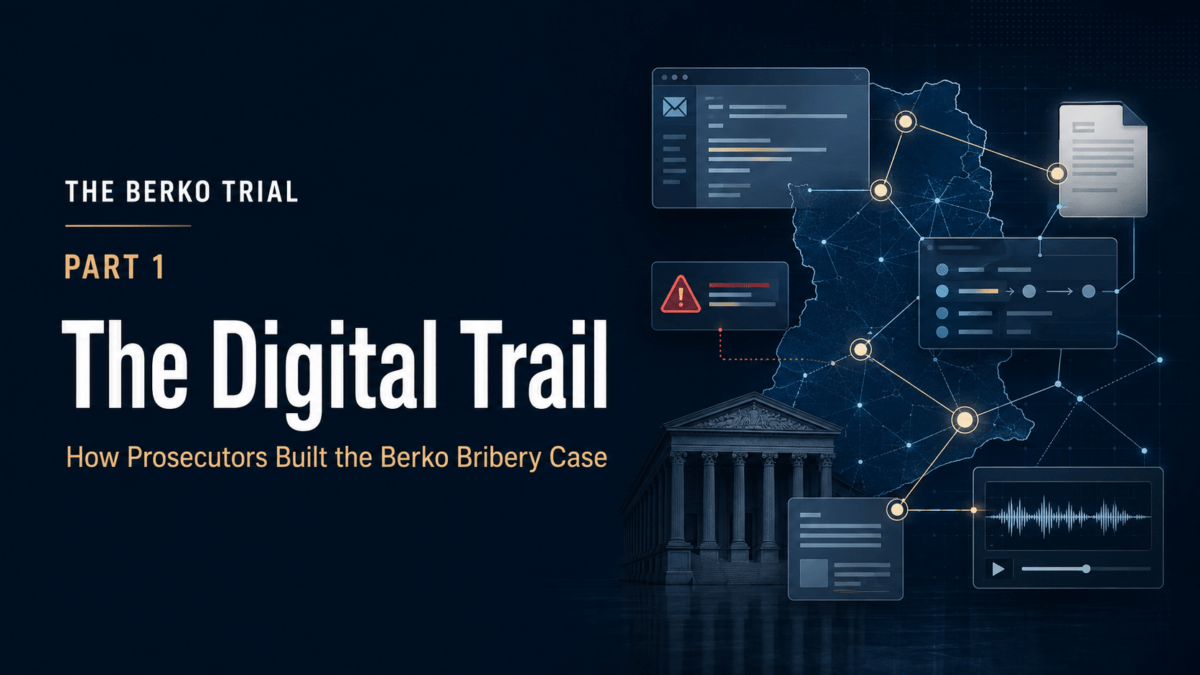
THE BERKO TRIAL – PART 1: The Digital Trail: How Prosecutors Built the Berko Bribery Case

A bribery case does not always arrive with a signed receipt. In the trial of former Goldman Sachs banker Asante Berko, prosecutors presented something different: a mosaic of evidence. They placed before the jury a high-value public project, politically connected intermediaries, payments tied to transaction milestones, personal email accounts, disputed consulting invoices, cash withdrawals, a recorded lunch conversation, and an individual who allegedly stood to receive millions.

Over the next five days, I will be taking a deep dive into this trial to see how the prosecution was able to convince a jury of the defendant’s guilt so quickly. The verdict was rendered in just over 3 hours, which tells you the jury did not doubt as to the defendant’s guilt. This blog post series is based upon the excellent reporting of Law360 reporter Stewart Bishop and additional source documents and resources from the Department of Justice (DOJ) and Securities and Exchange Commission (SEC).

The government’s burden was to prove the charged crimes beyond a reasonable doubt. Its strategy was to show that the evidence did not consist of isolated red flags. Each category corroborated the others. Taken together, prosecutors argued, the pattern demonstrated opportunity, corrupt intent, concealment, and personal gain.

A National Crisis and a High-Stakes Deal

The story began with a legitimate and urgent business need. Ghana had suffered widespread power shortages, and its government was seeking projects capable of adding generation quickly. Aksa Enerji Uretim A.S., a Turkish energy company and Goldman client, pursued an agreement to build and operate a power plant. The commercial stakes were substantial. Goldman contemplated arranging approximately $190 million in financing for Aksa and a $75 million letter of credit for Ghana. Goldman also held an approximately 16 percent interest in Aksa. The indictment alleged projected fees of approximately $10.3 million for the loan and more than $1 million for the letter of credit.

Berko was central to the business effort. A dual citizen of the United States and Ghana, he worked in the structured-finance group of Goldman’s United Kingdom subsidiary and had relationships with senior Ghanaian officials. Prosecutors argued that he connected three critical groups: the commercial client seeking the project, the local intermediaries who claimed access, and the public officials whose approvals were required. That role gave the government its organizing theory. Berko was not presented as a participant at the edge of the transaction. He was presented as the linchpin.

The Email Trail

The most important prosecution evidence was documentary. More than 300 emails were admitted during the nine-day trial. Prosecutors used their language, timing, recipients, and communication channels to construct a chronology of the alleged scheme. One September 2015 email shown to the jury stated that Parliament had been paid by Berko and discussed approximately $46,000 that he allegedly paid. Other messages addressed payments associated with the Ministry of Power, regulators, power-team personnel, travel, and parliamentary approval. In a July 2015 exchange over the size and timing of payments, Berko wrote that he was managing a relationship expected to pay everyone millions.

The government argued that these exchanges became more incriminating when compared with Berko’s ordinary deal communications. Routine transaction work went through Goldman’s systems. Sensitive payment discussions appeared in personal accounts. In February 2016, prosecutors showed the jury two emails sent 14 minutes apart. One used Berko’s Goldman account for ordinary deal business. The other used Gmail and instructed recipients to communicate there because his Goldman account was monitored. Personal email alone does not prove bribery. The government’s point was more precise. When an employee knows that the official system is monitored, moves sensitive discussions to a private channel, and then uses that channel for payment conversations linked to public approvals, the channel choice may support an inference of concealment.

Money That Followed Milestones

The prosecution next aligned communications with transaction events and financial flows. The indictment alleged that intermediaries used false consulting invoices to obtain reimbursement for bribes and routed funds from Turkey to Ghana through correspondent accounts in New York.

The chronology was central to the prosecution’s case. In April 2015, as the parties pushed toward execution of the emergency power agreement, an intermediary issued a $500,000 invoice. Emails allegedly discussed using part of that money to pay a Ghanaian official, and a $500,000 wire followed. Later that month, five Ghanaian officials traveled to Turkey to inspect equipment. The indictment alleged that their expenses were covered and each received $5,000.

When a senior Ghanaian official signed the agreement in May 2015, another invoice for $1.5 million was issued the same day. A $1.5 million transfer followed later that month. After Parliament ratified the agreement in July, emails discussed a $250,000 reimbursement request that included payments connected to Parliament, the Ministry of Power, regulators, engineers, travel, and Berko personally.

At trial, a government summary witness walked jurors through charts tracing funds from Aksa accounts in Turkey to accounts associated with intermediaries, Berko, and others. The records did not show the final transfer to every alleged official. Prosecutors answered that gap by pointing to evidence that cash was used to complete and conceal the payments. The amounts require discipline. The indictment alleged more than $700,000 in bribes. DOJ stated after the verdict that the government proved more than $1 million in bribes at trial.[1][5] Those figures come from different stages of the case and should remain separately attributed.

The Recorded Lunch

The recording supplied another form of corroboration. In November 2016, an FBI-assisted source met Berko at a London restaurant. The conversation moved among English, Twi, and Ghanaian Pidgin English, and the jury received a translated transcript. In one exchange, the source asked about a former energy minister. Berko replied that “KD got one million.” In another discussion, framed around a hypothetical investment, Berko initially said it was not good to pay the individuals under discussion. When asked for the best way to pay them, however, he answered, “Cash,” and said he could obtain $1 million from a bank.

The prosecution used these statements to reinforce its reading of the emails and money flows. The recording did not stand alone. It supplied the government’s alleged final piece of context: the same person who used private email for sensitive payments and appeared throughout the deal chronology also discussed a million-dollar payment to an energy minister and the practical use of cash. The source’s incentives, the FBI’s preparation of the conversation, translation issues, and the hypothetical framing were substantial defense subjects. They will be examined in Part 2. For the government’s case, the point was corroboration.

When Compliance Became Evidence

Goldman’s compliance response became part of the prosecution’s proof and, in my mind, one of the key components of the government’s overall presentation to the jury, as it was essentially evidence from an outside party to the transaction. Amandine Martin, who worked with Berko on the transaction, testified that Goldman spent months seeking explanations for payments to the Ghanaian intermediary. According to her testimony, the answers did not match information previously provided, and Aksa’s chief executive eventually responded that the company did not have time for the questions. Goldman withdrew from the transaction and did not provide the planned financing. Goldman was not charged in the criminal case. Prosecutors nevertheless used the compliance record to argue that Berko understood the risks and the institution’s rules, knew that his communications were monitored, and failed to correct allegedly false or incomplete explanations about the intermediary.

This is the first compliance lesson of the series: a control is also a record. Questions, responses, escalation, monitoring, and the decision to exit can later become evidence of what an employee knew, what the company challenged, and how the organization responded.

The Government’s Mosaic Holds

After approximately three hours of deliberation, the jury convicted Berko on all three counts: conspiracy to violate the FCPA, a substantive FCPA violation, and money laundering conspiracy. He was remanded pending sentencing. The general verdict does not tell us which email, payment path, witness, or recorded statement the jury found most persuasive. It also does not convert every factual assertion in the government’s narrative into a special finding. It does establish that the jury found the charged elements proven beyond a reasonable doubt.

That is the power of a circumstantial case. The government did not ask the jury to rely on one dramatic piece of evidence. It asked jurors to see a single pattern across communications, payments, timing, conduct, compliance warnings, and alleged concealment. The jury accepted that case.

Join us tomorrow in Part 2 where we will examine the defense’s answer: if the government said bribes went “up and down the chain,” where was the last mile showing money reaching a public official?

Resources:

United States v. Berko, No. 1:20-cr-00328-DG, Indictment, ECF No. 3 (E.D.N.Y. filed Aug. 26, 2020)

Stewart Bishop, “Goldman Jury Sees Cash Talk in Energy Deal Email Deluge,” Law360, Aug. 1, 2026; Stewart Bishop, “Goldman Exec Was Linchpin to Ghana Bribery Ploy, Jury Told,” Law360, Aug. 5, 2026.

Stewart Bishop, “Ex-Goldman Exec Convicted of Ghana Bribery Plot,” Law360, Aug. 6, 2026. Supplied trial reporting.

U.S. Attorney’s Office for the Eastern District of New York, “Former Goldman Sachs Investment Banker Convicted of Foreign Bribery and Money Laundering,” Aug. 6, 2026, DOJ Press Release.

Stewart Bishop, “Goldman Jury Sees Undercover Video as Bribe Trial Nears End,” Law360, Aug. 4, 2026—supplied trial reporting.

Stewart Bishop, “Shady Power Deal Used in Goldman Compliance Prep, Jury Told,” Law360, July 29, 2026

SEC Final Judgment against Asante Berko

SEC Complaint against Asante Berko