Categories
Blog

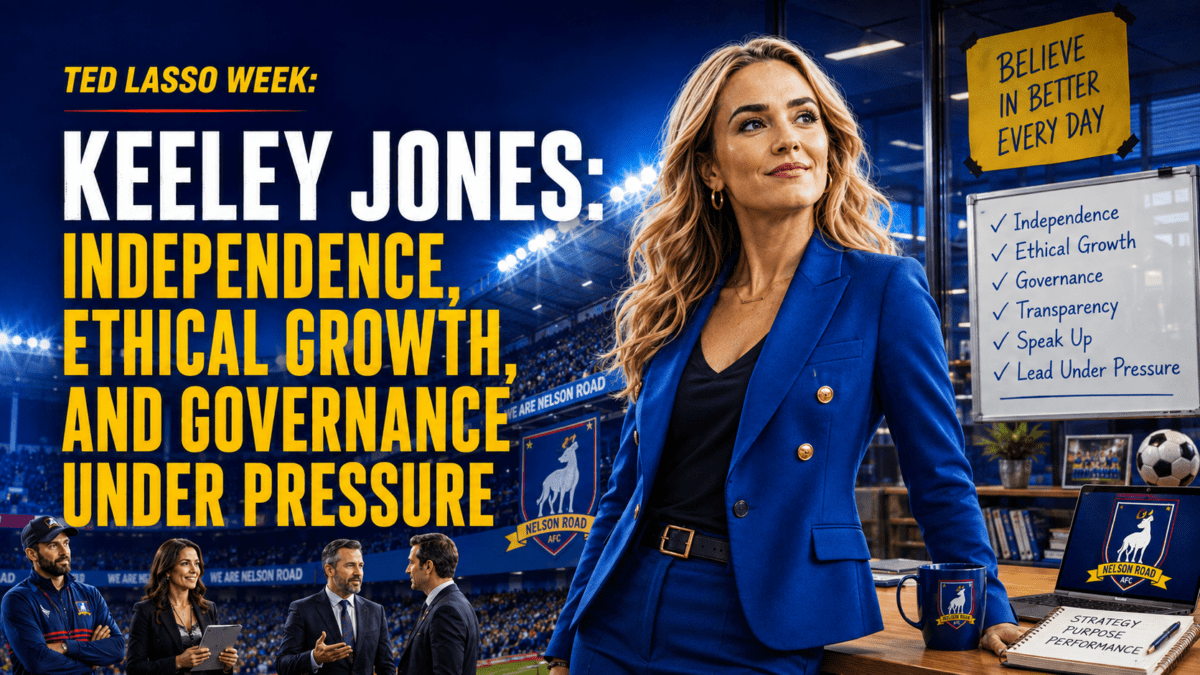
Ted Lasso Week: Part 5 – Keeley Jones: Independence, Ethical Growth, and Governance Under Pressure

Season 4 of Ted Lasso is out. Matt Kelly reposted a blog he wrote during the original run of the series, and he and I did a deeper dive into the show and its popularity for compliance professionals in an episode of Compliance into the Weeds. I decided to take a deep dive into five characters from the show and use them to explore compliance topics. Over five blog posts, I have considered Manager Ted Lasso, Assistant Manager Nate Shelley, player and later coach Roy Kent, and social media influencer Keeley Jones. Today we conclude with Part 5, where we look at Keeley Jones, who starts as a social media influencer for AFC Richmond but goes on to found her own business. We explore what happens when a talented professional becomes a founder and must build the organization around her.

Keeley has judgment, courage, creativity, and empathy. She can read a room and recognize misconduct before people with greater status are willing to name it. Yet this only reveals that ethical instinct is not the same as governance. As her authority grows, decisions involving friends, investors, employees, personal relationships, privacy, and funding require processes that do not depend solely on the founder making the right call. For compliance professionals, Keeley’s story is about governance keeping pace with growth.

Ethical Leadership Begins Before the Title

Keeley earns influence before she has formal authority. In “The Diamond Dogs” (Season 1, Episode 8), she discovers that Rebecca arranged the paparazzi scheme involving Keeley and Ted. She confronts Rebecca and insists that she tell Ted the truth. The friendship does not excuse the misconduct, and Rebecca’s ownership of Richmond does not silence Keeley.

Keeley acts as Richmond’s missing speak-up system. Her intervention leads to Rebecca’s confession in “All Apologies” (Season 1, Episode 9). The lesson is not that every employee should conduct an investigation alone. It is that organizations need people who will raise difficult issues and systems that protect them when they do. A best-practice compliance program must have reporting and guidance mechanisms employees can use without fear of retaliation. Keeley dares to speak. A mature organization should not make courage the control.

Entrepreneurship Creates Governance Debt

Keeley’s public-relations work for Richmond turns into an opportunity to build her own firm. In “Inverting the Pyramid of Success” (Season 2, Episode 12), investors offer to fund Keeley’s venture, KJPR. Rebecca encourages her to take the opportunity. The funding provides staff, offices, and credibility. It also creates governance debt. Keeley now answers to a board she did not build and depends on a capital provider she does not control. The founder’s personal brand becomes part of the firm’s risk profile.

KJPR should know who approves hiring, client commitments, spending, external statements, workplace relationships, access to sensitive information, and crisis decisions. Growth does not eliminate the need for speed. It prevents speed from becoming uncontrolled discretion.

Hiring a Friend Tests Founder Judgment

In “(I Don’t Want to Go to) Chelsea” (Season 3, Episode 2), Keeley hires her friend Shandy after seeing her demonstrate creative ability during a commercial shoot. Keeley recognizes overlooked talent because she was once overlooked herself. That instinct is admirable. The process is weak. The decision appears to lack a defined role, structured assessment, reference checks, clear reporting line, or behavioral expectations. Shandy later makes unauthorized decisions and publishes an offensive campaign that damages a client relationship. In “Signs” (Season 3, Episode 5), Keeley fires her.

Keeley ultimately protects the firm. She also learns that loyalty cannot substitute for selection controls. A founder who hires a friend should disclose the relationship, use an independent reviewer, document qualifications, define authority, and establish measurable performance expectations. The safeguards protect the company, the team, and the friendship.

DOJ’s Evaluation of Corporate Compliance Programs (ECCP) asks whether organizations use risk-based processes: “Does the company deploy its compliance resources in a risk-based manner, with greater scrutiny applied to greater areas of risk?”; train people for their responsibilities, “targeted training sessions to enable employees to timely identify and raise issues to appropriate compliance, internal audit, or other risk management functions”; and finally apply discipline consistently, “Does the compliance function monitor its investigations and resulting discipline to ensure consistency?” Those questions matter at twenty employees as well as twenty thousand. Informality can be proportionate. It cannot be indistinguishable from favoritism.

Investor Influence Becomes a Conflict

KJPR’s most significant governance failure arises when Keeley begins a romantic relationship with Jack Danvers, the venture capitalist whose firm funds KJPR. Their relationship begins in “Signs” and becomes public inside the office in “The Strings That Bind Us” (Season 3, Episode 7). The central issue is not the relationship itself. It is the power structure around it. Jack influences the capital supporting KJPR and has access to its leadership and board. Keeley’s personal relationship is therefore inseparable from financing, employment stability, reputation, and strategic control.

A functioning conflicts process would require disclosure to disinterested board members, recusal from relevant funding and compensation decisions, independent review, anti-retaliation protections, and a plan for managing the relationship’s end. The organization would also need to consider whether gifts and public displays create obligations or perceptions of influence. KJPR appears to have no independent mechanism for doing any of this. The conflict remains personal until its consequences become corporate.

A Privacy Crisis Reveals Whose Reputation Matters

In “We’ll Never Have Paris” (Season 3, Episode 8), an intimate video Keeley previously sent to Jamie is leaked online. Jack’s lawyers prepare a public statement in which Keeley would apologize for making the video. Keeley refuses. Her refusal is an ethical decision. The statement would shift responsibility from the people who stole and distributed private material to the person whose privacy was violated. It would protect investor reputation by requiring the victim to accept blame.

An effective incident response would center Keeley’s safety and agency while preserving evidence, identifying the source and scope of the breach, assessing legal duties, seeking removal of the material, coordinating communications, and reviewing data security practices. It would also determine what the company knows, who decides, and when the board receives information.

Capital Concentration Threatens Independence

The conflict reaches its predictable conclusion in “International Break” (Season 3, Episode 10). Jack’s board withdraws KJPR’s funding, the office is dismantled, and Keeley learns that the firm will close within two days. She is the founder, but she is the last person meaningfully informed. This is third-party and concentration risk. KJPR depends on one financial sponsor whose governance rights, exit powers, and personal connections could end the business. DOJ’s ECCP asks whether companies understand the business rationale and risks of third-party relationships, use appropriate contractual controls, and monitor those relationships over time.

For a founder, due diligence must run both ways. Before accepting capital, leaders should understand board control, reserved powers, termination rights, communication duties, reputation expectations, data ownership, dispute mechanisms, and contingency funding. A capitalization table is also a control map. Rebecca ultimately offers financing, and Barbara leaves Jack’s organization to rebuild alongside Keeley. The outcome is hopeful, but the governance lesson remains. Replacement capital should not recreate the same dependency under a more trusted name. Friendship does not eliminate conflicts. It makes clear documentation more important.

Independence Does Not Mean Isolation

By “So Long, Farewell” (Season 3, Episode 12), Keeley has rebuilt the firm with Barbara and presents Rebecca with a proposal for an AFC Richmond women’s team. Her final act is not a return to the security of working for someone else. It is the launch of a new strategic opportunity grounded in purpose, partnership, and a broader vision for Richmond. Keeley also refuses to let Roy and Jamie reduce her future to a choice between them. She defines her professional and personal direction herself.

The strongest version of independence is not freedom from investors, colleagues, boards, or controls. It is the ability to make principled decisions within governance that protects the organization from dependency, favoritism, coercion, and the founder’s own blind spots.

Questions for CCOs

Keeley’s journey should prompt five questions:

  1. Are governance, compliance, and control responsibilities growing as quickly as the business?
  2. Do hiring and promotion processes manage friendship, affinity, and founder bias?
  3. Can a genuinely independent decision-maker review conflicts involving investors, directors, or founders?
  4. Does the incident-response plan protect affected people while addressing legal, technical, and reputational risk?
  5. Could the loss of one investor, client, platform, or vendor threaten the organization’s survival?

The Richmond Way

Across five character studies, AFC Richmond gives compliance professionals a complete operating model. Ted shows that culture begins with trust and psychological safety. Rebecca shows that power requires independent oversight. Nate shows that promotion can create culture risk. Roy shows that middle managers make standards real. Keeley shows that growth must be matched by governance.

The connecting principle is effectiveness. DOJ, COSO, Caremark, and the Sentencing Guidelines all point to organizations beyond statements of intent. Leaders must design systems, empower people, monitor behavior, respond to warning signs, remediate failures, and test whether improvements work.

Belief can start a culture. Accountability sustains it.

Categories
Blog

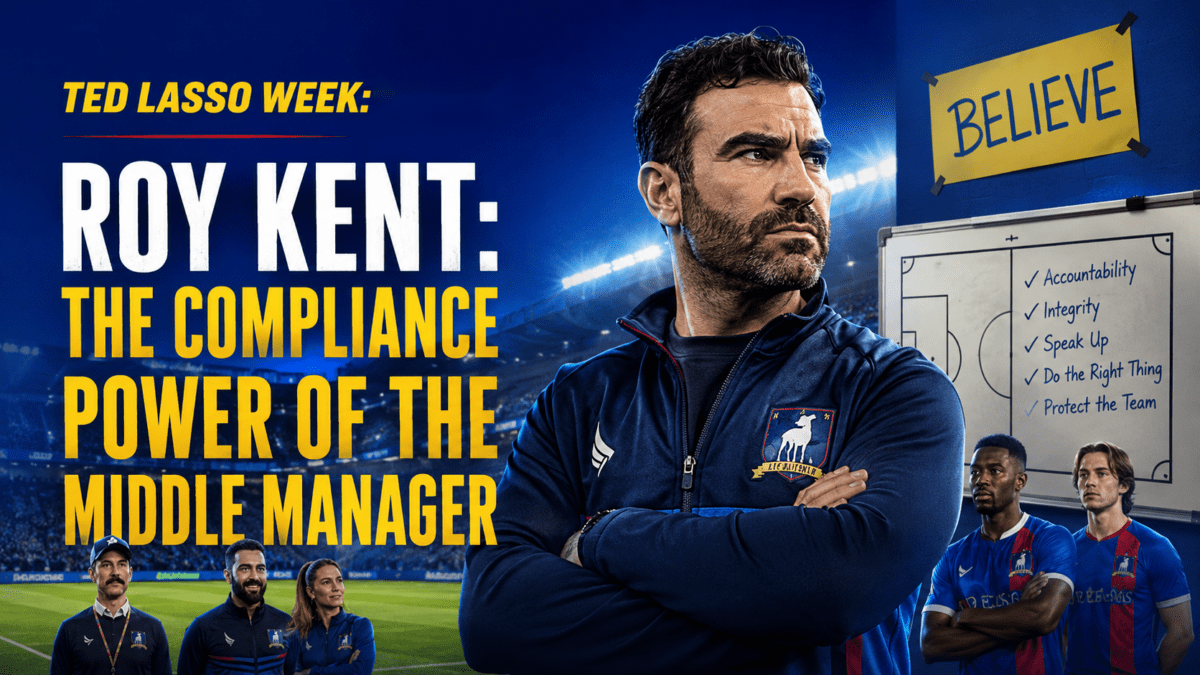
Ted Lasso Week: Part 4 – Roy Kent: The Compliance Power of the Middle Manager

Season 4 of Ted Lasso is out. Matt Kelly reposted a blog he wrote during the original run of the series, and he and I did a deeper dive into the show and its popularity for compliance professionals in an episode of Compliance into the Weeds. I decided to take a deep dive into five characters from the show and use them to explore compliance topics. Over five blog posts, I have considered Manager Ted Lasso, Assistant Manager Nate Shelley, player and later coach Roy Kent, and social media influencer Keeley Jones. Today in Part 4, I consider the sometimes painful transition of an aging sports star into middle-management coaching.

In Part Three, Nate Shelley demonstrated the danger of promoting technical talent without preparing or monitoring the new manager. Roy Kent provides the counterpoint. He is demanding, impatient, and frequently intimidating, but he understands that leadership happens close to the work. Ted can articulate Richmond’s values. Rebecca can provide authority and resources. Roy determines whether those values survive contact with the locker room. He corrects behavior, confronts stars, coaches struggling employees, and translates general expectations into specific action.

For compliance professionals, Roy illustrates the power of the middle manager. He also shows the risk. The same informal authority that can strengthen culture can magnify poor judgment when it is not bounded by self-awareness, escalation, and accountability.

Authority Exists Before the Title

Roy begins the series as Richmond’s captain, not a member of management. Yet his teammates watch him, follow him, and adjust their behavior around him. He has informal authority, which often matters more than the organizational chart.

In “Trent Crimm: The Independent” (Season 1, Episode 3), Ted recognizes that Jamie Tartt and other players are bullying Nate. Rather than solve the problem solely through formal coaching authority, Ted pushes Roy to act. Roy confronts Jamie and forces the locker room to change. That is the tone in the middle. Employees often look to a respected supervisor, veteran, or peer leader to determine whether the code of conduct is real. If that person laughs at an offensive joke, ignores a control override, or protects a top performer, the policy loses. If that person intervenes, the standard gains operational force.

The DOJ Evaluation of Corporate Compliance Programs (ECCP) directs prosecutors to examine how managers at all levels encourage or discourage compliance through their words and actions. Compliance leaders therefore need to identify informal influencers, not merely designated supervisors. On this point, the ECCP states, “it is important for a company to create and foster a culture of ethics and compliance with the law at all levels of the company. The effectiveness of a compliance program requires a high-level commitment by company leadership to implement a culture of compliance from the middle and the top.” Culture travels through both. The ECCP goes on to state “[t]he company’s culture of compliance, including awareness among employees that any criminal conduct, including the conduct underlying the investigation, will not be tolerated.”

Standards Must Apply to Stars and to the Manager

Roy’s credibility comes partly from his willingness to confront Jamie, Richmond’s most talented player. He refuses to accept the idea that performance excuses selfishness or abuse. That is a central compliance principle. Standards that bend around revenue generators and star executives are not standards.

Roy faces the same test personally in “All Apologies” (Season 1, Episode 9). His age and injuries have reduced his performance, but his identity is tied to being captain and playing every match. When Ted decides to bench him, Roy initially resists. He ultimately reports for training in the reserve bib and supports the team. The decision matters because accountability becomes credible when the influential employee accepts the rule applied to everyone else. Roy does not enjoy the outcome, but he demonstrates that status does not confer immunity.

Effective Coaching Diagnoses the Cause

In “The Hope That Kills You” (Season 1, Episode 10), Roy selects Isaac McAdoo as the next captain. By “Rainbow” (Season 2, Episode 5), Isaac is struggling under the weight of that role. Ted asks Roy for help. Roy does not respond with another motivational speech or a threat. He takes Isaac to the neighborhood pitch where Roy learned to play and places him in an informal match. The intervention helps Isaac rediscover that football is a game he loves.

This is root-cause analysis at the individual level. The visible problem is poor performance. The underlying issue is that responsibility has displaced purpose and confidence. Roy changes the environment, observes Isaac, and chooses an intervention connected to the cause. The compliance application is substantial. When an employee misses a control, a manager should not automatically assign retraining. The cause may be an unrealistic target, conflicting procedures, poor system design, inadequate staffing, fear of escalation, or a supervisor who rewards shortcuts. Training cannot repair a misaligned incentive. Discipline cannot correct an unusable process.

Coaching Can Turn a Risk Into an Asset

Roy’s relationship with Jamie becomes his strongest management case. He begins by confronting Jamie’s entitlement. In “Man City” (Season 2, Episode 8), after Jamie finally strikes back at his abusive father, Roy recognizes the pain beneath the conduct and embraces him. The response is neither a lecture nor an endorsement of violence. It is a manager recognizing that the employee needs support before instruction.

In “4-5-1” (Season 3, Episode 3), Jamie asks how he can become better than Zava. Roy offers to train him. The work continues through “Sunflowers” (Season 3, Episode 6), when their training in Amsterdam becomes reciprocal, and Jamie teaches Roy to ride a bicycle. Roy does not lower the standard for Jamie. He gives him the discipline, attention, and feedback needed to meet a higher one. This is what good remediation should accomplish. It should protect the organization while creating a credible path for behavioral improvement.

Managers need tools for these conversations: clear expectations, documented feedback, measurable improvement goals, support resources, escalation thresholds, and follow-up. Candor without structure can become hostility. Compassion without standards can become avoidance. Roy is most effective when he combines both.

Informal Power Can Also Amplify Bad Judgment

Roy is not a flawless compliance model. In “Big Week” (Season 3, Episode 4), he and Coach Beard show the players security footage of Nate tearing the “BELIEVE” sign, despite Ted’s decision not to use it as motivation. The team becomes enraged, loses discipline, receives multiple red cards, and falls to West Ham. Roy intends to motivate. He instead weaponizes internal security footage and emotional injury.

The failure offers three lessons. First, managers must understand the limits of delegated authority. Silence or ambiguity from senior leadership is not permission to bypass its stated judgment. Second, incentives built on anger can produce foreseeable misconduct. Third, a result-driven culture can make an improper method appear acceptable until the damage becomes visible.

Roy’s training methods can also cross from demanding into unsafe or humiliating, as the red-string exercise in “The Strings That Bind Us” (Season 3, Episode 7) demonstrates. A strong manager should challenge employees. The organization must still set boundaries around safety, dignity, and acceptable conduct. This is why middle-management training cannot be limited to explaining policy. Managers need scenario-based practice on investigations, privacy, retaliation, discipline, escalation, health and safety, conflicts, and the use of employee information.

The Best Managers Remain Coachable

Roy’s development is possible because he gradually accepts that leadership does not require invulnerability. In “So Long, Farewell” (Season 3, Episode 12), he joins the Diamond Dogs, asks whether people can change, and later begins therapy. He becomes Richmond’s manager, but his promotion is framed as the next stage of development, not proof that the work is finished.

That distinction matters. Organizations often treat promotion as validation rather than increased risk. The best managers remain open to feedback, seek guidance, acknowledge uncertainty, and use available expertise. Middle managers are a critical source of that information. They should not filter out bad news to protect their numbers. Boards and executives should ask whether managers escalate emerging risks, whether the organization rewards such escalation, and whether retaliation or fear is blocking the flow of information.

Questions for CCOs

Roy’s journey should prompt five questions:

  1. Who are the organization’s informal culture carriers, and how are they engaged?
  2. Are managers evaluated and rewarded for how they achieve results, not only for the results themselves?
  3. Do managers know how to diagnose root causes, escalate concerns, and document behavioral coaching?
  4. Are high performers subject to the same conduct standards as everyone else?
  5. Does manager training distinguish productive candor from intimidation, retaliation, humiliation, and unsafe pressure?

Roy Kent demonstrates that middle managers are the operational heart of compliance. They make standards visible, detect weak signals, and decide whether employees experience accountability as fair. Compliance cannot succeed around them. It must succeed through them.

Next in the Series: Keeley Jones and Governance Under Pressure

Roy’s challenge is translating established values into frontline behavior. Keeley Jones faces the next organizational stage: building a business, accepting investor capital, managing employees, and preserving independence while personal and commercial pressures converge. Join us in our series finale, where we will examine founder risk, conflicts of interest, privacy, third-party influence, and why governance must grow as quickly as the company it is designed to protect.

Categories
Blog

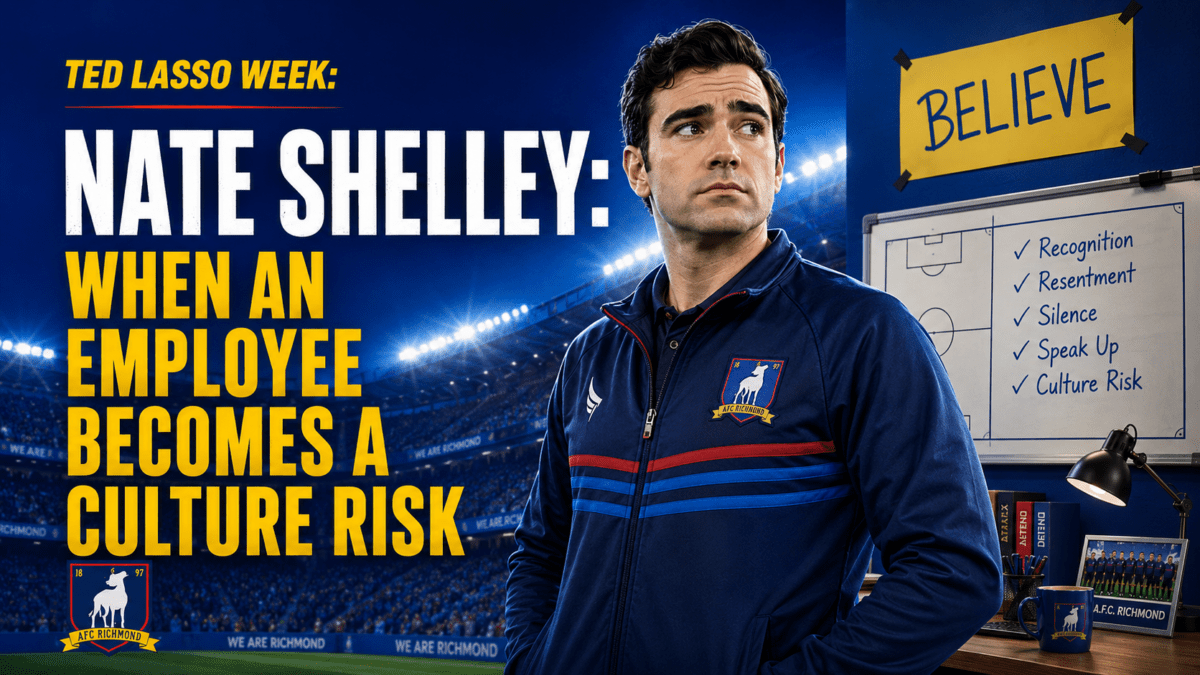
Ted Lasso Week: Part 3 – Nate Shelley: When an Employee Becomes a Culture Risk

Season 4 of Ted Lasso is out. Matt Kelly reposted a blog he wrote during the original run of the series, and he and I did a deeper dive into the show and its popularity for compliance professionals in an episode of Compliance into the Weeds. I decided to take a deep dive into five characters from the show and use them to explore compliance topics. Over five blog posts, I will consider Manager Ted Lasso, Assistant Manager Nate Shelley, player and later coach Roy Kent, and social media influencer Keeley Jones. Today in Part 3, we consider the professional journey of Nate Shelley, who begins the series as the equipment manager, or in football parlance, the ‘kit man,’ but rises into the managerial ranks.

In Part Two, Rebecca Welton showed how concentrated authority can turn an executive’s private grievance into organizational misconduct. Nate Shelley presents a different risk. His damage begins below the executive level, after AFC Richmond promotes a technically gifted employee without preparing him to exercise power.

Nate is not a villain. He is the overlooked kit man whom players ridicule and leaders barely notice. Ted recognizes his tactical ability, Roy stops the bullying, and Richmond promotes him. Yet the organization mistakes recognition for readiness. Once Nate receives authority, the humiliation he experienced does not disappear. He redirects it toward people with less power.

For compliance professionals, Nate’s story shows that culture risk can emerge when organizations reward expertise, overlook behavioral warning signs, fail to adequately train new managers, and then fail to monitor them.

Promotion Changes the Risk Profile

In “Trent Crimm: The Independent” (Season 1, Episode 3), Jamie Tartt and other players bully Nate until Roy intervenes. Ted also invites Nate to contribute tactical ideas. Those decisions establish dignity and psychological safety for an employee who had neither.

By “The Hope That Kills You” (Season 1, Episode 10), Nate has been promoted to assistant coach. The promotion is understandable. He knows football, sees patterns others miss, and has already helped the team. What Richmond never appears to assess is whether he can supervise people, receive criticism, manage conflict, protect confidential information, or use authority consistently. This is a common corporate failure. The strongest engineer becomes an engineering manager. The top salesperson becomes a regional leader. The best investigator becomes an investigation director. Technical performance is treated as proof of leadership capacity.

Section 8B2.1 of the 2025 U.S. Sentencing Guidelines requires reasonable efforts in selecting personnel with substantial authority, practical training based on role and responsibility, monitoring, and consistent discipline. An effective promotion process should assess conduct, not merely output. It should also include manager training, defined escalation duties, coaching, and a meaningful review period.

Richmond changes Nate’s title. It does not build the controls that should accompany his new power.

The Bullied Employee Becomes the Bullying Manager

Nate’s deterioration becomes unmistakable in “The Signal” and “Headspace” (Season 2, Episodes 6 and 7). Public praise for his tactical decision produces the “Wonder Kid” identity he craves. He also belittles Colin Hughes and directs increasingly harsh treatment at Will, the young employee who replaced him as kit man. Coach Beard witnesses Nate humiliating Colin and tells him to do better. Nate then delivers a public apology. Yet when Will gives him a personalized jersey, Nate responds with private abuse. The apparent correction does not change the conduct. It relocates the harm to a more vulnerable target.

That sequence should concern every compliance officer. A manager confronted about misconduct may learn the wrong lesson: avoid witnesses, control the record, and retaliate where detection is less likely. Closing a matter after an apology, without checking the experience of affected employees or monitoring subsequent conduct, can make the organization less safe.

The DOJ Evaluation of Corporate Compliance Programs asks how managers at all levels demonstrate commitment to compliance, whether employees are comfortable reporting concerns, whether there are “lines of reporting and communications,” and whether discipline is consistent. “Have disciplinary actions and incentives been fairly and consistently applied across the organization? ” Does the compliance function monitor its investigations and resulting discipline to ensure consistency? “And whether the company examines root causes,” “Has the company undertaken a root cause analysis into areas where certain conduct is comparatively over- or under-reported?” Nate’s conduct calls for more than informal coaching. It calls for fact-finding, documentation, protection of Will and Colin, and a plan to determine whether behavior actually changes (i.e., ongoing monitoring).

Warning Signs Are Data

Richmond receives signals throughout Season 2. Nate becomes preoccupied with status, press coverage, social media approval, and perceived slights. He resents Roy’s return to the coaching staff. He spits at his reflection to manufacture confidence. His criticism becomes personal, and his treatment of lower-status employees worsens.

None of these facts alone proves that Nate will betray the team. Together, they form a pattern. Compliance programs fail when each signal remains isolated: Human Resources sees a complaint, a supervisor observes disrespect, colleagues notice resentment, and senior leadership sees performance. No one assembles the complete picture. This is the pattern recognition issue. If no one person or data analytics tool is watching the pattern, it may not be noticed until it is too late.

Under the COSO Internal Control Framework, Richmond’s weakness spans risk assessment (Objective 2), information and communication (Objective 4), and monitoring (Objective 5). The organization has values, but it lacks a reliable process for gathering culture data and testing whether managers operate consistently with those values.

Grievance Becomes Betrayal

Nate’s culture risk becomes an organizational crisis in “Midnight Train to Royston” (Season 2, Episode 11). Trent Crimm informs Ted that an article will reveal Ted’s panic attack and that Nate is the source. In “Inverting the Pyramid of Success” (Season 2, Episode 12), Nate accuses Ted of abandoning him, rejects Ted’s apology, acts out by tearing the “BELIEVE” sign in half, and leaves for West Ham.

Nate has legitimate feelings about recognition, communication, and his relationship with Ted. Those feelings do not justify leaking a colleague’s sensitive health information to inflict reputational harm. Explanation is not exoneration. It also leads to what I consider one of the most reprehensible lines in the entire series when Nate screams at Ted, “You don’t belong here.”

Organizations should examine both individual accountability and system failure. Why did Nate believe betrayal was his only effective channel? Why did no one detect the escalating mistreatment of employees? Who owned his development after promotion? What information could he access because of his trusted position? Why did Richmond lack a process that could address his grievance before it became retaliation? A root-cause analysis that labels Nate disloyal and stops there will miss the control failures that allowed the risk to mature.

Incentives Can Amplify the Wrong Behavior

At West Ham, Rupert rewards Nate with title, status, a car, and proximity to power. In “Smells Like Mean Spirit” (Season 3, Episode 1), Nate mocks Richmond and Ted publicly and humiliates a West Ham player during training. Rupert does not remediate Nate’s insecurity. He weaponizes it.

This is incentive design in human form. One organization can suppress destructive behavior while another celebrates it. Compensation is only one incentive. Access, attention, public praise, elite membership, and fear of exclusion can be equally powerful. Nate eventually recognizes the cost. After refusing Rupert’s invitation to a private “boys’ night,” he leaves West Ham, as confirmed in “International Break” (Season 3, Episode 10). His departure is meaningful because he gives up the status he once treated as proof of worth.

Reintegration Requires More Than Forgiveness

Nate begins repairing harm by quietly completing Will’s work and leaving an apology in “International Break.” In “Mom City” (Season 3, Episode 11), several players invite him back, but Nate hesitates because Ted has not approved the plan. Beard ultimately offers him a second chance. In “So Long, Farewell” (Season 3, Episode 12), Nate apologizes directly to Ted and returns to the coaching staff.

The human story is redemption. The compliance story is reintegration. A sound return-to-work plan would document findings, consider the views and safety of affected employees, define Nate’s role, require coaching, reinforce confidentiality and anti-retaliation standards, and monitor conduct over time. Restoration can support culture, but only if it does not communicate that talent or remorse erases accountability.

Questions for CCOs

Nate’s journey should prompt five questions:

  1. Do promotion decisions evaluate leadership conduct and risk, or only technical results?
  2. Are new managers trained on retaliation, confidentiality, escalation, discipline, and psychological safety?
  3. Can lower-status employees report misconduct by a popular or high-performing manager without fear?
  4. Does the organization combine complaint, exit, survey, investigation, and performance data to identify patterns?
  5. When a former employee returns after misconduct, is reintegration structured, documented, and monitored?

Nate becomes a culture risk because Richmond sees his talent before he understands his relationship with power. His story reminds us that employees do not become ethical managers through promotion alone.

Next in the Series: Roy Kent and the Power of the Middle Manager

Nate shows what happens when managerial authority is granted without preparation or sustained oversight. Roy Kent offers the counterpoint. He is imperfect, confrontational, and sometimes slow to change, but he understands that standards become real through daily coaching, direct feedback, and visible accountability. In Part Four, we will examine why middle managers are the operational heart of an effective compliance program and how Roy converts leadership expectations into behavior inside the locker room.

Categories
Blog

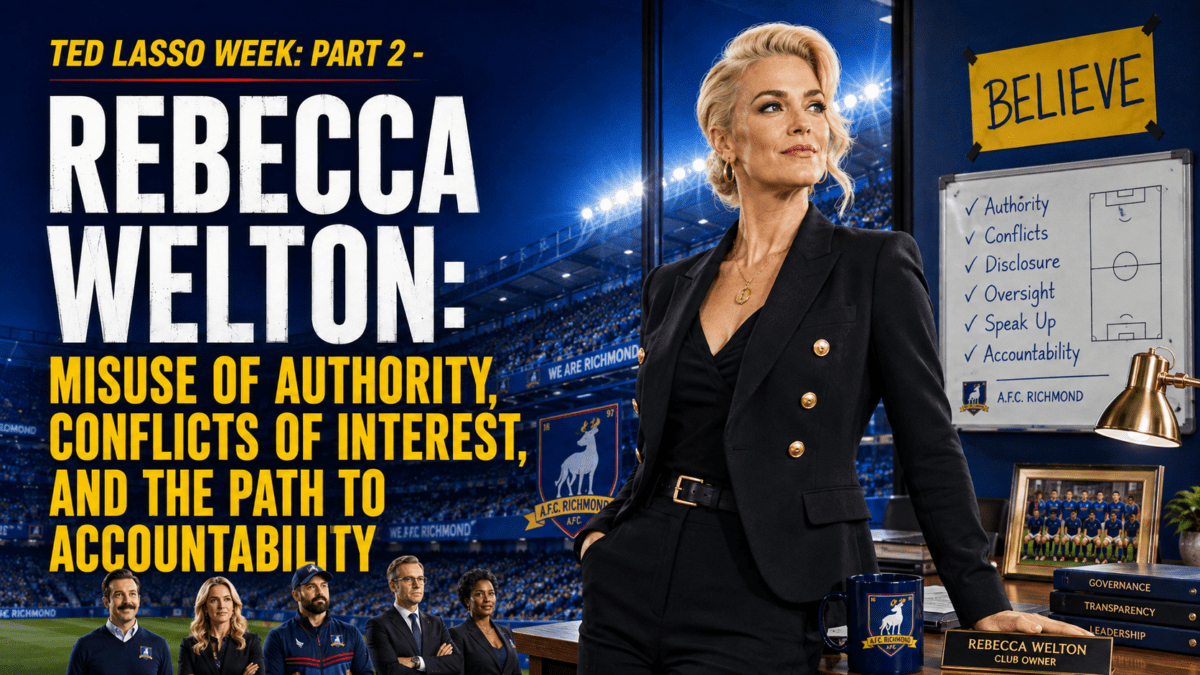
Ted Lasso Week: Part 2 – Rebecca Welton: Misuse of Authority, Conflicts of Interest, and the Path to Accountability

Season 4 of Ted Lasso is out. Matt Kelly reposted a blog he wrote during the original run of the series, and he and I did a deeper dive into the show and its popularity for compliance professionals in an episode of Compliance into the Weeds. I decided to take a deep dive into five characters from the show and use them to explore compliance topics. Over five blog posts, I will consider Manager Ted Lasso, Assistant Manager Nate Shelley, player and later coach Roy Kent, and social media influencer Keeley Jones. Today in Part 2, we consider compliance lessons through the character of team owner Rebecca Welton.

In Part 1, we considered how Ted Lasso built psychological safety and an ethical culture while sometimes allowing empathy to outrun accountability. Rebecca Welton presents the problem from the other side of the executive table. She begins as the source of AFC Richmond’s misconduct, then becomes the leader best positioned to acknowledge it.

Rebecca’s story is not simply a redemption arc. It is a governance case study about what happens when personal objectives capture corporate authority. It also shows why confession, forgiveness, and improved behavior are necessary but insufficient elements of an effective remediation program. The compliance lesson is direct: power creates risk when no independent mechanism can question the person exercising it.

When the Owner Becomes the Risk

In “Pilot” (Season 1, Episode 1), Rebecca hires Ted, an American football coach with no soccer experience, to manage a Premier League club. Her stated rationale is irrelevant because her actual purpose is to destroy the institution Rupert Mannion loves. She uses Richmond’s people, reputation, competitive position, and financial value to pursue a private grievance.

That is a classic conflict between personal interest and organizational duty. Rebecca is not accepting an envelope of cash or steering a contract to a relative. Her conflict is more fundamental: she has converted corporate decision-making into an instrument of revenge. The COSO Internal Control Framework begins with the control environment, including integrity, ethical values, oversight, authority, and accountability. At Richmond, the control environment fails at the top. The owner sets an improper objective, possesses the authority to execute it, and faces no visible independent challenge.

Compliance officers should take note. Conflicts of interest do not end with disclosure forms. They arise whenever personal relationships, status, resentment, financial incentives, or outside interests can distort business judgment. The greater the executive’s authority, the stronger the required safeguards.

Concentrated Authority Silences Challenge

Rebecca’s plan requires assistance. Higgins facilitates her agenda even though he recognizes the harm. In “Make Rebecca Great Again” (Season 1, Episode 7), Rebecca arranges for a photographer to capture Ted and Keeley in a compromising image. The objective is not legitimate media strategy. It is manufactured reputational damage intended to destabilize Ted and the club.

Higgins is not merely an unfortunate bystander. He is a senior employee who allows access, information, and organizational machinery to serve the owner’s improper purpose. His eventual resignation is a delayed act of conscience, but the episode demonstrates how authority can corrupt the escalation process. Employees may know that conduct is wrong and still conclude that challenging the owner is futile or career-ending.

The DOJ Evaluation of Corporate Compliance Programs asks whether “compliance personnel (1) sufficient qualifications, seniority, and stature (both actual and perceived) within the organization; (2) sufficient resources, namely, staff to undertake the requisite auditing, documentation, and analysis effectively; and (3) sufficient autonomy from management, such as direct access to the board of directors or the board’s audit committee.” It also asks whether managers encourage or discourage compliance through their conduct. Richmond has no credible independent function capable of reviewing Rebecca’s decisions, investigating her conduct, or escalating around her.

Accountability Begins With Truth

Keeley becomes the effective speak-up channel Richmond lacks. Once she discovers Rebecca’s scheme, she does not accept friendship, hierarchy, or reputational risk as reasons to stay silent. She insists that Rebecca tell Ted the truth. Rebecca finally does so in “All Apologies” (Season 1, Episode 9). She admits that she hired Ted to fail, orchestrated the paparazzi scheme, and engineered Jamie Tartt’s return to Manchester City to weaken Richmond. Most importantly, she does not minimize her purpose. She explains that she wanted to hurt Rupert and used Ted and the club to do it.

This is an effective apology because it identifies conduct, intent, and harm. It also accepts the possibility of consequences. Yet it is not a remediation. Nevertheless, Ted forgives her immediately, but an actual organization could not stop there. The U.S. Sentencing Guidelines require an organization to respond appropriately after misconduct and take reasonable steps to prevent similar conduct. DOJ asks whether the company performed a root-cause analysis, disciplined responsible individuals, repaired controls, and tested whether remediation works.

Richmond would need an independent review of affected personnel decisions, financial consequences, sponsor and stakeholder impacts, the use of confidential information, and Higgins’s role. It would also need governance changes that prevent one executive from repeating the conduct. An apology can reopen trust. Only remediation can reduce recurrence risk.

The Conflict Problem Returns With Sam

Rebecca’s growth does not eliminate conflicts. In “The Signal” and “Headspace” (Season 2, Episodes 6 and 7), Rebecca discovers that her anonymous Bantr match is Sam Obisanya, a Richmond player. Their relationship develops in “Man City” (Season 2, Episode 8) and continues secretly into “No Weddings and a Funeral” (Season 2, Episode 10).

The relationship is portrayed with warmth and mutual affection. That does not resolve the organizational issue. Rebecca owns the club that controls Sam’s employment environment. Her decisions can affect contracts, playing resources, sponsorships, reputation, and career opportunities. Even if she never exercises that power improperly, the imbalance creates an appearance of favoritism and raises questions about consent, retaliation, confidentiality, and recusal.

The compliance response is not moral judgment. It is a process. A conflict policy must apply to owners and senior executives, not only employees. Disclosure should go to an independent board member or committee. The organization should document safeguards, remove the conflicted leader from relevant decisions, protect the less powerful party, and monitor for retaliation or preferential treatment. Rebecca eventually pauses the relationship, but Richmond never appears to activate a formal conflict-management process. Personal restraint is not a control.

From Personal Ownership to Stewardship

Rebecca’s leadership changes when she stops treating Richmond as property and begins treating it as an institution held in trust for others. In “Do the Right-est Thing” (Season 2, Episode 3), Sam protests sponsor Dubai Air because of its connection to environmental damage in Nigeria. Rebecca backs the players despite the commercial risk. She recognizes that sponsorship revenue does not outrank organizational values.

Her transformation is clearest in “International Break” (Season 3, Episode 10). Edwin Akufo invites elite club owners to join an exclusive league built around scarcity, control, and profit. Rebecca rejects the proposal by reminding the room that football belongs to the people whose lives and communities give it meaning. She chooses stakeholder legitimacy over a lucrative insiders’ arrangement.

In “So Long, Farewell” (Season 3, Episode 12), she completes that shift by selling 49 percent of Richmond to its supporters. The woman who once used the club as a weapon ultimately distributes part of its ownership to the community.

This is what ethical remediation should seek: not a return to the status quo, but a more accountable operating model.

Questions for CCOs

Rebecca’s journey should prompt five questions:

  1. Can an allegation against the CEO, founder, controlling shareholder, or board chair bypass that person and reach an independent decision-maker?
  2. Do conflict rules cover personal relationships, vendettas, reputational motives, and executive discretion, or only financial interests?
  3. When senior misconduct occurs, who controls the investigation, discipline, disclosure, and remediation plan?
  4. Does the board receive reliable information about culture and mission-critical risks without management filtering?
  5. Are remediation measures tested, documented, and sustained after the responsible leader apologizes?
  6. Rebecca Welton shows that leaders can change. Compliance must make that change governable. Trust is rebuilt when truth is followed by independent review, proportional accountability, control improvements, and evidence that the organization learned.

Next Up: Nate Shelley and Culture Risk

Rebecca’s failure begins with power concentrated at the top. Nate Shelley’s failure develops lower in the organization, where insecurity, humiliation, status, and unaddressed resentment turn a once-overlooked employee into a destructive manager and trusted insider. In Part 3, we will examine the warning signs Richmond missed, the consequences of promoting technical talent without preparing them to lead, and why a speak-up culture must detect harm committed by newly empowered employees as readily as misconduct committed by executives.

Categories
Blog

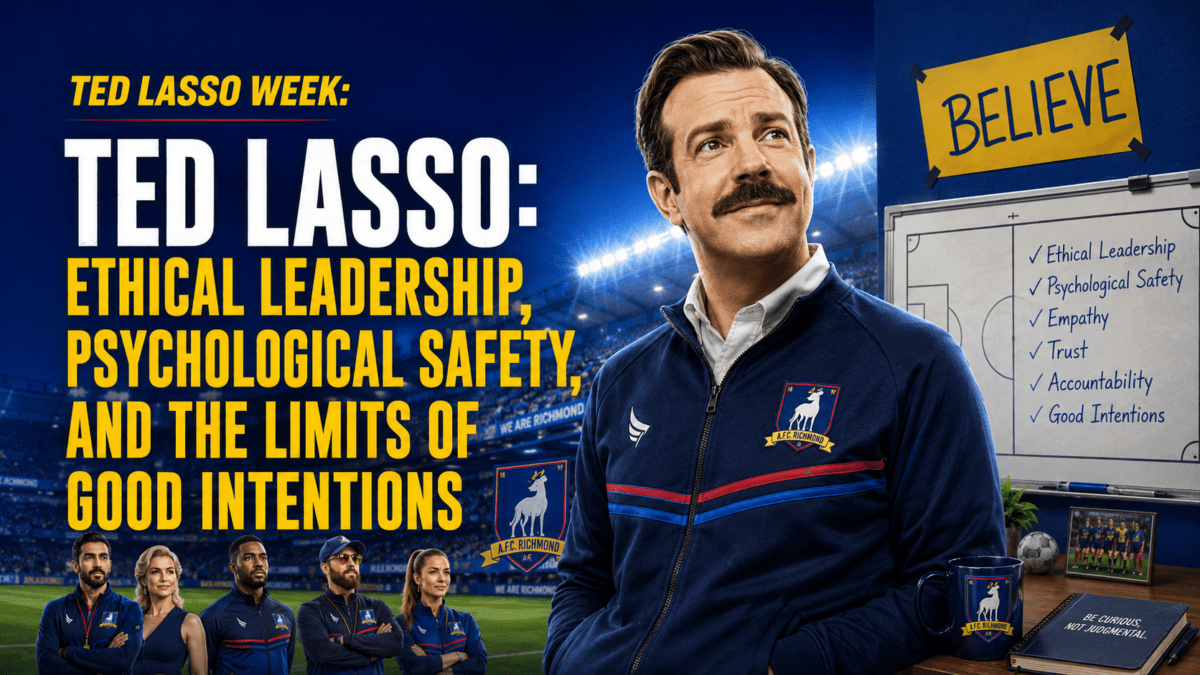
Ted Lasso Week: Part 1 – Ted Lasso: Ethical Leadership, Psychological Safety, and the Limits of Good Intentions

Season 4 of Ted Lasso has begun dropping (a new episode releases each Wednesday). Matt Kelly reposted a blog he wrote during the original run of the series, and he and I did a deeper dive into the show and its popularity for compliance professionals in an episode of Compliance into the Weeds. I decided to take a deep dive into five characters from the show and use them to explore compliance topics. Over the next 5 blog posts, I will consider team owner Rebecca Welton, Assistant Manager Nate Shelley, player and later coach Roy Kent, and social media influencer Keeley Jones. Today in Part 1, we begin with compliance lessons through the character of Ted Lasso.

Ted Lasso arrives at AFC Richmond with no meaningful knowledge of English football, a skeptical locker room, a hostile press, and an owner who secretly hired him to fail. On paper, he is an obvious control failure. In practice, he becomes the architect of Richmond’s cultural transformation.

For compliance professionals, that transformation is the point. Ted demonstrates how a leader can create trust, encourage candor, and turn values into daily behavior. He also demonstrates the limits of values-led leadership. Good intentions do not investigate misconduct. Empathy does not test a control. Forgiveness does not remediate a root cause.

The compliance lesson from Ted is not simply to “believe.” It is to build a culture in which accountability, information, controls, and oversight support belief.

Culture Is What the Leader Does

Ted’s first contribution is not tactical. It is behavioral. He learns names, asks questions, listens to people with little formal authority, and treats the kit man, Nate Shelley, as a colleague whose observations matter. In “Trent Crimm: The Independent” (Season 1, Episode 3), Ted recognizes that Jamie Tartt and other players are humiliating Nate. Rather than deliver a speech about respect and move on, Ted engages Roy Kent, the informal leader whose intervention can change locker-room conduct.

That is tone at the top connected to conduct in the middle. The DOJ Evaluation of Corporate Compliance Programs (ECCP) asks how senior leaders and managers have encouraged compliance through their words and actions. It states in part, “Beyond compliance structures, policies, and procedures, it is important for a company to create and foster a culture of ethics and compliance with the law at all levels of the company. The effectiveness of a compliance program requires a high-level commitment by company leadership to implement a culture of compliance from the middle and the top.”

The Principles of Federal Prosecution of Business Organizations (Justice Manual) likewise directs prosecutors to examine culture at all levels, including discipline, treatment of complaints, and incentives. 9.28.300 states in part that prosecutors shall consider “the pervasiveness of wrongdoing within the corporation, including the complicity in, or the condoning of, the wrongdoing by individuals in corporate management”. In Section 9-28.800, it directs the DOJ to review a “company’s culture of compliance”.

Ted understands instinctively that culture does not travel through posters. It travels through managers, peer leaders, everyday decisions, and the behavior an organization tolerates. A chief compliance officer can publish a code. Only operational leaders can make that code real during the meeting, on the sales call, and inside the locker room.

Psychological Safety Requires a Response System

Ted creates space for people to speak before they have status. He accepts tactical input from Nate, invites dissent from Coach Beard, and builds the Diamond Dogs as an informal forum for candid discussion. By “La Locker Room Aux Folles” (Season 3, Episode 9), Richmond can confront Colin Hughes’s sexuality and Isaac McAdoo’s reaction with empathy. Ted initially hears the team’s claim that Colin’s identity makes no difference, then corrects the underlying message: the team should care because Colin’s experience matters.

This is psychological safety in practice. Employees must be able to raise a concern, disclose vulnerability, or challenge a decision without humiliation or retaliation. Yet a compliance program needs more than an approachable leader. Equally importantly, a culture of Speak Up must be paired with a culture of Listen Up.

Richmond relies heavily on Ted’s availability and temperament. That is a strength while Ted is present and a key-person risk when he is absent. A mature speak-up program requires intake standards, anti-retaliation controls, escalation criteria, case tracking, trend analysis, and board reporting. An open door is valuable. It is not an operating system.

Accountability Must Apply to Stars and Friends

Ted’s strongest accountability moment comes in “Tan Lines” (Season 1, Episode 5), when he benches Jamie after the star player refuses to follow the team’s approach. Ted chooses collective standards over short-term performance. That is exactly the decision many organizations avoid when the employee at issue is a top salesperson, rainmaker, founder, or executive.

He is less decisive when loyalty clouds his judgment. In “All Apologies” (Season 1, Episode 9), Beard and Nate press Ted to confront Roy’s declining performance. Ted initially resists, even though the competitive risk is visible. He eventually has the necessary conversation and gives Roy a dignified path to support the team from the bench.

The contrast matters. DOJ asks whether discipline is applied consistently and whether the company tolerates misconduct by high performers. Compliance credibility collapses when consequences depend on revenue, rank, or personal affection. Ethical leadership is not the absence of hard decisions. It is the willingness to make them fair and explain the standard.

Forgiveness Is Not Remediation

Rebecca’s confession in “All Apologies” presents Ted’s greatest strength and clearest compliance blind spot. She admits that she hired him to fail, manipulated club decisions, and used people as instruments in her campaign against Rupert. Ted forgives her immediately.

At a human level, the scene is powerful. At an organizational level, forgiveness cannot close the matter. Richmond would still need to establish what happened, preserve evidence, identify affected decisions, assess financial and stakeholder harm, determine whether others participated, evaluate disclosure obligations, and strengthen governance.

The US Sentencing Guidelines require organizations to respond appropriately after misconduct and take steps to prevent recurrence. DOJ similarly focuses on root-cause analysis, remediation, and whether control improvements are tested. Ted offers grace, which can support rehabilitation. He does not create a record showing that the organization learned from the failure.

This distinction should matter to every CCO: mercy concerns the person; remediation concerns the institution. A company may do both. It cannot substitute one for the other.

Vulnerability Can Strengthen the Control Environment

Ted’s panic attacks show the cost of a culture in which even a supportive leader believes he must appear invulnerable. His attack during karaoke in “Make Rebecca Great Again” (Season 1, Episode 7) remains largely private. In “Headspace” and “Man City” (Season 2, Episodes 7 and 8), he finally engages with Dr. Sharon Fieldstone and begins addressing the trauma connected to his father’s suicide. After Nate leaks his panic attack to the press, Ted speaks honestly to the team and the public in “Inverting the Pyramid of Success” (Season 2, Episode 12).

Leaders retain legitimate medical privacy. The compliance point is not compelled disclosure. Organizations need trusted support channels, succession and contingency plans, and an environment where asking for help is not treated as weakness. Ted’s eventual candor reduces stigma. His earlier concealment creates an information vacuum that Nate weaponizes.

Within the COSO Internal Control Framework, Ted materially improves the control environment and information and communication. Richmond’s weakness is monitoring. Warning signs involving Nate, including humiliation of subordinates, resentment, and escalating hostility, do not reach a reliable response process before he leaks Ted’s health information and leaves for West Ham.

The Final Test Is Whether Culture Outlasts the Leader

By Season 3, Ted increasingly shifts from hero to system builder. “Sunflowers” and “The Strings That Bind Us” (Season 3, Episodes 6 and 7) show Richmond developing Total Football through shared learning, role flexibility, and trust. In “So Long, Farewell” (Season 3, Episode 12), Ted leaves, but Roy, Beard, Rebecca, Higgins, and the players can carry the culture forward.

That is the institutional test. A compliance program that depends on one charismatic executive is not sustainable. Caremark oversight principles require boards to make a good-faith effort to establish and monitor information and reporting systems, particularly around mission-critical risks, as the Delaware Supreme Court emphasized in Marchand v. Barnhill (the Bluebell Ice Cream case). Ted changes Richmond’s values. Governance must ensure that those values become repeatable processes, reliable information, and accountable decisions.

Practical Takeaways for CCOs 

Ted Lasso offers five questions for a CCO and compliance team:

  1. Do employees trust leaders, and can the organization demonstrate that concerns receive a consistent response?
  2. Are high performers held to the same behavioral standards as everyone else?
  3. When misconduct occurs, does forgiveness follow investigation and remediation rather than replace them?
  4. Are managers trained and monitored as culture carriers, especially after promotion?
  5. Would the speak-up culture and compliance program remain effective if a trusted leader departed tomorrow?

Ted’s enduring lesson is that ethical culture begins with human connection. Effective compliance begins there as well, but it cannot end there. Richmond becomes stronger when curiosity replaces judgment, candor replaces silence, and team standards replace individual entitlement. The next step for any real organization is to convert those behaviors into controls that can be tested, monitored, reported, and sustained.

Join us tomorrow in Part 2, as we turn to Rebecca Welton, whose decision to use AFC Richmond as an instrument of personal revenge reveals the risks created when concentrated authority operates without independent challenge. We will examine executive conflicts, institutional remediation, and Rebecca’s transformation from conflicted owner to accountable steward by requiring governance that can hold power to account.


Categories
Compliance Into the Weeds

Compliance into the Weeds: Ted Lasso, Culture and Compliance

The award-winning Compliance into the Weeds is the only weekly podcast that takes a deep dive into a compliance-related topic, literally going into the weeds to explore a subject more fully. Looking for some hard-hitting insights on compliance? Look no further than Compliance into the Weeds! In this episode of Compliance into the Weeds, Tom Fox and Matt Kelly celebrate the return of Ted Lasso for Season 4.

Tom and Matt begin with why Ted Lasso resonates with compliance officers as a study of workplace dynamics, leadership, and building a culture of trust. They highlight how Ted focuses on coaching people and shaping club-wide culture through “thousands of imperceptible moments,” culminating in “total football,” where shared expectations and mutual support enable improvisation and performance. They connect this to compliance goals of embedding ethics so employees can handle new situations on the fly and to Jim Collins’ “level five” leadership and humility, illustrated by Ted renaming Trent Crimm’s book from “The Ted Lasso Way” to “The Richmond Way.” They also link the show to the military OODA loop (observe, orient, decide, act) as a model for empowered decision-making within clear objectives and boundaries and preview Season 4’s shift to Ted coaching a women’s team.

Key highlights:

  • Ted Lasso Returns Season Four
  • Culture and Trust at Richmond
  • Total Football and Compliance
  • The Richmond Way Leadership Lesson
  • Level Five Humility
  • OODA Loop Meets Compliance

Resources:

Matt in Radical Compliance

Tom

Instagram

Facebook

YouTube

Twitter

LinkedIn

A multi-award-winning podcast, Compliance into the Weeds was most recently honored as one of the Top 25 Regulatory Compliance Podcasts, a ⁠Top 10 Business Law Podcast⁠, and ⁠a Top 12 Risk Management Podcast⁠. Compliance into the Weeds has been conferred a Davey, Communicator, and W3 Award, all for podcast excellence. 

Categories
Everything Compliance

Everything Compliance – Pop Culture and Compliance: Succession, Ted Lasso and The Office

Welcome to the only roundtable podcast in compliance as we celebrate our second century of shows. Everything Compliance has been honored by W3 as the top podcast talk show. In this episode, we have the quartet of Jay Rosen, Jonathan Marks, Matt Kelly, and from across the pond, Jonathan Armstrong, with Tom Fox sitting in on this episode. We consider the world of pop culture as it relates to compliance by looking at Succession, Ted Lasso, and The Office, and conclude with fan-fav Shout Outs and Rants section.

1. Matt Kelly at the eternal optimism of Ted Lasso and discusses The Richmond Way. He cites a 2018 blog post, The Best Compliance on Television. He shouts out the new Spiderman movie, Spiderman Across the Spider-verse.

2. Jonathan Marks looks at Succession, focusing on the conduct of Shiv Roy. Marks shouts out to Kody Clemens for getting a walk-off hit while his father is in the stands.

3. Tom Fox also looks at Succession and divines three lessons for the compliance professional. He shouts out to the 9th Circuit Court of Appeals to allow a lawsuit to move forward, which alleges rock lyrics can cause emotional distress.

4. Jay Rosen explains why America needs Ted Lasso. Rosen shouts out to the month of June for having the best sports month each year.

5. Jonathan Armstrong reviews the UK version of The Office. He shouts out to all those helicopter pilots hovering outside the London courtroom where Prince Harry is giving testimony in his libel suit.

The members of Everything Compliance are:

•       Jay Rosen– Jay is Vice President, Business Development Corporate Monitoring at Affiliated Monitors. Rosen can be reached at JRosen@affiliatedmonitors.com

•       Karen Woody – One of the top academic experts on the SEC. Woody can be reached at kwoody@wlu.edu

•       Matt Kelly – Founder and CEO of Radical Compliance. Kelly can be reached at mkelly@radicalcompliance.com

•       Jonathan Armstrong –is our UK colleague, who is an experienced data privacy/data protection lawyer with Cordery in London. Armstrong can be reached at jonathan.armstrong@corderycompliance.com

•       Jonathan Marks is Partner, Firm Practice Leader – Global Forensic, Compliance & Integrity Services at Baker Tilly. Marks can be reached at jonathan.marks@bakertilly.com