


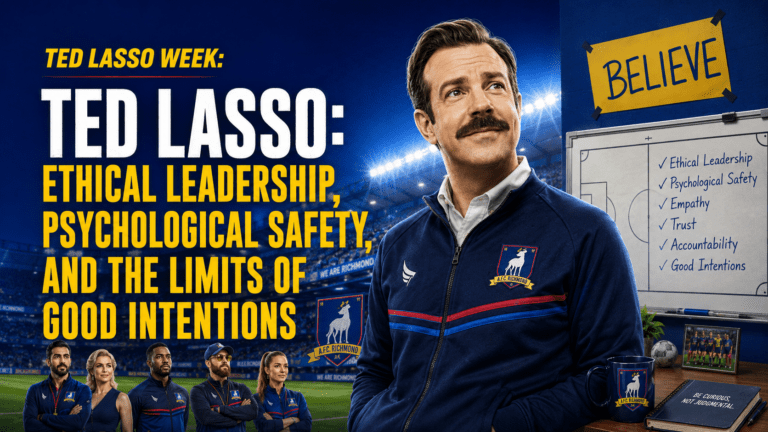
Season 4 of Ted Lasso has begun dropping (a new episode releases each Wednesday). Matt Kelly reposted a blog he wrote during the original run of the series, and he and I did a deeper dive into the show and its popularity for compliance professionals in an episode of Compliance into the Weeds. I decided to take a deep dive into five characters from the show and use them to explore compliance topics. Over the next 5 blog posts, I will consider team owner Rebecca Welton, Assistant Manager Nate Shelley, player and later coach Roy Kent, and social media influencer Keeley Jones. Today in Part 1, we begin with compliance lessons through the character of Ted Lasso.
Ted Lasso arrives at AFC Richmond with no meaningful knowledge of English football, a skeptical locker room, a hostile press, and an owner who secretly hired him to fail. On paper, he is an obvious control failure. In practice, he becomes the architect of Richmond’s cultural transformation.
For compliance professionals, that transformation is the point. Ted demonstrates how a leader can create trust, encourage candor, and turn values into daily behavior. He also demonstrates the limits of values-led leadership. Good intentions do not investigate misconduct. Empathy does not test a control. Forgiveness does not remediate a root cause.
The compliance lesson from Ted is not simply to “believe.” It is to build a culture in which accountability, information, controls, and oversight support belief.
Culture Is What the Leader Does
Ted’s first contribution is not tactical. It is behavioral. He learns names, asks questions, listens to people with little formal authority, and treats the kit man, Nate Shelley, as a colleague whose observations matter. In “Trent Crimm: The Independent” (Season 1, Episode 3), Ted recognizes that Jamie Tartt and other players are humiliating Nate. Rather than deliver a speech about respect and move on, Ted engages Roy Kent, the informal leader whose intervention can change locker-room conduct.
That is tone at the top connected to conduct in the middle. The DOJ Evaluation of Corporate Compliance Programs (ECCP) asks how senior leaders and managers have encouraged compliance through their words and actions. It states in part, “Beyond compliance structures, policies, and procedures, it is important for a company to create and foster a culture of ethics and compliance with the law at all levels of the company. The effectiveness of a compliance program requires a high-level commitment by company leadership to implement a culture of compliance from the middle and the top.”
The Principles of Federal Prosecution of Business Organizations (Justice Manual) likewise directs prosecutors to examine culture at all levels, including discipline, treatment of complaints, and incentives. 9.28.300 states in part that prosecutors shall consider “the pervasiveness of wrongdoing within the corporation, including the complicity in, or the condoning of, the wrongdoing by individuals in corporate management”. In Section 9-28.800, it directs the DOJ to review a “company’s culture of compliance”.
Ted understands instinctively that culture does not travel through posters. It travels through managers, peer leaders, everyday decisions, and the behavior an organization tolerates. A chief compliance officer can publish a code. Only operational leaders can make that code real during the meeting, on the sales call, and inside the locker room.
Psychological Safety Requires a Response System
Ted creates space for people to speak before they have status. He accepts tactical input from Nate, invites dissent from Coach Beard, and builds the Diamond Dogs as an informal forum for candid discussion. By “La Locker Room Aux Folles” (Season 3, Episode 9), Richmond can confront Colin Hughes’s sexuality and Isaac McAdoo’s reaction with empathy. Ted initially hears the team’s claim that Colin’s identity makes no difference, then corrects the underlying message: the team should care because Colin’s experience matters.
This is psychological safety in practice. Employees must be able to raise a concern, disclose vulnerability, or challenge a decision without humiliation or retaliation. Yet a compliance program needs more than an approachable leader. Equally importantly, a culture of Speak Up must be paired with a culture of Listen Up.
Richmond relies heavily on Ted’s availability and temperament. That is a strength while Ted is present and a key-person risk when he is absent. A mature speak-up program requires intake standards, anti-retaliation controls, escalation criteria, case tracking, trend analysis, and board reporting. An open door is valuable. It is not an operating system.
Accountability Must Apply to Stars and Friends
Ted’s strongest accountability moment comes in “Tan Lines” (Season 1, Episode 5), when he benches Jamie after the star player refuses to follow the team’s approach. Ted chooses collective standards over short-term performance. That is exactly the decision many organizations avoid when the employee at issue is a top salesperson, rainmaker, founder, or executive.
He is less decisive when loyalty clouds his judgment. In “All Apologies” (Season 1, Episode 9), Beard and Nate press Ted to confront Roy’s declining performance. Ted initially resists, even though the competitive risk is visible. He eventually has the necessary conversation and gives Roy a dignified path to support the team from the bench.
The contrast matters. DOJ asks whether discipline is applied consistently and whether the company tolerates misconduct by high performers. Compliance credibility collapses when consequences depend on revenue, rank, or personal affection. Ethical leadership is not the absence of hard decisions. It is the willingness to make them fair and explain the standard.
Forgiveness Is Not Remediation
Rebecca’s confession in “All Apologies” presents Ted’s greatest strength and clearest compliance blind spot. She admits that she hired him to fail, manipulated club decisions, and used people as instruments in her campaign against Rupert. Ted forgives her immediately.
At a human level, the scene is powerful. At an organizational level, forgiveness cannot close the matter. Richmond would still need to establish what happened, preserve evidence, identify affected decisions, assess financial and stakeholder harm, determine whether others participated, evaluate disclosure obligations, and strengthen governance.
The US Sentencing Guidelines require organizations to respond appropriately after misconduct and take steps to prevent recurrence. DOJ similarly focuses on root-cause analysis, remediation, and whether control improvements are tested. Ted offers grace, which can support rehabilitation. He does not create a record showing that the organization learned from the failure.
This distinction should matter to every CCO: mercy concerns the person; remediation concerns the institution. A company may do both. It cannot substitute one for the other.
Vulnerability Can Strengthen the Control Environment
Ted’s panic attacks show the cost of a culture in which even a supportive leader believes he must appear invulnerable. His attack during karaoke in “Make Rebecca Great Again” (Season 1, Episode 7) remains largely private. In “Headspace” and “Man City” (Season 2, Episodes 7 and 8), he finally engages with Dr. Sharon Fieldstone and begins addressing the trauma connected to his father’s suicide. After Nate leaks his panic attack to the press, Ted speaks honestly to the team and the public in “Inverting the Pyramid of Success” (Season 2, Episode 12).
Leaders retain legitimate medical privacy. The compliance point is not compelled disclosure. Organizations need trusted support channels, succession and contingency plans, and an environment where asking for help is not treated as weakness. Ted’s eventual candor reduces stigma. His earlier concealment creates an information vacuum that Nate weaponizes.
Within the COSO Internal Control Framework, Ted materially improves the control environment and information and communication. Richmond’s weakness is monitoring. Warning signs involving Nate, including humiliation of subordinates, resentment, and escalating hostility, do not reach a reliable response process before he leaks Ted’s health information and leaves for West Ham.
The Final Test Is Whether Culture Outlasts the Leader
By Season 3, Ted increasingly shifts from hero to system builder. “Sunflowers” and “The Strings That Bind Us” (Season 3, Episodes 6 and 7) show Richmond developing Total Football through shared learning, role flexibility, and trust. In “So Long, Farewell” (Season 3, Episode 12), Ted leaves, but Roy, Beard, Rebecca, Higgins, and the players can carry the culture forward.
That is the institutional test. A compliance program that depends on one charismatic executive is not sustainable. Caremark oversight principles require boards to make a good-faith effort to establish and monitor information and reporting systems, particularly around mission-critical risks, as the Delaware Supreme Court emphasized in Marchand v. Barnhill (the Bluebell Ice Cream case). Ted changes Richmond’s values. Governance must ensure that those values become repeatable processes, reliable information, and accountable decisions.
Practical Takeaways for CCOs
Ted Lasso offers five questions for a CCO and compliance team:
- Do employees trust leaders, and can the organization demonstrate that concerns receive a consistent response?
- Are high performers held to the same behavioral standards as everyone else?
- When misconduct occurs, does forgiveness follow investigation and remediation rather than replace them?
- Are managers trained and monitored as culture carriers, especially after promotion?
- Would the speak-up culture and compliance program remain effective if a trusted leader departed tomorrow?
Ted’s enduring lesson is that ethical culture begins with human connection. Effective compliance begins there as well, but it cannot end there. Richmond becomes stronger when curiosity replaces judgment, candor replaces silence, and team standards replace individual entitlement. The next step for any real organization is to convert those behaviors into controls that can be tested, monitored, reported, and sustained.
Join us tomorrow in Part 2, as we turn to Rebecca Welton, whose decision to use AFC Richmond as an instrument of personal revenge reveals the risks created when concentrated authority operates without independent challenge. We will examine executive conflicts, institutional remediation, and Rebecca’s transformation from conflicted owner to accountable steward by requiring governance that can hold power to account.