Categories
Daily Compliance News

Daily Compliance News: August 17, 2026 the States Combatting Federal Corruption Edition

Welcome to the Daily Compliance News. Each day, Tom Fox, the Voice of Compliance brings to you compliance related stories to start your day. Sit back, enjoy a cup of morning coffee and listen in to the Daily Compliance News. All, from the Compliance Podcast Network. Each day we consider four stories from the business world, compliance, ethics, risk management, leadership or general interest for the compliance professional.

  • 4 things states can do to combat federal corruption.  (JustSecurity)
  • Fury now greater at health care execs. (NYT)
  • Former TriColor CEO must face criminal charges. (Reuters)
  • JPMorgan de-banks Polymarket. (WSJ)

To learn about the intersection of Sherlock Holmes and the modern compliance professional, check out my latest book, The Game is Afoot-What Sherlock Holmes Teaches About Risk, Ethics and Investigations on Amazon.com

Categories
FCPA Compliance Report

FCPA Compliance Report – Data Analytics in Compliance: Lessons from Scoular

In this episode, Tom Fox welcomes back Vince Walden, CEO of Kona AI, which is the sponsor of this podcast series. Vince is well-known for his leadership around data analytics, machine learning and AI. We take a deep dive into all of these topics through the lens of the Scoular FCPA Enforcement action.

The Scoular case is unique as a learning mechanism for the use of data analytics, machine learning and AI for compliance. In this matter there were roughly 2,000 near-$2,000 payments tied to customs brokerage activity. This case illustrates broader uses of data analytics beyond numbers, including mining unstructured text in invoice and payment-description fields (e.g., repeated terms like “re-inspection fee” and Spanish phrases) and linking it to structured AP data.

Walden explains how combining structured and unstructured data reduces investigator bias, how round-dollar and repetitive payments to high-risk vendors can be continuously risk scored using hundreds of tests, and how machine learning can “find more like this” across large transaction populations. We discuss integrating communications data when available, using monitoring within typical 30–60 day payment cycles to prevent payments, supporting self-disclosure decisions amid DOJ guidance, and launching a minimum viable analytics program by starting with AP spend, invoices, POs, and payments pulled from ERP systems.

Key Highlights

  • Structured vs Unstructured Data
  • Red Flags Round Dollars
  • Text Mining and Three Lines
  • Transactional Fingerprints
  • Machine Learning for Compliance
  • Linking Comms and Payments
  • Prevention Through Monitoring
  • Continuous Improvement and ROI
  • Self-Disclosure and Culture Data
  • 90 Day Analytics Roadmap

Resources

KonaAI

Vince Walden on LinkedIn


Tom Fox

Instagram

Facebook

YouTube

Twitter

LinkedIn

To learn about the intersection of Sherlock Holmes and the modern compliance professional, check out my latest book, The Game is Afoot-What Sherlock Holmes Teaches About Risk, Ethics and Investigations on Amazon.com

Categories
Trekking Through Compliance

Trekking Through Compliance: Episode 78 – Risk Management Insights from All Our Yesterdays

When you think of Star Trek: The Original Series, certain episodes stand out for their moral clarity, exploration of ethics, and leadership lessons. Others, like All Our Yesterdays, are more subtle but no less rich in compliance and risk management insights.

As the story unfolds, the episode reveals more than just a sci-fi adventure; it presents a compelling case study in the importance of preparation, situational awareness, adaptability, and decision-making under pressure. For the compliance professional, All Our Yesterdays offers five key risk management lessons that are as relevant in the boardroom as they are in a time-portal crisis.

Lesson 1: Understand the Operating Environment Before You Act

Illustrated by: Kirk, Spock, and McCoy don’t fully grasp that the Atavachron sends people into different periods, permanently altering them to survive there, until after they have stepped through the portals.

Compliance Lesson. One of the most preventable compliance failures happens when leaders act without fully understanding the operational landscape.

Lesson 2: Know the Long-Term Consequences of Your Decisions

Illustrated by: Atoz explains that once a traveler passes through the Atavachron, they undergo physiological changes to survive in the chosen period. Returning without those adaptations can be fatal.

Compliance Lesson. Compliance decisions, especially around risk tolerance, often have long-term and sometimes irreversible consequences. For example, approving a high-risk third party because “we need them for this deal” can embed systemic vulnerabilities that are difficult to unwind later.

Lesson 3: Adapt Your Strategy to Changing Conditions

Illustrated by: Spock, under the influence of the prehistoric era, begins to revert to the more emotional mindset of ancient Vulcans, displaying anger, impatience, and even affection for Zarabeth, a woman trapped in that time

Compliance Lesson. Risk environments are dynamic. Market conditions shift, laws change, counterparties evolve, and cultural contexts can reshape behavior, sometimes subtly, sometimes dramatically.

Lesson 4: Factor in Human Behavior When Assessing Risk

Illustrated by: Zarabeth tells Spock and McCoy they can never return to their own time, a claim that at first appears to be based on Atoz’s rules but is also shaped by her emotional motives.

Compliance Lesson. Risk management isn’t just about numbers, metrics, or legal frameworks—it’s about people, their incentives, and their biases.

Lesson 5: Time Is a Critical Risk Variable

Illustrated by: The central urgency in All Our Yesterdays comes from the imminent nova of Sarpeidon’s sun. For Kirk, Spock, and McCoy, the clock is ticking.

Compliance Lesson. In compliance risk management, timing is often the difference between proactive control and reactive crisis.

Final Compliance Reflections

All Our Yesterdays may be set in a science fiction universe, but its lessons are firmly grounded in the reality of corporate compliance. Every compliance officer will, at some point, face the equivalent of a ticking sun about to go nova, a high-stakes situation where incomplete information, shifting conditions, human bias, and the relentless march of time intersect.

Remember, you may not have an Atavachron in your compliance toolkit, but you do have the power to choose which “yesterday” you’ll prepare for today. The right risk management approach ensures that, when the heat is on, your organization is not scrambling for the exit portal, as it’s already where it needs to be.

Resources:

⁠⁠Excruciatingly Detailed Plot Summary by Eric W. Weisstein⁠⁠

⁠⁠MissionLogPodcast.com⁠⁠

⁠⁠Memory Alpha

Fiona is an AI generated voice

Categories
Blog

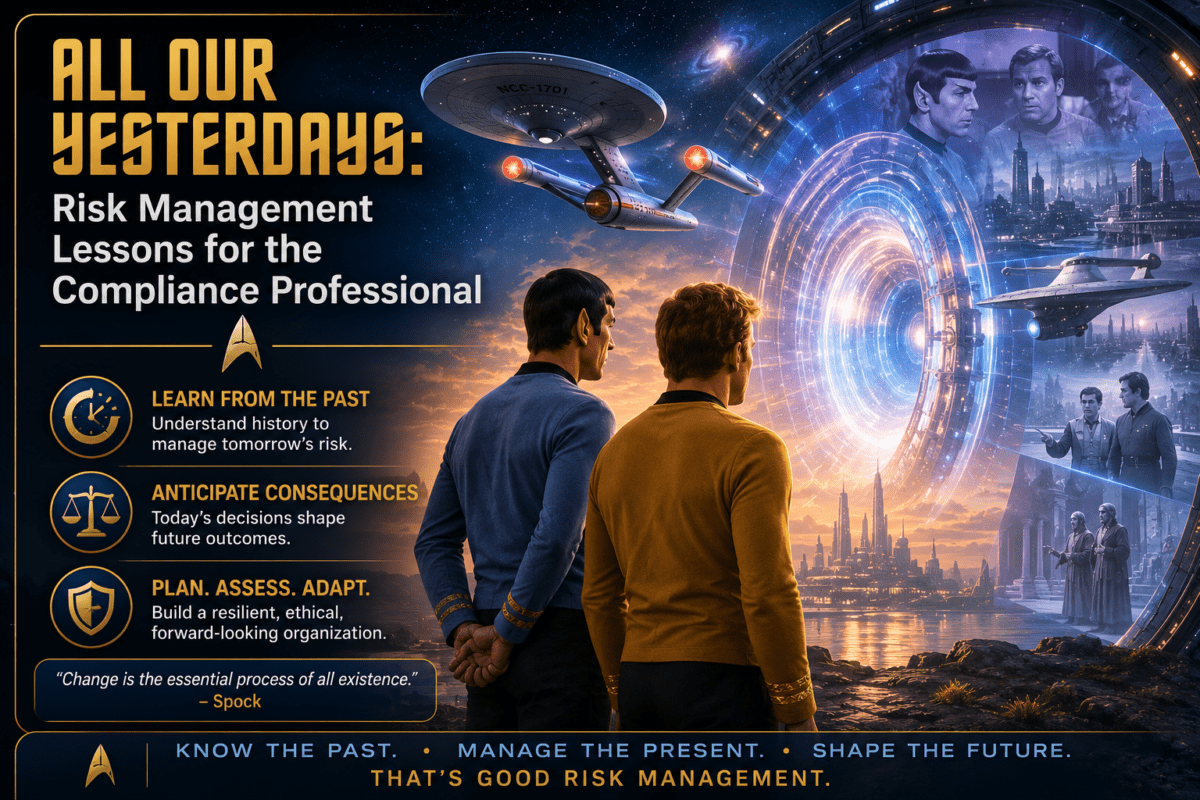
All Our Yesterdays: Risk Management Lessons for the Compliance Professional

When you think of Star Trek: The Original Series, certain episodes stand out for their moral clarity, exploration of ethics, and leadership lessons. Others, like All Our Yesterdays, are more subtle but no less rich in compliance and risk management insights.

In this episode, Captain Kirk, Mr. Spock, and Dr. McCoy beam down to the planet Sarpeidon just before its sun is about to go nova. They find the planet seemingly deserted except for a mysterious librarian named Mr. Atoz. He explains that the people have escaped into the planet’s past using a time travel device called the Atavachron. Unfortunately, in true Star Trek fashion, the landing party becomes separated; Kirk into a duel-filled era resembling the late Middle Ages, and Spock and McCoy into a frozen prehistoric wilderness.

As the story unfolds, the episode reveals more than just a sci-fi adventure; it presents a compelling case study in the importance of preparation, situational awareness, adaptability, and decision-making under pressure. For the compliance professional, All Our Yesterdays offers five key risk management lessons that are as relevant in the boardroom as they are in a time-portal crisis.

Lesson 1: Understand the Operating Environment Before You Act

Illustrated by: When Kirk, Spock, and McCoy first arrive, they assume the library is a static place in the present day. They don’t fully grasp that the Atavachron sends people into different periods, permanently altering them to survive there, until after they have stepped through the portals.

Compliance Lesson. One of the most preventable compliance failures happens when leaders act without fully understanding the operational landscape. Just as Kirk should have gathered more intelligence before stepping through the portal, compliance officers must conduct thorough due diligence before making high-impact decisions, especially in new markets or with new business models.

Jumping into a jurisdiction with unfamiliar regulatory structures or cultural norms without advance research can leave your compliance program operating with blind spots. A robust risk assessment, stakeholder mapping, and regulatory scan are your “Atavachron briefing”; without them, you’re walking through the wrong portal unprepared.

Lesson 2: Know the Long-Term Consequences of Your Decisions

Illustrated by: Atoz explains that once a traveler passes through the Atavachron, they undergo physiological changes to survive in the chosen period. Returning without those adaptations can be fatal. This means each journey into the past is not just a visit—it’s a permanent commitment.

Compliance Lesson. Compliance decisions, especially around risk tolerance, often have long-term and sometimes irreversible consequences. For example, approving a high-risk third party because “we need them for this deal” can embed systemic vulnerabilities that are difficult to unwind later.

Spock and McCoy’s plight in the ice age is a reminder that once certain paths are chosen, backing out may be impossible or costly. Before green-lighting any strategy or business partner, ask: What will be the long-term compliance footprint? Are we setting ourselves up for future exposure? Risk management is not just about the next quarter; it’s about the next decade.

Lesson 3: Adapt Your Strategy to Changing Conditions

Illustrated by Spock, under the influence of the prehistoric era, begins to revert to the more emotional mindset of ancient Vulcans, displaying anger, impatience, and even affection for Zarabeth, a woman trapped in that time. McCoy, ill from the cold, must rely on Spock’s shifting judgment to survive.

Compliance Lesson. Risk environments are dynamic. Market conditions shift, laws change, counterparties evolve, and cultural contexts can reshape behavior, sometimes subtly, sometimes dramatically. The compliance officer must be alert to these shifts and recalibrate strategies accordingly.

Like Spock, even seasoned professionals can find themselves influenced by their environment in ways they don’t immediately recognize. Compliance teams need to build monitoring systems that not only track external risk factors but also assess how those factors may be affecting decision-makers internally. Adaptation is not a sign of weakness—it’s a core competency in sustainable risk management.

Lesson 4: Factor in Human Behavior When Assessing Risk

Illustrated by: Zarabeth tells Spock and McCoy they can never return to their own time, a claim that at first appears to be based on Atoz’s rules but is also shaped by her emotional motives. Her loneliness influences how she frames the “facts.”

Compliance Lesson. Risk management isn’t just about numbers, metrics, or legal frameworks—it’s about people, their incentives, and their biases. Vendors may hide problems to protect their contracts. Employees may omit details in self-reporting to avoid blame. Executives may downplay risk to push through a deal.

Zarabeth’s well-intentioned but self-serving misinformation underscores the need for independent verification of claims. Compliance programs should be designed to collect and validate facts from multiple sources, reducing the risk of being swayed by the partial truths of a single stakeholder.

Lesson 5: Time Is a Critical Risk Variable

Illustrated by: The central urgency in All Our Yesterdays comes from the imminent nova of Sarpeidon’s sun. The people had to evacuate into the past before the moment of destruction; anyone left behind would perish. For Kirk, Spock, and McCoy, the clock is ticking.

Compliance Lesson. In compliance risk management, timing is often the difference between proactive control and reactive crisis. Delaying a decision, such as suspending a suspicious transaction, escalating a whistleblower report, or halting engagement with a questionable vendor, can mean the difference between a manageable incident and a reputational disaster.

The episode reinforces the importance of early detection and swift action. Compliance teams should have rapid-response protocols, much like an evacuation plan, that can be activated the moment credible risk signals appear. The longer you wait, the narrower your options become.

Final Compliance Reflections

All Our Yesterdays may be set in a science fiction universe, but its lessons are firmly grounded in the reality of corporate compliance. Every compliance officer will, at some point, face the equivalent of a ticking sun about to go nova, a high-stakes situation where incomplete information, shifting conditions, human bias, and the relentless march of time intersect.

The episode reminds us that effective risk management is not simply about having a well-written policy. It’s about equipping yourself and your team to:

  • Anticipate the terrain.
  • Weigh long-term consequences before stepping through the “portal.”
  • Stay agile under environmental pressures.
  • Test assumptions and verify information.
  • Act decisively when the moment demands it.

In All Our Yesterdays, Kirk, Spock, and McCoy return to the present just in time, thanks to quick thinking, adaptability, and the ability to work within and around constraints. In the corporate compliance world, those same skills can mean the difference between a controlled risk event and a full-blown regulatory disaster.

Remember, you may not have an Atavachron in your compliance toolkit, but you do have the power to choose which “yesterday” you’ll prepare for today. The right risk management approach ensures that, when the heat is on, your organization is not scrambling for the exit portal as it’s already where it needs to be.

 Resources:

⁠⁠Excruciatingly Detailed Plot Summary by Eric W. Weisstein⁠⁠

⁠⁠MissionLogPodcast.com⁠⁠

⁠⁠Memory Alpha

Categories
Blog

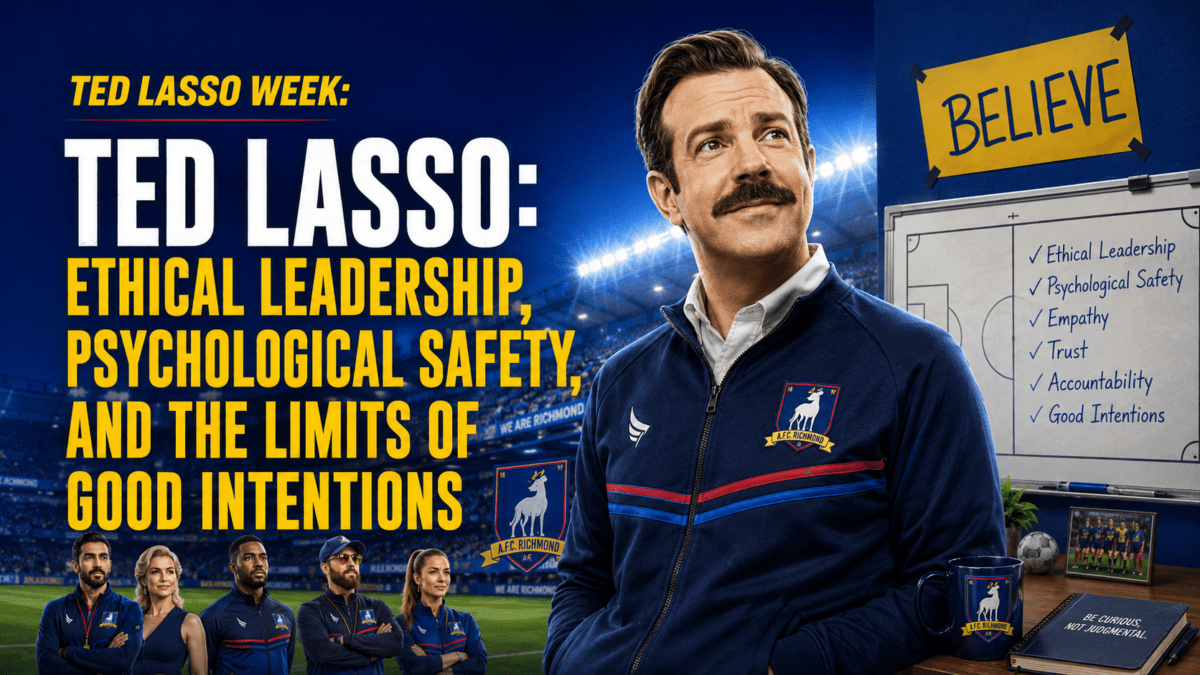
Ted Lasso Week: Part 1 – Ted Lasso: Ethical Leadership, Psychological Safety, and the Limits of Good Intentions

Season 4 of Ted Lasso has begun dropping (a new episode releases each Wednesday). Matt Kelly reposted a blog he wrote during the original run of the series and he and I did a deeper dive into the show and its popularity for compliance professional in an episode of Compliance into the Weeds. I decided to take a deep dive into five of the characters in the show and use them to explore compliance topics. Over the next 5 blogs posts I will consider team owner Rebecca Welton, Assistant Manager Nate Shelby, player and later coach Roy Kent and social media influencer Keely Jones. Today in Part 1 we begin with compliance lessons through the character of Ted Lasso.

Ted Lasso arrives at AFC Richmond with no meaningful knowledge of English football, a skeptical locker room, a hostile press, and an owner who secretly hired him to fail. On paper, he is an obvious control failure. In practice, he becomes the architect of Richmond’s cultural transformation.

For compliance professionals, that transformation is the point. Ted demonstrates how a leader can create trust, encourage candor, and turn values into daily behavior. He also demonstrates the limits of values-led leadership. Good intentions do not investigate misconduct. Empathy does not test a control. Forgiveness does not remediate a root cause.

The compliance lesson from Ted is not simply to “believe.” It is to build a culture in which belief is supported by accountability, information, controls, and oversight.

Culture Is What the Leader Does

Ted’s first contribution is not tactical. It is behavioral. He learns names, asks questions, listens to people with little formal authority, and treats the kit man, Nate Shelley, as a colleague whose observations matter. In “Trent Crimm: The Independent” (Season 1, Episode 3), Ted recognizes that Jamie Tartt and other players are humiliating Nate. Rather than deliver a speech about respect and move on, Ted engages Roy Kent, the informal leader whose intervention can change locker-room conduct.

That is tone at the top connected to conduct in the middle. The DOJ Evaluation of Corporate Compliance Programs (ECCP) asks how senior leaders and managers have encouraged compliance through their words and actions. It states in part “Beyond compliance structures, policies, and procedures, it is important for a company to create and foster a culture of ethics and compliance with the law at all levels of the company. The effectiveness of a compliance program requires a high-level commitment by company leadership to implement a culture of compliance from the middle and the top.”

The Principles of Federal Prosecution of Business Organizations (Justice Manual) likewise directs prosecutors to examine culture at all levels, including discipline, treatment of complaints, and incentives. 9.28.300 states in part prosecutors shall consider “the pervasiveness of wrongdoing within the corporation, including the complicity in, or the condoning of, the wrongdoing by individuals in corporate management”. In Section 9-28.800, it directs the DOJ to review a “company’s culture of compliance”.

Ted understands instinctively that culture does not travel through posters. It travels through managers, peer leaders, everyday decisions, and the behavior an organization tolerates. A chief compliance officer can publish a code. Only operational leaders can make that code real during the meeting, on the sales call, and inside the locker room.

Psychological Safety Requires a Response System

Ted creates space for people to speak before they have status. He accepts tactical input from Nate, invites dissent from Coach Beard, and builds the Diamond Dogs as an informal forum for candid discussion. By “La Locker Room Aux Folles” (Season 3, Episode 9), Richmond is capable of confronting Colin Hughes’s sexuality and Isaac McAdoo’s reaction with empathy. Ted initially hears the team’s claim that Colin’s identity makes no difference, then corrects the underlying message: the team should care because Colin’s experience matters.

This is psychological safety in practice. Employees must be able to raise a concern, disclose vulnerability, or challenge a decision without humiliation or retaliation. Yet a compliance program needs more than an approachable leader. Equally importantly a culture of Speak Up must be paired with a culture of Listen Up.

Richmond relies heavily on Ted’s availability and temperament. That is a strength while Ted is present and a key-person risk when he is absent. A mature speak-up program requires intake standards, anti-retaliation controls, escalation criteria, case tracking, trend analysis, and board reporting. An open door is valuable. It is not an operating system.

Accountability Must Apply to Stars and Friends

Ted’s strongest accountability moment comes in “Tan Lines” (Season 1, Episode 5), when he benches Jamie after the star player refuses to follow the team’s approach. Ted chooses collective standards over short-term performance. That is exactly the decision many organizations avoid when the employee at issue is a top salesperson, rainmaker, founder, or executive.

He is less decisive when loyalty clouds his judgment. In “All Apologies” (Season 1, Episode 9), Beard and Nate press Ted to confront Roy’s declining performance. Ted initially resists, even though the competitive risk is visible. He eventually has the necessary conversation and gives Roy a dignified path to support the team from the bench.

The contrast matters. DOJ asks whether discipline is applied consistently and whether the company tolerates misconduct by high performers. Compliance credibility collapses when consequences depend on revenue, rank, or personal affection. Ethical leadership is not the absence of hard decisions. It is the willingness to make them fairly and explain the standard.

Forgiveness Is Not Remediation

Rebecca’s confession in “All Apologies” presents Ted’s greatest strength and clearest compliance blind spot. She admits that she hired him to fail, manipulated club decisions, and used people as instruments in her campaign against Rupert. Ted forgives her immediately.

At a human level, the scene is powerful. At an organizational level, forgiveness cannot close the matter. Richmond would still need to establish what happened, preserve evidence, identify affected decisions, assess financial and stakeholder harm, determine whether others participated, evaluate disclosure obligations, and strengthen governance.

The US Sentencing Guidelines require organizations to respond appropriately after misconduct and take steps to prevent recurrence. DOJ similarly focuses on root-cause analysis, remediation, and whether control improvements are tested. Ted offers grace, which can support rehabilitation. He does not create a record showing that the organization learned from the failure.

This distinction should matter to every CCO: mercy concerns the person; remediation concerns the institution. A company may do both. It cannot substitute one for the other.

Vulnerability Can Strengthen the Control Environment

Ted’s panic attacks show the cost of a culture in which even a supportive leader believes he must appear invulnerable. His attack during karaoke in “Make Rebecca Great Again” (Season 1, Episode 7) remains largely private. In “Headspace” and “Man City” (Season 2, Episodes 7 and 8), he finally engages with Dr. Sharon Fieldstone and begins addressing the trauma connected to his father’s suicide. After Nate leaks his panic attack to the press, Ted speaks honestly to the team and the public in “Inverting the Pyramid of Success” (Season 2, Episode 12).

Leaders retain legitimate medical privacy. The compliance point is not compelled disclosure. It is that organizations need trusted support channels, succession and contingency plans, and an environment in which asking for help is not treated as weakness. Ted’s eventual candor reduces stigma. His earlier concealment creates an information vacuum that Nate weaponizes.

Within the COSO Internal Control Framework, Ted materially improves the control environment and information and communication. Richmond’s weakness is monitoring. Warning signs involving Nate, including humiliation of subordinates, resentment, and escalating hostility, do not reach a reliable response process before he leaks Ted’s health information and leaves for West Ham.

The Final Test Is Whether Culture Outlasts the Leader

By Season 3, Ted increasingly shifts from hero to system builder. “Sunflowers” and “The Strings That Bind Us” (Season 3, Episodes 6 and 7) show Richmond developing Total Football through shared learning, role flexibility, and trust. In “So Long, Farewell” (Season 3, Episode 12), Ted leaves, but Roy, Beard, Rebecca, Higgins, and the players can carry the culture forward.

That is the institutional test. A compliance program that depends on one charismatic executive is not sustainable. Caremark oversight principles require boards to make a good-faith effort to establish and monitor information and reporting systems, particularly around mission-critical risks, as the Delaware Supreme Court emphasized in Marchand v. Barnhill (the Bluebell Ice Cream case). Ted changes Richmond’s values. Governance must ensure that those values become repeatable processes, reliable information, and accountable decisions.

Practical Takeaways for CCOs 

Ted Lasso offers five questions for a CCO and compliance team:

  1. Do employees trust leaders, and can the organization demonstrate that concerns receive a consistent response?
  2. Are high performers held to the same behavioral standards as everyone else?
  3. When misconduct occurs, does forgiveness follow investigation and remediation rather than replace them?
  4. Are managers trained and monitored as culture carriers, especially after promotion?
  5. Would the speak-up culture and compliance program remain effective if a trusted leader departed tomorrow?

Ted’s enduring lesson is that ethical culture begins with human connection. Effective compliance begins there as well, but it cannot end there. Richmond becomes stronger when curiosity replaces judgment, candor replaces silence, and team standards replace individual entitlement. The next step for any real organization is to convert those behaviors into controls that can be tested, monitored, reported, and sustained.

Join us tomorrow in Part 2, as we turn to Rebecca Welton, whose decision to use AFC Richmond as an instrument of personal revenge reveals the risks created when concentrated authority operates without independent challenge. We will examine executive conflicts, institutional remediation, and Rebecca’s transformation from conflicted owner to accountable steward by requiring governance capable of holding power to account.