Categories
Blog

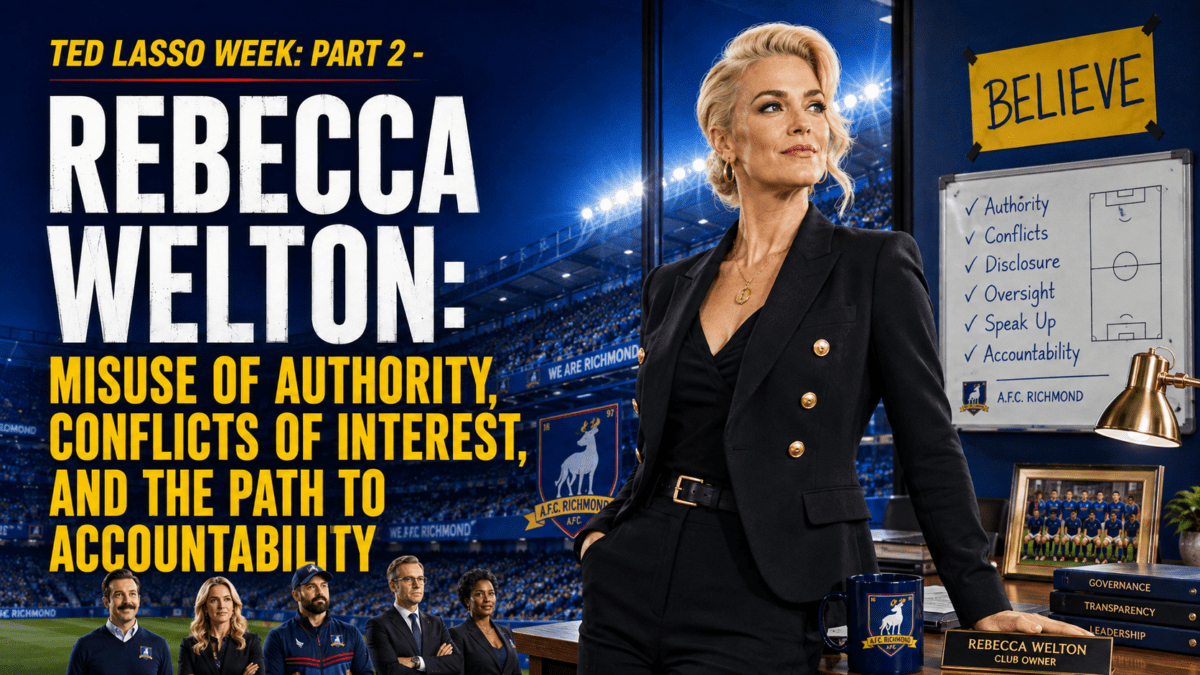
Ted Lasso Week: Part 2 – Rebecca Welton: Misuse of Authority, Conflicts of Interest, and the Path to Accountability

Season 4 of Ted Lasso is out. Matt Kelly reposted a blog he wrote during the original run of the series, and he and I did a deeper dive into the show and its popularity for compliance professionals in an episode of Compliance into the Weeds. I decided to take a deep dive into five characters from the show and use them to explore compliance topics. Over five blog posts, I will consider Manager Ted Lasso, Assistant Manager Nate Shelley, player and later coach Roy Kent, and social media influencer Keeley Jones. Today in Part 2, we consider compliance lessons through the character of team owner Rebecca Welton.

In Part 1, we considered how Ted Lasso built psychological safety and an ethical culture while sometimes allowing empathy to outrun accountability. Rebecca Welton presents the problem from the other side of the executive table. She begins as the source of AFC Richmond’s misconduct, then becomes the leader best positioned to acknowledge it.

Rebecca’s story is not simply a redemption arc. It is a governance case study about what happens when personal objectives capture corporate authority. It also shows why confession, forgiveness, and improved behavior are necessary but insufficient elements of an effective remediation program. The compliance lesson is direct: power creates risk when no independent mechanism can question the person exercising it.

When the Owner Becomes the Risk

In “Pilot” (Season 1, Episode 1), Rebecca hires Ted, an American football coach with no soccer experience, to manage a Premier League club. Her stated rationale is irrelevant because her actual purpose is to destroy the institution Rupert Mannion loves. She uses Richmond’s people, reputation, competitive position, and financial value to pursue a private grievance.

That is a classic conflict between personal interest and organizational duty. Rebecca is not accepting an envelope of cash or steering a contract to a relative. Her conflict is more fundamental: she has converted corporate decision-making into an instrument of revenge. The COSO Internal Control Framework begins with the control environment, including integrity, ethical values, oversight, authority, and accountability. At Richmond, the control environment fails at the top. The owner sets an improper objective, possesses the authority to execute it, and faces no visible independent challenge.

Compliance officers should take note. Conflicts of interest do not end with disclosure forms. They arise whenever personal relationships, status, resentment, financial incentives, or outside interests can distort business judgment. The greater the executive’s authority, the stronger the required safeguards.

Concentrated Authority Silences Challenge

Rebecca’s plan requires assistance. Higgins facilitates her agenda even though he recognizes the harm. In “Make Rebecca Great Again” (Season 1, Episode 7), Rebecca arranges for a photographer to capture Ted and Keeley in a compromising image. The objective is not legitimate media strategy. It is manufactured reputational damage intended to destabilize Ted and the club.

Higgins is not merely an unfortunate bystander. He is a senior employee who allows access, information, and organizational machinery to serve the owner’s improper purpose. His eventual resignation is a delayed act of conscience, but the episode demonstrates how authority can corrupt the escalation process. Employees may know that conduct is wrong and still conclude that challenging the owner is futile or career-ending.

The DOJ Evaluation of Corporate Compliance Programs asks whether “compliance personnel (1) sufficient qualifications, seniority, and stature (both actual and perceived) within the organization; (2) sufficient resources, namely, staff to undertake the requisite auditing, documentation, and analysis effectively; and (3) sufficient autonomy from management, such as direct access to the board of directors or the board’s audit committee.” It also asks whether managers encourage or discourage compliance through their conduct. Richmond has no credible independent function capable of reviewing Rebecca’s decisions, investigating her conduct, or escalating around her.

Accountability Begins With Truth

Keeley becomes the effective speak-up channel Richmond lacks. Once she discovers Rebecca’s scheme, she does not accept friendship, hierarchy, or reputational risk as reasons to stay silent. She insists that Rebecca tell Ted the truth. Rebecca finally does so in “All Apologies” (Season 1, Episode 9). She admits that she hired Ted to fail, orchestrated the paparazzi scheme, and engineered Jamie Tartt’s return to Manchester City to weaken Richmond. Most importantly, she does not minimize her purpose. She explains that she wanted to hurt Rupert and used Ted and the club to do it.

This is an effective apology because it identifies conduct, intent, and harm. It also accepts the possibility of consequences. Yet it is not a remediation. Nevertheless, Ted forgives her immediately, but an actual organization could not stop there. The U.S. Sentencing Guidelines require an organization to respond appropriately after misconduct and take reasonable steps to prevent similar conduct. DOJ asks whether the company performed a root-cause analysis, disciplined responsible individuals, repaired controls, and tested whether remediation works.

Richmond would need an independent review of affected personnel decisions, financial consequences, sponsor and stakeholder impacts, the use of confidential information, and Higgins’s role. It would also need governance changes that prevent one executive from repeating the conduct. An apology can reopen trust. Only remediation can reduce recurrence risk.

The Conflict Problem Returns With Sam

Rebecca’s growth does not eliminate conflicts. In “The Signal” and “Headspace” (Season 2, Episodes 6 and 7), Rebecca discovers that her anonymous Bantr match is Sam Obisanya, a Richmond player. Their relationship develops in “Man City” (Season 2, Episode 8) and continues secretly into “No Weddings and a Funeral” (Season 2, Episode 10).

The relationship is portrayed with warmth and mutual affection. That does not resolve the organizational issue. Rebecca owns the club that controls Sam’s employment environment. Her decisions can affect contracts, playing resources, sponsorships, reputation, and career opportunities. Even if she never exercises that power improperly, the imbalance creates an appearance of favoritism and raises questions about consent, retaliation, confidentiality, and recusal.

The compliance response is not moral judgment. It is a process. A conflict policy must apply to owners and senior executives, not only employees. Disclosure should go to an independent board member or committee. The organization should document safeguards, remove the conflicted leader from relevant decisions, protect the less powerful party, and monitor for retaliation or preferential treatment. Rebecca eventually pauses the relationship, but Richmond never appears to activate a formal conflict-management process. Personal restraint is not a control.

From Personal Ownership to Stewardship

Rebecca’s leadership changes when she stops treating Richmond as property and begins treating it as an institution held in trust for others. In “Do the Right-est Thing” (Season 2, Episode 3), Sam protests sponsor Dubai Air because of its connection to environmental damage in Nigeria. Rebecca backs the players despite the commercial risk. She recognizes that sponsorship revenue does not outrank organizational values.

Her transformation is clearest in “International Break” (Season 3, Episode 10). Edwin Akufo invites elite club owners to join an exclusive league built around scarcity, control, and profit. Rebecca rejects the proposal by reminding the room that football belongs to the people whose lives and communities give it meaning. She chooses stakeholder legitimacy over a lucrative insiders’ arrangement.

In “So Long, Farewell” (Season 3, Episode 12), she completes that shift by selling 49 percent of Richmond to its supporters. The woman who once used the club as a weapon ultimately distributes part of its ownership to the community.

This is what ethical remediation should seek: not a return to the status quo, but a more accountable operating model.

Questions for CCOs

Rebecca’s journey should prompt five questions:

  1. Can an allegation against the CEO, founder, controlling shareholder, or board chair bypass that person and reach an independent decision-maker?
  2. Do conflict rules cover personal relationships, vendettas, reputational motives, and executive discretion, or only financial interests?
  3. When senior misconduct occurs, who controls the investigation, discipline, disclosure, and remediation plan?
  4. Does the board receive reliable information about culture and mission-critical risks without management filtering?
  5. Are remediation measures tested, documented, and sustained after the responsible leader apologizes?
  6. Rebecca Welton shows that leaders can change. Compliance must make that change governable. Trust is rebuilt when truth is followed by independent review, proportional accountability, control improvements, and evidence that the organization learned.

Next Up: Nate Shelley and Culture Risk

Rebecca’s failure begins with power concentrated at the top. Nate Shelley’s failure develops lower in the organization, where insecurity, humiliation, status, and unaddressed resentment turn a once-overlooked employee into a destructive manager and trusted insider. In Part 3, we will examine the warning signs Richmond missed, the consequences of promoting technical talent without preparing them to lead, and why a speak-up culture must detect harm committed by newly empowered employees as readily as misconduct committed by executives.


Categories
Daily Compliance News

Daily Compliance News: March 25, 2026, The Deadlocked Jury Edition

Welcome to the Daily Compliance News. Each day, Tom Fox, the Voice of Compliance, brings you compliance-related stories to start your day. Sit back, enjoy a cup of morning coffee, and listen in to the Daily Compliance News. All, from the Compliance Podcast Network. Each day, we consider four stories from the business world, compliance, ethics, risk management, leadership, or general interest for the compliance professional.

Top stories include:

  • FirstEnergy bribery jury deadlocked. (Ohio Capital Journal)
  • Trades bet over $500MM on oil immediately before the Trump announcement. (FT)
  • EU nearing decision on Google and EU competition law violation. (WSJ)
  • Lawmakers move to ban sports betting in prediction markets. (WSJ)
Categories
Daily Compliance News

Daily Compliance News: March 20, 2026, The Flight Corridor Risk Edition

Welcome to the Daily Compliance News. Each day, Tom Fox, the Voice of Compliance, brings you compliance-related stories to start your day. Sit back, enjoy a cup of morning coffee, and listen in to the Daily Compliance News. All, from the Compliance Podcast Network. Each day, we consider four stories from the business world, compliance, ethics, risk management, leadership, or general interest for the compliance professional.

Top stories include:

  • Why did the lead investigator not testify in the FirstEnergy trial? (Cleveland.com)
  • The Nigerian ABC commission pays money back to NNPC. (Business Insider Africa)
  • Flight corridors and risk management. (NYT)
  • COI, corruption, and more in the Paramount deal. (WSJ)
Categories
Daily Compliance News

Daily Compliance News: January 20, 2026, The First We Kill All the Lawyers Edition

Welcome to the Daily Compliance News. Each day, Tom Fox, the Voice of Compliance, brings you compliance-related stories to start your day. Sit back, enjoy a cup of morning coffee, and listen in to the Daily Compliance News. All, from the Compliance Podcast Network. Each day, we consider four stories from the business world, compliance, ethics, risk management, leadership, or general interest for the compliance professional.

Top stories include:

  • Those fighting corruption are under attack. (NYT)
  • Lawyers are endangered in the US. (FT)
  • DOJ to eliminate lawyers’ recusals from conflicts. (MTN)
  • Trump attacks the legal profession in the 2025 review. (EFF)
Categories
FCPA Compliance Report

FCPA Compliance Report – Navigating Corporate Ethics and Compliance Trends in 2026 with Mike Volkov, Part 2

Welcome to the award-winning FCPA Compliance Report, the longest-running podcast in compliance. In this inaugural episode of 2026, Tom Fox welcomes back his good friend and colleague, Mike Volkov, to reflect on the tumultuous year of 2025 and discuss the new trends for the upcoming year. This is Part 2 of a two-part series.

This episode delves into the significance of the False Claims Act (FCA) as a critical tool for government enforcement, discussing its constitutionality and potential outcomes before the Supreme Court. The conversation expands to discuss how FCA applies across various areas, such as trade enforcement and tariffs, and how it encourages corporate whistleblowing. Additionally, the discussion highlights the growing role of technology, AI, and ChatGPT in compliance, as well as the risks associated with their use. Other focal points include the importance of conflict-of-interest programs and the impact of ethical conduct on marketplace dynamics. The episode underlines the growing scrutiny from financial institutions and private equity over compliance practices, as well as the long-term trend towards a more ethics-driven corporate culture.

Key highlights:

  • Supreme Court and Constitutionality Issues on the FCA
  • Corporate Whistleblowers and DOJ’s Stance
  • Technology, AI, and Compliance Risks
  • Conflict of Interest and Ethical Culture
  • Marketplace Accountability and Corporate Reputation
  • Financial Institutions and Due Diligence

Resources:

Mike Volkov on LinkedIn

Volkov Law Group

Tom Fox

Instagram

Facebook

YouTube

Twitter

LinkedIn

Categories
Daily Compliance News

Daily Compliance News: January 14, 2026, The Ghost of Odebrecht Edition

Welcome to the Daily Compliance News. Each day, Tom Fox, the Voice of Compliance, brings you compliance-related stories to start your day. Sit back, enjoy a cup of morning coffee, and listen in to the Daily Compliance News. All, from the Compliance Podcast Network. Each day, we consider four stories from the business world, compliance, ethics, risk management, leadership, or general interest for the compliance professional.

Top stories include:

  • Why didn’t Trump think of this? (Haaretz) sub req’d
  • Former Panamanian President goes on trial for corruption. (KTBS)
  • What is a COI (Part 359)? (FT)
  • SEC punts on yet another fraud case. (Reuters)
Categories
Daily Compliance News

Daily Compliance News: October 23, 2025, The Stay in Your Lane Edition

Welcome to the Daily Compliance News. Each day, Tom Fox, the Voice of Compliance, brings you compliance-related stories to start your day. Sit back, enjoy a cup of morning coffee, and listen in to the Daily Compliance News. All, from the Compliance Podcast Network. Each day, we consider four stories from the business world, compliance, ethics, risk management, leadership, or general interest for the compliance professional.

Top stories include:

  • More on BCG protocols. (WSJ)
  • Avoiding AI slop at work. (FT)
  • No Conflict of Interest here. (Reuters)
  • Belgian-EU prosecutor’s cross swords. (Euractiv)

The Daily Compliance News has been honored as the No. 2 in the Best Regulatory Compliance Podcast category.

Categories
Daily Compliance News

Daily Compliance News: July 11, 2025, The What is a COI Edition

Welcome to the Daily Compliance News. Each day, Tom Fox, the Voice of Compliance, brings you compliance-related stories to start your day. Sit back, enjoy a cup of morning coffee, and listen in to the Daily Compliance News, all from the Compliance Podcast Network. Every day, we consider four stories from the business world, compliance, ethics, risk management, leadership, or general interest for the compliance professional.

Top compliance stories:

  • NFLPA head works for private equity. (ESPN)
  • UK to ban NDAs. (Bloomberg)
  • Turkey uses corruption claims to arrest opponents. (Reuters)
  • Bid-rigging in stadium development. (WSJ)

You can donate to flood relief for victims of the Kerr County flooding by going to the Hill Country Flood Relief here.

Categories
Blog

The Bre-X Mining Scandal: Part 5 – A Guide for the 2024 Compliance Professional (Part 1)

As we close out this series on the Bre-X mining scandal, the lessons from this notorious case continue to resonate, especially for today’s compliance professionals. The fraud that led to the downfall of Bre-X and the ensuing financial catastrophe for countless investors serves as a stark reminder of the pivotal role compliance plays in maintaining the integrity of any business. This two-part conclusion will explore the critical takeaways for compliance professionals in 2024. In Part 1, I focus on due diligence, transparency, corporate governance, conflict of interest, and regulatory compliance.

The Importance of Rigorous Due Diligence

If Bre-X taught us anything, it is the value of relentless due diligence. In today’s fast-paced business environment, where misinformation can spread like wildfire and trust is fragile, compliance professionals must maintain an unwavering commitment to fact-checking and independent verification.

Verification of Claims. Compliance officers are the gatekeepers of corporate integrity. The Bre-X scandal is a textbook case of what happens when claims are accepted at face value without proper scrutiny. In 2024, ensuring that all claims—whether they pertain to financial projections, resource estimates, or technological capabilities—are rigorously verified by qualified third parties is more crucial than ever. This due diligence must extend beyond simple paper trails; it requires thorough, boots-on-the-ground verification.

Third-Party Validation. One of the core failures in the Bre-X case was the reliance on internal data, which went unchecked. Today’s compliance landscape demands an external layer of assurance. Relying solely on the company’s self-reported information can be perilous. Independent third-party audits, validation, and assessments are no longer optional; they prevent corporate fraud. External experts often see red flags insiders miss due to oversight or willful blindness.

Transparency and Accurate Reporting

Transparency is the lifeblood of compliance, and the Bre-X scandal illustrates what happens when companies stray from this fundamental principle. The fine line between optimism and misleading information can be blurry, but compliance officers must ensure this line is never crossed.

Clear and Honest Disclosure. Today’s compliance professionals must act as the arbiter of clear and accurate corporate disclosure. More is needed to provide minimal information that technically complies with regulations; companies must fully disclose material facts related to their performance, risks, and operational realities. Bre-X misled investors with rosy projections based on fraudulent data. Modern compliance teams must guard against the temptation to oversell the company’s prospects or downplay significant risks.

Avoiding Misleading Information. The Bre-X debacle warns about the dangers of making exaggerated or false claims to investors and stakeholders. In 2024, compliance professionals must adopt a zero-tolerance stance toward misleading information. This requires close collaboration with all departments, ensuring financial reports, press releases, and investor communications are fact-checked, realistic, and grounded in verifiable data. The role of compliance in safeguarding against exaggeration or outright deception cannot be overstated.

Strengthening Corporate Governance

One of the critical failures in the Bre-X case was weak corporate governance. As companies grow in complexity, ensuring robust oversight from the boardroom down is essential.

Effective Oversight. Boards of directors must not only be present; they must be actively engaged in the business. The Bre-X scandal exposed how passive oversight can contribute to unchecked fraud. Compliance professionals should ensure that board members, especially independent ones, are empowered to ask tough questions and hold management accountable. In 2024, compliance officers should push for regular, thorough reviews of corporate governance practices, ensuring that the board remains active in safeguarding the company’s integrity.

Separation of Duties. Another key lesson from Bre-X is the need for a clear separation of duties. The concentration of power in a few individuals, especially in processes like reporting geological results, led to unchecked manipulation. Modern compliance frameworks must ensure no single person holds too much sway over critical processes. In areas such as financial reporting or resource assessments, compliance professionals must establish checks and balances that prevent conflicts of interest and reduce the risk of fraud.

Understanding and Mitigating Conflict of Interest

Bre-X was rife with conflicts of interest that, had they been addressed, might have mitigated the extent of the damage. In 2024, compliance professionals must be vigilant in identifying and managing potential conflicts at all levels of the organization.

Identifying Conflicts. Conflicts of interest can undermine the integrity of any organization through personal financial gain, favoritism, or unaddressed personal relationships. Compliance officers must develop robust mechanisms for identifying and addressing conflicts before they escalate. In the Bre-X case, certain individuals stood to personally gain from inflated stock prices directly conflicting with their fiduciary duties. Modern-day compliance professionals must establish clear conflict-of-interest policies and ensure these are consistently enforced.

Establishing Clear Policies. It is not enough to identify conflicts; companies must have clear policies and procedures to manage them. This includes mandatory disclosures, regular audits, and a strong ethical culture encouraging employees to report potential conflicts. Employees should be trained to recognize conflicts of interest and be empowered to raise concerns without fear of retaliation. The Bre-X scandal reminds us that an unaddressed conflict of interest can lead to catastrophic outcomes for all stakeholders.

Enhanced Focus on Regulatory Compliance

Finally, the Bre-X scandal illustrates the importance of adhering to industry standards and anticipating regulatory changes. In the wake of Bre-X, Canada introduced NI 43-101, a set of strict guidelines for reporting mineral resources. The lesson here is that compliance professionals must stay current with regulations and be proactive in their approach.

Adhering to Industry Standards. In 2024, industry standards are constantly evolving. Whether environmental regulations, data privacy laws, or sector-specific standards like NI 43-101, compliance professionals must ensure that their organizations are always fully compliant. This requires staying informed about changes in the regulatory landscape and ensuring that the company’s internal practices are aligned with the latest requirements.

Proactive Compliance. Compliance officers should take a proactive approach rather than waiting for regulations to change. This includes monitoring industry trends, participating in industry working groups, and maintaining open lines of communication with regulators. Proactive compliance can prevent costly legal battles and protect the company’s reputation.

The Bre-X mining scandal remains a cautionary tale for compliance professionals, and the lessons learned from this case are more relevant than ever in 2024. By emphasizing rigorous due diligence, transparency, corporate governance, conflict of interest management, and proactive regulatory compliance, compliance officers can help safeguard their organizations against fraud and mismanagement that led to Bre-X’s downfall.

In Part 2 of this series, we will conclude this blog post by diving deeper into the evolving role of technology and how it has transformed the compliance landscape, offering new tools and challenges for today’s compliance professionals. Join us tomorrow.

Categories
Daily Compliance News

Daily Compliance News: July 16, 2024 – The Leisure Sickness Edition

Welcome to the Daily Compliance News. Each day, Tom Fox, the Voice of Compliance, brings you compliance-related stories to start your day. Sit back, enjoy a cup of morning coffee and listen to the Daily Compliance News. All from the Compliance Podcast Network.

Each day, we consider four stories from the business world: compliance, ethics, risk management, leadership, or general interest for the compliance professional.

In today’s edition of Daily Compliance News:

  • Are you getting sick when you have time off? (FT)
  • An ex-bankruptcy judge is now under criminal investigation.  (WSJ)
  • The X lawyers kicked off the case.  (Reuters)
  • Ex-Mozambique minister to stand trial in the US over tuna-bond fraud. (Bloomberg)

For more information on the Ethico ROI Calculator and a free White Paper on the ROI of Compliance, click here.