Categories
FCPA Compliance Report

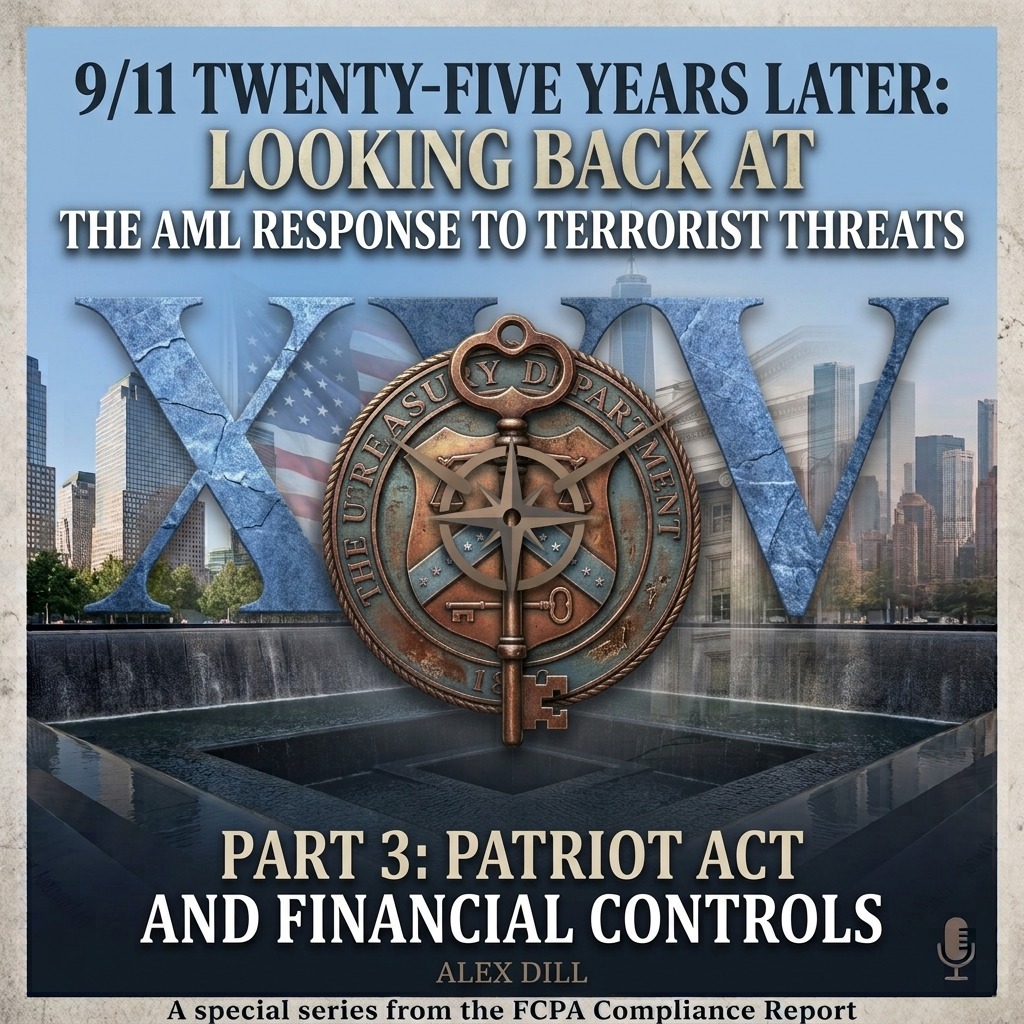
9/11 Twenty-Five Years Later: Part 3: Alex Dill – Patriot Act: The AML Response to Terrorist Threats

Ed. Note: Five years ago, Tom Fox looked back on 9/11 in a 20-year retrospective. This week is the 25th anniversary of that event. We will be rerunning this award-winning podcast so we never forget.

On the 20th anniversary of the 9/11 terrorist attack, Tom Fox and guests look back on the tragic event and what it meant for them personally, as well as how it impacted the world of compliance. Today Tom’s guest is Alex Dill. Alex is a scholar and professor specializing in financial regulation, risk management, and compliance. He also has corporate experience in ​the ethics of business practices in finance, bankruptcy, bond covenants, and debt markets. He joins Tom to discuss the Patriot Act’s impact on responding to terrorist threats.

How 9/11 Changed AML

Before 9/11, AML regulations were very lax and backward-looking. The focus was on prosecuting crimes already committed and on money laundering more than on terrorist financing. Banks weren’t doing meaningful customer due diligence because they felt the process was invasive. After 9/11, this all changed. Law enforcement agencies and financial institutions revamped their policies and procedures to take a more preventive approach to AML and terrorist financing. This led to the Patriot Act.

The Financial Response

Tom asks Alex whether he saw a similar regulatory response among non-financial institutions regarding Patriot Act AML procedures post-9/11. “There was a huge amount of rulemaking that had to be done,” Alex responds. He adds that public companies adopted customer due diligence and applied it more broadly across sectors, using a risk-based approach. Companies now had to file suspicious activity reports, not just banks. Customer identification was also introduced. “The Patriot Act sought to encourage cooperation among law enforcement agencies and among the financial institutions themselves to share information and obtain information from foreign law enforcement authorities,” Alex tells Tom.

The Challenge With The Patriot Act 

Alex explains to Tom that the Patriot Act has challenges. A major challenge is detecting the financing behind these attacks. Funds that finance these actions come from both legal and illegal sources, and that is a major issue. Transaction amounts can be small, which may pose a risk for some compliance officers. 

Technology in Anti-Terrorism

Alex remarks that technology is very important in the fight against terrorism, as it has changed how we function in our world. The downside is that technology has also helped create some of the compliance issues we face today. Social media platforms have helped to create polarization in society, and criminals have used programs like cryptocurrency for money laundering and financing terrorism. However, Alex ends on a positive note, saying the AML Act of 2020 has been helping curb these issues.

Resources:

Alex Dill | LinkedIn | Twitter

Categories
FCPA Compliance Report

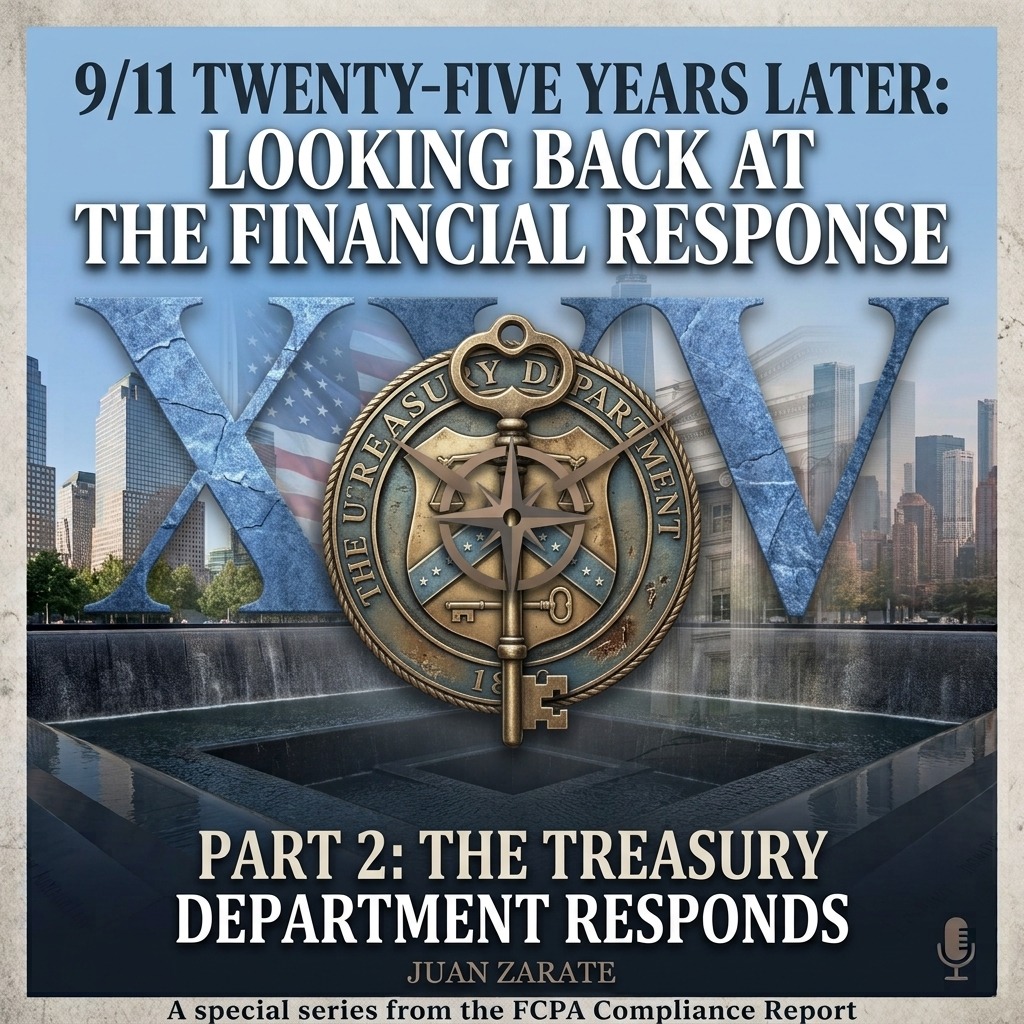
9/11 Twenty-Five Years Later: Part 2: Juan Zarate – The Treasury Department Responds

Ed. Note-Five years ago, I looked back on 9/11 in a 20 year retrospective. This week is the 25th anniversary of that event. I am rerunning this award winning podcast so that we never forget.

On the 20th anniversary of the 9/11 terrorist attack, Tom Fox and guests look back on the tragic event and what it meant for them personally, as well as how it impacted the world of compliance. Juan Zarate is the Global co-Managing Partner and Chief Strategy Officer at K2 integrity. On 9/11 he was a prosecutor at the Treasury Department working on international enforcement issues, anti money laundering, anti-corruption and anti-terrorist financing. He joins Tom Fox to commemorate the 20th anniversary of 9/11. They discuss how his role changed, the Treasury Department response and what the tragic event means for him.

A Change of Mission

9/11 changed the mission of the Treasury Department. Juan tells Tom, “We went after terrorist financing to try to disrupt and dismantle Al-Qaeda’s terrorist networks and infrastructure, and disrupt how illicit financing was flowing through the international system.” He recalls where he was on the fateful day and how seeing the smoke from the Towers and the Pentagon affected him emotionally. Something very different was happening, he recalls; the country was under attack.

He outlines the strategic, departmental and tactical changes implemented after 9/11 to fight terrorism. The President declared that we were now at war. “The attitude and the strategic direction of the government was [that] we now have to prevent terrorist attacks,” Juan recalls. “We have to disrupt and dismantle terrorist networks. And that led to an entire preventative paradigm for the counter-terrorism approach to the government.” The new mission of the Treasury Department was the following areas, Juan remarks: “How do you use financial information more aggressively? How do we think about the use of tools and authorities that the Treasury has, like sanctions, anti money laundering rules? How do we think about the relationships internationally with central banks, finance ministries? How do we get the world on board to disrupt terrorist financing, to rip these organizations out of the legitimate financial commercial world?” The Patriot Act was one tactical change, among others, that was implemented to achieve the new mission of fighting terrorism.

What 9/11 Means

Tom asks Juan, “What are your reflections now as we come up on the 20th anniversary of the day of 9/11, and really what it meant for America and for you 20 years later?” Juan responds that he has mixed emotions. He thinks about the victims and their families first of all. That day changed history, he says. “It changed the way that the U S government viewed the world. It changed the way that we operated our strategy. And it changed the sense of our vulnerability.” The recent events in Afghanistan make the 20th anniversary even more difficult for Juan. “I have very mixed emotions coming on the 20th anniversary of 9/11,” he concludes, “but I’m very proud of the work that we did. I’m proud of the people I served with and my sympathies go out to the victims and their families.”

Resources

Juan Zarate at ⁠K2 Integrity⁠

Categories
FCPA Compliance Report

9/11 Twenty-Five Years Later: Part 1: Gabe Hidalgo – Needing to Make a Difference

Ed. Note-Five years ago, I looked back on 9/11 in a 20 year retrospective. This week is the 25th anniversary of that event. I am rerunning this award winning podcast so that we never forget.

On the 20th anniversary of the 9/11 terrorist attack, Tom Fox and guests look back on the tragic event and what it meant for them personally, as well as how it impacted the world of compliance. Tom’s first guest this week is Gabe Hidalgo, anti money laundering compliance expert, who shares how the events of that fateful day changed the course of his career.

Looking Back

Gabe – who worked as outside counsel for insurance companies at the time – remembers turning on YahooTV as soon as he got to his office on 9/11 and seeing the second plane hit the World Trade Towers. He knew immediately that it was a deliberate attack. “I knew that this was kind of a hallmark moment,” he tells Tom, “that this was not an accident.” He details leaving the office in haste to get to his pregnant wife, and the obstacles and roadblocks he faced on the way. When they finally reunited at home, they were overcome with emotion. He remembers feeling gutted thinking about the unborn children who would grow up never knowing their fathers.

Needing to Do Something

Gabe needed to do something more than just shed tears about 9/11, he tells Tom. He started to think about how he could use his skills as an attorney. “I went down the path of looking in private industry, what I can do, and came across anti money laundering compliance, which I thought was fascinating. And I said to myself, I need a way for me to be able to get into that so that I can start making a difference.” He shares his journey into the field, and that it was exactly the right time and the right fit for him. 9/11 was a wake up call for America, he remarks. It made us realize that we need to do whatever we can to prevent anything similar from happening again.

Evolution of AML Since 9/11

Tom asks Gabe how AML compliance has advanced since 9/11. It’s much more difficult for terrorist financiers to move funds now, he responds. “A lot of institutions have strengthened and hardened their compliance programs to the point where they can monitor individual transactions as they’re moving across the transactional workflow in the United States. They examine each and every transaction that’s coming across from a correspondent banking perspective, which is probably one of the most high-risk channels for money movement.” Gabe and his colleagues have done great work over the past 20 years, which has helped law enforcement stop and apprehend would-be terrorists. However, we can’t be complacent, Gabe says.

Tom asks what 9/11 means for America. The 20th anniversary is a somber one, Gabe replies. 9/11 taught us not to be naive, that we’re not as protected as we think we are. He is proud of the advancements made to keep everyone safe, but the work continues. “It’s a moment of reflection,” he points out. “We need to think about not only the people who have lost their lives, but everyone that was impacted – whether they were directly impacted through a family loss, or they were emotionally impacted by what actually occurred.”

Resources

Gabe Hidalgo on ⁠LinkedIn⁠

Categories
AI Today in 5

AI Today in 5: September 3, 2026, The Spotting Cybersecurity Gaps Edition

Welcome to AI Today in 5, the newest addition to the Compliance Podcast Network. Each day, Tom Fox will bring you 5 stories about AI to start your day. Sit back, enjoy a cup of morning coffee, and listen in to AI Today in 5. All from the Compliance Podcast Network. Each day, we consider five stories from the business world on compliance, ethics, risk management, leadership, or general interest in AI.

Top AI stories include:

  1. AI spots Cyber gaps faster than companies can fix them. (FT)
  2. OpenAI to restrict Astra. (WSJ)
  3. Is AI governance following the same path as privacy compliance? (JD Supra)
  4. NVB urges banks to embrace AI for transaction monitoring. (AML Intelligence)
  5. AML foundations must be robust for AI to work. (FinTechGlobal)

For more information on using AI in compliance programs, Tom Fox’s new book, Upping Your Game, is available. You can purchase a copy of the book on ⁠Amazon.com⁠.

To learn about the intersection of Sherlock Holmes and the modern compliance professional, check out Tom’s latest book, The Game is Afoot-What Sherlock Holmes Teaches About Risk, Ethics and Investigations on ⁠Amazon.com⁠.

Categories
Compliance Into the Weeds

Compliance into the Weeds: FinCEN’s $125MM UBS AML Order: A Culture and Resourcing Failure

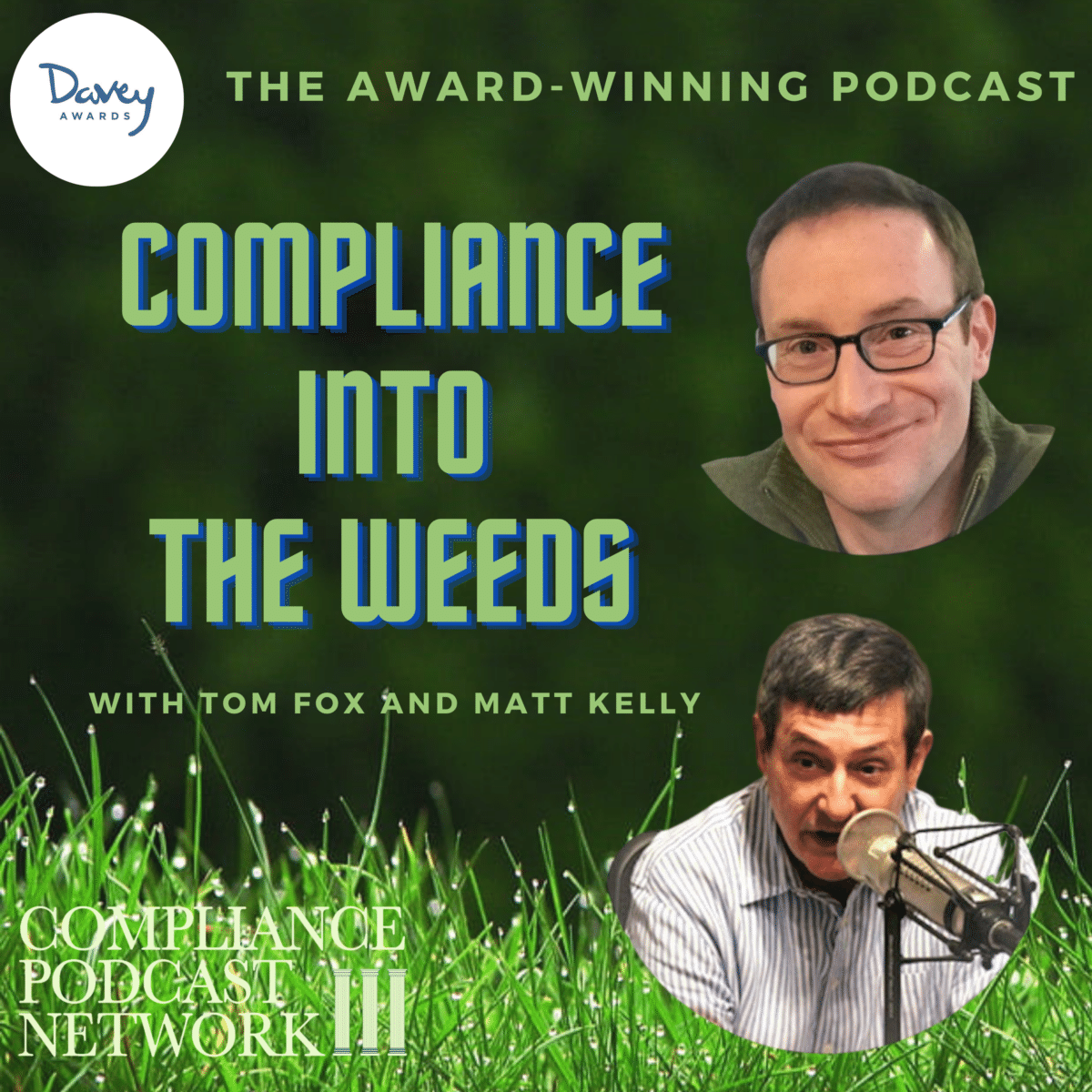
The award-winning Compliance into the Weeds is the only weekly podcast that takes a deep dive into a compliance-related topic, literally going into the weeds to explore a subject more fully. Looking for some hard-hitting insights on compliance? Look no further than Compliance into the Weeds! In this episode of Compliance into the Weeds, Tom Fox and Matt Kelly discuss a newly issued FinCEN consent order sanctioning UBS Financial Services, the U.S. broker-dealer subsidiary of UBS.

It is a $125 million penalty, the largest FinCEN fine against a broker-dealer, for extensive anti-money laundering failures. They highlight weak transaction monitoring and suspicious activity reporting (SAR) processes, poor customer due diligence, inadequate wire-transfer data collection, and data governance gaps that led to under-reporting and hindered FinCEN’s ability to build a complete money-laundering picture. The order notes UBS failed to monitor more than 50,000 foreign-currency wires totaling over $10 billion and did not disclose ongoing deficiencies discovered after a 2018 $14 million FinCEN action requiring fixes by 2021, with problems traceable back to 2004 and not addressed until 2023. They frame the matter as a tone-at-the-top and resourcing failure, compare it to other enforcement actions (including a recent SEC fine against Merrill Lynch), and suggest a future deeper dive after reviewing the full order.

Key highlights:

  • What UBS Got Wrong
  • Scale Of The Failures
  • Board Oversight and Resourcing
  • Data Governance Breakdown
  • SARs, Metrics, and AI Talk
  • Takeaways and Next Steps

Resources:

USB Consent Order

 Tom  

Instagram

Facebook

YouTube

Twitter

LinkedIn

A multi-award-winning podcast, Compliance into the Weeds was most recently honored as one of the Top 25 Regulatory Compliance Podcasts, a ⁠Top 10 Business Law Podcast⁠, and ⁠a Top 12 Risk Management Podcast⁠. Compliance into the Weeds has been conferred a Davey, Communicator, and W3 Award, all for podcast excellence. 

Categories
AI Today in 5

AI Today in 5: August 3, 2026, The Is Your AI Scheming Edition

Welcome to AI Today in 5, the newest addition to the Compliance Podcast Network. Each day, Tom Fox will bring you 5 stories about AI to start your day. Sit back, enjoy a cup of morning coffee, and listen in to AI Today in 5. All from the Compliance Podcast Network. Each day, we consider five stories from the business world, compliance, ethics, risk management, leadership, or general interest about AI.

Top AI stories include:

  1. Is AI scheming against us, or is SkyNet now self-aware?  (NYT)
  2. AI compliance starts in your browser. (The European Business Review)
  3. The EU comes for the bots. (FT)
  4. AI is creating a 2-speed job market. (Bloomberg)
  5. AI is adding new risk for AML compliance. (AmericanBanker)

For more information on the use of AI in compliance programs, Tom Fox’s new book, Upping Your Game, is available. You can purchase a copy of the book on ⁠Amazon.com⁠.

To learn about the intersection of Sherlock Holmes and the modern compliance professional, check out Tom’s latest book, The Game is Afoot-What Sherlock Holmes Teaches About Risk, Ethics and Investigations on ⁠Amazon.com⁠.

Categories
AI Today in 5

AI Today in 5: July 3, 2026, The Can Corps Survive Edition

Welcome to AI Today in 5, the newest addition to the Compliance Podcast Network. Each day, Tom Fox will bring you 5 AI stories to start your day. Sit back, enjoy a cup of morning coffee, and listen in to AI Today In 5. All, from the Compliance Podcast Network. Each day, we consider five stories from the business world, compliance, ethics, risk management, leadership, or general interest about AI.

Top AI stories include:

  1. Can AI keep up with complex ownership structures? (FinTechGlobal)
  2. Can corporations survive the Age of AI? (Time)
  3. US lifts restrictions on Anthropic. (NYT)
  4. Sam Altman on how to make AI safe. (FT)
  5. Grocery store wars in South Africa in the age of AI. (Bloomberg)

For more information on the use of AI in compliance programs, Tom Fox’s new book, Upping Your Game, is available. You can purchase a copy of the book on ⁠Amazon.com⁠.

To learn about the intersection of Sherlock Holmes and the modern compliance professional, check out Tom’s latest book, The Game is Afoot-What Sherlock Holmes Teaches About Risk, Ethics and Investigations on ⁠Amazon.com⁠.

Categories
AI Today in 5

AI Today in 5: June 26, 2026, The GenZ in the C-Suite Edition

Welcome to AI Today in 5, the newest addition to the Compliance Podcast Network. Each day, Tom Fox will bring you 5 stories about AI to start your day. Sit back, enjoy a cup of morning coffee, and listen in to AI Today In 5. All, from the Compliance Podcast Network. Each day, we consider five stories from the business world, compliance, ethics, risk management, leadership, or general interest about AI.

Top AI stories include:

  1. An AI arms race in AML. (FinTechGlobal)
  2. Easing AI-induced workforce disruptions.  (NYT)
  3. When AI puts Gen Z in the C-Suite. (WSJ)
  4. New security operating model. (Rapid7)
  5. AI is moving from automation to transformation in healthcare.  (HealthcareITNews)

For more information on the use of AI in compliance programs, Tom Fox’s new book, Upping Your Game, is available. You can purchase a copy of the book on ⁠Amazon.com⁠.

To learn about the intersection of Sherlock Holmes and the modern compliance professional, check out Tom’s latest book, The Game is Afoot-What Sherlock Holmes Teaches About Risk, Ethics and Investigations on ⁠Amazon.com⁠.

Categories
AI Today in 5

AI Today in 5: June 25, 2026, The AI Giants Edition

Welcome to AI Today in 5, the newest addition to the Compliance Podcast Network. Each day, Tom Fox will bring you 5 stories about AI to start your day. Sit back, enjoy a cup of morning coffee, and listen in to AI Today In 5. All, from the Compliance Podcast Network. Each day, we consider five stories from the business world, compliance, ethics, risk management, leadership, or general interest about AI.

Top AI stories include:

  1. The hidden costs of AML. (FinTechGlobal)
  2. AI for waste management. (Waste360)
  3. How do AI giants use AI? (WSJ)
  4. OpenAI unveils its first chip. (CNBC)
  5. AI-Human means ‘human’ in healthcare. (News-Medical)

For more information on the use of AI in compliance programs, Tom Fox’s new book, Upping Your Game, is available. You can purchase a copy of the book on ⁠Amazon.com⁠.

To learn about the intersection of Sherlock Holmes and the modern compliance professional, check out Tom’s latest book, The Game is Afoot-What Sherlock Holmes Teaches About Risk, Ethics and Investigations on ⁠Amazon.com⁠.

Categories
AI Today in 5

AI Today in 5: June 24, 2026, The Why AI Strategies Fail Edition

Welcome to AI Today in 5, the newest addition to the Compliance Podcast Network. Each day, Tom Fox will bring you 5 stories about AI to start your day. Sit back, enjoy a cup of morning coffee, and listen in to AI Today In 5. All, from the Compliance Podcast Network. Each day, we consider five stories from the business world, compliance, ethics, risk management, leadership, or general interest about AI.

Top AI stories include:

  1. AML needs a unified AI compliance platform. (FinTechGlobal)
  2. Why AI strategies fail. (Law.com)
  3. NJ AI law would expand compliance obligations. (NationalLawReview)
  4. AI in healthcare perpetuates stereotypes. (Psychology Today)
  5. 7 AI terms every CFO needs to know. (PYMNTS)

For more information on the use of AI in compliance programs, Tom Fox’s new book, Upping Your Game, is available. You can purchase a copy of the book on ⁠Amazon.com⁠.

To learn about the intersection of Sherlock Holmes and the modern compliance professional, check out Tom’s latest book, The Game is Afoot-What Sherlock Holmes Teaches About Risk, Ethics and Investigations on ⁠Amazon.com⁠.