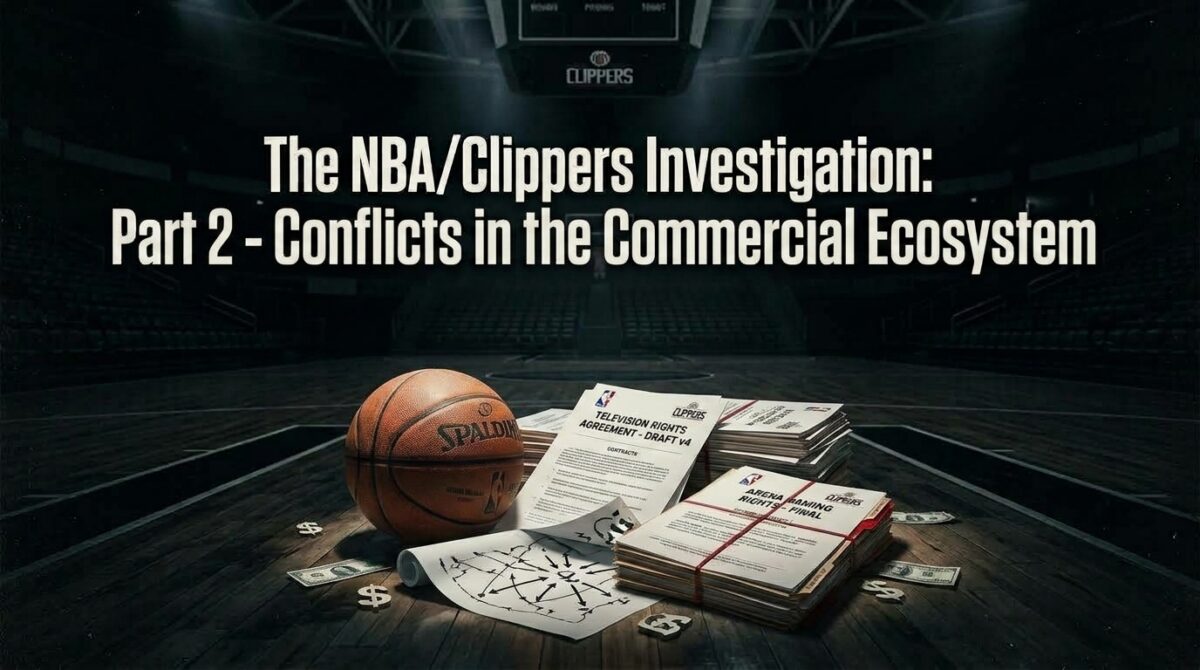
The Clippers investigation demonstrates why conflict controls must follow influence, economic benefit, and interconnected transactions, not merely financial ownership. In Part 2 of this five-part series, we consider what conflicts of interest are, why they are so divisive, and why compliance professionals must stay vigilant to prevent them from arising.
The most consequential conflicts of interest rarely arrive with a label. They appear as introductions, relationship management, commercial creativity, customer accommodation, or an effort to satisfy an important stakeholder. Each step may look defensible on its own. The compliance risk becomes visible only when the organization connects the people, payments, contracts, incentives, and timing. That is one of the central lessons from the investigation into the LA Clippers and Kawhi Leonard salary cap circumvention.
The independent investigators’ report (Wachtell Report) concluded that the Clippers initiated and facilitated endorsement opportunities between Leonard and four companies doing business with the team: Aspiration Partners, Boingo Wireless, Daktronics, and Lockton Insurance. Investigators further found that the team induced those companies to enter the endorsement arrangements by offering or providing Clippers business.
This was not a traditional conflict involving an executive awarding a contract to a company the executive secretly owned. It was a commercial ecosystem in which organizational business, personal relationships, vendor incentives, and benefits for a powerful player allegedly became intertwined. The Athletic seemed to believe that these conflicts were all at the behest of Leonard’s personal representative, Uncle Dennis. But even if the requests originated from the Leonard Camp, the Clippers put the entire sordid process into motion.
The Conflict Was in the Network
Conflict programs often focus on a narrow question: Does the employee have a financial interest in the counterparty? That question matters, but it is not enough.
The Wachtell Report identified personal and professional relationships involving Clippers President of Business Operations Gillian Zucker and two of the companies. At one company, her husband served as board chair during the relevant period, and Zucker reportedly had a 30-year working relationship with its chief executive. At another, she had a longstanding relationship with the president and recommended him internally as the Clippers considered service providers.
Relationships do not establish wrongdoing. Longstanding connections can create legitimate business opportunities. The compliance issue is whether the relationships were disclosed, independently evaluated, and removed from decisions that could benefit the related parties or another favored stakeholder.
Aspiration presented a different form of entanglement. In September 2021, Aspiration entered into a 23-year, $382.5 million sponsorship arrangement with the Clippers, a 23-year, $72 million sustainability services agreement for the Intuit Dome, and an agreement under which Steve Ballmer personally invested $50 million in Aspiration. Weeks later, the process leading to Aspiration’s proposed endorsement agreement with Leonard began.
Again, an investment, sponsorship, services agreement, or endorsement relationship is not inherently improper. The risk arose from their combination. Investigators concluded that Clippers personnel participated in developing Leonard’s endorsement arrangement and later approved Forum business that Aspiration’s co-founder had linked to completion of that endorsement deal.
The compliance question was therefore not simply whether Ballmer had disclosed his investment. It was whether anyone independently assessed the total relationship and asked whether the organization, its owner, its vendor, and its player were participating in genuinely separate transactions.
Procurement Leverage as a Compliance Risk
The Wachtell Report’s discussion of Daktronics makes the commercial leverage particularly clear. Daktronics was competing for the Intuit Dome scoreboard and signage business. According to investigators, Clippers personnel proposed directing part of the vendor’s expected “spend back” to an endorsement agreement with Leonard.
Daktronics reportedly believed that refusing could jeopardize its opportunity to win the arena contract. Investigators found that a Clippers executive specified the proposed endorsement economics and later requested an additional payment after the scope of the scoreboard purchase increased.
This is a critical third-party risk lesson. A vendor may appear to make an independent payment, but the customer’s purchasing power can shape its decision. The organization cannot treat the vendor as an independent actor if its executives use procurement leverage to influence the vendor’s decision.
The DOJ’s Evaluation of Corporate Compliance Programs (ECCP) directs prosecutors to examine the business rationale for using a third party, whether contracts accurately describe the services, whether the work was actually performed, whether compensation was commensurate with that work, and how third-party management is integrated into procurement and vendor management. Those questions apply well beyond anti-bribery enforcement.
They can be adapted to any commercial arrangement:
- Why is this party entering the transaction?
- Who proposed the arrangement and its economic terms?
- Is another pending contract influencing the decision?
- Are the services real, measurable, and proportionate to the payment?
- Who ultimately receives the economic benefit?
If compliance cannot answer those questions, due diligence is incomplete.
The Limits of Disclosure and Recusal
Many organizations would respond to these facts by strengthening annual conflict questionnaires. That would help, but it would be insufficient. Annual disclosures capture static information. The Clippers matter involved dynamic relationships developing across sponsorship, procurement, personal investment, consulting, endorsement, and expense activity. No annual form could evaluate the full risk unless the organization also had transaction-level escalation.
Recusal presents a similar challenge. An executive can abstain from the final signature and still shape the outcome through introductions, recommendations, term-sheet comments, internal advocacy, or communications with the vendor. Effective recusal must address influence, not merely signature authority.
A defensible conflict process should contain four elements.
- Your organization needs a broad definition of conflict. It should cover actual, potential, and perceived conflicts, including close personal relationships, family roles, outside investments, prior professional affiliations, and benefits directed to third parties at an employee’s request.
- Disclosures must be tied to decisions. Procurement, legal, finance, compliance, and business approvers should receive relevant conflict information before approving the transaction.
- Independent reviewers or monitors must have access to the entire relationship. A sponsor agreement, consulting contract, personal investment, and endorsement deal cannot be reviewed in separate silos when they involve the same parties.
- Your organization must document how it managed the conflict. (Document Document Document) Approval should identify the business rationale, benchmarking, competitive process, recusals, alternative providers, deliverables, monitoring plan, and responsible control owner.
An Internal Control Issue, Not Just an Ethics Issue
Conflicts are frequently treated as personal ethics matters. They are also internal control risks. The COSO Internal Control–Integrated Framework provides the right lens. The control environment establishes expectations for integrity and accountability. Risk assessment identifies where influence and commercial pressure could distort decisions. Control activities impose approvals, segregation of duties, and documentation. Information and communication move relevant facts to independent decision-makers. Monitoring determines whether the controls work over time.
When conflicts span several transactions, the control system must aggregate information. A procurement reviewer may see a vendor contract. Finance may see an advance payment. Marketing may see an endorsement agreement. The owner’s office may see an investment. Compliance must be all four.
This is also a governance question. Under the Organizational Sentencing Guidelines, governing authorities must understand the compliance program and reasonably oversee its implementation and effectiveness. Board oversight becomes especially important when a transaction involves senior executives, controlling owners, or stakeholders whose commercial importance may compromise ordinary review.
The Clippers investigation shows that a conflict can exist without a secret ownership interest or a direct personal payment. It can arise when influence, relationships, and commercial leverage align to deliver a benefit that the organization could not provide directly.
Tomorrow in blog post 3, we will examine why the Clippers matter represents an internal controls failure and how procurement data, payment analytics, expense monitoring, and a substance-over-form review could have identified the pattern earlier.