Categories
Great Women in Compliance

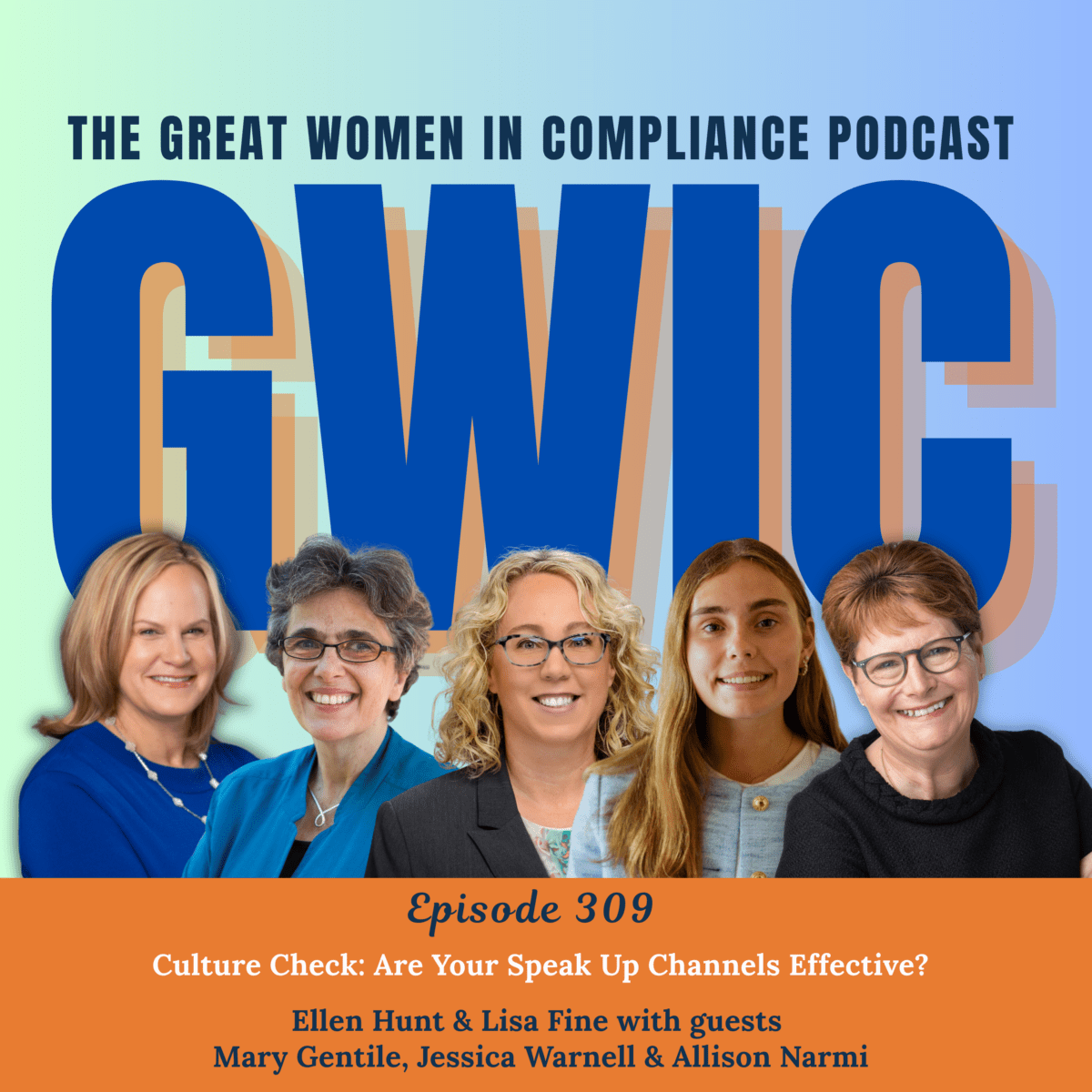
Great Women in Compliance: Culture Check: Are Your Speak Up Channels Effective?

Ever wish you could benchmark your Speak Up channels against more than just volume, issue types, and time to close? 

The Speak Up Self-Assessment (SUSA) was designed to help you go deeper by assessing organizational infrastructure—including reporting channels, confidentiality safeguards, follow-up processes, and governance of whistleblowing systems.

In this roundtable episode, we speak with guests: 

  • Professor Jessica McManus Warnell
  • Dr. Mary Gentile 
  • Allison Narmi 

about the work they are doing to bring a free, anonymous diagnostic tool to self-assess speak-up channels. Building on the work done in the EU, our guests today are members of the project team that has developed an American version of the tool, with support from the Notre Dame Deloitte Center for Ethical Leadership. Link to the EU version here – https://edhec.az1.qualtrics.com/jfe/form/SV_eleMjkHraHzw6Hk

U.S. version coming soon.  

Categories
All Things Investigations

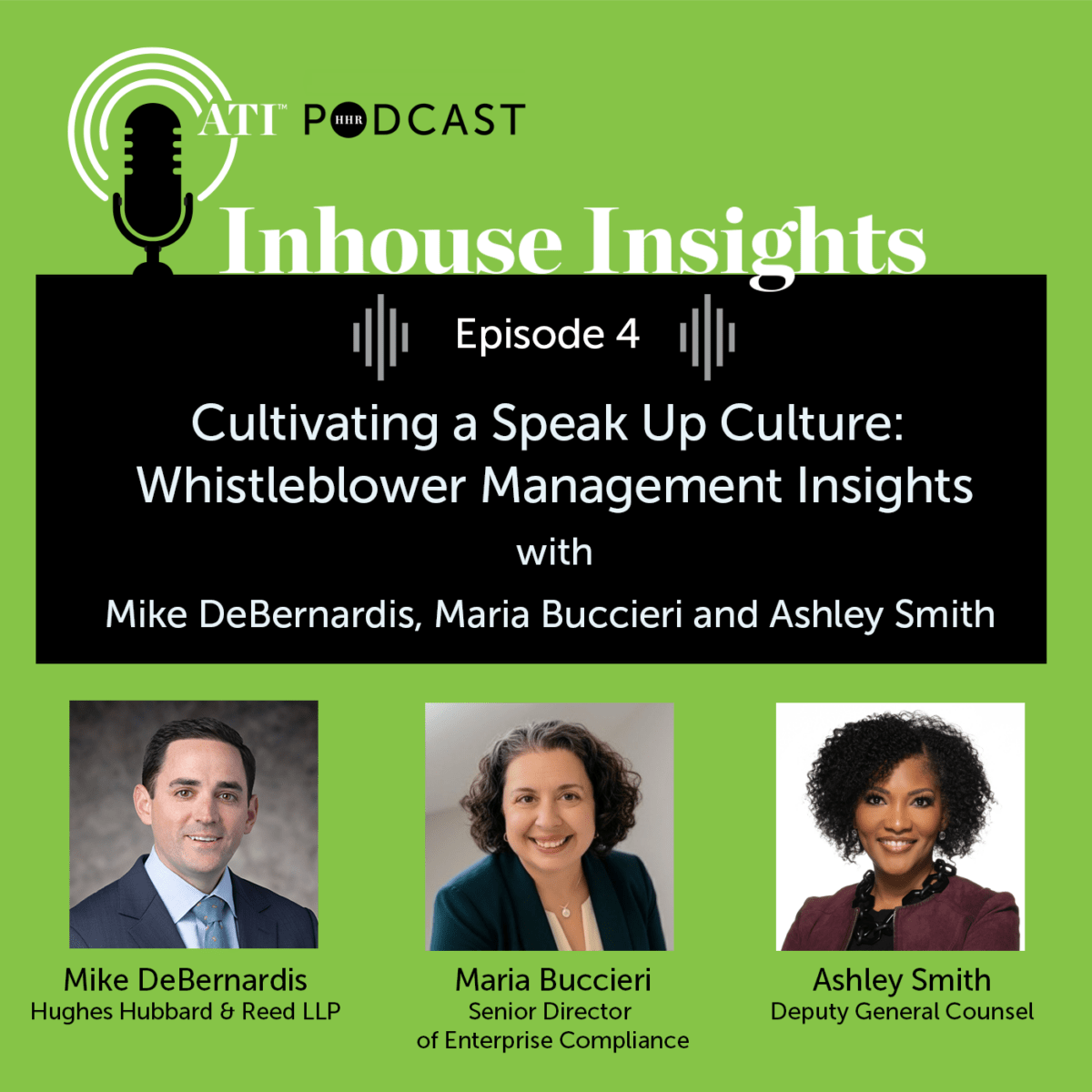
ATI In-House Insights: Cultivating a Speak Up Culture: Whistleblower Management Insights with Maria Buccieri and Ashley Smith

Welcome to the Hughes Hubbard Anti-Corruption & Internal Investigations Practice Group’s podcast, All Things Investigation. This is a special series featuring sights from in-house practitioners, hosted by Mike DeBernardis. In this podcast, Mike visits with Maria Buccieri and Ashley Smith, Deputy General Counsel at Amtrak, about Encouraging and Managing Whistleblowers.

Ashley and Maria, both compliance and legal leaders from Amtrak, discuss how to encourage and manage whistleblowers as a core element of an effective compliance program, emphasizing that a lack of reports does not indicate a healthy organization. They describe a “speak-up” culture as one where employees feel heard, senior leaders model speaking up, and reporting is accessible across a diverse workforce through multiple channels (phone, email, QR codes, mobile tools, in-person availability) and languages. Key barriers include fear of retaliation (often through subtle workplace ostracism), disappointment when nothing happens, and loss of anonymity. They outline best practices for handling reports consistently with other serious complaints, preserving confidentiality “as much as possible,” training mid-level managers and investigators, and maintaining communication with reporters during lengthy investigations. They also caution against dismissing “serial reporters,” recommending contextual analysis and internal process checks.

Key highlights:

  • Healthy Speak Up Culture
  • Why Employees Stay Silent
  • Handling Reports Fairly
  • Protecting Confidentiality
  • Keeping Reporters Updated
  • Serial Reporters and Sparse Tips

Resources:

Hughes Hubbard & Reed Website

Mike DeBernardis

Maria Buccieri on LinkedIn

Ashley Smith on LinkedIn

Categories
Blog

AI Governance and Speak-Up Culture: The Earliest Warning System May Already Be in Your Workforce

There is a hard truth about AI governance that too many companies are still avoiding: the first people to spot an AI problem are usually not board members, not senior executives, and not even the governance committee. It is the employee using the tool, reviewing the output, dealing with the customer, watching the workflow break down, or seeing the machine produce something that feels off. That is why AI governance is not only about policies, models, controls, and oversight structures. It is also about culture. More specifically, it is about a culture of speaking up.

If employees see an AI tool making questionable recommendations, generating inaccurate summaries, mishandling sensitive information, producing biased outcomes, or being used beyond its approved purpose, do they know that this is a reportable issue? Do they know where to raise it? Do they believe someone will listen? Do they trust that raising a concern will help rather than harm their career? Those are not soft questions. They are governance questions.

In anti-corruption compliance, we have long since learned that hotlines, reporting channels, and anti-retaliation protections are not mere ethical ornaments. They are detection mechanisms. They are how organizations surface risks before they become scandals. AI governance now needs the same mindset. If your employees are your earliest warning system, then your speak-up culture may be one of your most important AI controls.

Why Employees See AI Failures First

AI rarely fails in the abstract. It fails in use. A board deck may describe a tool in elegant terms. A vendor demo may look polished. A pilot may be carefully supervised. But once a system enters daily operations, it interacts with real people, real data, real pressures, and real shortcuts. That is when the problems begin to show themselves.

An employee may notice that a tool is confidently wrong. A manager may realize that staff are over-relying on generated summaries without checking the source material. Someone in HR may see that a screening tool is producing odd results. A sales employee may notice that a customer-facing chatbot is inventing answers. A compliance analyst may find that an AI-assisted monitoring process is missing obvious red flags. A procurement professional may discover that a vendor quietly changed a feature set or data practice.

In each of those examples, the problem shows up at the point of use, not at the point of approval. That is why the old compliance lesson still applies: the people closest to the work are often closest to the risk. In AI governance, that means employees are often the first line of detection. But detection is useless if the culture tells them to keep their heads down.

The Governance Blind Spot

Many organizations are investing significant effort in AI principles, governance committees, acceptable-use policies, and risk classification. That is all important. But many of these programs have a blind spot. They are built as if AI risk will reveal itself only through formal testing, audit reviews, or leadership dashboards. It will not.

Some AI failures will surface through monitoring and controls. But many will first appear as employee discomfort, confusion, skepticism, or observation. Someone will notice that a tool is being used in a way that feels wrong. Someone will catch a factual error before it leaves the building. Someone will realize that human review is not actually happening. Someone will see mission creep. Someone will spot a gap between policy and practice.

If the governance model does not actively encourage employees to raise those concerns, the company has built an AI oversight program with one eye closed. That is a dangerous place to be because AI risk is often cumulative. A small issue ignored today becomes a larger issue tomorrow. An inaccurate output tolerated in a low-stakes setting becomes normalized in a higher-stakes one. A quietly expanded use case becomes a de facto business process. Silence is how minor flaws become systemic failures.

Speak-Up Culture as an AI Control

Let us be clear about terms. Speak-up culture is not simply a hotline number posted on the intranet. It is the set of signals an organization sends about whether employees are expected, supported, and protected when they raise concerns.

In the AI context, a healthy speak-up culture means employees understand that reporting concerns about AI outputs, use cases, data handling, or control failures is part of responsible business conduct. It means managers know that AI concerns are not “just tech issues” to be brushed aside. It means investigators and compliance teams are prepared to triage and assess AI-related reports intelligently. It means retaliation protections apply as much to someone challenging a machine-enabled workflow as they do to someone reporting bribery, harassment, or fraud.

This matters because AI can create a special kind of silence. Employees may hesitate to challenge a system that leadership has praised as innovative. They may worry that questioning the tool makes them sound resistant to change or insufficiently sophisticated. They may assume someone more senior has already validated the output. They may think, “Surely the machine knows better than I do.” That is exactly the kind of cultural dynamic compliance should distrust.

Machines do not deserve deference. Controls deserve scrutiny. A mature AI governance program, therefore, needs to treat employee reporting as a formal part of its control environment. Speak-up culture is not adjacent to AI governance. It is part of AI governance.

What CCOs Should Be Asking

If you are a Chief Compliance Officer, there are several questions you should be asking right now.

First, do employees understand that AI-related concerns are reportable? Many organizations have not made this explicit. Staff know they should report harassment, bribery, theft, and retaliation. They may not know whether to report unreliable AI output, a suspicious recommendation, a data input concern, or a business team using a tool outside its approved scope. If you have not told them, do not assume they know.

Second, are your reporting channels equipped to receive AI-related concerns? Hotline categories, case-intake forms, and triage protocols may need to be updated. If an employee reports that an AI tool is generating misleading outputs in a regulated workflow, who receives that report? Compliance? Legal? Security? IT? HR? Some combination? If ownership is unclear, reports will stall, and stalled reports teach employees not to bother.

Third, are managers trained to respond appropriately when AI concerns are raised informally? This is critical. Many concerns will not begin in a hotline. They will begin in a meeting, a hallway conversation, a team chat, or an email to a supervisor. If the manager shrugs, dismisses, or minimizes the issue, the detection system fails before it starts.

Fourth, are anti-retaliation protections being reinforced in the AI context? Employees who challenge AI use may be questioning a high-profile project, a popular vendor, or a senior executive’s initiative. That can create subtle pressure to stay quiet. Compliance should be ahead of that dynamic, not behind it.

Building an AI Speak-Up Framework

What does a practical approach look like?

The first step is to define what types of AI concerns employees should raise. Be concrete. Tell them to report suspected misuse of AI tools, outputs that appear inaccurate or biased, use of AI in sensitive decisions without proper review, input of restricted data into unapproved systems, unauthorized expansion of use cases, missing human oversight, and vendor or system changes that appear to alter risk.

The second step is to build AI examples into training and communication. Employees need realistic scenarios, not vague encouragement. Show them what an AI red flag looks like. Show them what “raising a hand” looks like. Show them where to go and what happens next.

The third step is to update the hotline and investigations protocols. Add intake categories if needed. Develop triage guidance. Decide when AI matters should be handled as compliance cases, operational incidents, model-risk issues, or cross-functional reviews. The goal is not bureaucracy. The goal is clarity.

The fourth step is to train managers as escalation points. In every effective compliance program, middle management is the translation layer between policy and daily operations. AI governance is no different. Managers need to know when a concern can be resolved locally, when it must be escalated, and when the pattern itself suggests a control problem.

The fifth step is to close the feedback loop. Employees are more likely to report concerns when they believe reporting leads to action. That does not mean revealing confidential case details. Communicating that the company takes these issues seriously, investigates them, learns from them, and improves controls as needed. Silence from management breeds silence from employees.

What to Monitor in an AI Speak-Up Program

Here is where compliance can bring its trademark discipline. Track the volume and type of AI-related concerns. Look for concentration by business unit, geography, or tool. Monitor whether concerns are coming in through formal hotlines or informal channels. Review time to triage and time to resolution. Look for patterns involving data handling, output reliability, human review failures, or scope creep. Compare the reported concerns with the company’s list of approved use cases. If you see repeated confusion or repeated exceptions, that tells you something important about your governance design.

Just as importantly, look for the absence of reporting. If your company has materially deployed AI tools and no employee has ever raised a concern, I would not automatically celebrate. I would ask whether employees know what to report, trust the channels, or believe leadership wants candor. In compliance, no reports can mean no problems. It can also mean no trust. Wise CCOs know the difference is everything.

Why This Is Good for Business

Some executives still hear “speak-up culture” and think of delay, friction, and complication. I hear something different. I hear early detection, faster correction, and better decision-making.

A workforce that feels empowered to raise AI-related concerns provides the company with a real-time sensing mechanism. It catches problems before they scale. It surfaces control failures before regulators, plaintiffs’ lawyers, journalists, or customers do. It gives management better information. It helps the board exercise real oversight. Most of all, it creates a culture where innovation is more sustainable because people are not afraid to challenge what does not look right. That is not anti-innovation. That is responsible innovation.

Compliance has always been at its best when it helps the business move fast without becoming reckless. Speak-up culture does exactly that. It does not tell employees to fear AI. It tells them to use judgment, raise concerns, and protect the enterprise when the technology does not behave as expected.

Final Thoughts

Every company deploying AI should ask itself a simple question: Who will notice first when something goes wrong? In many cases, the answer is your employees. The next question is even more important: have you built a culture where they will say something?

If the answer is uncertain, then your AI governance program has a serious weakness. You may have policies. You may have committees. You may have training modules and vendor reviews. But if employees do not feel empowered to raise a hand when they see a problem, then one of your most valuable detection controls is missing in action.

Categories
Great Women in Compliance

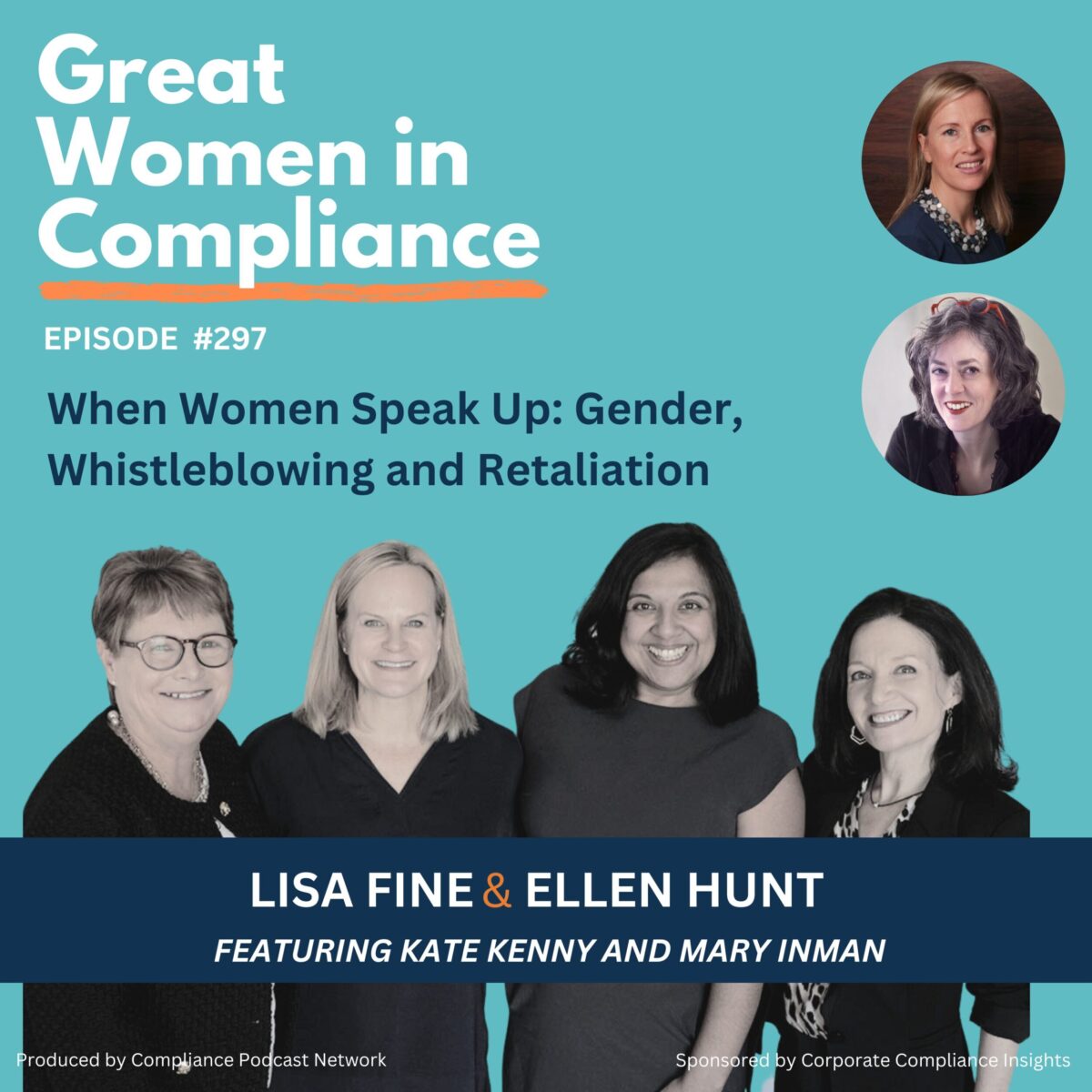
Great Women in Compliance – When Women Speak Up: Gender, Whistleblowing and Retaliation

In this roundtable episode of the Great Women in Compliance Podcast, Lisa Fine and Ellen Hunt are joined by whistleblower attorney Mary Inman and Professor Kate Kenny from the University of Galway to explore what really happens when women speak up. Drawing on Professor Kenny’s decade-long research on whistleblowing—including recent work with Transparency International—the conversation examines why women whistleblowers often face greater challenges, which deter them from raising concerns or from deciding to leave a job, rather than speaking up.

The discussion unpacks how gender stereotypes, gaslighting, and organizational culture shape how concerns are received and why women are more likely to speak up when strong protections, anonymity, and collective reporting options are in place. Mary Inman adds a practitioner’s perspective, sharing what she sees in real cases and why many women choose to report together rather than go it alone.

As Ethics and Compliance practitioners consider how to help people speak up, this episode challenges us to review our programs and make improvements to support anyone raising concerns.

Categories
Compliance Tip of the Day

Compliance Tip of the Day – Using Comms to Drive Speak Up

Welcome to “Compliance Tip of the Day,” the podcast that brings you daily insights and practical advice for navigating the ever-evolving landscape of compliance and regulatory requirements. Whether you’re a seasoned compliance professional or just starting your journey, we aim to provide you with bite-sized, actionable tips to help you stay on top of your compliance game. Join us as we explore the latest industry trends, share best practices, and demystify complex compliance issues to keep your organization on the right side of the law. Tune in daily for your dose of compliance wisdom, and let’s make compliance a little less daunting, one tip at a time.

Today, we consider the role of communications in your reporting system.

For more on this topic, check out The Compliance Handbook: A Guide to Operationalizing your Compliance Program, 6th edition, which LexisNexis recently released. It is available here.

Categories
Compliance Into the Weeds

Compliance into the Weeds: Examining the Impact of Reducing Middle Management on Corporate Culture

The award-winning Compliance into the Weeds is the only weekly podcast that takes a deep dive into a compliance-related topic, literally going into the weeds to explore a subject more fully. Seeking insightful perspectives on compliance? Look no further than Compliance into the Weeds! In this episode, Tom Fox and Matt Kelly discuss the implications of reducing the number of middle managers in corporate America.

Kelly’s blog post, inspired by a Wall Street Journal article, serves as the foundation for a broader discussion on how the reduction of managers impacts corporate culture, employee dynamics, and compliance programs. They explore the reasons behind this trend, such as the desire for agility or cost-cutting, and its effects on communication, institutional knowledge, and the role of compliance officers. They also explore potential solutions, including the use of AI, enhanced training, and adaptive compliance strategies, to mitigate the risks associated with fewer middle managers.

Key highlights:

  • Corporate America’s Managerial Shift
  • Implications for Corporate Culture
  • AI and Compliance Solutions
  • Institutional Knowledge and Risks
  • Compliance Takeaways and Final Thoughts

Resources:

Matt on Radical Compliance

Tom

Instagram

Facebook

YouTube

Twitter

LinkedIn

A multi-award-winning podcast, Compliance into the Weeds was most recently honored as one of the Top 25 Regulatory Compliance Podcasts, a Top 10 Business Law Podcast, and a Top 12 Risk Management Podcast. Compliance into the Weeds has been conferred the Davey, Communicator, and W3 Awards for podcast excellence.

Categories
Compliance Tip of the Day

Compliance Tip of the Day – AI, Whistleblowing and a Culture of Speak Up

Welcome to “Compliance Tip of the Day,” the podcast where we bring you daily insights and practical advice on navigating the ever-evolving landscape of compliance and regulatory requirements. Whether you’re a seasoned compliance professional or just starting your journey, we aim to provide you with bite-sized, actionable tips to help you stay on top of your compliance game. Join us as we explore the latest industry trends, share best practices, and demystify complex compliance issues to keep your organization on the right side of the law. Tune in daily for your dose of compliance wisdom, and let’s make compliance a little less daunting, one tip at a time.

How can AI enhance your whistleblower program, improve your culture of Speak Up, and crowdsource intelligence from your employees?

For more on this topic, check out The Compliance Handbook, a Guide to Operationalizing Your Compliance Program, 6th edition, which LexisNexis recently released. It is available here.

Categories
Trekking Through Compliance

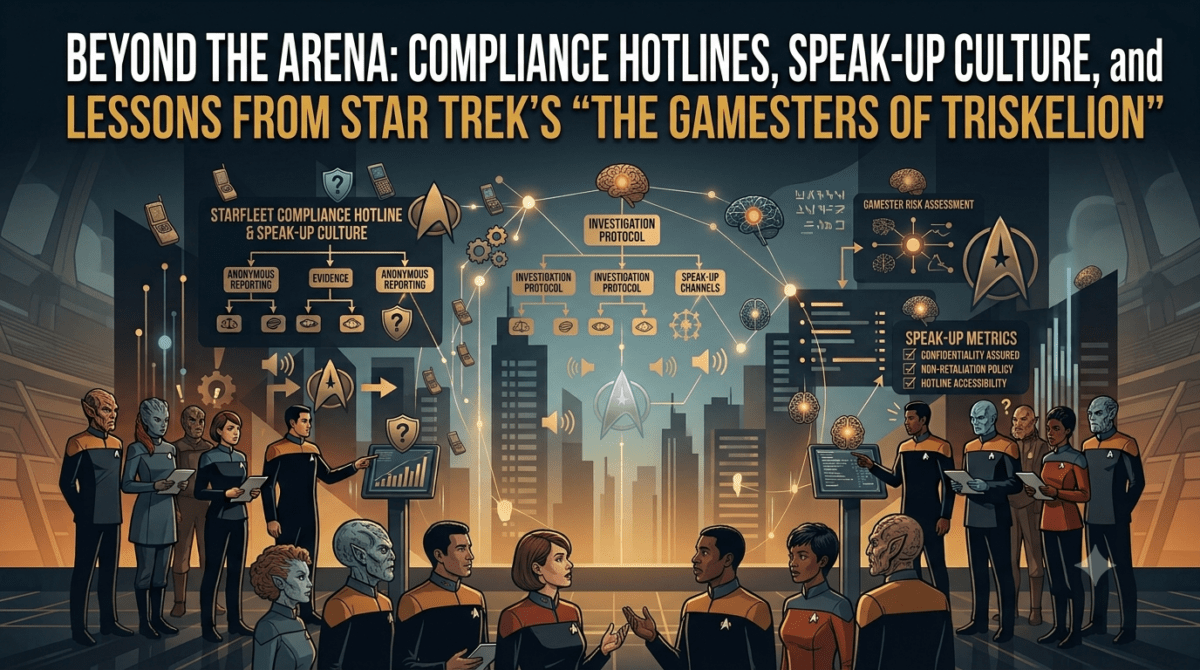
Trekking Through Compliance: Episode 45 – Beyond the Arena: Compliance Hotlines, Speak-Up Culture, and Lessons from “The Gamesters of Triskelion”

For compliance professionals, building a culture where employees feel empowered to speak up, whether as victims or as bystanders, is both an ethical imperative and a business necessity. Yet, fostering this environment goes far beyond simply installing a hotline or posting policies on the intranet. It requires trust, accessibility, and leadership that encourages all voices, especially those witnessing misconduct, not just those experiencing it firsthand.

No episode of Star Trek: The Original Series illustrates the importance of courage, communication, and the role of bystanders quite like “The Gamesters of Triskelion.” It is an allegory that resonates in the modern workplace, where power imbalances, fear, and bystander inaction can allow harassment and misconduct to flourish in the shadows.

But just as Kirk and his crew refuse to be mere pawns, so too must organizations encourage employees to break free from silence, whether as victims or witnesses, to foster a truly ethical and accountable culture.

Lesson 1: Accessibility and Trust—The Foundation of Any Hotline Program

Illustrated By: Kirk’s first attempts to communicate with the Providers, demanding answers and voicing his protest against the system.

Compliance Lesson: A hotline or internal reporting system is only as effective as its accessibility and the trust employees have in it.

Lesson 2: Bystander Empowerment—Everyone Has a Role in Speaking Up

Illustrated By: Uhura witnesses Chekov being attacked by another thrall and later supports Shahna when she faces abuse from the Providers.

Compliance Lesson: A true speak-up culture extends beyond encouraging direct victims to report. It actively enlists bystanders, colleagues, supervisors, and contractors who observe misconduct or questionable behavior.

Lesson 3: Remove Barriers to Reporting—Simplify and Normalize the Process

Illustrated By: Kirk negotiates with the Providers, insisting on open communication, transparency, and fair treatment for himself and the others.

Compliance Lesson: Internal reporting mechanisms should be straightforward and widely communicated. Complicated processes or unclear outcomes deter people from coming forward.

Lesson 4: Leadership Sets the Tone—Champion Speak-Up Behavior at the Top

Illustrated By: Kirk rallies Uhura, Chekov, and Shahna, modeling courage and vocal opposition even under surveillance.

Compliance Lesson: Tone at the top matters. Leaders who demonstrate, support, and reward speaking up create an environment where others feel safe to do the same.

Lesson 5: Close the Loop—Respond, Resolve, and Communicate Outcomes

Illustrated By: After Kirk’s defiance and challenge, the Providers agree to his terms, ultimately restoring freedom and dignity to the captives.

Compliance Lesson: Effective reporting systems require not only intake but meaningful response. Employees must see that their concerns are taken seriously and addressed appropriately.

Final ComplianceLog Reflections

The Gamesters of Triskelion” demonstrates that courage, solidarity, and a voice can challenge even the most entrenched power structures. For compliance professionals, the episode serves as a poignant reminder that hotlines and policies are only the starting point. The real work is building an environment where every employee, victim, or bystander knows they have the right, the tools, and the support to speak up, and that their concerns will be heard and acted upon.

Live long, prosper, and always encourage your crew to speak up.

Resources:

Excruciatingly Detailed Plot Summary by Eric W. Weisstein

MissionLogPodcast.com

Memory Alpha

Categories
Blog

Beyond the Arena: Compliance Hotlines, Speak-Up Culture, and Lessons from Star Trek’s “The Gamesters of Triskelion”

For compliance professionals, building a culture where employees feel empowered to speak up, whether as victims or as bystanders, is both an ethical imperative and a business necessity. Yet, fostering this environment goes far beyond simply installing a hotline or posting policies on the intranet. It requires trust, accessibility, and leadership that encourages all voices, especially those witnessing misconduct, not just those experiencing it firsthand.

No episode of Star Trek: The Original Series illustrates the importance of courage, communication, and the role of bystanders quite like “The Gamesters of Triskelion.” In this memorable installment, Captain Kirk, Lieutenant Uhura, and Chekov are kidnapped and forced to fight as gladiators for the amusement of alien “Providers.” While the spectacle is one of brute force, the true victory comes not from physical strength but from challenging the system, refusing to remain silent, and advocating for oneself and others.

Today, we beam down and explore the key compliance lessons, literally scene by scene, from this classic episode, and see how it can help us reimagine our approach to hotlines, internal reporting, and speak-up culture in today’s organizations.

The Gamesters of Triskelion” places our heroes in an alien arena, stripped of their autonomy and pitted against each other. Their every move is watched, wagered upon, and manipulated by unseen masters. It’s an allegory that resonates in the modern workplace, where power imbalances, fear, and bystander inaction can allow harassment and misconduct to flourish in the shadows.

But just as Kirk and his crew refuse to be mere pawns, so too must organizations encourage employees to break free from silence, whether as victims or witnesses, to foster a truly ethical and accountable culture.

Lesson 1: Accessibility and Trust—The Foundation of Any Hotline Program

Illustrated By: Kirk’s first attempts to communicate with the Providers, demanding answers and voicing his protest against the system. When Captain Kirk is abducted, his first instinct is to seek information, challenge authority, and demand a platform for his concerns. But the providers initially deny him any means to voice his objections. Reflecting a system where grievances are suppressed and channels for reporting are inaccessible.

Compliance Lesson: A hotline or internal reporting system is only as effective as its accessibility and the trust employees have in it. Too often, organizations install a hotline as a check-the-box exercise, but if employees don’t trust the process or fear retaliation, it becomes as useless as shouting into the void. Build trust by ensuring anonymity, robust anti-retaliation protections, and transparent processes for follow-up. Empower all employees, not just those harmed directly but also those who witness wrongdoing, to report concerns with confidence.

Lesson 2: Bystander Empowerment—Everyone Has a Role in Speaking Up

Illustrated By: Uhura witnesses Chekov being attacked by another thrall and later supports Shahna when she faces abuse from the Providers. Uhura’s actions exemplify the power of the bystander. Though she is a victim of abduction, she does not remain passive when she witnesses Chekov in danger or Shahna being mistreated. She steps forward, speaks up, and supports those around her, even putting herself at risk.

Compliance Lesson: An authentic speak-up culture extends beyond encouraging direct victims to report. It actively enlists bystanders, colleagues, supervisors, and contractors who observe misconduct or questionable behavior. Compliance professionals should provide training on bystander intervention, communicate that speaking up is a shared responsibility, and recognize those who do. This not only prevents harm but also signals to all employees that silence is not neutrality; it is complicity.

Lesson 3: Remove Barriers to Reporting—Simplify and Normalize the Process

Illustrated By: Kirk negotiates with the providers, insisting on open communication, transparency, and fair treatment for himself and the others. Throughout the episode, Kirk persistently challenges the opaque rules of the Triskelion arena. He demands not just a voice, but a fair and understandable process—something the providers grudgingly grant after repeated confrontation.

Compliance Lesson: Internal reporting mechanisms should be straightforward and widely communicated. Complicated processes or unclear outcomes deter people from coming forward. Normalize reporting by making it a routine, non-threatening part of workplace culture, much like regular safety drills or team meetings. Remind employees frequently, in plain language, of how and why to report concerns, and ensure that doing so is free from bureaucratic or emotional hurdles.

Lesson 4: Leadership Sets the Tone—Champion Speak-Up Behavior at the Top

Illustrated By: Kirk rallies Uhura, Chekov, and Shahna, modeling courage and vocal opposition even under surveillance. Kirk’s leadership in the arena is marked by his refusal to comply quietly with unjust commands. He models courage and vocal opposition, inspiring those around him, especially Shahna, a bystander-turned-ally, to question the status quo and ultimately join his cause.

Compliance Lesson: Tone at the top matters. Leaders who demonstrate, support, and reward speaking up create an environment where others feel safe to do the same. Encourage managers and executives to share stories of when they reported concerns or acted as ethical bystanders. Celebrate transparency and moral courage, not just technical compliance. When leaders set the example, the entire organization takes notice.

Lesson 5: Close the Loop—Respond, Resolve, and Communicate Outcomes

Illustrated By: After Kirk’s defiance and challenge, the Providers agree to his terms, ultimately restoring freedom and dignity to the captives. The climax of the episode comes when the Providers, confronted with Kirk’s unwavering demands and the support of his crew, capitulate. They not only allow complaints to be aired, but they also listen, act, and restore justice.

Compliance Lesson: Effective reporting systems require not only intake but meaningful response. Employees must see that their concerns are taken seriously and addressed appropriately. This includes timely investigation, resolution, and, where possible, communication back to the reporter (even if only in general terms). When employees see real action and outcomes, trust grows and participation in the system increases. Closing the loop is essential to sustaining a robust speak-up culture.

Final ComplianceLog Reflections

The Gamesters of Triskelion” demonstrates that courage, solidarity, and a voice can challenge even the most entrenched power structures. For compliance professionals, the episode serves as a poignant reminder that hotlines and policies are only the starting point. The real work is building an environment where every employee, victim, or bystander knows they have the right, the tools, and the support to speak up, and that their concerns will be heard and acted upon.

As you assess your organization’s internal reporting and speak-up culture, ask yourself:

  • Are your hotlines and reporting channels truly accessible and trusted?
  • Have you equipped and empowered bystanders, not just victims, to act?
  • Are you constantly removing barriers to speaking up and normalizing the process?
  • Does your leadership model champion the values you expect from everyone?
  • Do you always close the loop by providing feedback and taking visible action?

True compliance is not measured by silence, but by the willingness of all to speak, intervene, and challenge injustice. Like Kirk and his crew, our mission is not just to survive the arena but to change it for the better.

Live long, prosper, and always encourage your crew to speak up.

Resources

Excruciatingly Detailed Plot Summary by Eric W. Weisstein

MissionLogPodcast.com

Memory Alpha

Categories
FCPA Compliance Report

FCPA Compliance Report – Revolutionizing Speak Up: Ariel D. Weindling on Enhancing Whistleblower Systems

Welcome to the award-winning FCPA Compliance Report, the longest-running podcast in compliance. Today, Tom Fox welcomes back Ariel D. Weindling, founder of NotMe Solutions, a whistleblower reporting solution, to discuss innovations and strategies for enhancing speak-up cultures in organizations.

Weindling, with a background in employment law, critiques current whistleblower systems for prioritizing regulatory compliance over genuine employee engagement. He shares insights on implementing effective speak-up programs, emphasizing the importance of trust, timely resolution, and a culture of listening. Weindling also highlights key findings from over 20,000 reports through NotMe Solutions, including common issues reported and the importance of leadership in fostering a culture of speaking up.

Key highlights:

  • Challenges in Current Speak Up Cultures
  • Building Effective Compliance Programs
  • Evaluating Existing Speak Up Systems
  • The Importance of Listening in Speak Up Cultures
  • Role of Leadership in Speak Up Culture
  • Innovations in the Speak Up Space

Resources:

Ariel D. Weindling on LinkedIn

Not Me (Company)

Tom Fox

Instagram

Facebook

YouTube

Twitter

LinkedIn

For more information on the use of AI in Compliance programs, see my new book, Upping Your Game. You can purchase a copy of the book on Amazon.com