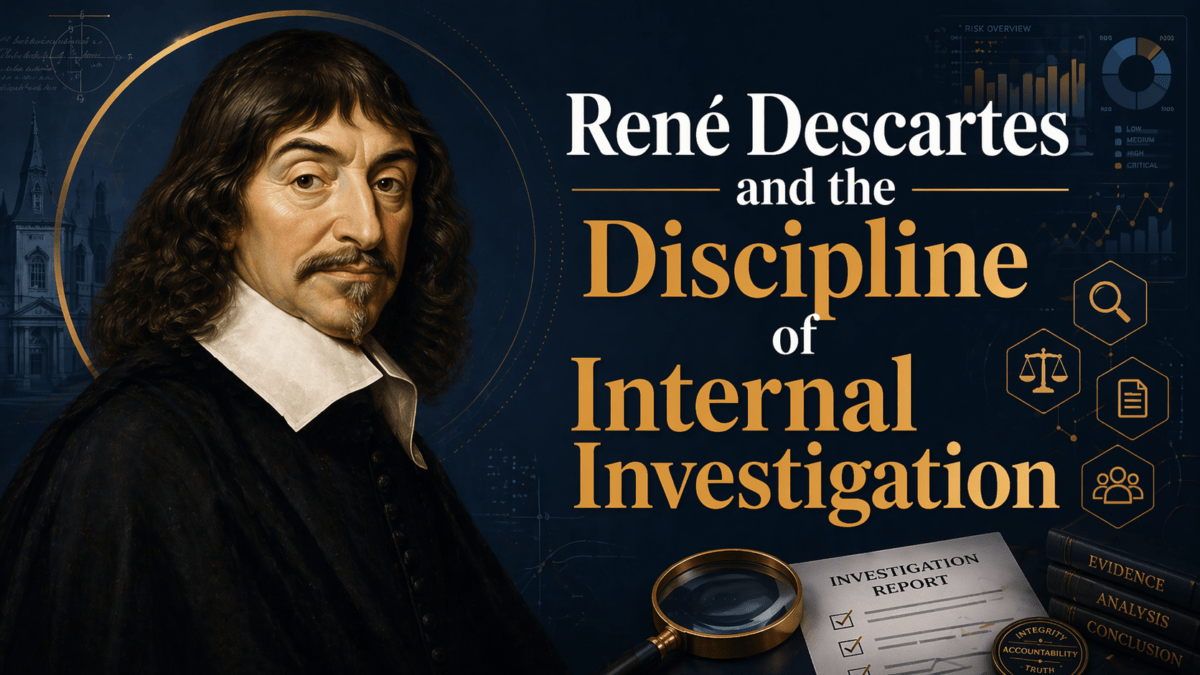
This week, we are moving to Enlightenment Thinkers to see their influence on modern compliance programs. This week’s category is broader than philosophers, as many of these men excelled in numerous fields such as science, mathematics, calculus, and medicine. However, each contributed a key component that relates directly to our modern compliance regimes. In this post, we consider René Descartes and what he teaches as the next step beyond Bacon: that evidence must be rigorously examined.
If Francis Bacon taught us that a compliance program must be grounded in evidence, René Descartes teaches the next step: evidence must be examined with rigor. That is why Descartes is the natural second installment in this series on what Enlightenment thinkers can teach us about modern corporate compliance. Bacon gave us empiricism. Descartes gives us a method. Bacon tells us to look. Descartes tells us how to think about what we find.
For the compliance professional, that is no small matter. Modern compliance programs do not fail only because they lack information. They often fail because organizations do not ask the right questions, challenge convenient assumptions, or investigate troubling facts with sufficient discipline. A hotline report comes in, and management prematurely dismisses it. A financial anomaly is explained away because the business result looks attractive. A third-party red flag is rationalized because the market opportunity seems too important to slow down. In each case, the problem is not simply a lack of data. The problem is a lack of disciplined inquiry.
That is where Descartes has something important to say to the modern Chief Compliance Officer.
Why Descartes Matters to Compliance
René Descartes is best known for methodical doubt. He believed that if one wanted to arrive at reliable knowledge, one had to strip away weak assumptions and test what could be known. He did not advocate doubt for its own sake. He advocated doubt as a disciplined tool, a way to avoid error and reach sound conclusions. His method required breaking problems into parts, analyzing them carefully, proceeding in an orderly manner, and ensuring nothing important was overlooked. That is remarkably close to what an effective compliance investigation function should do.
The compliance professional cannot assume an allegation is false because it is inconvenient. Nor can one assume it is true because it is emotionally compelling. The task is to examine. What happened? Who knew what, and when? What documents exist? What controls should have operated? Where are the inconsistencies? What explanation fits the evidence, and what explanation merely sounds comforting? Descartes would have recognized this immediately. A sound conclusion requires method, not instinct.
In a corporate environment, that is especially important because organizations are full of narratives. Managers tell stories about performance. Employees tell stories about why something was necessary. Third parties tell stories about local customs or business necessities. The compliance function should listen, but it cannot stop there. It must test those stories against facts.
The DOJ Expects More Than a Quick Answer
The Department of Justice’s Evaluation of Corporate Compliance Programs (ECCP) does not use philosophical language, but its expectations align closely with Cartesian thinking. The ECCP asks whether investigations are properly scoped, whether the company has adequate resources to conduct them, whether the company preserves and analyzes relevant data, whether reporting structures support independence, and whether lessons learned are used to improve the compliance program. That is not a request for superficial closure. It is a demand for disciplined inquiry.
The ECCP is not interested in whether a company can produce a memo that says the matter has been reviewed. It wants to know whether the review was credible. Did the company ask hard questions? Did it follow the evidence even when the evidence was uncomfortable? Did it look at underlying causes or accept a narrow explanation that minimized institutional responsibility? These are Descartes’ questions as much as the DOJ’s.
Method Beats Reaction
One of the most important lessons Descartes offers is that method matters more than reaction. Too many organizations still respond to reports of misconduct in an ad hoc fashion. The identity of the reporter, the subject’s seniority, or the business sensitivity of the issue can distort the process from the outset. Some matters are overreacted to because they are visible. Others are under-investigated because they are politically awkward. That is not a system. That is improvisation. A mature compliance program requires a clear, repeatable investigative method.
That begins with triage. Allegations should be assessed based on risk, scope, subject matter, and potential impact. Matters involving senior leadership, financial controls, corruption risk, retaliation, or systemic process failures may require immediate escalation and greater independence. Low-risk issues may still require attention, but not every matter needs the same level of response. Cartesian thinking does not mean treating every problem identically. It means applying a coherent method to determine what level of inquiry is warranted.
From there, the matter should be broken down into manageable components. What is the allegation? What business process is implicated? What documents are likely relevant? Who are the key custodians? What data sources exist? What is the working timeline? What controls should have operated? What policy provisions may have been implicated? This is classic Descartes: divide complex problems into smaller parts so they can be understood.
Disciplined Skepticism Is a Compliance Strength
Compliance professionals sometimes worry that skepticism will be perceived as mistrust. But disciplined skepticism is not cynicism. It is not hostility. It is professional rigor. It is the recognition that people often explain events in self-protective ways, that organizations prefer neat stories to messy truths, and that important facts are often buried inside routine processes. Descartes would have understood that skepticism is a necessary safeguard against error.
Consider a common internal reporting scenario. A manager says that a questionable payment was simply an administrative oversight. Perhaps that is true. But a compliance professional guided by Descartes would ask several follow-up questions. Was it really isolated? Have similar payments occurred before? Were approval thresholds bypassed? Was the vendor properly vetted? Were invoice descriptions vague or coded? Did someone raise concerns earlier? Was the explanation consistent across all available records? None of those questions accuse. They clarify.
Documentation Turns Inquiry Into Credibility
Another Cartesian lesson for compliance is the importance of orderly reasoning. An investigation cannot simply be sound in substance. It must also be documented in a way that shows how the conclusion was reached. This is essential for institutional memory, for regulatory defensibility, and for credibility with boards and senior management.
A well-documented investigation answers basic but vital questions. What was alleged? Who handled the matter? What evidence was reviewed? Which witnesses were interviewed? What facts were established? What policy or control failures were identified? What conclusion was reached, and why? What remediation followed? This kind of documentation is not bureaucratic excess. It is proof of intellectual discipline.
Without it, the company cannot show that it acted reasonably. It cannot identify patterns across matters. It cannot demonstrate consistency. It cannot revisit earlier decisions when new facts emerge. Most importantly, it cannot turn an individual case into organizational learning. Descartes’ method was about structured thinking. In corporate compliance, documentation is how structured thinking becomes durable.
Independence Matters When the Facts Get Uncomfortable
No discussion of investigations would be complete without addressing independence. The most elegant methodology in the world will not help if investigators are pressured to protect favored executives, minimize business disruption, or avoid awkward findings. Cartesian rigor requires a willingness to follow the facts wherever they lead. That, in turn, requires real autonomy.
The ECCP addresses this directly through its focus on stature, authority, resources, and access. Can the compliance function investigate senior personnel? Can it escalate concerns to the board or audit committee when necessary? Is it empowered to challenge management narratives? These are not secondary governance questions. They are central to whether the investigation process can produce reliable conclusions.
There is a reason so many compliance failures involve not merely misconduct, but management interference with the review of misconduct. When power shapes the investigation, facts become negotiable. Descartes would have seen that as a fundamental corruption of method.
Investigations Must Lead to Remediation
A Cartesian compliance program does not end with a finding. It asks what the finding means for the system. That is why investigations must connect to remediation and root cause analysis. If an allegation is substantiated, the question is not simply who violated what rule. The question is what enabled the failure.
Was the training insufficient? Were incentives pushing employees toward bad decisions? Was a manager creating pressure that undermined ethical judgment? Did the approval process invite shortcuts? Was the policy too vague to guide real-world conduct? These questions push the company from conclusion to improvement.
This is where Descartes connects back to Bacon. Bacon teaches that we need evidence. Descartes teaches that we must reason carefully from the evidence. Together, they create a powerful model for compliance effectiveness. The company observes, investigates, documents, learns, and improves.
The Compliance Officer as a Guardian of Clear Thinking
If Bacon cast the compliance officer as an institutional scientist, Descartes casts the compliance officer as a guardian of clear thinking. In a corporation full of pressure, narrative, hierarchy, and urgency, that role is vital. Someone must insist that facts be tested, that assumptions be challenged, that conclusions be explained, and that the process remain disciplined when the easier path is to settle for a quick answer.
That is not merely an investigative skill. It is a governance function. It protects employee fairness, the board’s credibility, and the company’s defensibility. It also builds trust over time, because people learn that reports are taken seriously, that outcomes are reasoned rather than political, and that the system values truth over convenience.
René Descartes may seem an unlikely guide for corporate compliance. Yet his method of doubt, order, and careful reasoning belongs squarely within the modern best-practices compliance program. In an era where companies are judged not simply on whether they responded, but on how they responded, Descartes offers an enduring lesson: clear thinking is a control.
Five Lessons Learned for the Modern Compliance Professional
First, allegations should trigger a method, not a reaction. A repeatable investigative framework reduces bias and improves consistency.
Second, disciplined skepticism is a professional obligation. Compliance must test explanations against facts rather than accept convenient narratives.
Third, complex matters should be broken into parts. Scoping, evidence review, interviews, control mapping, and timeline construction all improve rigor.
Fourth, documentation is essential. It is how the company proves that its inquiry was credible and how it preserves institutional learning.
Fifth, an investigation is not complete until it informs remediation. Findings should lead to enhancements in control, policy changes, training updates, or broader governance improvements.
Coming Next: John Locke and the Legitimacy of Compliance Governance
If Francis Bacon teaches us to gather evidence and René Descartes teaches us to examine it rigorously, John Locke asks an equally important question: why should anyone trust the system in the first place? In Part 3, I will explore how Locke’s ideas about legitimacy, rights, and accountable authority provide a powerful framework for speak-up culture, non-retaliation, fairness, and board oversight. In the world of compliance, authority alone is never enough. It must also be credible.