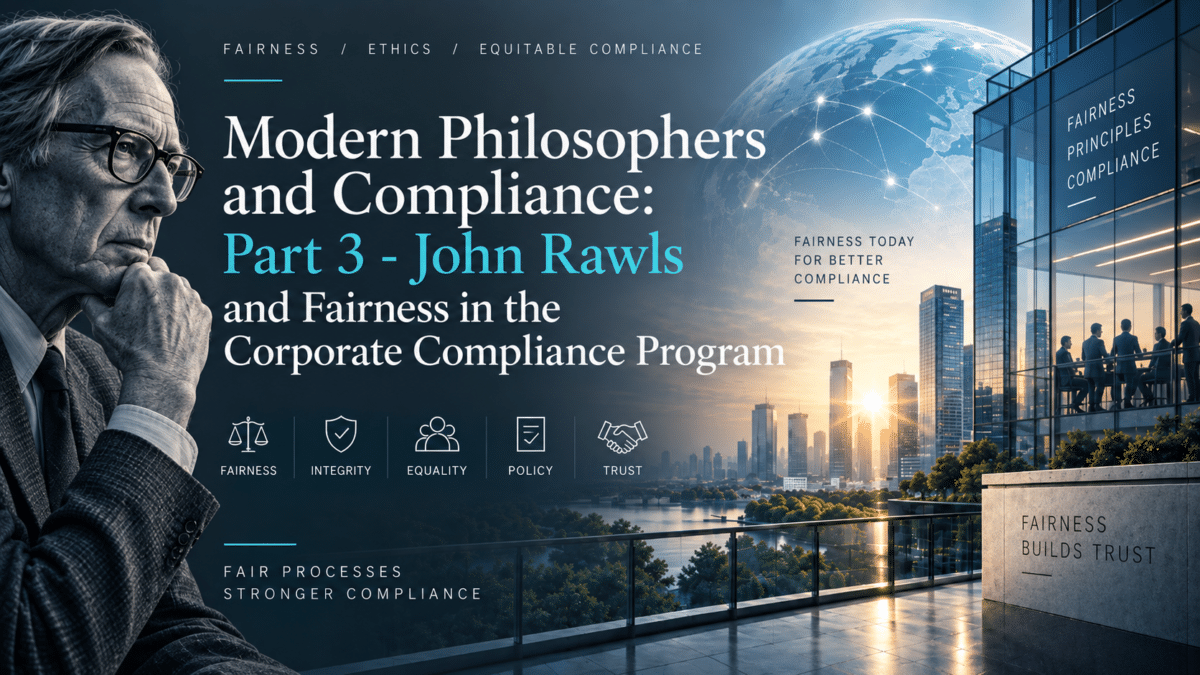
This week we will conclude our lengthy exploration of the philosophical underpinnings of the modern corporate compliance program. We have examined Hannah Arendt and her concepts of personal responsibility and how they relate to the modern compliance program, and Simone de Beauvoir and the conditions for ethical action in a corporation. We will review Jürgen Habermas and the governance of speaking up and Hans Jonas and responsibility for the future of corporate compliance. Today we continue with John Rawls and the twin concepts of Institutional Justice and Institutional Fairness in a corporate compliance program.
A compliance program promises how the company will exercise power. Employees are asked to follow rules, disclose concerns, cooperate with investigations, and accept consequences when misconduct is established. In return, they should be able to expect a process whose protections and standards do not depend on their commercial value or proximity to leadership. John Rawls gives compliance professionals a practical way to examine that promise.
In the first two posts, we considered personal responsibility through Hannah Arendt and the conditions for ethical action through Simone de Beauvoir. Today, in Part 3, Rawls brings us to the design of the institution itself. Would employees accept its rules if they did not know which position they would occupy when those rules were applied?
Justice as Fairness and the Corporate Institution
Rawls was an American political philosopher whose A Theory of Justice, published in 1971, developed an account of justice as fairness. His theory addresses society’s basic structure, including the institutions that distribute rights, opportunities, and advantages. It prioritizes equal basic liberties and addresses fair opportunity and the conditions under which economic inequalities can be justified.
A corporation is a different kind of institution. Rawls’s principles cannot simply be converted into an employee handbook. The useful connection is an approach to justification: examine institutional arrangements from a standpoint that limits the influence of personal advantage.
Rawls developed this approach through the original position, a hypothetical situation in which people select principles behind a veil of ignorance. They lack knowledge of their own social position and particular advantages, while retaining general knowledge relevant to institutional design. The restriction prevents them from tailoring principles to their individual circumstances.
In compliance, we can adapt that thought experiment. Imagine designing a disciplinary process without knowing whether you will be a junior employee, a regional executive, a witness, or the person accused. What protections would you require? Which differences in treatment could you defend? The exercise asks policy owners to step outside the interests associated with their current roles.
Designing the Process Before Knowing the Employee
Consider this hypothetical. A multinational company discovers that a regional sales director submitted personal expenses as business entertainment. The investigation establishes that he knowingly mischaracterized the expenses and had received clear training. He has no prior disciplinary record. His business unit produces a significant share of company revenue.
Six months earlier, the company dismissed a junior account manager for knowingly submitting comparable personal expenses. Assume the amounts, evidence of intent, training, and disciplinary history are materially similar, and no relevant legal difference exists. The sales director’s sponsor now recommends a warning because losing him could disrupt customer relationships.
The CCO faces a concrete governance question. Is the proposed distinction consistent with a defensible standard, or has commercial importance become a private exemption? The hypothetical deliberately holds relevant factors constant so that management must address the remaining reason for different treatment.
Apply the veil of ignorance. Would employees endorse a policy under which the consequences for deliberate expense falsification depend on how difficult the offender is to replace? Would leaders accept that principle if they expected to occupy the junior role? Asking those questions before deciding the case makes the underlying rule visible.
The company must still manage business continuity. It can plan customer coverage and succession while determining an appropriate response. Those operational responsibilities should be distinguished from the criteria used to assess misconduct. Otherwise, the need to retain an individual can quietly become the standard for deciding accountability.
The DOJ Connection Through Consistent Discipline
The Department of Justice’s Evaluation of Corporate Compliance Programs (ECCP) explicitly examines whether discipline and incentives are applied fairly and consistently. In Rawlsian terms, these map to what we call Institutional Fairness and Institutional Justice. The ECCP asks whether comparable misconduct received different treatment, why differences occurred, and how consistency is assessed across organizational levels and locations.
That inquiry aligns with the practical question raised by our hypothetical: can the company explain the distinction using relevant facts and established criteria? Rawls supplies a philosophical lens for examining the justification. The ECCP supplies an enforcement framework for scrutinizing actual practice.
Consistency requires judgment. An inadvertent mistake and deliberate concealment can warrant different responses. Supervisory responsibility, repeated misconduct, cooperation, harm, and applicable legal requirements may also matter. The organization should identify the factors it considers and document how they affect the outcome.
Return to the sales director. The decision-makers should examine the earlier case and any genuinely relevant distinctions. They should also consider whether the earlier response was itself appropriate. Fairness does not require repeating an unjustified sanction merely to preserve a record of identical outcomes. If the standard needs correction, the company should explain the correction and, with counsel and human resources, consider its implications for prior cases.
Fair Investigations Protect the Credibility of Findings
Institutional Fairness depends on a credible investigation. An organization cannot justify a consequence through careful reasoning if favoritism, prejudgment, or a refusal to examine contradictory evidence shaped the underlying inquiry.
The ECCP examines whether investigations are independent, objective, appropriately scoped, and documented. Applying Rawls’s thought experiment adds a practical design question: what process would we accept without knowing whether we would make the allegation or have to answer it?
Both positions deserve consideration. A reporter should have a reliable route for raising concerns and protection against retaliation. An accused person should have an appropriate opportunity to respond to material allegations before final findings, subject to legitimate investigative and legal constraints. Witnesses should be treated respectfully, and credibility assessments should rest on evidence.
These are proposed governance safeguards, rather than a claim that Rawls or the ECCP establishes a uniform corporate procedure. Companies must adapt their protocols to the circumstances and applicable law. They should nonetheless be able to explain why any significant departure was necessary and who authorized it.
In our hypothetical, an investigator whose promotion depends on the sales director may face a conflict. An independent assignment can protect the inquiry. The executive sponsor should supply relevant information without controlling findings. Clear roles reduce the opportunity for commercial pressure to influence the factual record before a disciplinary decision is even considered.
Exceptions Need Reasons That Survive Scrutiny
Policies inevitably encounter circumstances their authors did not anticipate. A mature compliance program needs a disciplined method for handling exceptions. The question is whether the justification would apply to another similarly situated person.
Consider a policy requiring advance approval for certain travel. An emergency evacuation and a preferred executive’s scheduling convenience present different reasons for an exception. The decision record should identify the relevant circumstances, the authority approving the departure, and any compensating safeguards. A personal relationship with the approver is not a defensible criterion.
Rawls also used reflective equilibrium, a method of working toward coherence among considered judgments and principles through revision. Applied by analogy, it encourages the CCO to examine difficult cases alongside the stated policy. A recurring, well-founded exception may reveal a defective rule. A convenient exception may reveal unwillingness to enforce a sound one.
The response should follow the evidence. Revise an impractical requirement where warranted, communicate the change, and preserve the underlying control objective. Where the rule is appropriate, address unauthorized departures. Employees should be able to understand how the company reaches these conclusions without needing personal access to influential decision-makers.
Testing Fairness and Reporting It to the Board
Fairness should be examined through case review and data. The ECCP addresses disciplinary transparency and monitors consistency in investigations and discipline. This is Institutional Justice in practice. For the same misconduct, does an employee in Brazil face the same consequences as your top salesperson in the United States? A practical review can compare similar matters while preserving the factual differences needed to interpret outcomes.
Start with a defined category, such as deliberate expense falsification. Compare findings, disciplinary history, role responsibilities, sanctions, and the reasons recorded for departures from the usual approach. Also review investigation duration and decision ownership. An unexplained delay involving an influential leader can warrant scrutiny even before determining a sanction.
Differences in outcomes signal the need for inquiry. Small samples, different legal requirements, and materially different conduct can make aggregate comparisons misleading. A dashboard should help reviewers identify questions that require examination of the underlying cases. It should not assign a fairness score that disguises unresolved factual distinctions.
The board needs visibility into material exceptions and management’s response to unexplained disparities. Directors should ask whether a disciplinary recommendation involving a senior leader was changed, who changed it, and why. The answer should include the relevant evidence and the standard applied, with appropriate protection for confidential information.
Communication with employees also deserves deliberate attention. The company can explain its decision criteria and use carefully anonymized examples without exposing private case details. When confidentiality limits disclosure, explain the process that supports accountability. Leaving employees to infer the rules from departures and rumors weakens the company’s ability to demonstrate fairness.
Five Key Rawls Takeaways for the Compliance Professional
- Test policies without assuming your own position. Ask whether you would accept a process as a junior employee, reporter, witness, or accused executive. Use the answers to identify protections that should not depend on influence.
- Define the reasons that justify different outcomes. Document relevant distinctions such as intent, responsibility, prior conduct, and legal requirements. Examine claims of commercial indispensability with particular care.
- Protect the integrity of the investigation. Identify conflicts, assign appropriate independence, examine contradictory evidence, and provide a fair opportunity to respond. Record the reasons for significant procedural departures.
- Review exceptions as evidence about the program. Determine whether they expose a policy defect or selective enforcement. Correct flawed rules transparently and address departures that lack a defensible basis.
- Give the board a clear account of consistency. Present material disparities, executive exceptions, and corrective actions with sufficient context to assess them. Use case evidence to explain what aggregate measures cannot resolve.
Rawls gives the compliance professional a demanding question: could we justify this rule before knowing whom it would benefit? For boards, the corresponding test is whether the company applies standards it would defend to employees at every level. The program’s credibility depends on the answers demonstrated in actual decisions.
In Part 4, we will turn to Jürgen Habermas and the role of reasoned dialogue in corporate compliance. Having examined fair institutional rules with Rawls, we will consider how employees can question those rules, challenge decisions, and have their concerns meaningfully considered. That discussion takes us into speak-up culture and the governance of disagreement.