


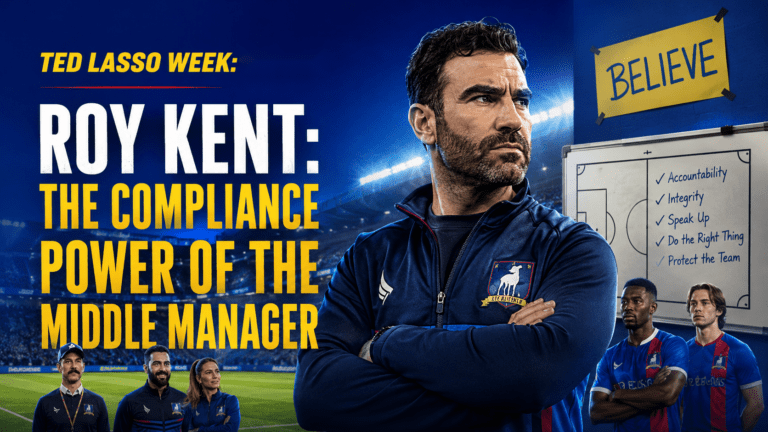
Season 4 of Ted Lasso is out. Matt Kelly reposted a blog he wrote during the original run of the series, and he and I did a deeper dive into the show and its popularity for compliance professionals in an episode of Compliance into the Weeds. I decided to take a deep dive into five characters from the show and use them to explore compliance topics. Over five blog posts, I have considered Manager Ted Lasso, Assistant Manager Nate Shelley, player and later coach Roy Kent, and social media influencer Keeley Jones. Today in Part 4, I consider the sometimes painful transition of an aging sports star into middle-management coaching.
In Part Three, Nate Shelley demonstrated the danger of promoting technical talent without preparing or monitoring the new manager. Roy Kent provides the counterpoint. He is demanding, impatient, and frequently intimidating, but he understands that leadership happens close to the work. Ted can articulate Richmond’s values. Rebecca can provide authority and resources. Roy determines whether those values survive contact with the locker room. He corrects behavior, confronts stars, coaches struggling employees, and translates general expectations into specific action.
For compliance professionals, Roy illustrates the power of the middle manager. He also shows the risk. The same informal authority that can strengthen culture can magnify poor judgment when it is not bounded by self-awareness, escalation, and accountability.
Authority Exists Before the Title
Roy begins the series as Richmond’s captain, not a member of management. Yet his teammates watch him, follow him, and adjust their behavior around him. He has informal authority, which often matters more than the organizational chart.
In “Trent Crimm: The Independent” (Season 1, Episode 3), Ted recognizes that Jamie Tartt and other players are bullying Nate. Rather than solve the problem solely through formal coaching authority, Ted pushes Roy to act. Roy confronts Jamie and forces the locker room to change. That is the tone in the middle. Employees often look to a respected supervisor, veteran, or peer leader to determine whether the code of conduct is real. If that person laughs at an offensive joke, ignores a control override, or protects a top performer, the policy loses. If that person intervenes, the standard gains operational force.
The DOJ Evaluation of Corporate Compliance Programs (ECCP) directs prosecutors to examine how managers at all levels encourage or discourage compliance through their words and actions. Compliance leaders therefore need to identify informal influencers, not merely designated supervisors. On this point, the ECCP states, “it is important for a company to create and foster a culture of ethics and compliance with the law at all levels of the company. The effectiveness of a compliance program requires a high-level commitment by company leadership to implement a culture of compliance from the middle and the top.” Culture travels through both. The ECCP goes on to state “[t]he company’s culture of compliance, including awareness among employees that any criminal conduct, including the conduct underlying the investigation, will not be tolerated.”
Standards Must Apply to Stars and to the Manager
Roy’s credibility comes partly from his willingness to confront Jamie, Richmond’s most talented player. He refuses to accept the idea that performance excuses selfishness or abuse. That is a central compliance principle. Standards that bend around revenue generators and star executives are not standards.
Roy faces the same test personally in “All Apologies” (Season 1, Episode 9). His age and injuries have reduced his performance, but his identity is tied to being captain and playing every match. When Ted decides to bench him, Roy initially resists. He ultimately reports for training in the reserve bib and supports the team. The decision matters because accountability becomes credible when the influential employee accepts the rule applied to everyone else. Roy does not enjoy the outcome, but he demonstrates that status does not confer immunity.
Effective Coaching Diagnoses the Cause
In “The Hope That Kills You” (Season 1, Episode 10), Roy selects Isaac McAdoo as the next captain. By “Rainbow” (Season 2, Episode 5), Isaac is struggling under the weight of that role. Ted asks Roy for help. Roy does not respond with another motivational speech or a threat. He takes Isaac to the neighborhood pitch where Roy learned to play and places him in an informal match. The intervention helps Isaac rediscover that football is a game he loves.
This is root-cause analysis at the individual level. The visible problem is poor performance. The underlying issue is that responsibility has displaced purpose and confidence. Roy changes the environment, observes Isaac, and chooses an intervention connected to the cause. The compliance application is substantial. When an employee misses a control, a manager should not automatically assign retraining. The cause may be an unrealistic target, conflicting procedures, poor system design, inadequate staffing, fear of escalation, or a supervisor who rewards shortcuts. Training cannot repair a misaligned incentive. Discipline cannot correct an unusable process.
Coaching Can Turn a Risk Into an Asset
Roy’s relationship with Jamie becomes his strongest management case. He begins by confronting Jamie’s entitlement. In “Man City” (Season 2, Episode 8), after Jamie finally strikes back at his abusive father, Roy recognizes the pain beneath the conduct and embraces him. The response is neither a lecture nor an endorsement of violence. It is a manager recognizing that the employee needs support before instruction.
In “4-5-1” (Season 3, Episode 3), Jamie asks how he can become better than Zava. Roy offers to train him. The work continues through “Sunflowers” (Season 3, Episode 6), when their training in Amsterdam becomes reciprocal, and Jamie teaches Roy to ride a bicycle. Roy does not lower the standard for Jamie. He gives him the discipline, attention, and feedback needed to meet a higher one. This is what good remediation should accomplish. It should protect the organization while creating a credible path for behavioral improvement.
Managers need tools for these conversations: clear expectations, documented feedback, measurable improvement goals, support resources, escalation thresholds, and follow-up. Candor without structure can become hostility. Compassion without standards can become avoidance. Roy is most effective when he combines both.
Informal Power Can Also Amplify Bad Judgment
Roy is not a flawless compliance model. In “Big Week” (Season 3, Episode 4), he and Coach Beard show the players security footage of Nate tearing the “BELIEVE” sign, despite Ted’s decision not to use it as motivation. The team becomes enraged, loses discipline, receives multiple red cards, and falls to West Ham. Roy intends to motivate. He instead weaponizes internal security footage and emotional injury.
The failure offers three lessons. First, managers must understand the limits of delegated authority. Silence or ambiguity from senior leadership is not permission to bypass its stated judgment. Second, incentives built on anger can produce foreseeable misconduct. Third, a result-driven culture can make an improper method appear acceptable until the damage becomes visible.
Roy’s training methods can also cross from demanding into unsafe or humiliating, as the red-string exercise in “The Strings That Bind Us” (Season 3, Episode 7) demonstrates. A strong manager should challenge employees. The organization must still set boundaries around safety, dignity, and acceptable conduct. This is why middle-management training cannot be limited to explaining policy. Managers need scenario-based practice on investigations, privacy, retaliation, discipline, escalation, health and safety, conflicts, and the use of employee information.
The Best Managers Remain Coachable
Roy’s development is possible because he gradually accepts that leadership does not require invulnerability. In “So Long, Farewell” (Season 3, Episode 12), he joins the Diamond Dogs, asks whether people can change, and later begins therapy. He becomes Richmond’s manager, but his promotion is framed as the next stage of development, not proof that the work is finished.
That distinction matters. Organizations often treat promotion as validation rather than increased risk. The best managers remain open to feedback, seek guidance, acknowledge uncertainty, and use available expertise. Middle managers are a critical source of that information. They should not filter out bad news to protect their numbers. Boards and executives should ask whether managers escalate emerging risks, whether the organization rewards such escalation, and whether retaliation or fear is blocking the flow of information.
Questions for CCOs
Roy’s journey should prompt five questions:
- Who are the organization’s informal culture carriers, and how are they engaged?
- Are managers evaluated and rewarded for how they achieve results, not only for the results themselves?
- Do managers know how to diagnose root causes, escalate concerns, and document behavioral coaching?
- Are high performers subject to the same conduct standards as everyone else?
- Does manager training distinguish productive candor from intimidation, retaliation, humiliation, and unsafe pressure?
Roy Kent demonstrates that middle managers are the operational heart of compliance. They make standards visible, detect weak signals, and decide whether employees experience accountability as fair. Compliance cannot succeed around them. It must succeed through them.
Next in the Series: Keeley Jones and Governance Under Pressure
Roy’s challenge is translating established values into frontline behavior. Keeley Jones faces the next organizational stage: building a business, accepting investor capital, managing employees, and preserving independence while personal and commercial pressures converge. Join us in our series finale, where we will examine founder risk, conflicts of interest, privacy, third-party influence, and why governance must grow as quickly as the company it is designed to protect.