Categories
Blog

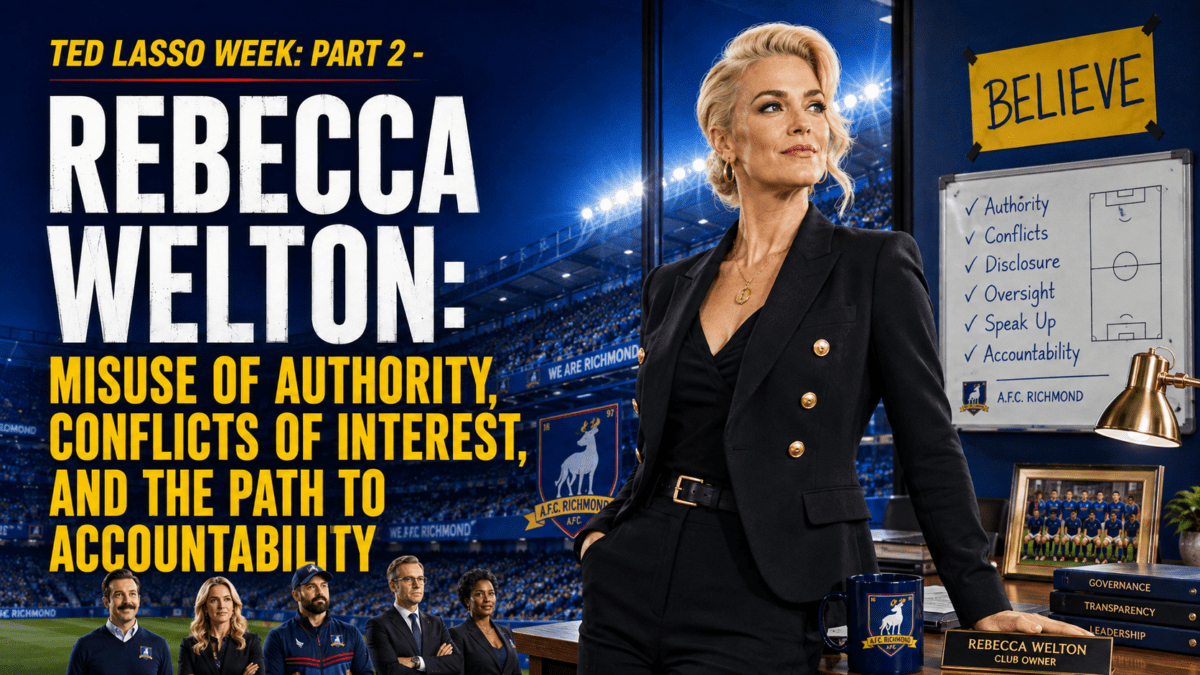
Ted Lasso Week: Part 2 – Rebecca Welton: Misuse of Authority, Conflicts of Interest, and the Path to Accountability

Season 4 of Ted Lasso is out. Matt Kelly reposted a blog he wrote during the original run of the series, and he and I did a deeper dive into the show and its popularity for compliance professionals in an episode of Compliance into the Weeds. I decided to take a deep dive into five characters from the show and use them to explore compliance topics. Over five blog posts, I will consider Manager Ted Lasso, Assistant Manager Nate Shelley, player and later coach Roy Kent, and social media influencer Keeley Jones. Today in Part 2, we consider compliance lessons through the character of team owner Rebecca Welton.

In Part 1, we considered how Ted Lasso built psychological safety and an ethical culture while sometimes allowing empathy to outrun accountability. Rebecca Welton presents the problem from the other side of the executive table. She begins as the source of AFC Richmond’s misconduct, then becomes the leader best positioned to acknowledge it.

Rebecca’s story is not simply a redemption arc. It is a governance case study about what happens when personal objectives capture corporate authority. It also shows why confession, forgiveness, and improved behavior are necessary but insufficient elements of an effective remediation program. The compliance lesson is direct: power creates risk when no independent mechanism can question the person exercising it.

When the Owner Becomes the Risk

In “Pilot” (Season 1, Episode 1), Rebecca hires Ted, an American football coach with no soccer experience, to manage a Premier League club. Her stated rationale is irrelevant because her actual purpose is to destroy the institution Rupert Mannion loves. She uses Richmond’s people, reputation, competitive position, and financial value to pursue a private grievance.

That is a classic conflict between personal interest and organizational duty. Rebecca is not accepting an envelope of cash or steering a contract to a relative. Her conflict is more fundamental: she has converted corporate decision-making into an instrument of revenge. The COSO Internal Control Framework begins with the control environment, including integrity, ethical values, oversight, authority, and accountability. At Richmond, the control environment fails at the top. The owner sets an improper objective, possesses the authority to execute it, and faces no visible independent challenge.

Compliance officers should take note. Conflicts of interest do not end with disclosure forms. They arise whenever personal relationships, status, resentment, financial incentives, or outside interests can distort business judgment. The greater the executive’s authority, the stronger the required safeguards.

Concentrated Authority Silences Challenge

Rebecca’s plan requires assistance. Higgins facilitates her agenda even though he recognizes the harm. In “Make Rebecca Great Again” (Season 1, Episode 7), Rebecca arranges for a photographer to capture Ted and Keeley in a compromising image. The objective is not legitimate media strategy. It is manufactured reputational damage intended to destabilize Ted and the club.

Higgins is not merely an unfortunate bystander. He is a senior employee who allows access, information, and organizational machinery to serve the owner’s improper purpose. His eventual resignation is a delayed act of conscience, but the episode demonstrates how authority can corrupt the escalation process. Employees may know that conduct is wrong and still conclude that challenging the owner is futile or career-ending.

The DOJ Evaluation of Corporate Compliance Programs asks whether “compliance personnel (1) sufficient qualifications, seniority, and stature (both actual and perceived) within the organization; (2) sufficient resources, namely, staff to undertake the requisite auditing, documentation, and analysis effectively; and (3) sufficient autonomy from management, such as direct access to the board of directors or the board’s audit committee.” It also asks whether managers encourage or discourage compliance through their conduct. Richmond has no credible independent function capable of reviewing Rebecca’s decisions, investigating her conduct, or escalating around her.

Accountability Begins With Truth

Keeley becomes the effective speak-up channel Richmond lacks. Once she discovers Rebecca’s scheme, she does not accept friendship, hierarchy, or reputational risk as reasons to stay silent. She insists that Rebecca tell Ted the truth. Rebecca finally does so in “All Apologies” (Season 1, Episode 9). She admits that she hired Ted to fail, orchestrated the paparazzi scheme, and engineered Jamie Tartt’s return to Manchester City to weaken Richmond. Most importantly, she does not minimize her purpose. She explains that she wanted to hurt Rupert and used Ted and the club to do it.

This is an effective apology because it identifies conduct, intent, and harm. It also accepts the possibility of consequences. Yet it is not a remediation. Nevertheless, Ted forgives her immediately, but an actual organization could not stop there. The U.S. Sentencing Guidelines require an organization to respond appropriately after misconduct and take reasonable steps to prevent similar conduct. DOJ asks whether the company performed a root-cause analysis, disciplined responsible individuals, repaired controls, and tested whether remediation works.

Richmond would need an independent review of affected personnel decisions, financial consequences, sponsor and stakeholder impacts, the use of confidential information, and Higgins’s role. It would also need governance changes that prevent one executive from repeating the conduct. An apology can reopen trust. Only remediation can reduce recurrence risk.

The Conflict Problem Returns With Sam

Rebecca’s growth does not eliminate conflicts. In “The Signal” and “Headspace” (Season 2, Episodes 6 and 7), Rebecca discovers that her anonymous Bantr match is Sam Obisanya, a Richmond player. Their relationship develops in “Man City” (Season 2, Episode 8) and continues secretly into “No Weddings and a Funeral” (Season 2, Episode 10).

The relationship is portrayed with warmth and mutual affection. That does not resolve the organizational issue. Rebecca owns the club that controls Sam’s employment environment. Her decisions can affect contracts, playing resources, sponsorships, reputation, and career opportunities. Even if she never exercises that power improperly, the imbalance creates an appearance of favoritism and raises questions about consent, retaliation, confidentiality, and recusal.

The compliance response is not moral judgment. It is a process. A conflict policy must apply to owners and senior executives, not only employees. Disclosure should go to an independent board member or committee. The organization should document safeguards, remove the conflicted leader from relevant decisions, protect the less powerful party, and monitor for retaliation or preferential treatment. Rebecca eventually pauses the relationship, but Richmond never appears to activate a formal conflict-management process. Personal restraint is not a control.

From Personal Ownership to Stewardship

Rebecca’s leadership changes when she stops treating Richmond as property and begins treating it as an institution held in trust for others. In “Do the Right-est Thing” (Season 2, Episode 3), Sam protests sponsor Dubai Air because of its connection to environmental damage in Nigeria. Rebecca backs the players despite the commercial risk. She recognizes that sponsorship revenue does not outrank organizational values.

Her transformation is clearest in “International Break” (Season 3, Episode 10). Edwin Akufo invites elite club owners to join an exclusive league built around scarcity, control, and profit. Rebecca rejects the proposal by reminding the room that football belongs to the people whose lives and communities give it meaning. She chooses stakeholder legitimacy over a lucrative insiders’ arrangement.

In “So Long, Farewell” (Season 3, Episode 12), she completes that shift by selling 49 percent of Richmond to its supporters. The woman who once used the club as a weapon ultimately distributes part of its ownership to the community.

This is what ethical remediation should seek: not a return to the status quo, but a more accountable operating model.

Questions for CCOs

Rebecca’s journey should prompt five questions:

  1. Can an allegation against the CEO, founder, controlling shareholder, or board chair bypass that person and reach an independent decision-maker?
  2. Do conflict rules cover personal relationships, vendettas, reputational motives, and executive discretion, or only financial interests?
  3. When senior misconduct occurs, who controls the investigation, discipline, disclosure, and remediation plan?
  4. Does the board receive reliable information about culture and mission-critical risks without management filtering?
  5. Are remediation measures tested, documented, and sustained after the responsible leader apologizes?
  6. Rebecca Welton shows that leaders can change. Compliance must make that change governable. Trust is rebuilt when truth is followed by independent review, proportional accountability, control improvements, and evidence that the organization learned.

Next Up: Nate Shelley and Culture Risk

Rebecca’s failure begins with power concentrated at the top. Nate Shelley’s failure develops lower in the organization, where insecurity, humiliation, status, and unaddressed resentment turn a once-overlooked employee into a destructive manager and trusted insider. In Part 3, we will examine the warning signs Richmond missed, the consequences of promoting technical talent without preparing them to lead, and why a speak-up culture must detect harm committed by newly empowered employees as readily as misconduct committed by executives.

Categories
Great Women in Compliance

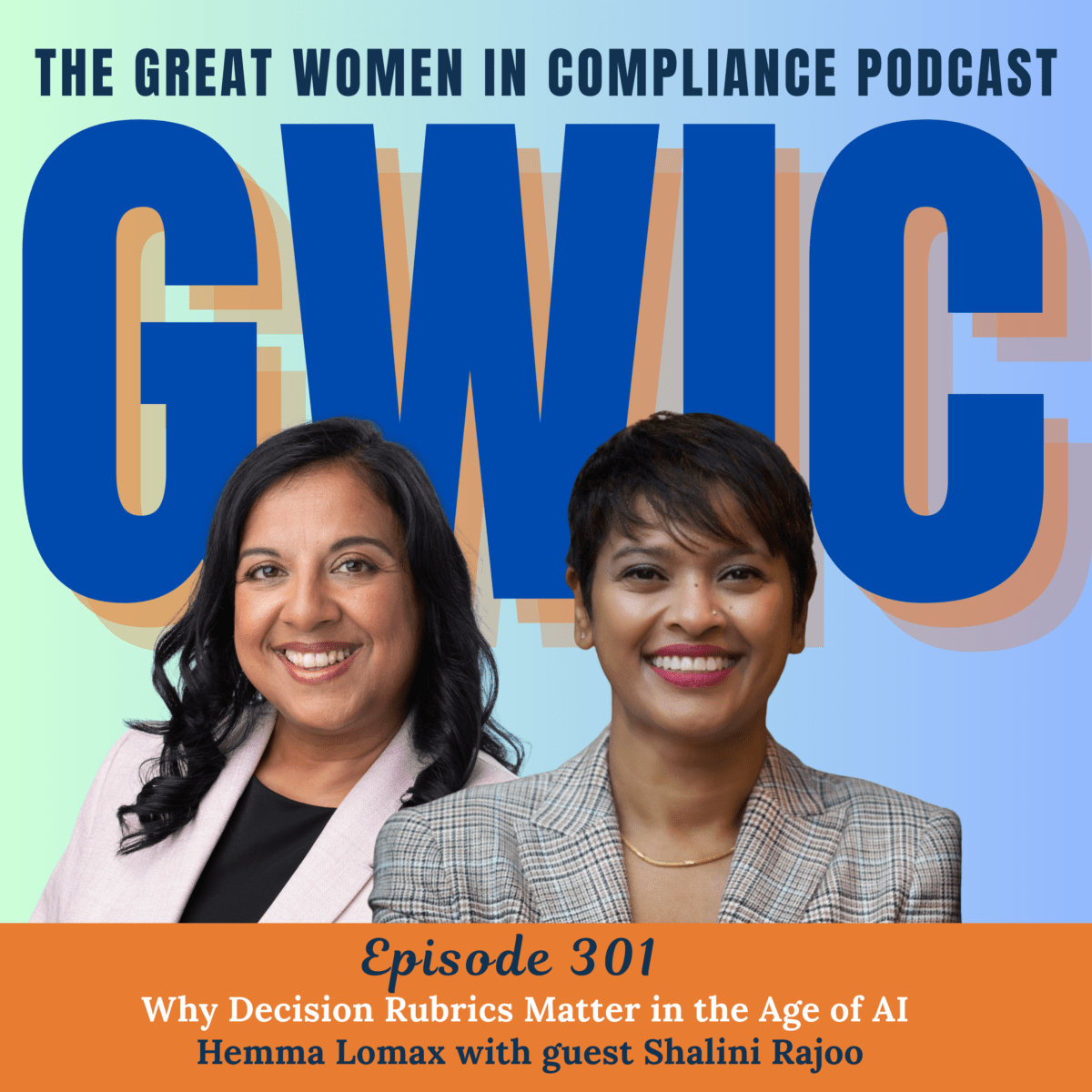
Great Women in Compliance: Why Decision Rubrics Matter in the Age of AI with Hemma Lomax and Shalini Rajoo

In this conversation, GWIC host Dr. Hemma R. Lomax and Shalini Rajoo explore the critical role of decision rubrics in governance, accountability, and trust, especially in the context of AI. Shalini shares her journey from law to compliance, emphasizing the importance of understanding systems and the impact of leadership on decision-making processes. They discuss how transparency and clarity in decision-making can build trust within organizations and the necessity of responsible AI governance. Practical tips for improving decision quality are also provided, highlighting the importance of self-awareness and critical thinking in leadership.

Takeaways:

  • The biggest risk in governance is unclear decisions.
  • AI amplifies existing clarity or confusion in decision-making.
  • Systems and rules reflect the identities of their architects.
  • Everyone has an impact on those around them every day.
  • Leadership is about improving the people around you.
  • It’s not just about rules; it’s about how people behave.
  • Decision rubrics provide consistency and predictability in outcomes.
  • Transparency in decision-making processes builds trust.
  • Slowing down to ask questions can lead to better decision-making.
  • Writing down the reasons for decisions brings clarity and accountability.

Sound bites:

“Systems and rules are not inherently neutral.”

“Transparency in decision making builds trust.”

“Slow is smooth, and smooth is fast.”

Chapters:

00:00 Introduction to Decision Rubrics and Governance

02:55 Shalini’s Journey: From Law to Governance

06:09 The Impact of Systems on Leadership and Accountability

09:09 Transitioning to Compliance and Ethics

11:49 Understanding Decision Rubrics in Compliance

15:06 The Role of Leadership in Decision Making

18:03 Designing Conditions for Effective Decision Making

20:47 The Importance of Transparency in Decision Processes

24:09 Decision Rubrics: Building Trust in Organizations

26:49 AI and Governance: Leadership Infrastructure Failures

29:47 Responsible AI: The Role of Ethics and Compliance

32:55 Practical Tips for Improving Decision Quality

36:00 Conclusion: The Future of Decision Making in AI

Guest Biography:

Shalini Rajoo is the Founder and Principal Consultant of Shalini Rajoo Advisory, LLC, where she partners with organizations to design governance, compliance, and decision-making systems that are resilient, trustworthy, and aligned to real operational pressures. Across more than two decades in law, compliance, HR, and organizational leadership, Shalini has helped companies and leaders move beyond check-the-box frameworks to build structures that embed accountability, clarity, and performance into everyday decisions.

She began her career in South Africa, first as a public prosecutor and then leading regulatory work with the Department of Trade and Industry, collaborating with legislative and executive stakeholders on corporate, competition, and consumer law. After relocating to the U.S., Shalini practiced commercial litigation. She later served as Director of Global Business Conduct for a Fortune 500 company, where she redesigned ethics and compliance systems, led global risk assessments, and championed psychological safety and integrity-based practices.

Today, Shalini’s work centers on helping leaders clarify decision rights, governance architectures, and accountability pathways — especially as organizations adopt AI and automation. She recently spoke at the Opal Group’s Corporate Governance & Ethics in the Age of AI conference, where she reframed AI governance as a leadership-infrastructure challenge rather than a purely technical or compliance one.

Categories
AI Today in 5

AI Today in 5: February 9, 2026, The AI Agents Doing Compliance Edition

Welcome to AI Today in 5, the newest addition to the Compliance Podcast Network. Each day, Tom Fox will bring you 5 stories about AI to start your day. Sit back, enjoy a cup of morning coffee, and listen in to the AI Today In 5. All, from the Compliance Podcast Network. Each day, we consider five stories from the business world, compliance, ethics, risk management, leadership, or general interest about AI.

Top AI stories include:

  1. What to do when AI is forced on compliance. (CW)
  2. Napier AI/AML report is out. (FinTechGlobal)
  3. AI and the accountability gap. (FinTechGlobal)
  4. Where AI is tearing through corporate America. (WSJ)
  5. Goldman is letting AI Agents do compliance. (PYMNTS)

For more information on the use of AI in Compliance programs, my new book, Upping Your Game, is available. You can purchase a copy of the book on Amazon.com.

Categories
Popcorn and Compliance

Popcorn and Compliance: Episode 5 – Invisible Compliance: Lessons from The Invisible Man

Welcome to a special series of Popcorn and Compliance. In this series, we will examine the Classic Universal Monster Movies from the 1930s and 1940s, mining them for compliance lessons. (Yes, it really is an excuse to rewatch them all.) In this series, we will examine Frankenstein, Dracula, The Wolf Man, The Mummy, and conclude with The Invisible Man. In today’s episode of ‘Popcorn and Compliance,’ we wrap up our series by analyzing the 1933 classic, ‘The Invisible Man,’ for compliance insights.

Joined by Fiona and Timothy, Fox explores how Claude Rains’ portrayal of Jack Griffin, a scientist who becomes unhinged after discovering invisibility, parallels challenges in corporate compliance. The episode distills five key lessons: the perils of lacking transparency, the necessity of accountability, the critical role of organizational culture, the exponential risks when innovation outpaces ethics, and the importance of crisis preparedness. This episode highlights the importance of making the invisible visible in compliance practices, aiming to uncover hidden risks, enforce accountability, and maintain robust ethical standards.

Key highlights:

  • Exploring ‘The Invisible Man’
  • Lesson 1: The Dangers of Lack of Transparency
  • Lesson 2: The Importance of Accountability
  • Lesson 3: The Role of Culture in Compliance
  • Lesson 4: Innovation and Ethical Boundaries
  • Lesson 5: Crisis Preparedness
  • Final Thoughts

Resources:

Compliance Lessons from the Invisible Man on the FCPA Compliance and Ethics Blog

Tom Fox

Instagram

Facebook

YouTube

Twitter

LinkedIn

Categories
Innovation in Compliance

Innovation in Compliance – Exploring Sustainable Leadership and Accountability with Gina Cotner

Innovation comes in many areas, and compliance professionals need to be ready for it and embrace it. Join Tom Fox, the Voice of Compliance, as he visits with top innovative minds, thinkers, and creators in the award-winning Innovation in Compliance podcast. In this episode,  host Tom Fox welcomes back Gina Cotner, the CEO and founder of Athena Executive Services, to delve into crucial leadership topics relevant to the compliance community.

The discussion covers root cause analysis (RCA), the importance of creating a culture of accountability, and effective delegation without abdicating responsibility. Gina emphasizes the significance of asking open-ended, curious questions, continuous coaching, and managing up for sustained organizational success. They also touch on the role of trust, psychological safety, and clear communication in enhancing team performance and leadership practices, making it a must-listen for compliance officers and corporate leaders.

Key highlights:

  • The Importance of Root Cause Analysis
  • Creating a Culture of Accountability
  • Effective Delegation Strategies
  • Trust, Psychological Safety, and Communication
  • Applying Strategies in Different Contexts
  • Sustainable Leadership Practices

Resources:

Gina Cotner on LinkedIn

Athena Executive Services

Tom Fox

Instagram

Facebook

YouTube

Twitter

LinkedIn

LinkedIn

Check out my latest book, Upping Your Game-How Compliance and Risk Management Move to 2023 and Beyond, available from Amazon.com.

Innovation in Compliance was recently honored as the number 4 podcast in Risk Management by 1,000,000 Podcasts.

Categories
Culture Crafters

Culture Crafters – Building Accountability for Crisis Management

In this episode, the third part of a 3-part series of podcasts, Tom Fox and Sam Silverstein discuss how to build Accountability for Crisis Management. In this concluding Part 3, Tom and Sam discuss the importance of fostering a culture of accountability, particularly in times of disaster. Drawing on personal experiences of natural disasters, they explore the differences between proactive and reactive approaches to crisis management. Key takeaways include the necessity of auditing organizational crisis readiness, continuous leadership training, and integrating accountability into day-to-day operations. The episode underscores the significance of accountability in promoting trust, resilience, and effective communication within organizations. Practical steps for empowering employees and handling difficult conversations during crises are also covered.

Key highlights:

  • Proactive vs. Reactive Accountability
  • Steps to Implement Accountability in Crisis Management
  • The Importance of Culture Audits
  • Handling Difficult Conversations with Empathy
  • Empowering Employees Through Accountability

Resources:

Sam Silverstein

Sam Silverstein on LinkedIn

Sam Silverstein

The Culture Audit™

Categories
Culture Crafters

Culture Crafters – Strategies for Crisis Preparedness and Response

In this next episode in a 3-part series of podcasts, Tom Fox and Sam Silverstein discuss the critical role of accountability in navigating and mitigating business disasters.  Tom and Sam engage in a detailed discussion on the importance of accountability in managing business disasters. The conversation explores the importance of pre-crisis preparedness, effective crisis response, and fostering relationships built on trust and accountability. They emphasize practical steps for businesses to mitigate risks, maintain transparency, and support employees during tough times. They emphasize the crucial importance of accurate risk assessment, ethical decision-making, and fostering robust relationships with both internal and external stakeholders.

Key highlights:

  • Pre-Crisis Preparedness: Practical Steps
  • Crisis Response: Accountability in Action
  • Stabilization Phase: The Importance of Truth
  • Accountability with External Stakeholders
  • Recovery and Rebuild: Lessons Learned

Resources:

Sam Silverstein

Sam Silverstein on LinkedIn

Sam Silverstein

The Culture Audit™

Categories
Culture Crafters

Culture Crafters – Building a Culture of Accountability in the Face of Disasters

In this next series of podcasts, Tom Fox and Sam Silverstein discuss the critical role of accountability in navigating and mitigating business disasters. Triggered by the impactful floods near Kerrville, Texas, they explore how strategic frameworks of accountability can be applied during different phases of a crisis—from pre-crisis preparedness through crisis response, stabilization, and recovery. Emphasizing that accountability extends beyond tactical commitments to relational ones, they explore how robust human connections and a culture of accountability can empower businesses and communities to withstand and prosper in the face of disruptions like natural disasters, economic downturns, and geopolitical turmoil.

Key highlights:

  • The Role of Accountability in Business Disasters
  • Phases of Crisis Management
  • Pre-Crisis Preparedness
  • Crisis Response and Acting Decisively
  • Stabilization and Restoring Operations
  • Recovery, Growth, and Learning from Crises

Resources:

Sam Silverstein

Sam Silverstein on LinkedIn

Sam Silverstein

The Culture Audit™

Categories
FCPA Compliance Report

FCPA Compliance Report – Episode 771 – Accountability in Times of Crisis: A Conversation with Tom Fox and Sam Silverstein

Welcome to the award-winning FCPA Compliance Report, the longest-running podcast in compliance. In this episode, Tom Fox welcomes back Sam Silverstein in a conversation on the role of accountability in managing business disruptions and natural disasters.

Drawing from personal experiences and professional insights, they delve into the strategic framework necessary for businesses to navigate crises and rebuild stronger. Topics covered include pre-crisis preparedness, crisis response, stabilization phases, and recovery and growth, emphasizing the importance of a culture of accountability. Through practical steps and real-world examples, they explore how leaders can empower their teams, build trust with external stakeholders, and foster resilience within their organizations.

Key highlights:

  • The Role of Accountability in Crisis Management
  • Phases of Crisis Management
  • Pre-Crisis Preparedness
  • Crisis Response and Accountability
  • Stabilization and Recovery
  • The Importance of Truth in Leadership

Resources:

Connect with Sam Silverstein

Tom Fox

Instagram

Facebook

YouTube

Twitter

LinkedIn

For more information on the use of AI in Compliance programs, my new book, Upping Your Game. You can purchase a copy of the book on Amazon.com.

Categories
Innovation in Compliance

Innovation in Compliance – The Power of Accountability and Team Culture with Gina Cotner

Innovation comes in many areas, and compliance professionals need to be ready for it and embrace it. Join Tom Fox, the Voice of Compliance, as he visits with top innovative minds, thinkers, and creators in the award-winning Innovation in Compliance podcast. In this engaging episode, Tom Fox sits down with Gina Cotner, the founder and CEO & Founder of Athena Executive Services, to explore the importance of team culture and accountability in corporate settings.

Cotner delves into her professional background and the organic development of a strong team culture at Athena. She emphasizes the critical role of accountability as a cultural standard and provides actionable insights for leaders on how to instill this within their organizations. Key takeaways include the significance of consistency, the balance between compassion and accountability, and the role of follow-up as a leadership tool. With real-world examples and practical advice, Cotner provides a comprehensive guide to building and maintaining a high-performing, accountable team.

Key highlights:

  • Gina Cotner’s Professional Background
  • The Importance of Team Culture
  • Accountability in High-Performing Teams
  • Misunderstandings About Accountability
  • Building a Culture of Accountability
  • Consistency and Psychological Safety
  • Follow-Up as a Leadership Tool
  • Compassion in Leadership

Resources:

Follow Athena Executive Services on:

Company’s Website

LinkedIn

Instagram

Tom Fox

Instagram

Facebook

YouTube

Twitter

LinkedIn