


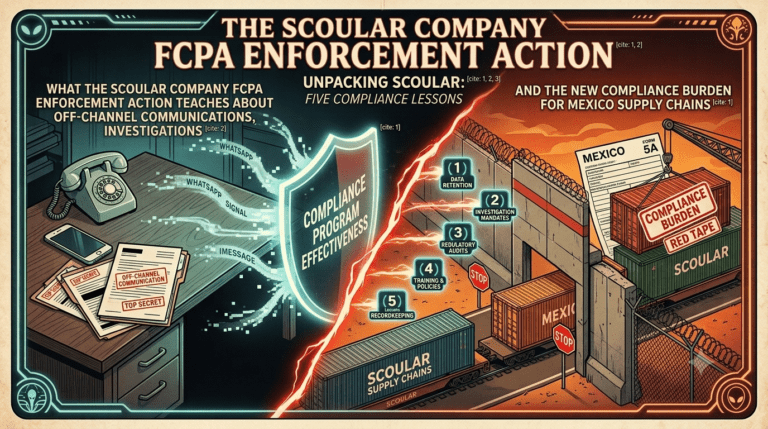
WhatsApp was not a footnote in The Scoular Company FCPA resolution. It was part of the operating system of the alleged bribery scheme. According to the Department of Justice Press Release (we are still waiting on the DPA and Criminal Information), Scoular Company employees communicated about shipments and bribes through WhatsApp and other means. Today I want to explore the issue of off-channel communication and what it means for your compliance program.
The compliance lesson is not simply that Scoular Company employees used WhatsApp. It is that an informal communications channel became embedded in a high-risk business process involving customs officials, third-party brokers, payment approvals, and financial records. Once that happens, messaging governance is no longer an information technology issue. It is an anti-corruption control.
Off-Channel Became the Business Channel
The phrase “off-channel” can be misleading. If employees regularly use WhatsApp to authorize payments, direct third parties, and solve customs problems, the application is not outside the business. It is where the business is being conducted. That distinction matters.
A company may have excellent controls inside its enterprise resource planning system. It may require purchase orders, segregation of duties, invoice matching, and documented approvals. Those controls can be bypassed if the substantive decision is made in a private chat and the formal system merely records the result. At Scoular Company, the reinspection invoice was one side of the control failure. The WhatsApp discussion was the other one.
The invoice gave the payment a facially legitimate description. The messaging channel allegedly supplied the knowledge, direction, and authorization behind it. Compliance teams should test both sides together. A recurring round-dollar customs charge becomes more significant when matched to a message asking a broker to get a train released. A failed inspection becomes more significant when followed by an off-channel approval and immediate border clearance. Communications analytics and transaction analytics should not operate as separate disciplines.
Enforcement Priorities Can Change. Evidence Does Not.
In my podcast with Matteson Ellis, Member and Latin America Practice Lead at Miller & Chevalier, we addressed the shift in federal enforcement attention surrounding off-channel communications. Ellis made the more durable point: even when a regulator changes its emphasis, WhatsApp messages remain evidence of knowledge, intent, authorization, concealment, and circumvention of control.
Ellis observed that the DOJ press release suggests Scoular’s internal investigation obtained access to relevant WhatsApp communications. That access was important because retrieving such data can be difficult, particularly when employees use personal devices, local privacy law limits review, or messages have not been retained. His conclusion should command the attention of every CCO. The off-channel issue may have become quieter, but the Scoular resolution can be read as bringing it back to the center of corporate investigations. A prosecutor does not need a standalone recordkeeping case to use a WhatsApp message as proof of an FCPA violation.
The 2024 ECCP Provides the Road Map
The DOJ’s 2024 Evaluation of Corporate Compliance Programs (ECCP) does not demand a single technology solution. It asks whether the company’s approach is reasonable for its business needs and risk profile. That is the correct standard because messaging use varies by country, function, and commercial reality. The ECCP organizes the inquiry around three practical areas:
- Communication channels. What electronic channels do employees actually use? How does use vary by jurisdiction and business function? What retention and deletion settings apply, and why did the company permit them?
- Policy environment. Can the company preserve communications when devices are replaced? What do privacy, security, employment, and bring-your-own-device rules permit? Can the company review business messages on personal devices, and are employees required to transfer business records into company systems?
- Risk management. Has the company ever exercised its access rights? What happens when an employee refuses access or violates the policy? Has messaging use impaired an investigation or the company’s response to prosecutors?
These are effectiveness questions. A written prohibition will not satisfy them if the business routinely ignores it, managers approve transactions in private chats, and the company cannot retrieve the records when misconduct surfaces.
A Defensible Program Starts With Commercial Reality
Ellis explained that an outright WhatsApp ban may not be practical in Latin America, where the application is widely used for business. A policy that conflicts with how employees, customers, and third parties actually work may drive communications further underground. The better approach is to define what may occur on the platform.
Ellis suggested limiting WhatsApp to logistical and administrative communications while keeping substantive commercial transactions and approvals inside controlled systems. That distinction is particularly important for customs payments, discounts, government interactions, third-party instructions, and exceptions to standard procedures.
A defensible framework should include the following controls:
- Map actual use: Survey high-risk functions and jurisdictions to determine which applications, devices, disappearing-message settings, and informal groups employees use.
- Classify communications: Separate low-risk logistics from approvals, commitments, payment decisions, government interactions, and other substantive business records.
- Build technical access: Use company-managed devices or approved enterprise integrations where appropriate so business communications can be retained, searched, placed on legal hold, and produced.
- Address local law: Analyze privacy, employment, consent, monitoring, and data-transfer requirements before an investigation begins. The access right must be lawful and operational.
- Create preservation protocols: Define what occurs when an employee changes devices, leaves the company, becomes subject to a legal hold, or refuses access to business communications.
- Enforce the rules: Test compliance, investigate violations, apply consequences consistently, and examine whether supervisors tolerated or encouraged off-channel approvals.
Investigations Must Be Ready Before the Message Disappears
Off-channel governance is tested in the first hours of an investigation. The company must identify relevant custodians, devices, applications, group chats, backup settings, linked desktops, and cloud accounts. It must issue a preservation notice that employees understand and implement. It must also determine whether consent, works council consultation, or another local-law step is required before collecting data.
The investigative team should not examine messaging data in isolation. It should connect communications to:
- Accounts-payable records
- Customs broker invoices
- Inspection results
- Shipment identifiers
- Clearance times
- Approval logs
- Bank data
This is where Scoular Company FCPA enforcement action becomes a model for a broader control lesson. The message can explain the invoice, and the invoice can corroborate the message. Ellis emphasized the value of having protocols ready before access is needed. That is critical. Negotiating employee consent, locating backups, and determining ownership of a device after a subpoena or whistleblower allegation arrives is not a defensible strategy. It is a delay, and delay can destroy evidence and cooperation.
Boards Should Treat Messaging as a Governance Risk
Boards do not need to select the retention platform or approve device settings. They do need assurance that management understands how high-risk business is actually conducted and can preserve the evidence required to investigate misconduct. The board should receive more than confirmation that a policy exists. It should receive information on:
- Policy exceptions
- Control testing
- Employee violations
- Disciplinary outcomes
- Collection failures
- Investigation delays
- High-risk jurisdictions and functions
For companies operating across the U.S.-Mexico border, customs, logistics, sales, procurement, and government-facing teams deserve particular attention. This is an oversight issue. If management cannot retrieve communications involving payments to government-facing third parties, the company may be unable to determine what occurred, identify responsible individuals, remediate the control failure, or cooperate effectively with prosecutors.
Questions for CCOs
- Which messaging platforms do employees and third parties actually use in our highest-risk markets?
- Can an employee approve a customs payment, direct a broker, or authorize an exception through WhatsApp?
- Can we lawfully and promptly preserve and retrieve business messages from company and personal devices?
- Have we tested those capabilities through a mock investigation or legal hold?
- Do transaction-monitoring reviews incorporate relevant messaging evidence when an anomaly is escalated?
- Have we disciplined employees and supervisors for circumventing approved channels?
The Bottom Line
Scoular Company did not become an off-channel communications case because employees happened to use WhatsApp. WhatsApp mattered because employees allegedly used it to facilitate and discuss a bribery scheme that operated through customs brokers and disguised invoices for six years. That is the compliance lesson. The channel, the payment, the third party, and the business outcome must be viewed as one control environment.
Companies should not ask whether WhatsApp is good or bad. They should ask whether the communications occurring there are permitted, preserved, accessible, monitored on a risk basis, and connected to the company’s formal approval and financial systems. If the company cannot answer those questions, its most important business records may be sitting on the device it controls least.