Categories
Blog

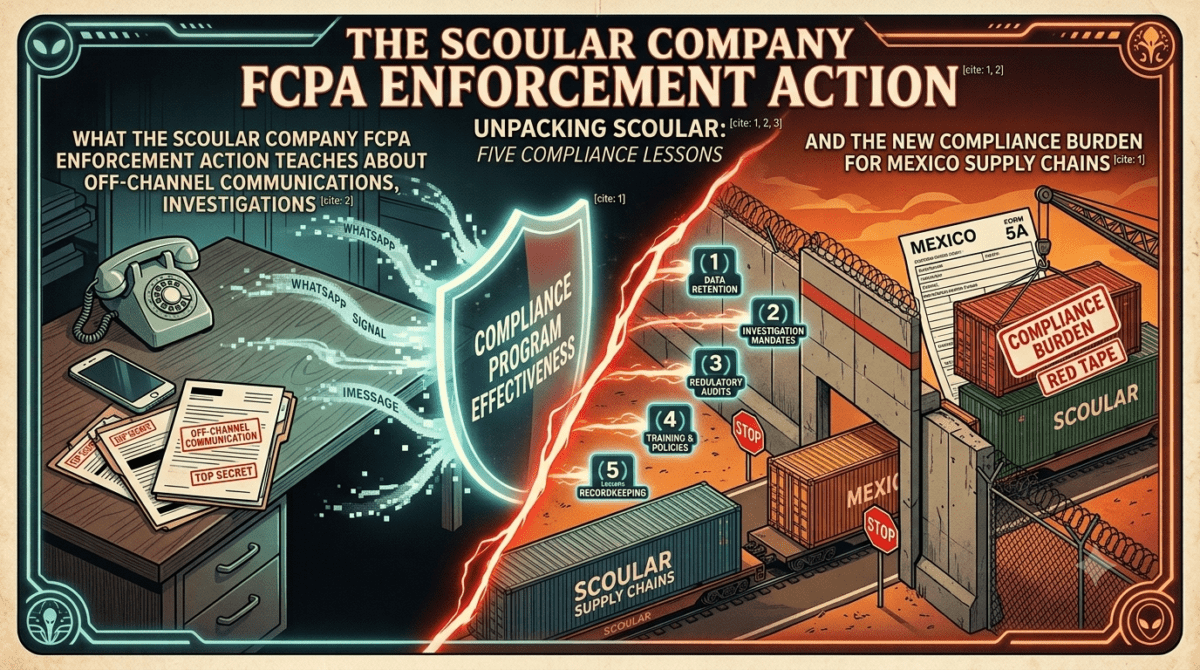
What Scoular Teaches About Off-Channel Communications, Investigations, and Compliance Program Effectiveness

WhatsApp was not a footnote in The Scoular Company FCPA resolution. It was part of the operating system of the alleged bribery scheme. According to the Department of Justice Press Release (we are still waiting on the DPA and Criminal Information), Scoular Company employees communicated about shipments and bribes through WhatsApp and other means. Today I want to explore the issue of off-channel communication and what it means for your compliance program.

The compliance lesson is not simply that Scoular Company employees used WhatsApp. It is that an informal communications channel became embedded in a high-risk business process involving customs officials, third-party brokers, payment approvals, and financial records. Once that happens, messaging governance is no longer an information technology issue. It is an anti-corruption control.

Off-Channel Became the Business Channel

The phrase “off-channel” can be misleading. If employees regularly use WhatsApp to authorize payments, direct third parties, and solve customs problems, the application is not outside the business. It is where the business is being conducted. That distinction matters.

A company may have excellent controls inside its enterprise resource planning system. It may require purchase orders, segregation of duties, invoice matching, and documented approvals. Those controls can be bypassed if the substantive decision is made in a private chat and the formal system merely records the result. At Scoular Company, the reinspection invoice was one side of the control failure. The WhatsApp discussion was the other one.

The invoice gave the payment a facially legitimate description. The messaging channel allegedly supplied the knowledge, direction, and authorization behind it. Compliance teams should test both sides together. A recurring round-dollar customs charge becomes more significant when matched to a message asking a broker to get a train released. A failed inspection becomes more significant when followed by an off-channel approval and immediate border clearance. Communications analytics and transaction analytics should not operate as separate disciplines.

Enforcement Priorities Can Change. Evidence Does Not.

In my podcast with Matteson Ellis, Member and Latin America Practice Lead at Miller & Chevalier, we addressed the shift in federal enforcement attention surrounding off-channel communications. Ellis made the more durable point: even when a regulator changes its emphasis, WhatsApp messages remain evidence of knowledge, intent, authorization, concealment, and circumvention of control.

Ellis observed that the DOJ press release suggests Scoular’s internal investigation obtained access to relevant WhatsApp communications. That access was important because retrieving such data can be difficult, particularly when employees use personal devices, local privacy law limits review, or messages have not been retained. His conclusion should command the attention of every CCO. The off-channel issue may have become quieter, but the Scoular resolution can be read as bringing it back to the center of corporate investigations. A prosecutor does not need a standalone recordkeeping case to use a WhatsApp message as proof of an FCPA violation.

The 2024 ECCP Provides the Road Map

The DOJ’s 2024 Evaluation of Corporate Compliance Programs (ECCP) does not demand a single technology solution. It asks whether the company’s approach is reasonable for its business needs and risk profile. That is the correct standard because messaging use varies by country, function, and commercial reality. The ECCP organizes the inquiry around three practical areas:

  • Communication channels. What electronic channels do employees actually use? How does use vary by jurisdiction and business function? What retention and deletion settings apply, and why did the company permit them?
  • Policy environment. Can the company preserve communications when devices are replaced? What do privacy, security, employment, and bring-your-own-device rules permit? Can the company review business messages on personal devices, and are employees required to transfer business records into company systems?
  • Risk management. Has the company ever exercised its access rights? What happens when an employee refuses access or violates the policy? Has messaging use impaired an investigation or the company’s response to prosecutors?

These are effectiveness questions. A written prohibition will not satisfy them if the business routinely ignores it, managers approve transactions in private chats, and the company cannot retrieve the records when misconduct surfaces.

A Defensible Program Starts With Commercial Reality

Ellis explained that an outright WhatsApp ban may not be practical in Latin America, where the application is widely used for business. A policy that conflicts with how employees, customers, and third parties actually work may drive communications further underground. The better approach is to define what may occur on the platform.

Ellis suggested limiting WhatsApp to logistical and administrative communications while keeping substantive commercial transactions and approvals inside controlled systems. That distinction is particularly important for customs payments, discounts, government interactions, third-party instructions, and exceptions to standard procedures.

A defensible framework should include the following controls:

  • Map actual use: Survey high-risk functions and jurisdictions to determine which applications, devices, disappearing-message settings, and informal groups employees use.
  • Classify communications: Separate low-risk logistics from approvals, commitments, payment decisions, government interactions, and other substantive business records.
  • Build technical access: Use company-managed devices or approved enterprise integrations where appropriate so business communications can be retained, searched, placed on legal hold, and produced.
  • Address local law: Analyze privacy, employment, consent, monitoring, and data-transfer requirements before an investigation begins. The access right must be lawful and operational.
  • Create preservation protocols: Define what occurs when an employee changes devices, leaves the company, becomes subject to a legal hold, or refuses access to business communications.
  • Enforce the rules: Test compliance, investigate violations, apply consequences consistently, and examine whether supervisors tolerated or encouraged off-channel approvals.

Investigations Must Be Ready Before the Message Disappears

Off-channel governance is tested in the first hours of an investigation. The company must identify relevant custodians, devices, applications, group chats, backup settings, linked desktops, and cloud accounts. It must issue a preservation notice that employees understand and implement. It must also determine whether consent, works council consultation, or another local-law step is required before collecting data.

The investigative team should not examine messaging data in isolation. It should connect communications to:

  • Accounts-payable records
  • Customs broker invoices
  • Inspection results
  • Shipment identifiers
  • Clearance times
  • Approval logs
  • Bank data

This is where Scoular Company FCPA enforcement action becomes a model for a broader control lesson. The message can explain the invoice, and the invoice can corroborate the message. Ellis emphasized the value of having protocols ready before access is needed. That is critical. Negotiating employee consent, locating backups, and determining ownership of a device after a subpoena or whistleblower allegation arrives is not a defensible strategy. It is a delay, and delay can destroy evidence and cooperation.

Boards Should Treat Messaging as a Governance Risk

Boards do not need to select the retention platform or approve device settings. They do need assurance that management understands how high-risk business is actually conducted and can preserve the evidence required to investigate misconduct. The board should receive more than confirmation that a policy exists. It should receive information on:

  • Policy exceptions
  • Control testing
  • Employee violations
  • Disciplinary outcomes
  • Collection failures
  • Investigation delays
  • High-risk jurisdictions and functions

For companies operating across the U.S.-Mexico border, customs, logistics, sales, procurement, and government-facing teams deserve particular attention. This is an oversight issue. If management cannot retrieve communications involving payments to government-facing third parties, the company may be unable to determine what occurred, identify responsible individuals, remediate the control failure, or cooperate effectively with prosecutors.

Questions for CCOs

  1. Which messaging platforms do employees and third parties actually use in our highest-risk markets?
  2. Can an employee approve a customs payment, direct a broker, or authorize an exception through WhatsApp?
  3. Can we lawfully and promptly preserve and retrieve business messages from company and personal devices?
  4. Have we tested those capabilities through a mock investigation or legal hold?
  5. Do transaction-monitoring reviews incorporate relevant messaging evidence when an anomaly is escalated?
  6. Have we disciplined employees and supervisors for circumventing approved channels?

The Bottom Line

Scoular Company did not become an off-channel communications case because employees happened to use WhatsApp. WhatsApp mattered because employees allegedly used it to facilitate and discuss a bribery scheme that operated through customs brokers and disguised invoices for six years. That is the compliance lesson. The channel, the payment, the third party, and the business outcome must be viewed as one control environment.

Companies should not ask whether WhatsApp is good or bad. They should ask whether the communications occurring there are permitted, preserved, accessible, monitored on a risk basis, and connected to the company’s formal approval and financial systems. If the company cannot answer those questions, its most important business records may be sitting on the device it controls least.

Categories
AI Today in 5

AI Today in 5: July 22, 2026, The $2tn Compliance Problem Edition

Welcome to AI Today in 5, the newest addition to the Compliance Podcast Network. Each day, Tom Fox will bring you 5 stories about AI to start your day. Sit back, enjoy a cup of morning coffee, and listen in to AI Today in 5. All from the Compliance Podcast Network. Each day, we consider five stories from the business world, compliance, ethics, risk management, leadership, or general interest about AI.

Top AI stories include:

  1. 5 AI trends in banking for 2026. (Retail Banker International)
  2. Compliance has a $2T AI problem. (Hackernoon)
  3. AI heads warn about Chinese AI. (WSJ)
  4. The US to scrutinize China AI for IP theft. (Bloomberg)
  5. Prediction markets and AI: Is compliance ready? (FinTech Global)

For more information on the use of AI in compliance programs, Tom Fox’s new book, Upping Your Game, is available. You can purchase a copy of the book on ⁠Amazon.com⁠.

To learn about the intersection of Sherlock Holmes and the modern compliance professional, check out Tom’s latest book, The Game is Afoot-What Sherlock Holmes Teaches About Risk, Ethics and Investigations on ⁠Amazon.com⁠.

Categories
Trekking Through Compliance

Trekking Through Compliance: Episode 52 – Cross-Cultural Compliance Lessons from “The Omega Glory”

As compliance professionals, we often talk about global organizations “boldly going” where few have gone before, into new markets, unfamiliar territories, and diverse cultures. But what happens when the culture you find is fundamentally different, yet disturbingly familiar? Star Trek’s “The Omega Glory” is one of the original series’ most controversial and fascinating explorations of cross-cultural misunderstanding, bias, and the search for common ground.

For the modern compliance officer, “The Omega Glory” is more than just a Star Trek curiosity. It’s a primer on the perils and potential of cross-cultural communication and a reminder that misunderstanding and ethnocentrism can undermine even the most well-intentioned mission.

Lesson 1: Don’t Assume Your Culture’s Symbols or Values Are Universal

Illustrated by: The Yangs hold these objects sacred but have lost the original meaning, reciting “freedom” and “justice” without understanding them.

Compliance Lesson: In global business, it is all too easy to assume that your organization’s symbols, policies, and values are understood the same way everywhere. What feels like common sense or “best practice” at headquarters may mean something entirely different or nothing across cultures.

Lesson 2: Recognize and Overcome Ethnocentrism—Your Way Is Not the Only Way

Illustrated by: Captain Tracey, he rationalizes his betrayal by viewing the Comms through his biased lens and refuses to see value in the Yangs’ ways.

Compliance Lesson: Ethnocentrism, the belief that one’s own culture is superior or “normal,” is a common barrier to cross-cultural compliance. Like Tracey, corporate leaders may favor one culture’s approach to ethics, risk, or problem-solving, dismissing others as backward or inefficient.

Lesson 3: Find the Universal, but Honor the Local

Illustrated by: Kirk translates a seemingly parochial value into a universal principle, bridging the cultural gap.

Compliance Lesson: While symbols, language, and rituals may differ across cultures, there are often shared ethical aspirations—fairness, trust, respect, and justice—that can unite global teams. The challenge is to articulate these universals in a way that honors local realities.

Lesson 4: Listen Actively and Engage with Curiosity

Illustrated by: Kirk doesn’t just lecture; he listens, observes, and asks questions—even when the answers are uncomfortable or surprising.

Compliance Lesson: Effective cross-cultural communication begins with active listening and curiosity, rather than assumptions or pronouncements.

Lesson 5: Bridge Divides with Shared Purpose, Not Just Rules

Illustrated by: In the episode’s climax, Kirk reframes the “rules” as a call to unity and understanding.

Compliance Lesson: Policies and procedures are essential, but they’re not enough to build absolute alignment across cultures. What endures is shared purpose: a vision that transcends division and speaks to the aspirations of every group in your organization.

To Truly Go Boldly, Build Cross-Cultural Bridges

The Omega Glory” is a sometimes-messy, always-provocative meditation on the risks and rewards of cross-cultural engagement. For compliance professionals, it serves as a reminder that communication isn’t just about translation or policy deployment; it is about building bridges.

Resources:

Excruciatingly Detailed Plot Summary by Eric W. Weisstein

MissionLogPodcast.com

Memory Alpha

Fiona is an AI-generated voice

Categories
Daily Compliance News

Daily Compliance News: July 21, 2026, The Darwin Award Nominees (Part 1058) Edition

Welcome to the Daily Compliance News. Each day, Tom Fox, the Voice of Compliance, brings you compliance-related stories to start your day. Sit back, enjoy a cup of morning coffee, and listen in to the Daily Compliance News. All from the Compliance Podcast Network. Each day, we consider four stories from the business world, compliance, ethics, risk management, leadership, or general interest for the compliance professional.

Top stories include:

  • Don’t try to shake down the national ABC chief (even in Nigeria). (BBC)
  • Trump Administration tries to disqualify the ABA’s law firm. (Reuters)
  • Is it real or is it Memorex? (WSJ)
  • The Flying Bribery Palace. (Empty Wheel)

To learn about the intersection of Sherlock Holmes and the modern compliance professional, check out Tom’s latest book, The Game is Afoot-What Sherlock Holmes Teaches About Risk, Ethics and Investigations on Amazon.com.

Categories
The Hill Country Podcast

The Hill Country Podcast: Keith Allen on Building Schreiner University Football From the Ground Up

Welcome to award-winning The Hill Country Podcast. The Texas Hill Country is one of the most beautiful places on earth. In this podcast, Hill Country resident Tom Fox visits with the people and organizations that make this the most unique area of Texas. In this award-winning podcast series, Tom Fox visits with Schreiner University Head Coach Keith Allen about his path from walking on at the University of Oklahoma to coaching and leading programs across college football and high school football.

Allen recounts taking a $700-a-month graduate assistant role over engineering offers, coaching stops including Louisiana Monroe, TCU, Quincy University, San Jose State, and eight years as head coach at Southwest Baptist, then winning a state championship while coaching and teaching in Florida before returning to Texas and joining Schreiner to launch its NCAA Division III, non-scholarship football program. He explains why Schreiner appealed to him: leading again, building a program from scratch, and strong university and community commitment to championship goals. Allen describes recruiting around “five fits” (spiritual, social, academic, athletic, financial), core values like “tough people win,” and promoting discipline, effort, and conditioning, and previews the Sept. 5 home opener versus Austin College; information is at sufootball.com.

Resources:

Schreiner University Football

Coach Keith Allen

Schreiner University 

Other Hill Country Focused Podcasts

Hill Country Authors Podcast

Hill Country Artists Podcast

Texas Hill Country Podcast Network

Cover Art

Nancy Huffman

Categories
Blog

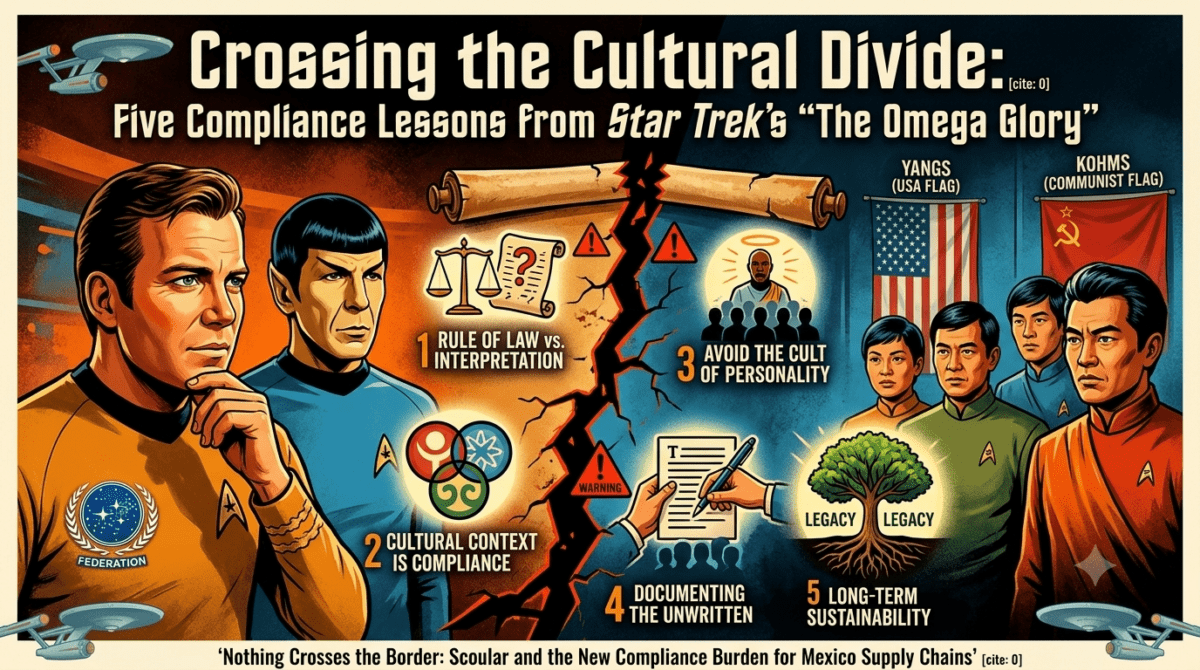
Crossing the Cultural Divide: Five Compliance Lessons from Star Trek’s “The Omega Glory”

As compliance professionals, we often talk about global organizations “boldly going” where few have gone before, into new markets, unfamiliar territories, and diverse cultures. But what happens when the culture you find is fundamentally different, yet disturbingly familiar? Star Trek’s “The Omega Glory” is one of the original series’ most controversial and fascinating explorations of cross-cultural misunderstanding, bias, and the search for common ground.

When Captain Kirk and the Enterprise crew encounter a planet locked in a centuries-long war between two factions, the Yangs and the Comms, they discover not only echoes of Earth’s past but also a profound challenge: how to understand, engage, and communicate across seemingly insurmountable cultural divides.

For the modern compliance officer, “The Omega Glory” is more than just a Star Trek curiosity. It’s a primer on the perils and potential of cross-cultural communication and a reminder that misunderstanding and ethnocentrism can undermine even the most well-intentioned mission.

Today, we explore five cross-cultural compliance lessons, backed by memorable scenes, that resonate for today’s global organizations.

Lesson 1: Don’t Assume Your Culture’s Symbols or Values Are Universal

Illustrated by: When Kirk and company finally realize that the Yangs are a “parallel” of Earth’s Yankees, complete with a tattered American flag and a distorted version of the U.S. Constitution, the moment is both poignant and unsettling. The Yangs hold these objects sacred, but they have lost the original meaning, reciting “freedom” and “justice” without understanding their true significance.

Compliance Lesson: In global business, it is all too easy to assume that your organization’s symbols, policies, and values are understood the same way everywhere. What feels like common sense or “best practice” at headquarters may mean something entirely different or nothing across cultures.

Effective cross-cultural communication starts with humility. Don’t take for granted that core values, codes of conduct, or even compliance “hot words” will be universally understood. They may be recited back, as the Yangs do with the Pledge of Allegiance, but without real comprehension or application. Translate, not just in terms of, but conceptually, your compliance values and policies for each culture. Use local examples and context. Verify understanding through discussion, rather than just distributing documents.

Lesson 2: Recognize and Overcome Ethnocentrism—Your Way Is Not the Only Way

Illustrated by: Captain Tracey, the stranded Federation captain, throws in his lot with the Comms, convinced their culture’s “discipline” and “order” make them superior. He rationalizes his betrayal by viewing the Comms through his biased lens and refuses to see value in the Yangs’ ways.

Compliance Lesson: Ethnocentrism, the belief that one’s own culture is superior or “normal,” is a common barrier to cross-cultural compliance. Like Tracey, corporate leaders may favor one culture’s approach to ethics, risk, or problem-solving, dismissing others as backward or inefficient.

Such bias blinds organizations to local realities, breeds resentment, and undermines buy-in for compliance programs. Actual cross-cultural effectiveness requires cultural intelligence: the ability to recognize, adapt to, and respect differences. Provide cross-cultural training to compliance teams and business leaders. Encourage self-reflection on cultural biases and challenge assumptions about what constitutes the “right” and “wrong” ways of operating.

Lesson 3: Find the Universal, but Honor the Local

Illustrated by: Kirk’s breakthrough comes when he helps the Yangs recognize that the Constitution’s words—“We the People”—apply to everyone, not just their tribe. He translates a seemingly parochial value into a universal principle, bridging cultural gaps.

Compliance Lesson: While symbols, language, and rituals may differ across cultures, there are often shared ethical aspirations—fairness, trust, respect, and justice—that can unite global teams. The challenge is to articulate these universals in a way that honors local realities.

Compliance communication should strike a balance between global standards and local flexibility. It’s not enough to declare “one policy, everywhere.” Instead, ask: How do our core principles show up in this culture? How can we adapt while staying true to our values? Co-create codes of conduct, training modules, and communications with local input. Make space for culturally relevant examples, stories, and illustrations that bring compliance to life.

Lesson 4: Listen Actively and Engage with Curiosity

Illustrated by: Throughout the episode, the Enterprise crew must decode the Yangs’ language, symbols, and intentions. Kirk doesn’t just lecture; he listens, observes, and asks questions—even when the answers are uncomfortable or surprising.

Compliance Lesson: Effective cross-cultural communication begins with active listening and curiosity, rather than assumptions or pronouncements. Before launching new policies or investigating potential misconduct, take time to learn local perspectives. Listen for what’s not being said. Recognize when confusion or resistance may mask deeper concerns.

In a compliance context, this means building trust, asking open-ended questions, and showing respect for cultural differences, even when they challenge your assumptions. Use listening tours, focus groups, and confidential interviews to gather local insights before implementing global compliance initiatives. Train compliance professionals in active listening and culturally sensitive questioning.

Lesson 5: Bridge Divides with Shared Purpose, Not Just Rules

Illustrated by: In the episode’s climax, Kirk calls both the Yangs and the Coms to embrace the true meaning behind their sacred words, not as tribal weapons but as a foundation for peace and a shared future. He reframes the “rules” as a call to unity and understanding.

Compliance Lesson: Policies and procedures are essential, but they’re not enough to build absolute alignment across cultures. What endures is shared purpose: a vision that transcends division and speaks to the aspirations of every group in your organization.

When compliance is positioned as a partner in building something greater—a fair workplace, a sustainable business, and a respected global brand—it resonates beyond checklists and codes. People will rally around shared meaning, not just mandates. In your cross-cultural compliance communications, highlight stories of global teamwork, shared victories, and how living your values advances business and personal success. Move from “you must” to “we can, together.”

To Truly Go Boldly, Build Cross-Cultural Bridges

The Omega Glory” is a sometimes messy, always provocative meditation on the risks and rewards of cross-cultural engagement. For compliance professionals, it’s a reminder that communication isn’t just about translation or policy deployment; it is about bridge-building.

As your organization grows, diversifies, and explores new frontiers, remember: the actual test of your compliance program is not how well it works at headquarters but how deeply it connects across every culture you serve. The Enterprise crew learned that words matter only when lived out by all people. For compliance, that’s the only path to lasting, meaningful impact.

Resources:

Excruciatingly Detailed Plot Summary by Eric W. Weisstein

MissionLogPodcast.com

Memory Alpha

Categories
Great Women in Compliance

Great Women in Compliance: Paula For the People: Let Go to Reach Further

What does it look like when your job title and your soul are perfectly aligned? For ethics & compliance officer Paula Young, the answer has always been simple: it’s about the people.

In this conversation, Paula Young and Sarah Hadden dive into what it really means to lead with humanity—how she earned the nickname “Paula For the People,” why she believes compliance is less about rules and more about winning hearts and minds, and what it took for her to stop being the person everyone handed work to and start being the person everyone looked to for vision.

A moment that has stayed with me is Paula’s story of a mud run she almost didn’t do. Standing at the base of a wall, covered in mud, holding on with everything she had—until her cousin screamed from the top, “You have to let go.” What she learned in that moment has carried her through divorce, reinvention, and every transition since.

We also talk about her work with Junior Achievement; her involvement with What Moves Her—a community that empowers women in leadership; and where she finds herself now: in a season of listening, learning, and gathering the courage for whatever comes next.

This episode begins cold—no introductions, no small talk—just Paula, at her most authentic, telling us exactly why she loves what she does. Enjoy.