


A company can publish thoughtful AI principles, appoint a governance committee, and still struggle to answer a basic question: who can stop an AI system when its behavior creates unacceptable business risk? For chief compliance officers and boards, that question reaches the heart of program effectiveness. Policies establish expectations. The real test comes when someone must decide, enforce a boundary, and show what happened.
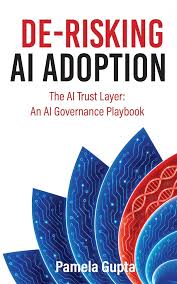
Pamela Gupta addresses that challenge in De-Risking AI Adoption: The AI Trust Layer: An AI Governance Playbook. Her central argument is that trustworthy AI requires an operating model connecting ownership, controls, deployment decisions, monitoring, and evidence. The book provides a structure for translating responsible AI commitments into repeatable business practices. For compliance professionals, its value lies in explaining how governance can support adoption while keeping accountability attached to the people making consequential decisions.
Making Trust Operational
Gupta defines trustworthy AI through three practical capabilities: people can understand the behavior to expect and its limits, verify what actually occurred, and identify an accountable person when something goes wrong. This moves the discussion toward demonstrable performance.
That approach should resonate with any CCO who has examined the distance between a written procedure and actual business conduct. An AI policy may require human oversight. Whether that oversight works depends on the reviewer’s information, competence, time, and authority to intervene. A human approval step has limited value if the organization rewards automatic acceptance or discourages challenges.
The compliance application is straightforward. For each significant AI use case, identify the business purpose, potential harm, responsible owner, operating limits, and evidence needed to evaluate performance. These questions belong at the beginning of development and procurement, when the answers can still shape the system.
Eight Pillars of AI Governance
The book organizes its methodology around AI TIPS™, Gupta’s framework of eight interconnected pillars: cybersecurity, privacy, ethics and bias, transparency, explainability, regulations, audit, and accountability. Together, they address the different ways AI can create enterprise exposure.
The connections matter. Security controls may protect information against unauthorized access while leaving questions about discriminatory outcomes unresolved. Transparency can establish which data and processes a system uses, while explainability addresses whether people can understand and challenge a particular decision. Independent assurance requires evidence from across these activities.
Gupta also presents mappings to established frameworks and standards, including the NIST AI Risk Management Framework and ISO/IEC 42001. Her purpose is to connect enterprise controls and evidence across multiple governance expectations.
For a compliance team, the practical lesson is to coordinate existing expertise. Privacy, security, legal, risk, audit, and business leaders each hold part of the answer. The CCO can help connect their work through common requirements, escalation procedures, and documented decisions. Business owners must remain answerable for the systems they deploy.
Accountability Must Carry Authority
Accountability receives special treatment throughout the book. Under Gupta’s methodology, a critical accountability failure blocks deployment regardless of the aggregate governance score. A system needs a named owner with authority to accept risk and stop its operation. Consequential uses also require appropriate human override and redress mechanisms.
This is a useful challenge to governance committees that distribute responsibility so broadly that no individual can decide. Participation in a committee does not automatically establish authority over a business process.
CCOs should translate this principle into explicit decision rights. Who approves the use case? Who accepts the remaining risk? Who authorizes exceptions? Who can suspend operation? Who addresses harm to an affected customer or employee? Document and understand those answers before an incident forces the organization to discover whether its governance arrangements work.
Governance Throughout the Lifecycle
Gupta’s gated lifecycle makes these responsibilities actionable. It follows AI from concept and planning through data preparation, development, independent validation, deployment, continuing monitoring, and retirement. Decision gates establish criteria for moving forward and identify the people authorized to approve or refuse progression.
Independent validation is particularly important. The team building a system should face review capable of challenging its assumptions and testing whether performance meets the intended use. Deployment readiness also includes monitoring, incident response, rollback capability, and operational procedures.
For compliance professionals, the lesson extends beyond initial approval. A system’s exposure can change when it receives new data, serves a different population, gains additional permissions, or undergoes a material modification. Gupta calls for defined triggers that return systems to validation.
Apply the same discipline to exceptions. Record the rationale, compensating controls, approver, remediation owner, and expiration date. An exception should remain visible until it is resolved. Retirement deserves similar attention, including appropriate data disposition and preservation of evidence needed to explain earlier decisions.
Measuring Whether Controls Work
The Trust Index gives Gupta’s framework a common measurement approach. It combines control implementation, control effectiveness, residual risk exposure, and compliance status into pillar scores and an overall assessment. The methodology assigns the greatest combined emphasis to whether controls exist and whether they work.
For boards, this creates a way to discuss changes in governance performance and direct attention toward unresolved weaknesses. Gupta also distinguishes inherent risk from current risk after controls. An inherently consequential use case does not become inconsequential because its controls improve.
The compliance implication is to examine the evidence supporting the number. Directors should understand significant weaknesses, testing results, exceptions, and corrective actions. A dashboard becomes useful when it supports decisions about resources, restrictions, and remediation. The underlying assessment must remain open to challenge, especially where a favorable aggregate score could obscure a serious problem in one area.
Governing AI That Takes Action
The book’s treatment of agentic AI deserves senior executives’ attention. An AI system that can invoke tools, modify records, send communications, or initiate transactions introduces questions about delegated business authority. Evaluating the model’s outputs covers only part of that exposure.
Gupta describes an agentic control plane that governs identity, permissions, tools, memory, delegation, observation, and intervention. A central principle is that consequential boundaries must operate outside the agent’s own reasoning. Written instructions alone cannot reliably limit what credentials and connected tools permit.
Consider a compliance application: an agent assisting with third-party onboarding. Management should distinguish permission to summarize diligence materials from permission to approve a supplier, alter payment information, or release a blocked transaction. Each capability requires deliberate authorization and appropriate controls.
Internal controls professionals know this lesson. Delegated authority needs defined limits, traceable actions, and effective intervention. Automation increases the importance of those disciplines because actions can occur faster than a person can review them.
Data and Third Parties Remain Central
Gupta also emphasizes the information an AI system uses when it acts. Policies, customer records, retrieved documents, and stored memory shape its behavior. Even a system operating within its permissions can make a harmful decision when its information is outdated or inappropriate.
For compliance teams, this means governing the sources behind AI advice. An assistant answering employee questions should use approved, current policies with identifiable owners and version histories. Access restrictions should continue to apply when information enters a retrieval system.
Third-party oversight must also reach beyond the primary model provider. Gupta examines tools, connectors, and packaged agent capabilities as supply-chain dependencies. She adds a business continuity question: what happens if a critical model becomes unavailable? Organizations should identify affected processes, evaluate alternatives, and test fallback arrangements before disruption forces an improvised response.
Evidence the Board Can Use
Gupta’s evidence-by-design approach connects the entire operating model. Significant decisions and actions should generate records as work occurs: approvals, validation results, system versions, permissions, relevant context, interventions, and monitoring outcomes. Those records should support reconstruction of a consequential action.
For boards, reporting should connect this evidence to oversight. Which systems carry the greatest exposure? Which controls have failed testing? Which exceptions remain unresolved? What has management restricted, delayed, or rejected? What decisions require board attention?
The CCO’s contribution is to make this reporting actionable and consistent with operational reality. Evidence should reveal where management needs to intervene and whether previous corrective actions achieved their intended result.
A useful starting exercise is to select one consequential AI decision and trace it from initial authorization to its outcome. Ask the owner to produce the supporting evidence. Any missing link identifies a concrete improvement for the governance program to address.
Practical Steps for CCOs and Boards
Gupta recommends starting with an honest readiness assessment and a manageable set of high-impact use cases, then expanding proven governance practices. Apply that approach through five actions:
- Inventory consequential AI systems, their owners, permissions, and dependencies.
- Establish authority for approval, exceptions, escalation, and suspension.
- Test controls against actual business risks and affected populations.
- Capture decision evidence during ordinary operations.
- Give the board visibility into unresolved exposure and remediation.
The business lesson from De-Risking AI Adoption is that effective governance makes responsible adoption repeatable. For CCOs and boards, the immediate task is to make accountability observable in how AI is approved, operated, challenged, and improved.