


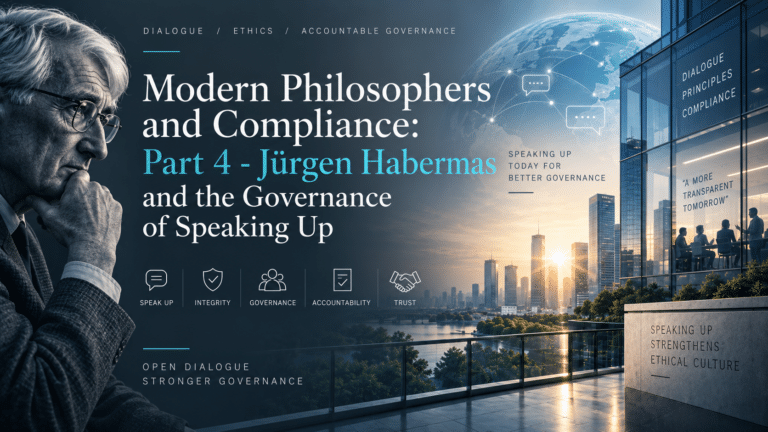
This week we will continue our lengthy exploration of the philosophical underpinnings of the modern corporate compliance program. We have looked at, or will look at, Hannah Arendt and her concepts around personal responsibility; Simone de Beauvoir and the conditions for ethical action in a corporation; and John Rawls and the twin concepts of institutional justice and fairness in a corporate compliance program. We will review Hans Jonas and the responsibility for the future of corporate compliance. Today we continue with Jürgen Habermas and the governance of speaking up.
A compliance concern has value when it receives a fair hearing and an accountable response. Employees may submit reports, attend risk meetings, and complete surveys while important decisions remain insulated from what they say. Jürgen Habermas gives compliance professionals a way to examine whether internal communication lets evidence and reasons influence the exercise of authority.
For the Chief Compliance Officer, the practical question is what happens next. Who considers the concern? What evidence is examined? Who explains the response? A speak-up culture needs answers to those questions throughout ordinary business operations and within the formal reporting system.
Reasoned Dialogue as an Ethical Discipline
Habermas was a German philosopher and social theorist whose major twentieth-century works include The Theory of Communicative Action and Moral Consciousness and Communicative Action. He distinguished action oriented toward mutual understanding from strategic action aimed at achieving an actor’s purposes. His discourse ethics examines how moral norms are justified through reasoned discussion among those affected.
The conditions of that discussion matter. Participants must be able to question assertions, offer reasons, and express their concerns without coercion preventing participation. Agreement matters differently when it results from examining arguments than when it reflects pressure or exclusion.
Corporate decision-making operates within authority structures, commercial obligations, and legal requirements. Applying Habermas does not turn every management decision into a vote. His ideas offer a demanding test of the process: have relevant claims been open to challenge, and have decision-makers responded to the reasons presented?
That test gives compliance a practical responsibility. The function should help create conditions in which a concern can reach the right decision-maker without losing its substance. Participation must include a meaningful opportunity to affect the analysis. Otherwise, consultation can become a procedure for endorsing a conclusion already reached.
The Meeting Where Agreement Came Too Quickly
Consider the following. A company plans to enter a new market through a local distributor. During a launch meeting, the regional president announces that the agreement must be signed before quarter-end. She then asks whether anyone has compliance concerns.
A diligence analyst explains that the distributor’s ownership information remains incomplete and that a proposed subcontractor has not been reviewed. The sales leader responds that the distributor comes highly recommended. The president asks whether there is evidence of wrongdoing. The analyst says there is not but explains that important questions remain unanswered.
The discussion moves on. The meeting summary records that compliance raised no substantiated misconduct concern and that the team supported proceeding. The analyst’s request for additional review disappears from the decision record.
The facts do not establish that the distributor is improper. They establish a failure to address the question raised. The analyst identified an information gap relevant to approval. Management answered a different question about proven misconduct. The resulting agreement rested on an incomplete description of the discussion.
Habermas helps the CCO identify that failure. The analyst spoke, but the process did not meaningfully engage the claim. A useful response would clarify the missing information, define the approval criteria, and assign responsibility for resolving the issue before an authorized decision.
The DOJ Connection Through Reporting and Response
The Department of Justice’s Evaluation of Corporate Compliance Programs (ECCP) examines whether employees are comfortable using reporting mechanisms, whether company practices discourage reporting, and whether compliance has access to reporting and investigative information.
Those inquiries connect employee voice to program effectiveness. A concern cannot inform the company’s response if employees are discouraged from raising it, it is mischaracterized, or it is withheld from the people responsible for assessing it. Habermas supplies a philosophical lens for examining the quality of that communication.
The CCO should extend this inquiry beyond hotline intake. Concerns arise in procurement discussions, contract reviews, operational meetings, and informal requests for guidance. The company needs a proportionate way to capture material unresolved issues from those settings. Employees should know when a conversation must be documented as an escalation.
In our hypothetical, the meeting summary should preserve the substance of the analyst’s concern. It should identify the missing information, the required review, the decision owner, and any conditions on proceeding. If the summary is inaccurate, the analyst should have a practical means to correct it. That mechanism protects the reliability of the decision record.
Management Must Answer the Concern Raised
Reasoned dialogue requires attention to what a person is actually saying. In compliance speak, a speak-up culture must be paired with a listen-up culture. A concern about missing diligence should receive an answer about diligence. A concern about an incentive should receive an examination of how that incentive affects behavior. General assurances about leadership commitment do not resolve either issue.
The CCO can help managers distinguish disagreement about facts, disagreement about applicable standards, and disagreement about available options. Each calls for a different response. Missing facts may require investigation. An unclear standard may require legal or policy interpretation. Competing options may require an authorized decision about a risk that can lawfully be accepted.
Return to the distributor. If the policy requires ownership verification before approval, management should obtain it or follow an authorized exception process where one exists and is permissible. A commercial deadline does not, by itself, satisfy the requirement. If the concern rests on a misunderstanding, the decision-maker should explain the evidence that resolves it.
This approach makes discussion more useful to the business. It identifies what must be resolved and who can resolve it. It also prevents repeated requests for assurance from replacing a decision. An effective compliance professional should state the issue clearly enough that management can respond to its substance.
Hierarchy Can Distort the Conversation
Managers influence discussion through timing, framing, and reaction. Announcing the desired outcome before inviting concerns can make disagreement appear obstructive. Requiring employees to prove misconduct before raising uncertainty can exclude the very questions that preventive controls are intended to address.
The ECCP examines whether senior and middle managers encourage or discourage compliance and whether their commitment persists when commercial interests compete with it. Compliance professionals can translate that inquiry into observation of actual decision processes.
For material risk reviews, circulate relevant information early enough for participants to assess. Invite questions before seeking approval. Ask responsible functions to identify unresolved matters in their own words. Where hierarchy discourages discussion, provide an independent route for concerns and follow up on how employees who challenge decisions are treated.
These measures do not guarantee agreement, nor should agreement be the sole objective. Decision-makers may reasonably reject an objection after reviewing the evidence. The record should explain why. A team can disagree about the preferred option while understanding the basis for the authorized decision and the obligations that follow.
The quality of the discussion also depends on access. An employee working overnight or speaking another language may need a different way to participate. A written question or private conversation can carry the same substantive concern as a confident presentation in a committee meeting. The company should assess the argument without making presentation style a proxy for credibility.
Closing the Loop Requires Evidence
Receiving a concern creates an obligation to route it appropriately and determine what response is warranted. The ECCP addresses timely investigation, follow-up, and accountability for findings and recommendations. The practical challenge is connecting those steps so an issue doesn’t disappear when one function transfers it to another.
For significant concerns, assign an owner, a response date, and a defined basis for closure. Record whether the company obtained additional evidence, changed the decision, introduced a safeguard, or concluded that further action was unnecessary. The explanation should be specific enough for an independent reviewer to follow.
Where appropriate, tell the person who raised the concern that it was considered and describe the process or outcome to the extent permitted. Protect personal information, legitimate confidentiality, and the integrity of the investigation. A useful response acknowledges the issue and explains the next step without disclosing restricted details.
The analyst should learn whether the ownership question was resolved and whether the subcontractor review remains a condition of approval. If the transaction proceeds under an exception, the record should identify the authority, rationale, and monitoring obligations. A concern that changes a control or approval condition provides tangible evidence that speaking up influences business operations.
The Board Must Hear Unresolved Disagreement
Board reporting can lose valuable information when management summarizes a complicated risk discussion as organizational alignment. Directors need visibility into material unresolved concerns within their oversight remit, particularly when compliance and business leadership differ about the adequacy of controls.
The ECCP examines private sessions with compliance and control functions, the information used in board oversight, and compliance autonomy and access to the board. These arrangements can help directors examine concerns that ordinary reporting channels have failed to resolve.
The CCO should present the issue, competing explanations, the evidence, and the required decision. Identify what is known, what remains uncertain, and who has authority to act. Directors should ask whether those closest to the issue find the summary accurate.
Reporting should also show whether the process improves decisions. Useful evidence includes material concerns that led to further diligence, changed approval conditions, or remediation. Volume alone provides an incomplete picture. The board needs to understand whether significant questions receive reasoned responses and whether corrective actions are completed.
Five Key Habermas Takeaways for the Compliance Professional
- Preserve the substance of employee concerns. Record the actual question, relevant evidence, and unresolved issue. Give employees a practical way to correct summaries that materially misstate what they raised.
- Require a response to the reasons presented. Distinguish factual gaps from policy questions and choices among permissible options. Assign each issue to someone with the competence and authority to address it.
- Design discussions that permit meaningful challenge. Share information in time for review, invite concerns before decisions, and provide independent escalation routes. Examine whether hierarchy or managerial reactions discourage participation.
- Connect reporting with accountable closure. Assign owners and response dates, document the basis for decisions, and communicate appropriate feedback. Verify that promised safeguards and remediation occur.
- Bring material disagreement into board oversight. Explain unresolved concerns accurately, including competing views and missing information. Show directors how employee challenge has changed decisions or exposed work still required.
Habermas offers the CCO a practical measure of speak-up culture: can the company show how it considered and answered a significant concern? The corresponding board question is whether a difficult issue can reach directors without being softened into apparent agreement. The answers reveal how seriously the organization treats reasoned challenge.
In our final installment, Part 5, we close out this series with Hans Jonas and responsibility for future consequences. Having examined how people exercise judgment, act under constraints, receive fair treatment, and challenge decisions, we will consider the people who cannot participate in today’s discussion. Jonas takes us into technology governance, AI, and the long-term effects of corporate power.