


Ed. Note: I was finally able to see the movie The Odyssey. To say it blew me away was an understatement. Even though it didn’t follow Homer’s work precisely or use ancient Greek, I still thought it was great cinema. Anytime you get people talking about the Greek classics, that is a win in my book. So check out the movie and enjoy it. Zendaya was great as Athena.
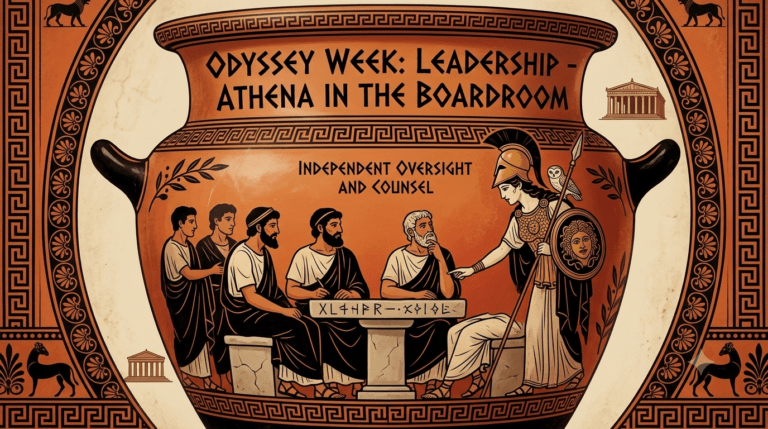
Athena does not row the ship. She does not lash herself to the mast, fight the Cyclops, navigate Scylla and Charybdis, or drag Odysseus’s crew away from every bad decision they seem determined to make. She is not in the trenches every day. She does not submit expense reports, approve vendors, review discount requests, or sit through the quarterly business review where someone explains why this deal is “strategic.” But Athena changes the journey.
She sees what Odysseus cannot see. She warns. She guides. She challenges. She protects. She appears at decisive moments when courage alone is not enough, and cleverness is about to become self-harm with better branding. That is why Athena belongs in the boardroom.
For corporate compliance, Athena represents independent oversight and wise counsel: the person, function, or governance body able to say, “That may win the deal, but it may also wreck the kingdom.” A compliance function that cannot challenge leadership is not Athena. Rather, it is simply decoration to meet a legal, statutory, or contractual requirement.
The Corporate Translation
Every company says it values compliance independence. The question is what that means when the business wants something. It is easy to celebrate compliance when compliance supports the decision already made. It is easy to invite the Chief Compliance Officer (CCO) to the meeting after the deal is signed, the press release is drafted, and the train has left the station with several questionable third parties in the dining car. That is not independence. That is archaeology.
Independent oversight means compliance has the authority, access, and resources to influence decisions before risk is accepted. It means the board hears directly from compliance. It means escalation does not depend on whether a business leader feels emotionally prepared for bad news. It means compliance can challenge high performers, powerful executives, and sacred business strategies without being treated as disloyal.
Athena does not exist to admire Odysseus. She exists to help him survive himself.
Access Is Not the Same as Influence
Many compliance officers technically have access to leadership. They attend meetings. They submit reports. They provide updates. They own several slides in the board deck, usually after cybersecurity and before “other business.” But access is not the same as influence.
Real access means compliance can raise concerns in a setting where they matter. It means there are private sessions with the board or audit committee. It means compliance can speak without management filtering, softening, or translating the message into something more comfortable. It means the board asks questions that go beyond “Any major issues?” which is the governance equivalent of asking a teenager whether school was fine.
The DOJ’s 2024 Evaluation of Corporate Compliance Programs (ECCP) focuses directly on whether compliance and control functions have autonomy and resources, including sufficient stature, sufficient staffing and resources, and autonomy from management, such as direct access to the board or audit committee. That is not a technical footnote. It is a central governance point. If the compliance function only reaches the board through management, the board may be hearing the music after someone else has adjusted the volume.
Authority Must Be Real
A compliance function without authority is like Athena without wisdom: impressive in name only. Authority means compliance can stop, modify, or escalate a transaction. It means policies are not optional when revenue is large enough. It means compliance concerns are documented, tracked, and resolved. It means the business must explain why it wants to proceed despite risk, not merely pressure compliance to “be practical.”
Practical compliance is not weak compliance. Practical compliance helps the business find a lawful and ethical path forward. But there is a difference between being practical and being domesticated. A good compliance function does not say no for sport. It says no when the facts, risks, and values of the company require it. It says, “not that way.” It says, “not with that intermediary.” It says, “not without diligence.” It says, “not until we understand the data, the customer, the payment, the conflict, or the control failure.”
The ECCP specifically asks how a company has responded when compliance raised concerns and whether transactions or deals have been stopped, modified, or further scrutinized because of compliance concerns. That is the right question. The ECCP states at one point, “Have they persisted in that commitment in the face of competing interests or business objectives?” Not whether compliance attended the meeting. Whether compliance changed the outcome. The ECCP further asked, “What role has compliance played in the company’s strategic and operational decisions? How has the company responded to specific instances where compliance raised concerns? Have some transactions or deals been stopped, modified, or further scrutinized as a result of compliance concerns?”
Resources Are a Statement of Values
Companies reveal what they value through budget. A board can praise compliance all day long. Still, if the function lacks staffing, technology, data access, training budget, investigative resources, and experienced personnel, the message is clear: “We support compliance, but preferably at a discount.”
No one would ask sales to grow revenue without systems, people, and market data. No one would ask finance to close the books with three spreadsheets, two interns, and a heroic attitude. Yet compliance teams are often expected to monitor global risk with underpowered tools and just enough headcount to keep the training completion dashboard from turning red.
That is not empowerment. That is wishful thinking. The ECCP asks whether compliance personnel have sufficient staffing to audit, document, analyze, and act on compliance efforts, whether resources are comparable to other parts of the company, and whether compliance has access to relevant data for timely monitoring and testing. Regarding funding and resources, the ECCP asks, “Has there been sufficient staffing for compliance personnel to effectively audit, document, analyze, and act on the results of the compliance efforts? Has the company allocated sufficient funds for the same? Have there been times when requests for resources by compliance and control functions have been denied, and if so, on what grounds? Does the company have a mechanism to measure the commercial value of investments in compliance and risk management?”
Those questions should make boards uncomfortable in a productive way. If the business has world-class tools to capture opportunity but outdated tools to detect risk, that imbalance is itself a governance decision.
Escalation: The Road from Concern to Action
Athena’s guidance matters because it reaches Odysseus when action is still possible. That is also the purpose of escalation. A well-designed escalation process moves concerns to the right people at the right time with enough information to make a decision. A weak escalation process traps concerns in email chains, local management reviews, or “let’s monitor this” limbo until the problem becomes a reportable event, a whistleblower complaint, or a headline.
Escalation should not depend on personality. It should not depend on whether the compliance officer is unusually persistent, politically skilled, or willing to become unpopular before breakfast. It should be built into governance.
What must be escalated? To whom? Within what timeframe? With what documentation? What happens when business and compliance disagree? Who decides? How are unresolved concerns reported to senior leadership or the board? These are not theoretical questions. They are the mechanics of wise counsel. Because without escalation, Athena is whispering in a locked room.
The Board’s Role: Ask Better Questions
Boards do not need to manage the compliance program day to day. That is not their role. But boards do need to oversee whether the program is real. That means asking better questions. The board should also pay attention to the moments when compliance loses. If compliance raised concerns and the business proceeded anyway, what happened? Was the decision documented? Were compensating controls added? Was the board informed? Did the risk later materialize? You learn a great deal about culture by examining what happens when wise counsel is inconvenient.
The Compliance Takeaway
Athena does not represent bureaucracy. She represents judgment. That distinction matters. Compliance officers are sometimes caricatured as the people who slow things down, complicate decisions, or drain the romance out of heroic commercial ambition. But the best compliance functions do something far more important: they help the organization see clearly before it acts.
They bring risk into the room. They challenge assumptions. They protect the company from cleverness without discipline. They help leaders understand that winning the deal, entering the market, launching the product, or pleasing the customer is not success if the path taken damages the company’s integrity.
Independent oversight is not ceremonial access. It is authority, resources, escalation, data, board engagement, and the organizational courage to let compliance challenge power. Odysseus needed Athena because brilliance has blind spots. So does every company.
The question is whether your Athena is truly in the boardroom or merely listed on the org chart.
Join us Tomorrow
Athena teaches that independent oversight is not ceremonial access but real authority, resources, escalation, data, board engagement, and the courage to let compliance challenge power. But that lesson only matters if the organization is willing to apply it to its most celebrated leaders, not merely its easiest targets. That brings us to Odysseus: the brilliant, strategic, results-driven leader every board wants and the very leader who can become the company’s most dangerous compliance risk when success becomes a shield. If Athena is the voice saying, “That may win the deal, but it may also wreck the kingdom,” Odysseus is the leader who wins the deal and forces the organization to ask whether anyone had the authority, courage, and independence to challenge how he did it. I hope you will join us tomorrow.