


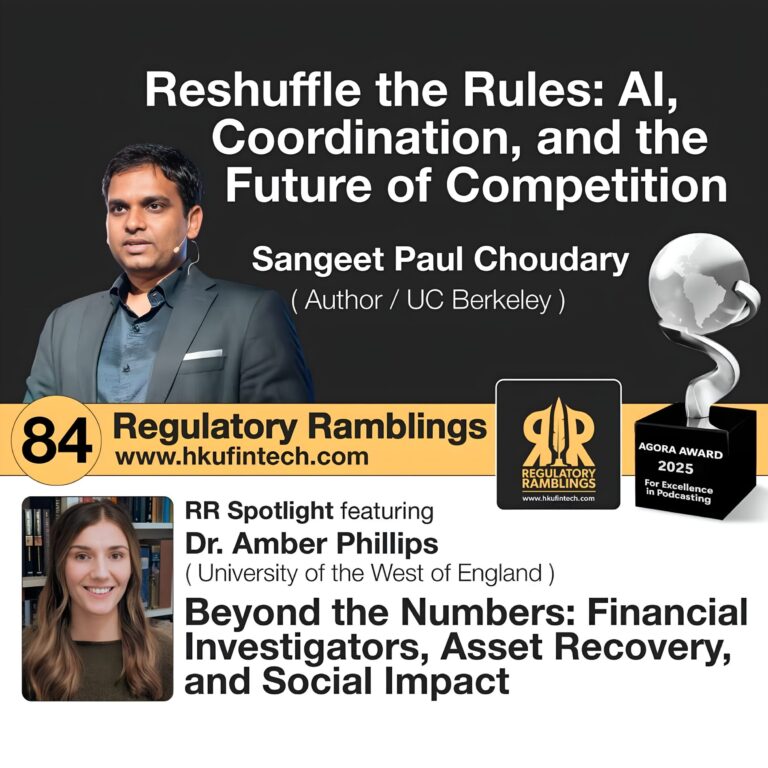
Today’s episode kicks off with a spotlight discussion with Dr. Amber Phillips, a British senior lecturer in criminology, on the importance of accredited financial investigators and asset recovery experts in ferreting out fraud. Following that, we’ll be chatting with the author Sangeet Paul Choudary from UC Berkeley about his new book Reshuffle: Who Wins When AI Restacks the Knowledge Economy. He reframes the artificial intelligence debate, arguing that AI should not be seen as a smarter brain but rather as better glue that creates synergies for human collaboration.
But first, on a recent episode of the Tax Justice Network’s podcast, Dr. Amber Phillips highlighted the importance of accredited financial investigators and how they are often unsung heroes in cracking cases—especially those involving financial fraud and the concealment of assets.
Biography:
Dr. Amber Phillips is a senior lecturer in criminology at UWE Bristol. Her journey as a criminologist began in 2012, while she lived and worked in Calabria, Italy. Her primary research interests are organized crime and economic crime, both of which draw on her continuing interest in mafia-type groups. She has developed collaborative partnerships with law enforcement practitioners and fellow academics in the UK and abroad. She is a member of the ECPR Standing Group on Organized Crime and the RUSI Strategic Hub for Organized Crime.
Amber’s work has been published in international journals, including Trends in Organised Crime, and she is a member of the editorial board for the Journal of Economic Criminology. Her most recent research has focused on the social reuse of confiscated mafia assets in Italy and the challenges faced by police officers investigating financial crime.
She is currently researching asset recovery in England and Wales, supported by a VC Early Career Researcher Award. She is also an expert reviewer for funding bodies, including the European Commission and the Independent Social Research Foundation.
Amber has been nominated and shortlisted for the UWE Outstanding Teacher Award and has written teaching-focused articles for Times Higher Education. She is a Fellow of the Higher Education Academy and has served as a mentor for the WHEN 100 Black Women Professors NOW program.
Sangeet Paul Choudary is the co-author of the book Platform Revolution. His latest work—Reshuffle, the subject of today’s discussion—was recently awarded the 2025 Thinkers50 Strategy Award at Guildhall in London for the most impactful idea in the field of strategy.
Thinkers50 has often been described by the Financial Times as the “Oscars of management thinking”—a premier global award recognizing leading management thinkers. Other shortlisted nominees this year included Karim Lakhani (Harvard Business School), Vijay Govindarajan (Dartmouth), Richard Rumelt (UCLA), and Seth Godin.
Sangeet has advised CEOs at more than 40 Fortune 500 companies and leading pre-IPO technology firms. He is currently a senior fellow at the University of California, Berkeley, and has spoken at premier global forums, including the G20 Summit, the World50 Summit, and the World Economic Forum.
Sangeet’s latest book offers a radical rethink of AI and a practical contribution to industry incumbents grappling with genAI.
Discussion:
The spotlight chat commences with Amber sharing with Regulatory Ramblings host Ajay Shamdasani why accredited financial investigators and asset recovery experts are so important for detecting malfeasance and why many in law enforcement lack the financial backgrounds or sophistication to stay one step ahead of criminals who are often far more financially savvy.
The growing role of analytics, data scientists, and AI in financial investigations raises the question of whether veteran investigators and asset recovery specialists still play a role in the process. The answer is a resounding yes.
Amber shares her thoughts on how stripping criminals of their pecuniary assets may be more effective than short custodial sentences. She also remarks that, from her discussions with investigators, they regard the possibility of turning ‘bad money’ into good money as a net positive for society.
The spotlight discussion concludes with a brief description of a research project that Amber is wrapping up, measuring success in financial recovery, called “Beyond the Figures.” The aim is to move beyond quantitative measures, as numbers are not always a reliable indicator of impact and success in asset recovery.
Following that, we chat with Sangeet about his new book, Reshuffle. From the overlooked brilliance of the shipping container to the F1 pits that dethroned Schumacher’s dominance, Sangeet unearths a powerful pattern: the most transformative technologies do not merely automate; they transform entire economic systems.
With vivid storytelling and razor-sharp analysis, Reshuffle connects the dots between technology, behavior, and economic architecture. It delivers a bold and incisive exploration of how AI’s impact goes far beyond changing how we work, reorienting the foundations of power and control in our economic systems.
Blending compelling examples, historical parallels, and bold insights, Reshuffle equips readers to navigate the many opportunities and challenges that AI introduces as it reshapes the knowledge economy. This book is your guide to understanding who wins and who gets left behind when AI restacks the deck.”
“What if we’ve misunderstood the real power of AI — not as a tool for doing tasks faster, but as the missing mechanism for making complex systems finally work together?” Sangeet asks
We have all heard the common refrain from thought leaders like Peter Zeihan that “AI won’t take your job, but someone using AI will.” At this point, it is a hackneyed phrase.
Sangeet shares with Ajay what drew him to AI, why he felt the need to write his book now, and what it offers to an ever-growing, crowded field.
His message is to the heads of executives of incumbent firms across sectors, and he elaborates during the broadcast that financial services sector veterans are still dealing with COBOL-based mainframes and siloed databases. Reshuffle provides a guide to thinking about how artificial AI will disrupt and how it can be harnessed.
Specifically for leaders in financial services, Sangeet’s framework offers sobering and practical lessons:
– AI is not an upgrade but a governance shift. It shifts control from top-down compliance to bottom-up feedback. Governance emerges not through rules but through continuous observation.
– Legacy integration is a coordination challenge, not a software one. AI exposes the limits of point solutions by making the frictions between them evident.
– The new competition operates above the algorithm. Those who own the models may not capture the most value; those who orchestrate decisions and distribution around them will.
– Traditional productivity metrics are misleading. Efficiency inside a department can destroy coherence across the enterprise. The metric to optimize is coordination quality.
In this context, financial institutions face a choice: remain custodians of static infrastructure or become orchestrators of dynamic ecosystems. The former optimizes for compliance; the latter competes for relevance.
In this new world of AI, the standard corporate playbook for digital transformation no longer works. AI is not a laboratory initiative; it is built around innovation labs, agile working, and sprints. These may remain helpful at a tactical level, but they do nothing to reconsider how the basis of value creation is changing, nor sustain an incumbent’s advantages of trust, compliance, and scale. If someone else can better coordinate all the disparate elements, banks or insurers focused just on digital transformation will lose.
The good news is that there is no reason why financial institutions cannot leverage AI to remain leaders in their field or even set the rules for the next cycle. But AI requires an even more radical approach than digitalization. Sangeet’s book is a good place to start.
The Regulatory Ramblings podcast is brought to you by The University of Hong Kong – Reg/Tech Lab, HKU-SCF Fintech Academy, Asia Global Institute, and HKU-edX Professional Certificate in Fintech, with support from the HKU Faculty of Law.
Useful links in this episode:
You might also be interested in:
-
Must have book by Ross Buckley, Douglas Arner & Dirk Zetzsche – FinTech: Finance, Technology & Regulation
-
Building Better Financial Systems: FinTech Sustainability – Research
-
HKU-SCF Fintech Academy – website
-
Asia Global Institute – website
-
Most sought-after Fintech course on edX – Introduction to Fintech
Connect with RR Podcast at:
LinkedIn: https://hk.linkedin.com/company/hkufintech
Facebook: https://www.facebook.com/hkufintech.fb/
Instagram: https://www.instagram.com/hkufintech/
Twitter: https://twitter.com/HKUFinTech
Threads: https://www.threads.net/@hkufintech
Website: https://www.hkufintech.com/regulatoryramblings
Connect with the Compliance Podcast Network at:
LinkedIn: https://www.linkedin.com/company/compliance-podcast-network/
Facebook: https://www.facebook.com/compliancepodcastnetwork/
YouTube: https://www.youtube.com/@CompliancePodcastNetwork
Twitter: https://twitter.com/tfoxlaw
Instagram: https://www.instagram.com/voiceofcompliance/
Website: https://compliancepodcastnetwork.net
