Categories
2 Gurus Talk Compliance

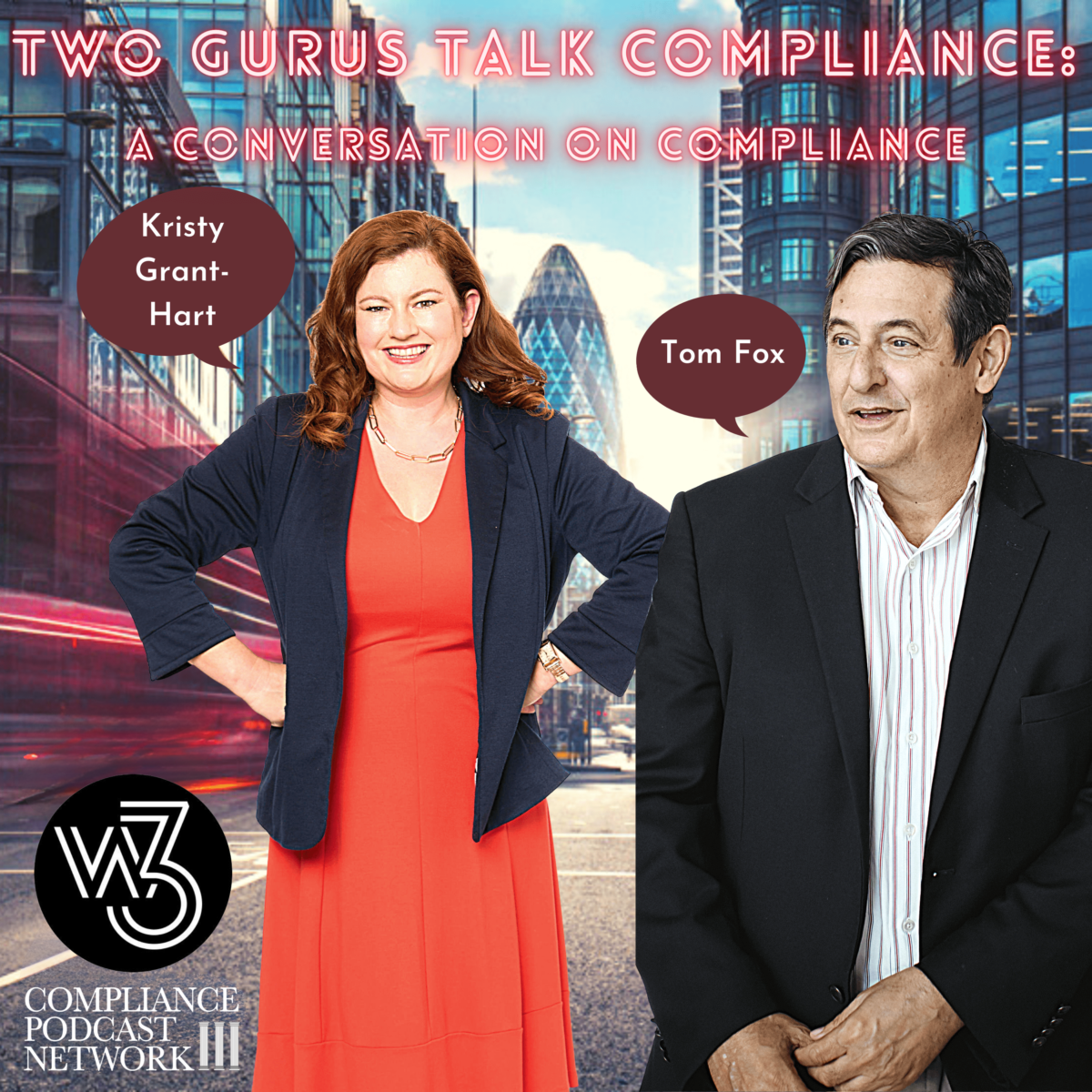
2 Gurus Talk Compliance – Episode 65 – The This Is Nuts Edition

What happens when two top compliance commentators get together? They talk compliance, of course. Join Tom Fox and Kristy Grant-Hart in 2 Gurus Talk Compliance as they discuss the latest compliance issues in this week’s episode! ABC protests topple the Bulgarian government, a French tennis player is suspended for 20 years over corruption, a UM coach is fired over an affair with a staffer, and Trump puts the DOJ in a no-win position over Warner Bros.

Stories this week include:

  • NY state could be a battleground for AI regulation. NYT
  • Massive fraud in aircraft parts uncovered in the UK. TheTimes
  • Switzerland charges Credit Suisse over Tuna Bond fraud. ACAMS
  • Former Labour PM convicted of corruption in Bangladesh. Independent
  • Lane Kiffin should be nowhere near Ole Miss football. WSJ
  • U.S. Supply Chains Deemed Vulnerable to Chinese Exploitation – WSJ
  • Europe Aimed to Set Standards for Tech Rules; Now It Wants to Roll Them Back – WSJ
  • Campbell Soup executive called its products food for “poor people,” lawsuit claims – CBS News
  • I Made an Offensive Joke. But So Did Everyone Else! Why Did I Get Fired? – NYT
  • Florida Man Stops Paying for Rental Car, Uses It to Give Uber Rides – FloridaMan.com

Connect with the Hosts:

Resources:

Kristy Grant-Hart on LinkedIn

Prove Your Worth

Tom

Instagram

Facebook

YouTube

Twitter

LinkedIn

Categories
Compliance Tip of the Day

Compliance Tip of the Day – Ethical Deployment of AI Powered Controls

Welcome to “Compliance Tip of the Day,” the podcast that brings you daily insights and practical advice for navigating the ever-evolving landscape of compliance and regulatory requirements. Whether you’re a seasoned compliance professional or just starting your journey, we aim to provide you with bite-sized, actionable tips to help you stay on top of your compliance game. Join us as we explore the latest industry trends, share best practices, and demystify complex compliance issues to keep your organization on the right side of the law. Tune in daily for your dose of compliance wisdom, and let’s make compliance a little less daunting, one tip at a time.

We conclude our week on internal controls by considering the ethical deployment of AI-powered internal controls.

For more on this topic, check out The Compliance Handbook: A Guide to Operationalizing your Compliance Program, 6th edition, which LexisNexis recently released. It is available here.

Categories
Daily Compliance News

Daily Compliance News: December 12, 2025, The All New York Times Edition

Welcome to the Daily Compliance News. Each day, Tom Fox, the Voice of Compliance, brings you compliance-related stories to start your day. Sit back, enjoy a cup of morning coffee, and listen in to the Daily Compliance News. All, from the Compliance Podcast Network. Each day, we consider four stories from the business world, compliance, ethics, risk management, leadership, or general interest for the compliance professional.

Top stories include:

  • ABC protests topple the Bulgarian government. (NYT)
  • French tennis player suspended for 20 years over corruption. (NYT)
  • UM coach fired over affair with staffer. (NYT)
  • Trump puts the DOJ in a no-win position over Warner Bros.(NYT)

The Daily Compliance News has been honored as the No. 2 in Best Regulatory Compliance Podcasts category.

Categories
Regulatory Ramblings

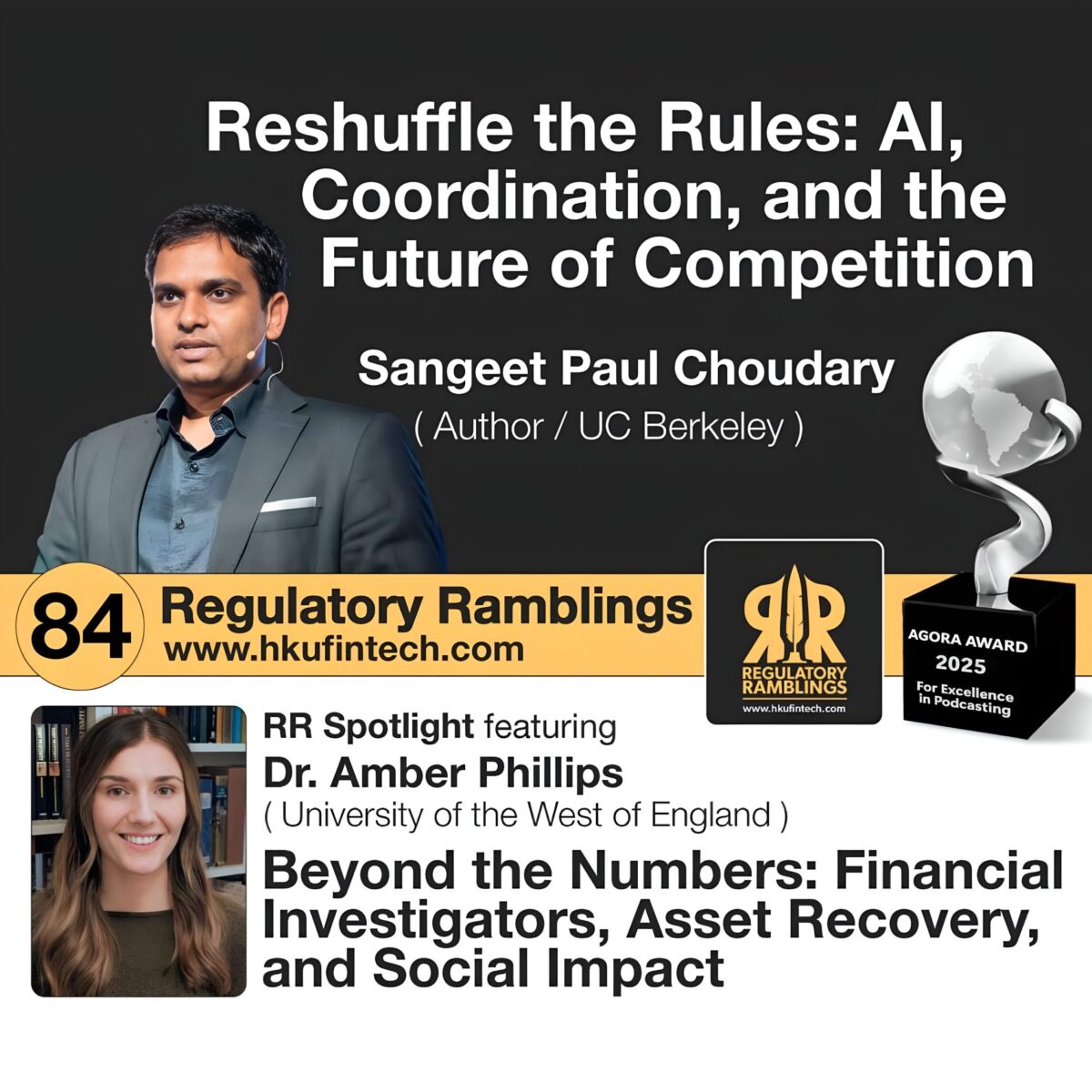
Regulatory Ramblings: Episode 84 – From Asset Recovery to AI Revolution: Risk, Coordination, and the Future with Sangeet Paul Choudary and Dr. Amber Phillips

Today’s episode kicks off with a spotlight discussion with Dr. Amber Phillips, a British senior lecturer in criminology, on the importance of accredited financial investigators and asset recovery experts in ferreting out fraud. Following that, we’ll be chatting with the author Sangeet Paul Choudary from UC Berkeley about his new book Reshuffle: Who Wins When AI Restacks the Knowledge Economy. He reframes the artificial intelligence debate, arguing that AI should not be seen as a smarter brain but rather as better glue that creates synergies for human collaboration.

But first, on a recent episode of the Tax Justice Network’s podcast, Dr. Amber Phillips highlighted the importance of accredited financial investigators and how they are often unsung heroes in cracking cases—especially those involving financial fraud and the concealment of assets.

Biography:

Dr. Amber Phillips is a senior lecturer in criminology at UWE Bristol. Her journey as a criminologist began in 2012, while she lived and worked in Calabria, Italy. Her primary research interests are organized crime and economic crime, both of which draw on her continuing interest in mafia-type groups. She has developed collaborative partnerships with law enforcement practitioners and fellow academics in the UK and abroad. She is a member of the ECPR Standing Group on Organized Crime and the RUSI Strategic Hub for Organized Crime.

Amber’s work has been published in international journals, including Trends in Organised Crime, and she is a member of the editorial board for the Journal of Economic Criminology. Her most recent research has focused on the social reuse of confiscated mafia assets in Italy and the challenges faced by police officers investigating financial crime.

She is currently researching asset recovery in England and Wales, supported by a VC Early Career Researcher Award. She is also an expert reviewer for funding bodies, including the European Commission and the Independent Social Research Foundation.

Amber has been nominated and shortlisted for the UWE Outstanding Teacher Award and has written teaching-focused articles for Times Higher Education. She is a Fellow of the Higher Education Academy and has served as a mentor for the WHEN 100 Black Women Professors NOW program.

Sangeet Paul Choudary is the co-author of the book Platform Revolution. His latest work—Reshuffle, the subject of today’s discussion—was recently awarded the 2025 Thinkers50 Strategy Award at Guildhall in London for the most impactful idea in the field of strategy.

Thinkers50 has often been described by the Financial Times as the “Oscars of management thinking”—a premier global award recognizing leading management thinkers. Other shortlisted nominees this year included Karim Lakhani (Harvard Business School), Vijay Govindarajan (Dartmouth), Richard Rumelt (UCLA), and Seth Godin.

Sangeet has advised CEOs at more than 40 Fortune 500 companies and leading pre-IPO technology firms. He is currently a senior fellow at the University of California, Berkeley, and has spoken at premier global forums, including the G20 Summit, the World50 Summit, and the World Economic Forum.

Sangeet’s latest book offers a radical rethink of AI and a practical contribution to industry incumbents grappling with genAI.

Discussion:

The spotlight chat commences with Amber sharing with Regulatory Ramblings host Ajay Shamdasani why accredited financial investigators and asset recovery experts are so important for detecting malfeasance and why many in law enforcement lack the financial backgrounds or sophistication to stay one step ahead of criminals who are often far more financially savvy.

The growing role of analytics, data scientists, and AI in financial investigations raises the question of whether veteran investigators and asset recovery specialists still play a role in the process. The answer is a resounding yes.

Amber shares her thoughts on how stripping criminals of their pecuniary assets may be more effective than short custodial sentences. She also remarks that, from her discussions with investigators, they regard the possibility of turning ‘bad money’ into good money as a net positive for society.

The spotlight discussion concludes with a brief description of a research project that Amber is wrapping up, measuring success in financial recovery, called “Beyond the Figures.” The aim is to move beyond quantitative measures, as numbers are not always a reliable indicator of impact and success in asset recovery.

Following that, we chat with Sangeet about his new book, Reshuffle. From the overlooked brilliance of the shipping container to the F1 pits that dethroned Schumacher’s dominance, Sangeet unearths a powerful pattern: the most transformative technologies do not merely automate; they transform entire economic systems.

With vivid storytelling and razor-sharp analysis, Reshuffle connects the dots between technology, behavior, and economic architecture. It delivers a bold and incisive exploration of how AI’s impact goes far beyond changing how we work, reorienting the foundations of power and control in our economic systems.

Blending compelling examples, historical parallels, and bold insights, Reshuffle equips readers to navigate the many opportunities and challenges that AI introduces as it reshapes the knowledge economy. This book is your guide to understanding who wins and who gets left behind when AI restacks the deck.”

“What if we’ve misunderstood the real power of AI — not as a tool for doing tasks faster, but as the missing mechanism for making complex systems finally work together?” Sangeet asks

We have all heard the common refrain from thought leaders like Peter Zeihan that “AI won’t take your job, but someone using AI will.” At this point, it is a hackneyed phrase.

Sangeet shares with Ajay what drew him to AI, why he felt the need to write his book now, and what it offers to an ever-growing, crowded field.

His message is to the heads of executives of incumbent firms across sectors, and he elaborates during the broadcast that financial services sector veterans are still dealing with COBOL-based mainframes and siloed databases. Reshuffle provides a guide to thinking about how artificial AI will disrupt and how it can be harnessed.

Specifically for leaders in financial services, Sangeet’s framework offers sobering and practical lessons:

– AI is not an upgrade but a governance shift. It shifts control from top-down compliance to bottom-up feedback. Governance emerges not through rules but through continuous observation.

– Legacy integration is a coordination challenge, not a software one. AI exposes the limits of point solutions by making the frictions between them evident.

– The new competition operates above the algorithm. Those who own the models may not capture the most value; those who orchestrate decisions and distribution around them will.

– Traditional productivity metrics are misleading. Efficiency inside a department can destroy coherence across the enterprise. The metric to optimize is coordination quality.

In this context, financial institutions face a choice: remain custodians of static infrastructure or become orchestrators of dynamic ecosystems. The former optimizes for compliance; the latter competes for relevance.

In this new world of AI, the standard corporate playbook for digital transformation no longer works. AI is not a laboratory initiative; it is built around innovation labs, agile working, and sprints. These may remain helpful at a tactical level, but they do nothing to reconsider how the basis of value creation is changing, nor sustain an incumbent’s advantages of trust, compliance, and scale. If someone else can better coordinate all the disparate elements, banks or insurers focused just on digital transformation will lose.

The good news is that there is no reason why financial institutions cannot leverage AI to remain leaders in their field or even set the rules for the next cycle. But AI requires an even more radical approach than digitalization. Sangeet’s book is a good place to start.

The Regulatory Ramblings podcast is brought to you by The University of Hong Kong – Reg/Tech Lab, HKU-SCF Fintech Academy, Asia Global Institute, and HKU-edX Professional Certificate in Fintech, with support from the HKU Faculty of Law.

Useful links in this episode:

  • Follow Amber Phillips on LinkedIn

  • Follow Sangeet Paul Choudary on LinkedIn

  • Choudary’s new book Reshuffle: Who wins when AI restacks the knowledge economy on  Amazon

You might also be interested in:

Connect with RR Podcast at:

LinkedIn: https://hk.linkedin.com/company/hkufintech 
Facebook: https://www.facebook.com/hkufintech.fb/
Instagram: https://www.instagram.com/hkufintech/ 
Twitter: https://twitter.com/HKUFinTech 
Threads: https://www.threads.net/@hkufintech
Website: https://www.hkufintech.com/regulatoryramblings 

Connect with the Compliance Podcast Network at:

LinkedIn: https://www.linkedin.com/company/compliance-podcast-network/
Facebook: https://www.facebook.com/compliancepodcastnetwork/
YouTube: https://www.youtube.com/@CompliancePodcastNetwork
Twitter: https://twitter.com/tfoxlaw
Instagram: https://www.instagram.com/voiceofcompliance/
Website: https://compliancepodcastnetwork.net

Categories
TechLaw10

TechLaw10: AI in Healthcare – Risks & Responsibilities

In this film, Punter Southall Law’s Jonathan Armstrong discusses AI in healthcare with Eric Sinrod, a California professor and attorney at Duane Morris LLP. They are joined by Rachel Sveiven, a Medical Student who has written a paper on the AI issues in medicine. This is episode 296 in the popular TechLaw10 series. You can listen to earlier podcasts here. Rachel starts by talking about some of the issues with AI in healthcare. Rachel, Eric, & Jonathan also talk about:

  • Liability for AI & for misdiagnosis
  • The issues of misdiagnosis, overdiagnosis, overtesting, & the role of chatbots
  • Whether AI prompts are disclosable
  • The issues with training data
  • Positive uses for AI
  • Issues with healthcare disparity
  • The need for care when gathering patient data

There is also a glossary of AI terms here, and Jonathan refers to the G v. K case here. He also discusses a data protection investigation into the collection of kidney disease data, available here. Our previous podcast on AI literacy is here.

Eric Sinrod’s details can be found here, and Jonathan Armstrong’s details are available here.

The TechLaw10 LinkedIn group is here.

Categories
AI Today in 5

AI Today in 5: December 12, 2025, The Person of the Year Edition

Welcome to AI Today in 5, the newest edition of the Compliance Podcast Network. Each day, Tom Fox will bring you 5 stories about AI to start your day. Sit back, enjoy a cup of morning coffee, and listen in to AI Today In 5. All, from the Compliance Podcast Network. Each day, we consider four stories from the business world, compliance, ethics, risk management, leadership, or general interest about AI.

Top AI stories include:

  1. AI Architects are Time’s Person of the Year. (Time)
  2. Disney licenses figures to Sora AI for use. (CNBC)
  3. McDonald’s pulls AI-created Christmas ads. (NBC News)
  4. AI hackers are getting very good. (WSJ)
  5. NAACP presses for equity-first AI in healthcare. (Reuters)

For more information on the use of AI in Compliance programs, my new book, Upping Your Game, is available. You can purchase a copy of the book on Amazon.com.

Categories
Blog

Netflix Acquisition of Warner Brothers: Part 5 – Post-Merger Integration – Where Compliance Either Succeeds or Fails

When Netflix announced its acquisition of Warner Bros., attention quickly turned to strategic synergies, content pipelines, and market influence. These are important, but they are not where the transaction’s success or failure will ultimately be determined. Deals succeed or fail in post-merger integration. For compliance professionals, this is the crucible. It is the period where two companies attempt to unify processes, cultures, systems, and risk management frameworks while moving at operational speed. When integration falters, compliance failures follow. When integration excels, compliance becomes a stabilizing force that supports the organization during a period of high-velocity change.

Compliance sits at the center of integration because compliance touches everything: governance, culture, systems, third-party relationships, data, reporting lines, training, investigations, and internal controls. It is one of the few functions that spans the entire enterprise. That makes compliance uniquely positioned to guide integration successfully. It also makes compliance uniquely exposed when integration fails.

Today, in our concluding Part 5, we explore why integration is the moment where compliance either rises or falters and what compliance leaders must do to ensure that the post-merger period strengthens rather than destabilizes the combined enterprise.

Day One Through Day Three Hundred: The Critical Window

The first year after closing defines the trajectory of a merger. This window is where employees decide whether leadership is credible, processes are coherent, and the combined organization knows where it is going. It is also the period when the greatest number of decisions must be made quickly and often without perfect information. That is where risk seeps into the cracks.

Compliance must treat integration as an enterprise-wide transformation project. That means establishing a structured roadmap for the first 30, 60, 180, and 300 days. Without this structure, integration becomes reactive rather than strategic. Reactive integration is where compliance failures escalate.

In this period, compliance must monitor employee sentiment, decision-making patterns, escalation pathways, and early deviation from established controls. Whether an organization grows stronger or weaker during integration depends on how quickly compliance identifies deviations and reinforces accountability.

Building a Unified Compliance Architecture

One of the first imperatives of integration is building a unified compliance architecture. Netflix and Warner Bros. bring different compliance footprints. Netflix has a culture that emphasizes transparency, individual accountability, and rapid feedback cycles. Warner Bros. brings decades of risk controls shaped by studio operations, talent relationships, union agreements, and global production infrastructure.

A unified architecture requires more than merging documents or standardizing policies. It requires understanding where each legacy system is strong, where it is vulnerable, and where alignment creates new risk.

Compliance leaders must establish:

  • A consolidated Code of Conduct.
  • A harmonized policy library.
  • Unified reporting channels.
  • Shared investigative procedures.
  • Enterprise-wide risk assessment methodologies.
  • Coherent training programs.

These components cannot be written. They must be communicated, taught, operationalized, and reinforced. Employees must understand not only what the policies say but also why they matter in the new organization.

Rationalizing Reporting Lines and Escalation Pathways

Mergers create confusion. Employees do not always know whom to contact, how to escalate concerns, or whether the people they previously relied on still have authority. That ambiguity is an enormous compliance risk.

Compliance leaders must create clarity early:

  • Who receives concerns?
  • How are investigations assigned?
  • What are the escalation criteria?
  • What timelines apply to decision-making?
  • How will employees receive feedback on issues they raise?

This clarity is not a luxury. It is a control. Without defined reporting pathways, concerns go unreported or unresolved. Both outcomes expose the business to avoidable harm.

Technology Integration: Where Risk Hides in Plain Sight

Technology integration is one of the most underestimated compliance risks. During a merger, companies aim to integrate systems spanning HR and payroll, content management, production workflows, distribution platforms, data governance, and internal controls.

Compliance must ensure that:

  • Data mapping is accurate.
  • Privacy rules are harmonized.
  • Access rights reflect new reporting structures.
  • Legacy systems are retired responsibly.
  • Audit trails are preserved, and
  • System changes do not inadvertently lower control effectiveness

Technology teams often focus on functionality and speed. Compliance must focus on integrity and accountability. Without disciplined oversight, integrations can create gaps or duplications that allow misconduct, data loss, or process failures to occur undetected.

Third-Party Integration: The Often Forgotten Battlefield

Netflix and Warner Bros. maintain extensive third-party ecosystems: production companies, talent agencies, global distributors, technology vendors, marketing partners, and international subsidiaries. Each third-party relationship carries risk. During a merger, that risk is magnified because:

  • Contract ownership may be ambiguous.
  • Oversight structures may change.
  • Legacy due diligence may be incomplete.
  • Vendor performance may deteriorate, and
  • New conflicts of interest may emerge.

Compliance must therefore implement a unified third-party risk management framework that includes:

  • Centralized onboarding and risk ranking;
  • Revised due diligence standards.
  • Contract alignment with the new Code of Conduct;
  • Clear monitoring obligations; and
  • Documented remediation protocols

An ungoverned third-party ecosystem is one of the most common sources of post-merger compliance failures.

The Cultural Dimension: The Invisible Integrator or Divider

Culture is the single greatest determinant of whether integration strengthens or weakens the enterprise. Netflix’s culture of candor and Warner Bros’ culture of tradition do not naturally conflict, but they do require careful alignment. Compliance must monitor cultural friction closely:

  • Decreased willingness to speak up
  • Divergent interpretations of policies
  • Informal workarounds
  • Turnover spikes in key departments
  • Erosion of decision transparency

Culture determines whether employees trust the compliance function, adhere to policies, and promptly escalate concerns. If cultural alignment is not prioritized, controls weaken regardless of the sophistication of the compliance architecture.

Documentation: The Foundation of Regulatory Credibility

Regulators expect visibility during integration. They expect companies to demonstrate that decisions were documented, risks were assessed, concerns were escalated, and oversight was effective.

Compliance must preserve:

  • Integration plans
  • Meeting notes
  • Risk assessments
  • Policy revisions
  • Training materials
  • Incident logs
  • Decision memos

Documentation is not bureaucratic. It is evidence. It demonstrates that the company fulfilled its obligations and that compliance was central to the integration process.

The Compliance Lesson

Integration is not an administrative exercise. It is a risk multiplier. It is also the moment when compliance can demonstrate its value most clearly. The Netflix acquisition of Warner Bros. offers an unmistakable reminder: strategic ambition means nothing if integration is weak. Compliance must lead with clarity, discipline, and foresight.

Where integration is intentional, guided, and well governed, compliance becomes a competitive asset. It stabilizes the organization, protects employees, and supports leadership during a period of profound change. Where integration is fragmented, rushed, or ignored, compliance fails. It fails not because of a lack of knowledge but because of a lack of structure.

For compliance professionals, this final lesson is the most important: the acquisition may create opportunity, but integration determines destiny.