


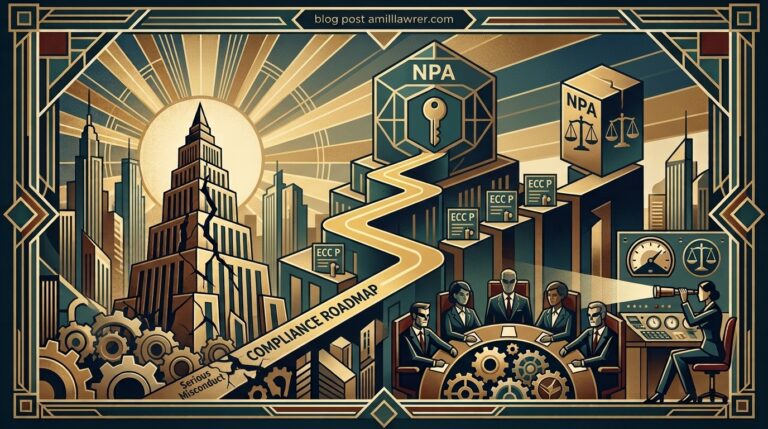
For years, compliance professionals have turned to the Department of Justice’s Evaluation of Corporate Compliance Programs (ECCP) to answer a fundamental question: What does an effective compliance program actually look like? Unfortunately, given statements from the early Trump Administration, many compliance professionals feared the Administration would withdraw or otherwise eviscerate the ECCP.
Southern Glazer’s resolution gives us one of the clearest answers in recent memory. The answer is a resounding no: the ECCP is alive and well, even under this DOJ.
Southern Glazer’s entered into a two-year Non-Prosecution Agreement (NPA) with the U.S. Attorney’s Office for the Northern District of California and agreed to pay $12.5 million to resolve a federal criminal investigation involving improper payments, gifts, travel, gift cards, and other benefits. Some of those benefits were facilitated through third-party vendors and concealed through false invoices.
The underlying conduct was serious. Five former Southern Glazer’s employees were indicted in March 2026 for an alleged conspiracy involving commercial bribery and obstruction. Prosecutors alleged that approved vendors and suppliers were used to disguise payments for prepaid gift cards, luxury items, and other benefits through false invoices. Yet Southern Glazer’s itself received an NPA.
For compliance professionals, the most important part of this resolution may be why. The government expressly credited Southern Glazer’s with making significant enhancements to its compliance program beginning in 2023 and, remarkably, specifically noted that the company had aligned those improvements with the factors contained in the ECCP. That makes Southern Glazer’s much more than another bribery enforcement action. It provides a roadmap for remediation.
The ECCP Is Not Sitting on the Shelf
There has been plenty of discussion about what role the ECCP would play in the current enforcement environment. Southern Glazer’s provides a concrete answer. DOJ didn’t merely mention that the company improved compliance. The NPA expressly credited Southern Glazer’s for its “significant efforts to enhance its Compliance Program” and to align that program with DOJ’s evaluation guidance.
That is important. The ECCP should not be treated as an academic document or something pulled from the shelf only after the government arrives. It is a blueprint for building, assessing, and improving a compliance program. Southern Glazer’s demonstrates the potential value of using that blueprint during remediation.
The company did not start from zero. DOJ acknowledged that during the relevant period Southern Glazer’s had compliance policies, a Code of Conduct and employee handbook, trade-practice training, and mechanisms for reporting, investigating, and remediating misconduct. In 2019, the company also notified certain third-party marketing companies that it would no longer process incentives through them and terminated their ability to handle incentives and gift cards. Yet the Statement of Facts makes clear that problems persisted. Employees continued using outside mechanisms for gift cards, travel funds, and other benefits after the 2019 intervention.
This case offers an important compliance lesson. Remediation cannot stop at closing the door through which misconduct previously traveled. Compliance must determine whether employees simply found another door.
Put Resources Behind Compliance
Southern Glazer’s response beginning in 2023 was substantial. Between 2022 and 2024, the company increased compliance headcount by 85 percent and compliance funding by more than 65 percent. It also retained outside compliance experts to advise on program enhancements and best practices. Those numbers matter.
DOJ has repeatedly focused through the ECCP on whether compliance has sufficient resources and authority. Southern Glazer’s provides a practical example of what investment can look like when an organization concludes that its existing compliance infrastructure does not adequately address its risks. This was not simply hiring more investigators after misconduct occurred. Southern Glazer strengthened its compliance architecture.
The General Counsel was promoted to Executive Vice President, Chief Legal and Compliance Officer, reporting directly to the CEO. The company created and filled a Senior Vice President of Compliance & Ethics position. It hired a Vice President and Associate General Counsel for the West region and remapped compliance around five business regions. That is a significant point for boards. If management says compliance is important, look at the organization chart and the budget. Resources are evidence of priorities.
Accountability Had to Follow Misconduct
Southern Glazer’s also addressed individual accountability. The NPA credits the company with removing certain vice presidents and managers for violations of company policy, disciplining additional employees, and replacing senior leadership for California and the West Region. That matters because compliance programs lose credibility quickly when discipline stops at organizational rank.
The Corporate Compliance Agreement takes this concept further. It requires applying disciplinary procedures consistently and fairly, regardless of an employee’s position or perceived importance. When misconduct is discovered, the company must also remediate the resulting harm and assess whether the compliance program itself requires modification. That is precisely the right question after misconduct:
Not simply, Who violated the policy?
But also, What allowed them to do it?
An effective investigation should therefore generate two workstreams. One addresses individual accountability. The other addresses program failure.
Follow the Money
The Southern Glazer’s case is also a powerful internal-controls case. The alleged misconduct involved gift cards, travel, luxury goods, entertainment, marketing expenditures, supplier funds, bill-backs, expense reimbursements, and third-party vendors. According to the Statement of Facts, employees sometimes used altered invoices purporting to reflect legitimate business purposes to circumvent company accounting controls.
Southern Glazer’s responded by moving compliance closer to those transactions. The company imposed a Trade Practice Compliance Audit Program and implemented its “iShop” platform for marketing and promotional spending. It also added mandatory ethics and compliance training and additional compliance resources. That is another important lesson from the ECCP.
Training and policies matter, but compliance effectiveness ultimately has to reach the business process. If bribery risk resides in marketing spend, test marketing spend. If risk resides in bill-backs, audit bill-backs. If employees can manipulate expense descriptions, analyze expense data. If misconduct travels through Accounts Payable, build controls into Accounts Payable. The goal is not simply to tell employees not to engage in misconduct. It is to make misconduct harder to execute and easier to detect.
Rebuild Third-Party Risk Around Payment Controls
The third-party remediation may be the most instructive aspect of the Southern Glazer’s resolution. Third parties were not peripheral to the alleged misconduct. They were part of the mechanism through which value could be transferred and transactions disguised.
Southern Glazer’s responded with a Third-Party Management Program requiring vendors to agree to the company’s compliance and audit standards. Vendors became subject to enhanced due diligence and documentation requirements. The company obtained audit rights. Most importantly, vendors had to be approved before the company could issue payment. Southern Glazer’s also offboarded vendors because of the new requirements. That last point deserves attention.
Third-party compliance frequently becomes an onboarding exercise. Conduct diligence. Assign a risk rating. Obtain contractual language. Approve the vendor. Done. Southern Glazer’s demonstrates why that was insufficient. The control environment must connect onboarding to payment. Accounts Payable should not merely assume that a vendor appearing in the system has passed appropriate compliance controls. The process should prevent payment when required approvals have not occurred. That is compliance embedded into operations.
Compliance Has to Reach the Field
Southern Glazer’s also created a network of state-level “Compliance Champions” responsible for promoting awareness locally and providing additional compliance support. That is particularly relevant for geographically dispersed organizations. Corporate compliance can design excellent policies from headquarters. Risk occurs where employees interact with customers, suppliers, distributors, government officials, and other third parties.
Compliance therefore needs mechanisms to reach those employees and understand what is actually happening locally. The ECCP’s focus on whether a compliance program works in practice is important here. A policy residing on an intranet is not embedded compliance. Employees must know whom to call, understand the rules, and believe compliance understands their business.
Tone at the Top Still Matters
Southern Glazer’s also strengthened senior leadership messaging. The NPA specifically cites communications from the President and CEO reinforcing the importance of ethics and compliance. The company also updated its corporate values around “HEART”: Honesty, Excellence, Agility, Respect, and Teamwork.
Tone at the top is sometimes dismissed as soft compliance. It should not be. But tone only matters when behavior follows the message. Here, leadership messaging was backed by increased resources, management changes, discipline, audit mechanisms, training, third-party controls, and structural changes. That combination is important.
A CEO email saying compliance matters is communication. A CEO message backed by budget, personnel, discipline and controls is governance.
Test Whether the Remediation Actually Works
The final lesson is perhaps the most important. Southern Glazer’s did not simply promise that its enhanced program would work. The Corporate Compliance Agreement requires periodic risk assessments, annual review of policies and procedures, appropriate compliance independence and resources, training, confidential reporting mechanisms, adequately resourced investigations, discipline, M&A procedures, and periodic testing designed to evaluate and improve program effectiveness.
The company must also report annually to the USAO and TTB regarding remediation and implementation of its compliance measures during the NPA. At the end of the term, the CEO, Executive Vice President, and Chief Legal and Compliance Officer must certify that the company has implemented a compliance program that meets the agreement’s requirements and is reasonably designed to detect and prevent trade-practice violations throughout its operations.
That puts real accountability behind remediation.
The Southern Glazer’s Roadmap
Every CCO facing a significant compliance failure should study Southern Glazer’s. The lesson is not that remediation guarantees an NPA. The agreement expressly states that the government reached its decision based on the individual facts and circumstances of this case.
The lesson is that remediation matters, and DOJ has given compliance professionals an unusually detailed picture of what meaningful remediation can look like. Southern Glazer’s strengthened leadership. It increased resources. It brought in outside expertise. It disciplined employees and changed management. It strengthened tone at the top. It pushed compliance into the field. It created new audit mechanisms. It improved training. It rebuilt third-party controls. It connected vendor approval to payment. And it committed to continued risk assessment, monitoring, and testing.
Most significantly, it did these things by expressly aligning its compliance program with the ECCP. For CCOs, that may be the most important takeaway from this entire resolution. Do not wait for prosecutors to use the ECCP to evaluate your compliance program. Use it yourself.
Ask whether your program is well designed. Ask whether it is adequately resourced and empowered to function effectively. Ask whether it works in practice. Then test the answers against your actual risks, transactions, third parties, investigations, and control environment.
Southern Glazer’s demonstrates that the ECCP is more than DOJ guidance. Used properly, it can be a roadmap for remediation, a framework for explaining compliance investment to senior management and the board, and, when misconduct occurs, evidence that the company understood the failure and built a stronger program in response.
That is the compliance lesson from Southern Glazer’s. The best time to align your program with the ECCP is before misconduct occurs. The second-best time is when you discover your existing controls weren’t enough.
Other Resources
Tom and Matt Kelly took a deep dive into the Southern Glazer NPA on this episode of Compliance into the Weeds.
Matt Kelly looked at it on Radical Compliance.